
DCE-200 · Lesson 3 of 5 · 35 min
Removing heat
Lesson 1 established that essentially all the power delivered to IT equipment becomes heat. A 10 MW data hall is a 10 MW heater running all year, and if its cooling stopped, the room temperature could rise by several degrees per minute until servers shut themselves down to protect their chips. Removing that heat reliably, and with as little extra energy and water as possible, is the job of the mechanical system. Cooling is also the largest overhead in most facilities, so it decides much of the PUE.
Heat follows a chain just as power does, in the opposite direction: from the chip to a heat sink, from the heat sink to air or liquid, from the room to a cooling plant, and from the plant to the outdoors. This chapter follows that chain, introduces the one equation that sizes every part of it, and explains why the rise of AI is moving data centres from air cooling toward liquid cooling. DCE-330 covers the design in detail.
The equation that sizes cooling
When a fluid (air or water) flows past a heat source and warms up, the heat it carries away is
where \(\dot{Q}\) is the heat rate (W), \(\dot{m}\) the mass flow rate (kg/s), \(c_p\) the specific heat (J/kg·K) and \(\Delta T\) the temperature rise of the fluid. For air, \(c_p \approx 1005\) J/kg·K and density \(\rho \approx 1.2\) kg/m³; for water, \(c_p \approx 4180\) J/kg·K and \(\rho \approx 1000\) kg/m³. Water carries about 3500 times as much heat per unit volume as air for the same temperature rise. That single fact explains the trend to liquid cooling.
Worked problem
Airflow for one kilowatt
Servers heat the air passing through them by 12 K (12 °C). What volume of air must flow through to remove 1 kW?
Show solution
- \(\dot{m} = \dot{Q}/(c_p\Delta T) = 1000/(1005 \times 12) = 0.0829\) kg/s.
- Volume flow = 0.0829 ÷ 1.2 = 0.0691 m³/s = 249 m³/h.
- In the cubic feet per minute that North American equipment data sheets often use: 0.0691 × 2119 = 146 cfm.
Answer: About 0.069 m³/s (146 cfm) per kilowatt at a 12 K rise
Worked problem
An air-cooled rack and an AI rack
Using the result above, what airflow do a 10 kW rack and a 120 kW rack need at a 12 K rise?
Show solution
- 10 kW: 10 × 0.0691 = 0.69 m³/s (about 1460 cfm), comfortably handled by server fans.
- 120 kW: 120 × 0.0691 = 8.3 m³/s (about 17,600 cfm) through one cabinet, which would need a gale through the rack, very loud fans and enormous fan power.
Answer: 0.69 m³/s versus 8.3 m³/s. Above roughly 40 to 50 kW per rack, air alone becomes impractical, and liquid must carry the heat away
How warm can it be?
IT equipment is designed for a range of inlet air conditions. The industry reference is the thermal guideline published by ASHRAE Technical Committee 9.9. Its recommended envelope for air entering servers is 18 °C to 27 °C (64.4 °F to 80.6 °F), with a dew point between −9 °C and 15 °C and relative humidity no higher than 60%. Wider allowable ranges let equipment run outside the recommended envelope for limited periods: for class A1 equipment, 15 °C to 32 °C (59 °F to 89.6 °F), and up to 45 °C for class A4.
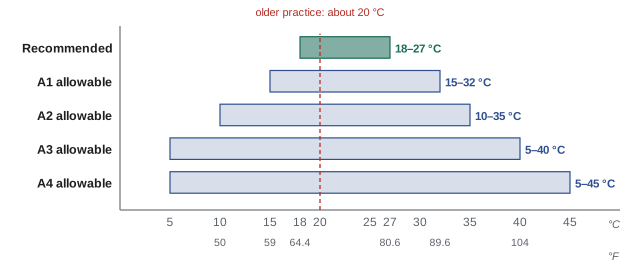
Older data centres were kept cold, around 18 to 20 °C, "to be safe". Running at the warmer end of the recommended range is one of the cheapest efficiency improvements: warmer supply air means warmer return air and warmer chilled water, which makes chillers more efficient and lets free cooling run for more hours of the year. The limit is that server fans speed up as inlet temperature rises, so the gain flattens out.
Air cooling in the white space
Hot aisles and cold aisles
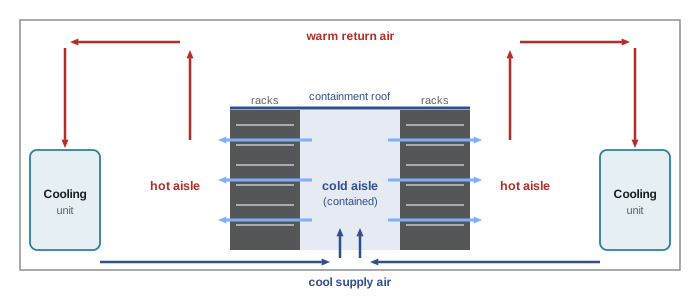
Servers draw air in at the front and exhaust it at the back. Racks are therefore arranged in rows facing each other: fronts face a cold aisle where cool supply air arrives, and backs face a hot aisle where warm exhaust collects and returns to the cooling units. Mixing the two streams wastes cooling: if hot exhaust recirculates to server inlets, those servers overheat; if cold supply air bypasses the servers and returns directly, the cooling units move air that did no work.
Containment solves this with physical barriers: doors at the ends of the cold aisle and a roof over it (cold-aisle containment), or a chimney or enclosure over the hot aisle (hot-aisle containment). Blanking panels in empty rack spaces and brush grommets where cables pass through complete the separation. Good containment lets supply temperatures rise and fan speeds fall.
Cooling units
Air is cooled by units placed around the perimeter of the hall, in the rows between racks, or in separate galleries:
- A CRAC (computer room air conditioner) contains its own refrigeration compressor, like a large air conditioner, and rejects heat to an outdoor condenser.
- A CRAH (computer room air handler) contains only fans and a coil fed with chilled water from a central plant. Large data centres mostly use CRAHs or fan walls (banks of fans and coils that form one wall of the hall).
Air reaches the racks either through a raised floor (a plenum under perforated tiles) or, increasingly, by flooding the hall from the side with the racks on a slab floor and cables overhead. Slab floors carry heavy AI racks better and are cheaper to build.
Fans use a large share of cooling energy. Their power follows the fan affinity laws: flow is proportional to speed, and power to speed cubed. Slowing fans to 80% speed cuts their power to \(0.8^3 = 51\%\). Variable-speed fans controlled to match the actual load are standard in efficient designs.
The cooling plant: getting heat outdoors
Heat collected from the hall must be rejected to the outdoor air. There are three main routes, often combined.
- Mechanical refrigeration: chillers use the vapour-compression cycle to pump heat from chilled water (typically supplied at 15 to 20 °C in modern data centres, warmer than in office buildings) to a warmer condenser loop. Their efficiency is expressed as a coefficient of performance (COP): heat moved per unit of electrical energy used.
- Evaporative cooling: cooling towers spray the condenser water through moving air, and evaporation of a small fraction of the water cools the rest. Evaporation is very effective but consumes water.
- Dry coolers: radiators with fans that reject heat to the air without evaporation. They use no water but can only cool the fluid to a few degrees above the outdoor temperature.
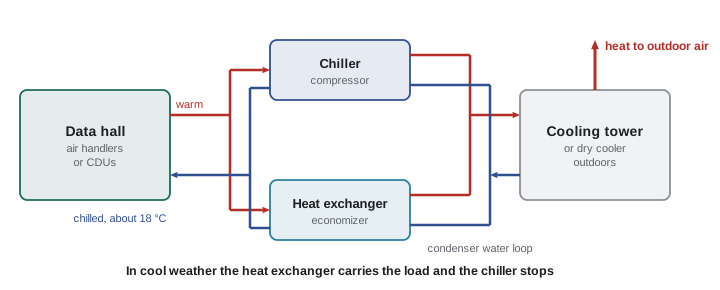
An economizer uses outdoor conditions to cool without running compressors, whenever the weather allows: an air-side economizer brings filtered outdoor air into the hall; a water-side economizer cools the chilled water directly through a heat exchanger with the cooling tower or dry cooler loop. Hours of economizer operation are often called free-cooling hours.
Canada's climate is a real advantage here. In Edmonton, Montreal or most of the country, outdoor air is cool enough for economizers to carry most or all of the load for much of the year, and chillers may run only on warm summer days. Cold climates bring their own design problems, though: freezing protection for water systems, very dry winter air, and snow and ice on equipment.
Worked problem
What the economizer saves
A 10 MW data hall is cooled by chillers with a COP of 6. How much electrical power do the chillers draw at full load? If a water-side economizer lets the chillers stay off for 60% of the year, how much chiller energy is saved annually?
Show solution
- Chiller power = heat ÷ COP = 10 MW ÷ 6 = 1.67 MW.
- Year-round operation: 1.67 × 8760 = 14,600 MWh.
- Running only 40% of the year: 14,600 × 0.4 = 5,840 MWh. Savings = 8,760 MWh per year (ignoring the pump and fan energy of the economizer itself).
Answer: About 1.7 MW at full load, and roughly 8,800 MWh saved per year, worth about $700,000 at $0.08 per kWh
Water
Evaporative cooling saves electricity but uses water, and water is becoming as important a siting constraint as power. Evaporating water absorbs about 2400 kJ/kg (its latent heat at typical tower temperatures).
Worked problem
Water evaporated per megawatt
If 1 MW of heat were rejected entirely by evaporation all year, how much water would evaporate?
Show solution
- Evaporation rate = 1000 kW ÷ 2400 kJ/kg = 0.417 kg/s.
- Per day: 0.417 × 86,400 = 36,000 kg = 36 m³.
- Per year: 36 × 365 = 13,140 m³. Per kWh of heat: 0.417 kg/s × 3600 s ÷ 1000 kWh = 1.5 L/kWh.
Answer: About 13,100 m³ per MW per year (1.5 L per kWh of heat), before adding the blowdown water a tower discharges to control mineral build-up. A 100 MW campus on full evaporative cooling would use over a million cubic metres a year
The industry metric is water usage effectiveness: WUE = annual site water use (litres) ÷ IT energy (kWh). Facilities with dry coolers or closed-loop liquid cooling can approach zero water use, at the cost of more electricity on hot days. The right balance depends on local water scarcity, electricity carbon intensity and climate.
In Alberta, for example, the Bow, Oldman and South Saskatchewan river sub-basins have been closed to new surface water licences since 2006, so new users must buy or transfer existing licences. Projects in water-stressed regions increasingly choose dry or closed-loop cooling.
Liquid cooling
As rack power rises past what air can handle, liquid takes over, in stages:
- Rear-door heat exchangers replace the back door of a rack with a water coil, cooling the exhaust air before it enters the room. They extend air cooling to perhaps 30 to 50 kW per rack.
- Direct-to-chip (cold plate) cooling bolts a metal plate with internal channels onto each processor and GPU. A coolant (water or water–glycol) flows through the plates and carries 70 to 90% of the heat; fans remove the rest from memory, power supplies and other components. A coolant distribution unit (CDU) in the row or hall isolates this clean technology loop from the facility water loop through a heat exchanger.
- Immersion cooling submerges whole servers in a tank of dielectric (non-conducting) fluid. It removes almost all the heat but changes how servers are built and serviced.
Worked problem
Coolant flow for an AI rack
A 120 kW rack is cooled by direct-to-chip liquid cooling. If the liquid carries all 120 kW with a 10 K temperature rise, what water flow is needed?
Show solution
- \(\dot{m} = 120{,}000/(4180 \times 10) = 2.87\) kg/s.
- For water, 2.87 kg/s ≈ 2.87 L/s = 172 L/min.
- That is about 45 US gallons per minute, the unit many cooling equipment data sheets use.
Answer: About 2.9 L/s (172 L/min, 45 gpm), through a pipe a few centimetres across, compared with 8.3 m³/s of air. That is the advantage of liquid cooling
Liquid cooling has another benefit: the coolant can return at 40 °C or more, warm enough to reject heat with dry coolers in almost any climate and useful for heating buildings. Its challenges are leaks near electronics, water quality, the cost of piping to every rack, and the need for operators and technicians with new skills.
Heat reuse
A data centre rejects enormous amounts of low-grade heat. Where there is a nearby user, such as a district heating network, greenhouses, aquaculture or industrial process heating, that heat can be sold instead of wasted, usually after a heat pump raises its temperature. Northern European data centres have connected to city heating networks for years; North American projects are beginning to do the same. Heat reuse works best with liquid cooling, because warmer return water needs less heat-pump work.
Common mistakes
MistakeSizing cooling for the IT load only.
InsteadAdd electrical losses in the room (UPS, PDUs, busway), lighting, people and solar gain through the envelope. And allow for growth.
MistakeKeeping the data hall as cold as possible "for safety".
InsteadEquipment is designed for 18–27 °C inlet air. Overcooling wastes energy and gives no reliability benefit within the envelope.
MistakeMeasuring room temperature at the ceiling or the return air.
InsteadWhat matters is the temperature of air entering the IT equipment, measured at rack inlets.
MistakeLeaving gaps in racks and between rows.
InsteadUse blanking panels and containment so hot exhaust cannot recirculate and cold air cannot bypass the servers.
MistakeTreating water use as free because the electricity bill falls.
InsteadEvaporative cooling consumes about 1.5 L per kWh of heat rejected. Water may be scarce, expensive or limited by licence.
Summary and key terms
- All IT power becomes heat, which must be carried from the chip to the outdoors through a chain of heat sinks, air or liquid, cooling units and a plant.
- Heat carried by a fluid: \(\dot{Q} = \dot{m} c_p \Delta T\). Air: about 0.069 m³/s (146 cfm) per kW at a 12 K rise. Water carries about 3500 times as much heat per unit volume.
- ASHRAE recommended server inlet: 18–27 °C (64.4–80.6 °F); warmer operation saves energy.
- Hot-aisle/cold-aisle layouts with containment prevent mixing. CRAHs or fan walls with chilled water serve large halls; fan power falls with the cube of speed.
- Heat leaves by chillers (rated by COP), cooling towers (evaporation) or dry coolers. Economizers provide free cooling in cool weather.
- Evaporation uses about 1.5 L of water per kWh of heat. WUE = site water ÷ IT energy.
- Above roughly 40–50 kW per rack, liquid cooling (rear doors, direct-to-chip with CDUs, immersion) is required. A 120 kW rack needs about 172 L/min of water at a 10 K rise.
- Specific heat (\(c_p\))
- The energy needed to raise 1 kg of a substance by 1 K.
- Hot aisle / cold aisle
- A layout in which racks face each other across cold supply aisles and back onto hot exhaust aisles.
- Containment
- Physical barriers that separate supply air from exhaust air.
- CRAC
- Computer room air conditioner: a cooling unit with its own refrigeration compressor.
- CRAH
- Computer room air handler: a fan-and-coil unit supplied with chilled water from a central plant.
- Chiller
- A machine that uses a refrigeration cycle to cool water.
- Coefficient of performance (COP)
- Heat removed divided by the electrical energy used to remove it.
- Cooling tower
- Equipment that rejects heat by evaporating part of the water passing through it.
- Dry cooler
- A fan-and-coil heat exchanger that rejects heat to outdoor air without evaporation.
- Economizer
- A system that uses cool outdoor air or water to provide cooling without running compressors.
- WUE
- Water usage effectiveness: annual site water use in litres divided by IT energy in kWh.
- Direct-to-chip cooling
- Liquid cooling through cold plates mounted on processors and accelerators.
- Coolant distribution unit (CDU)
- Equipment that pumps coolant to racks and exchanges heat between the technology cooling loop and the facility water loop.
- Immersion cooling
- Cooling servers by submerging them in a dielectric fluid.
Practice problems
Work each problem on paper first, then reveal the answer to check.
What mass flow of air removes 5 kW with a 15 K rise?
Show answer
ṁ = 5000 ÷ (1005 × 15) = 0.332 kg/s, or 0.276 m³/s.
A rack's servers move 0.5 m³/s of air and the air warms by 14 K. How much heat is removed?
Show answer
ṁ = 0.5 × 1.2 = 0.6 kg/s; Q = 0.6 × 1005 × 14 = 8.4 kW.
Is a server inlet temperature of 30 °C within the ASHRAE recommended envelope? Within the A1 allowable range?
Show answer
Not within the recommended 18–27 °C, but within the A1 allowable 15–32 °C.
A chiller removes 3 MW of heat and draws 0.5 MW. What is its COP?
Show answer
COP = 3 ÷ 0.5 = 6.
Fans slow from 100% to 70% speed. Estimate the new fan power as a fraction of the original.
Show answer
0.7³ = 0.343, about 34%.
Estimate the water a cooling tower evaporates per day while rejecting 5 MW.
Show answer
5000 ÷ 2400 = 2.08 kg/s × 86,400 = 180,000 kg = 180 m³ per day.
A facility uses 60,000 m³ of water a year with an IT energy of 87,600 MWh. What is its WUE?
Show answer
60,000,000 L ÷ 87,600,000 kWh = 0.68 L/kWh.
Find the water flow, in L/min, to carry 80 kW from a rack with an 8 K temperature rise.
Show answer
ṁ = 80,000 ÷ (4180 × 8) = 2.39 kg/s = 144 L/min.
Why does raising the chilled water supply temperature increase free-cooling hours?
Show answer
The economizer can cool water only to a few degrees above the outdoor (wet- or dry-bulb) temperature. A warmer target is reachable on more days of the year.
Give one advantage and one disadvantage of direct-to-chip liquid cooling compared with air cooling.
Show answer
Advantage: it removes very high heat loads with small flows and allows warm return water for dry cooling or heat reuse. Disadvantage: piping to every rack adds cost and the risk of leaks, and requires new maintenance skills.
Lesson quiz · 5 questions
Score 60% or more to complete this lesson.
Create a free account to save your progress, take quizzes and earn a certificate.