
CRE-450 · Lesson 5 of 12 · 26 min
Privacy and safety practices for family content
Lesson 2 asked whether a moment should be shared at all. This lesson is about how to share safely when you decide to. Family content can unintentionally reveal where children live, where they go to school, what their daily routine looks like and what they look like from many angles. Small details that seem harmless on their own can combine into a picture that lets a stranger identify or locate a child. The practices in this lesson apply the idea of data minimization, sharing only what the content genuinely needs, to video, photos and captions. They build on the creator privacy and security habits in CRE-350, extending them to the children in a creator's life.
How small details add up
Security professionals use the term aggregation to describe how separate pieces of harmless information combine into something sensitive. A child's first name alone reveals little. Add the name of their school seen on a uniform badge, a view of the street from the front window, a mention of the local park and a regular weekly routine, and a determined person may be able to find them. Viewers rarely set out to do this, but family channels reach very large audiences, and only one person with harmful intentions needs to piece the details together.
| Type of detail | Examples to watch for | Safer practice |
|---|---|---|
| Location | House exterior, street signs, landmarks, licence plates, views from windows, geotags | Film indoors or in neutral settings; blur plates and signs; turn off geotags |
| School and activities | Uniforms, logos, school names, team jerseys, recital programs | Avoid or blur logos; do not name schools or clubs |
| Routine and timing | Saying where you are now, regular schedules, "every Saturday at the rink" | Post after you leave; vary and avoid announcing routines |
| Identity | Full names, birthdays, ages with exact dates, documents on screen | Use first names or nicknames; avoid birthdays and documents |
| Body and appearance | Bath, swimming, changing, close-ups of feet or bodies | Do not post; frame shots to avoid them |
| Home details | Floor plans in house tours, security systems, room layouts | Avoid full house tours; never show alarms or locks |
Photo and video metadata
Digital photos and videos often carry hidden information called metadata, including the date, time, camera model and sometimes exact GPS coordinates. Most major platforms remove location metadata from uploaded files, but not every service does, and files shared by email, messaging apps or personal websites may keep it. Good habits include turning off location tagging in the camera app for family filming, checking metadata before sharing files directly with brands or editors, and using editing or export settings that strip metadata.
Background details are a separate risk. A reflection in a window, a parcel label with an address, a calendar on the fridge or a whiteboard with a child's schedule can all be read in high-resolution video. Make a habit of scanning the frame before filming and checking the final cut at full screen before posting.
Delayed posting and live content
One of the simplest safety habits is to post after the fact. Sharing that you are at a particular theme park, beach or shopping centre right now tells viewers where to find you and your children. Posting a day or a week later, or after you have left, removes most of that risk. Livestreams are the exception, because they are real time by nature, so family livestreams should take place at home or in neutral settings, never reveal current outdoor locations, and follow the platform rules in lesson 4.
Worked problem
Scoring the location risk of a planned video
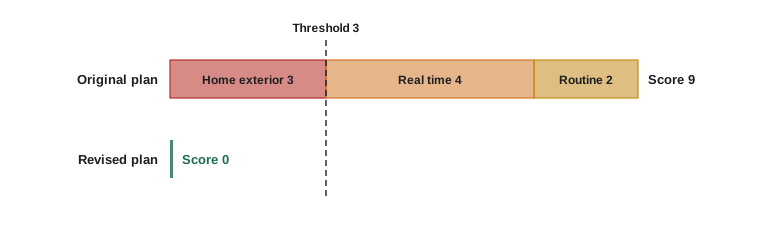
A creator scores each video on four location factors: home exterior visible (3 points), school or club identifiable (3), current location revealed in real time (4), regular routine announced (2). A planned video shows the children walking to the bus stop outside the home, mentions it happens every weekday at 8 a.m. and is posted the same morning. What is the score, and what changes would bring it below a threshold of 3?
Show solution
- Home exterior visible: 3. School not identifiable: 0. Current location in real time: posted the same morning, with the children at school, so partly; the creator scores it 4 to be cautious. Routine announced: 2.
- Total: \( 3 + 0 + 4 + 2 = 9 \).
- Changes: film inside instead of at the street (removes 3), drop the time and weekday mention (removes 2), and post on a weekend after editing (removes 4).
- Revised score: 0.
Answer: The original scores 9, well above the threshold. Filming indoors, removing the routine and delaying posting bring it to 0. Writing the score down makes the trade-offs visible.
Data minimization for children
Data minimization means collecting and sharing only the personal information you actually need. For family content, ask before each video: what information about the child does this content need to work? A video about a family recipe does not need the child's full name, age or school. A back-to-school video does not need the school's name or the route there. The less information is published, the less can be misused, and the less there is to remove later.
Minimization also applies to information you collect offline. If you run giveaways, sign-ups or fan mail, avoid collecting children's information, use a PO box or virtual mailbox rather than your home address, and delete entries once the giveaway ends.
Fan mail, meet-ups and physical safety
Many family creators receive gifts and letters, and some hold meet-ups. These are generally positive, but they create physical safety considerations. A separate business address, opening mail away from children, not showing return addresses on screen and never inviting viewers to the family home are basic steps. CRE-350 covered event safety in detail; for events involving children, add a ratio of trusted adults to children, a rule that children are never alone with fans, and a clear plan to leave if anyone behaves inappropriately.
Watching for misuse
Despite good practice, family content can be misused, for example downloaded and reposted on other sites, compiled with sexualized commentary or used to create fake images. Signs to watch for include sudden spikes of views on innocent videos from unexpected sources, comments with timestamps pointing to particular moments, requests for specific kinds of videos, and unknown accounts collecting a child's images. If you see these signs, respond protectively: remove or make the content private, turn off comments, block and report accounts to the platform, and report suspected exploitation to the national tipline.
| Situation | Where to report in Canada |
|---|---|
| Account or comment breaking platform rules | The platform's reporting tool |
| Suspected sexual exploitation of a child, including misuse of images | Cybertip.ca |
| A young person wanting sexual images of themselves removed | NeedHelpNow.ca |
| A child in immediate danger | Police, 9-1-1 |
Report rather than investigate. Do not download, share or keep copies of exploitative material as evidence, which can itself be illegal; describe what you saw and where to the tipline and let professionals handle it.
Reviewing and deleting older content
Many family channels began before current practices became common, so their archives contain content that would not pass today's checks. A periodic archive review, applying the dignity score from lesson 2 and the location score from this lesson, can identify videos to edit, make private or delete. As children grow up, involve them in reviewing their own appearances.
Some laws support removal. Quebec's privacy law gives individuals, in some circumstances, a right to have information about them de-indexed, and the Office of the Privacy Commissioner has supported a right to de-indexing for youth. Commitments to remove content when a child asks, even where no law requires it, are an important part of a family channel's policy.
Worked problem
Estimating time for an archive review
A family channel has 600 videos featuring children. A quick screening takes about 2 minutes per video, and about 15 % will need a closer review taking 15 minutes each. How long will the review take?
Show solution
- Screening: \( 600 \times 2 = 1{,}200 \) minutes, or 20 hours.
- Closer review: \( 0.15 \times 600 = 90 \) videos at 15 minutes = 1,350 minutes, or 22.5 hours.
- Total: about 42.5 hours.
Answer: About 42 hours, or roughly a week of full-time work. Spreading it over several months, starting with the most viewed videos, makes it manageable.
A family privacy checklist
- Turn off location tagging for family filming and strip metadata before sharing files.
- Scan the frame and the final cut for addresses, signs, uniforms, documents and reflections.
- Post after you leave a location; never announce routines.
- Use first names or nicknames; never share birthdays, school names or full house tours.
- Use a separate business address and handle fan mail away from children.
- Watch for signs of misuse and report to the platform and the national tipline.
- Review the archive regularly and remove content when a child asks.
Working with editors, assistants and collaborators
Privacy practices only work if everyone who handles footage follows them. Editors may have access to hours of raw footage showing the inside of the home, children in private moments and identifying details that never appear in the final cut. A responsible family creator shares the privacy checklist with everyone on the team, limits access to raw footage to those who need it, stores footage securely with strong passwords and two-factor authentication, and deletes raw footage that is no longer needed. Contracts with editors and assistants should include confidentiality terms and a commitment not to keep or share footage of the children. When collaborating with other creators, agree in advance what may be filmed and shared, especially when their children and yours appear together, and respect other families' rules even if they are stricter than your own.
Teaching children their own privacy habits
As children grow, they start creating and sharing content of their own. Family creators are well placed to teach good habits early: thinking before posting, keeping locations and school names private, using private accounts, never sharing passwords and telling a trusted adult if anyone online makes them uncomfortable. Children who see their parents protecting their privacy learn that privacy is normal and valuable, not something to be traded for views.
Finally, apply the same care to photos as to video. Still images are easier to copy and reuse, and a single photo can reveal a uniform, a street sign or a house number just as clearly as a video frame.
Common mistakes
MistakePosting live or same-day from places the children visit.
InsteadPost after you leave and never announce routines.
MistakeAssuming one harmless detail cannot matter.
InsteadConsider aggregation: details combine to identify or locate a child.
MistakeSharing files directly without checking metadata.
InsteadTurn off geotags and strip metadata before sharing files.
MistakeKeeping copies of exploitative material as evidence.
InsteadReport to the national tipline without downloading or sharing the material.
MistakeNever revisiting old family videos.
InsteadReview the archive periodically and involve children as they grow up.
Summary and key terms
- Aggregation means separate harmless details can combine to identify or locate a child.
- Location, school, routine, identity, body and home details all need care.
- Metadata and background details can reveal more than the content intends.
- Posting after leaving a location removes much of the risk of real-time sharing.
- Data minimization means sharing only what the content genuinely needs.
- Watch for signs of misuse and report suspected exploitation to the national tipline.
- Archive reviews and removal on request protect children as they grow up.
- Aggregation
- Combining separate pieces of information into something more revealing.
- Data minimization
- Collecting and sharing only the personal information actually needed.
- Metadata
- Hidden information in a file, such as date, device and location.
- Geotag
- Location information attached to a photo, video or post.
- Delayed posting
- Sharing content about a location after leaving it.
- Archive review
- A periodic check of older content against current standards.
- PO box
- A mailbox at a post office used instead of a home address.
- Misuse
- Use of content for purposes the creator did not intend, especially harmful ones.
- Tipline
- A national service for reporting online exploitation of children.
- Location risk score
- A simple score adding points for details that could locate a child.
Practice problems
Work each problem on paper first, then reveal the answer to check.
What is aggregation?
Show answer
Separate harmless details combining into something that identifies or locates a person.
Name three location details to remove.
Show answer
House exterior, street signs, licence plates, landmarks, views from windows, geotags.
Why post after leaving a location?
Show answer
So viewers cannot find you and your children in real time.
What does data minimization ask?
Show answer
What information does this content genuinely need?
A video scores home exterior 3, routine 2. What is the score?
Show answer
5.
Name two signs of misuse of family content.
Show answer
Odd view spikes, timestamp comments, requests for specific videos, unknown accounts collecting images.
Where do you report suspected exploitation in Canada?
Show answer
Cybertip.ca.
Why not keep copies of exploitative material?
Show answer
Keeping or sharing it can be illegal; report it instead.
400 videos at 3 minutes screening each. Screening time?
Show answer
1,200 minutes, or 20 hours.
Name two fan-mail safety steps.
Show answer
Separate business address, open mail away from children, hide return addresses.
Lesson quiz · 5 questions
Score 60% or more to complete this lesson.
Create a free account to save your progress, take quizzes and earn a certificate.