
CRE-450 · Lesson 2 of 12 · 26 min
Children in content: consent, dignity and the digital footprint
Children have appeared in family photos and home movies for as long as cameras have existed. What has changed is scale, permanence and money. A family album is seen by relatives; a family channel is seen by strangers worldwide, archived indefinitely and often earns income. This lesson looks at why children are a special case, what consent means for a child, how to protect a child's dignity, and how to think about the long-term digital footprint that content creates. CRE-420 lesson 10 introduced child creator laws and CRE-350 discussed wellbeing; this lesson goes deeper into the ethics that sit underneath those rules.
Why children are different
Children are not small adults. Three features make content involving them ethically different from content involving consenting adults.
- Limited capacity to consent. Young children cannot understand what it means for a video to be public, permanent and monetized. Even teenagers may not foresee how they will feel about content as adults.
- Dependence on parents. Children usually cannot say no to a parent who controls their home, money and daily life. When the parent is also the creator, there is a built-in conflict of interest.
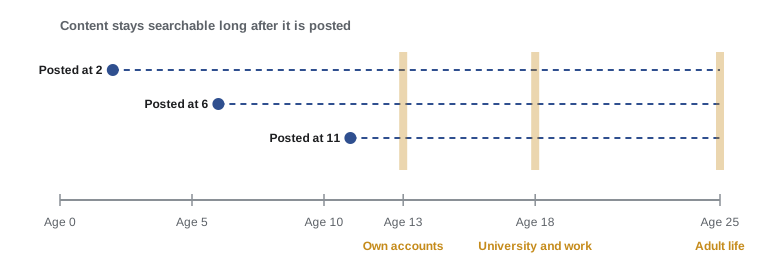
- A long future. Content posted when a child is five may still be searchable when they apply for university, look for work or start relationships. The child bears the consequences for decades; the parent made the decision.
International law recognizes these differences. The UN Convention on the Rights of the Child, which Canada and almost every other country have ratified, protects children's privacy in Article 16 and requires that the best interests of the child be a primary consideration in actions affecting them in Article 3. The US has signed but not ratified the Convention, but its principles are widely used in ethics and policy discussions in both countries. In 2021 the UN Committee on the Rights of the Child adopted General Comment No. 25, which applies these rights to the digital environment and specifically mentions risks from commercial use of children's images.
Sharenting
The word sharenting describes parents sharing information, photos and videos of their children online. Most sharenting is ordinary and harmless: a first-day-of-school photo shared with family. It becomes a concern when it is public, frequent, monetized, intimate or revealing. Researchers have estimated that many children have a substantial online presence created by their parents before they are old enough to have social media accounts of their own. Concerns include embarrassment, loss of control over one's own story, identity theft from details such as full names and birthdays, and, in the worst cases, images being taken and misused by people with harmful intentions.
A useful distinction is between sharing about your own experience as a parent and sharing your child's experience. A parent talking about the challenges of sleep deprivation is telling their own story. A video of a child's medical procedure, toilet training or emotional meltdown is telling the child's story, and the child has a strong interest in how, and whether, it is told.
Consent and assent
Ethics distinguishes between consent and assent. Consent is a legally and ethically valid agreement from someone with capacity to understand. Assent is a child's own agreement, given at a level appropriate to their age, even though their parent provides the formal consent. Good practice seeks both: parental consent and the child's genuine assent, with the child's no respected.
| Approximate age | What the child can understand | Good practice |
|---|---|---|
| Under 5 | Little understanding of audiences or permanence | Minimize identifiable content; parents decide conservatively in the child's long-term interest |
| 5 to 9 | Can understand "lots of strangers will see this" in simple terms | Ask for assent each time; respect refusals; avoid embarrassing or private moments |
| 10 to 13 | Understands audiences, can foresee some peer reactions | Explain the content, show the final cut, give a real veto |
| 14 to 17 | Close to adult understanding; strong interest in self-presentation | Treat as a partner; written agreement on what is posted; share in decisions and income |
These ages are approximate; children develop at different rates. The principle, sometimes called the child's evolving capacity, is that a child's say should grow as their understanding grows. A practical habit is to ask a school-age child before filming and again before posting, and to treat any sign of reluctance as a no.
Dignity: what not to post
Some categories of content carry a high risk of lasting harm and are best avoided altogether, regardless of how popular they might be. Platforms also restrict many of them, and lesson 4 covers platform rules.
- Nudity or partial nudity of any kind, including bath time, swimming, changing and toilet training. Even innocent images can be taken and misused, and many platforms remove them.
- Distress, punishment and humiliation, such as tantrums, crying, pranks that frighten a child or videos about discipline.
- Medical and mental health details, including diagnoses, procedures, therapy and behavioural difficulties, which belong to the child's private health information.
- Intimate milestones, such as puberty, first periods or first crushes.
- Identifying information, such as full names, school names, routines and home details, covered in lesson 5.
The ten-year test from lesson 1 captures most of this. A good additional question is whether you would post the same content if it showed an adult relative instead of your child. If an adult would object, a child is likely to object later too.
Worked problem
Scoring a family video against a dignity checklist
A creator scores proposed videos on five dignity questions, one point for each concern: (1) child identifiable, (2) private or intimate moment, (3) distress or embarrassment, (4) health information, (5) no assent from a child old enough to give it. A video of a nine-year-old's first piano recital, filmed with the child's enthusiastic agreement and showing their face, scores how many points? A video of the same child crying after a dental procedure?
Show solution
- Recital: identifiable (1); not private (0); no distress (0); no health information (0); assent given (0). Score 1.
- Dental video: identifiable (1); private medical moment (1); distress (1); health information (1); assent unlikely or not sought (1). Score 5.
- A simple rule might be: 0 to 1, post with normal care; 2, rework; 3 or more, do not post.
Answer: The recital scores 1 and is reasonable to post; the dental video scores 5 and should not be posted. The scoring makes the creator's reasoning explicit and consistent.
Children as workers
When a child appears regularly in monetized content, they are doing work, even if the family does not call it that. Filming can take hours, require repeated takes and interfere with play, school and rest. Child performer laws in the traditional entertainment industry limit working hours and require breaks and schooling for exactly this reason. Lesson 3 covers how those rules apply, or fail to apply, to family content, but responsible creators set their own limits regardless.
Worked problem
Estimating a child's filming time
A family channel posts four videos a week. Each video features the child for about 8 minutes of final footage, and the creator estimates a shooting ratio of 10 minutes filmed for every minute used, plus setup. How many hours a week does the child spend being filmed?
Show solution
- Final footage per week: \( 4 \times 8 = 32 \) minutes.
- Filming time at a 10:1 ratio: \( 32 \times 10 = 320 \) minutes, about 5.3 hours.
- Adding setup and retakes of, say, 25 %: \( 5.3 \times 1.25 \approx 6.7 \) hours a week.
Answer: About 6 to 7 hours a week, the equivalent of a significant part-time job for a school-age child. Writing the number down helps families decide whether the workload is reasonable.
The right to be forgotten, for children
A growing number of laws and policies give people some ability to remove content created about them as children. Minnesota's law, for example, lets a minor ask for content featuring them to be deleted after they turn 13, and Quebec's privacy law gives people a right to request de-indexing in some circumstances. Platforms also have processes for removing content posted by others. Even where no law requires it, a responsible family creator commits in advance to removing content when a child asks, and plans for the child to review their own archive as they grow up.
In practice, removal from the creator's channel does not remove copies others have downloaded or reposted. This is why prevention, not posting identifying or intimate content in the first place, matters far more than later removal.
Positive alternatives
Responsible family content is still possible and popular. Creators use approaches such as these:
- Focusing on the parent's own experience, skills and opinions rather than filming the child.
- Showing children without faces, from behind, or only hands and voices, with no names.
- Using nicknames and avoiding identifying details.
- Featuring children only in positive, ordinary activities they are proud of, with their agreement.
- Letting older children co-create, with control over their own appearances and a share of income.
When a child says no later
Children who agreed to appear when they were younger sometimes change their minds as teenagers, and some former child stars of family channels have described the distress of finding that videos of their childhood could not be taken back. A responsible family creator plans for this from the start. Keep a simple record of which videos feature each child, so that removal is quick if asked. Talk with children about their online presence at natural moments, such as starting a new school, and treat their wishes about the archive as seriously as their wishes about new content. Some families agree that, when each child turns a certain age, the child reviews the archive and decides what stays public. These conversations can be uncomfortable for parents whose income depends on the content, which is exactly why committing to them in advance matters.
Common mistakes
MistakeAssuming young children can agree to being filmed for a public channel.
InsteadRecognize young children cannot understand audiences or permanence; decide conservatively in their long-term interest.
MistakeTreating a parent's story and a child's story as the same.
InsteadShare your own experience as a parent; protect the child's private experiences.
MistakePosting bath, toilet or changing scenes because they are innocent.
InsteadNever post nudity or partial nudity of children; images can be misused.
MistakeRelying on later deletion to fix a mistake.
InsteadPrevent harm by not posting identifying or intimate content; copies can persist.
MistakeIgnoring how much time filming takes from a child's life.
InsteadEstimate filming hours and set limits that protect school, play and rest.
Summary and key terms
- Children differ from adults because of limited capacity to consent, dependence on parents and a long future.
- The UN Convention on the Rights of the Child protects children's privacy and best interests, and General Comment 25 applies it online.
- Sharenting becomes a concern when it is public, frequent, monetized, intimate or revealing.
- Good practice seeks both parental consent and the child's assent, growing with the child's capacity.
- Nudity, distress, health details, intimate milestones and identifying information should not be posted.
- Regular filming is work and should be limited to protect school, play and rest.
- Removal later is imperfect, so prevention is far more important.
- Sharenting
- Parents sharing information, photos and videos of their children online.
- Consent
- A valid agreement from someone with capacity to understand what they are agreeing to.
- Assent
- A child's own agreement, appropriate to their age, alongside a parent's consent.
- Evolving capacity
- The principle that a child's say should grow as their understanding grows.
- Best interests of the child
- The principle that a child's interests must be a primary consideration in decisions affecting them.
- Digital footprint
- The lasting record of information about a person online.
- General Comment No. 25
- UN guidance applying children's rights to the digital environment.
- Conflict of interest
- A situation where a person's own interests may conflict with their duty to someone else.
- Shooting ratio
- The amount of footage filmed compared with the amount used.
- De-indexing
- Removing a page from search engine results.
Practice problems
Work each problem on paper first, then reveal the answer to check.
Give three reasons children are different from adults in content.
Show answer
Limited capacity to consent, dependence on parents and a long future.
What is the difference between consent and assent?
Show answer
Consent is valid agreement with capacity; assent is a child's age-appropriate agreement alongside parental consent.
Which article of the UN Convention protects children's privacy?
Show answer
Article 16.
Name three categories of child content best avoided.
Show answer
Nudity, distress or humiliation, health details, intimate milestones, identifying information.
A child appears in 3 videos a week, 10 minutes each, at an 8:1 shooting ratio. Filming hours?
Show answer
3 × 10 × 8 = 240 minutes, or 4 hours.
What extra question tests whether to post a child's moment?
Show answer
Would you post it if it showed an adult relative?
Why is later removal not enough?
Show answer
Copies may already have been downloaded or reposted.
How should consent practice change for a 15-year-old?
Show answer
Treat them as a partner with a written agreement, a real veto and a share in decisions and income.
Name two positive alternatives for family content.
Show answer
Focus on the parent, show children without faces, use nicknames, feature proud ordinary moments, let teens co-create.
What does General Comment 25 address?
Show answer
Children's rights in the digital environment.
Lesson quiz · 5 questions
Score 60% or more to complete this lesson.
Create a free account to save your progress, take quizzes and earn a certificate.