
CRE-350 · Lesson 6 of 12 · 27 min
Online harassment: types, impacts and response plans
Criticism comes with public work. Harassment is something else: behaviour intended to intimidate, humiliate, silence or harm. Many creators face it at some point, and some face it constantly. This lesson defines the main forms of online harassment, looks at who is most affected and how it harms people, and sets out a calm, documented approach to responding. The following lessons cover privacy and doxxing, moderation tools and the legal and reporting options available in your country.
Some of the material here describes abusive behaviour in general terms. If you are currently being harassed, it is fine to read this lesson in short sections, and to ask a trusted person to help you put a plan in place.
Criticism, conflict and harassment
Not every negative comment is harassment, and treating all criticism as abuse can make it harder to learn and to keep a healthy community. A useful way to tell them apart is to look at target, intent and pattern. Criticism targets the work: "the audio was hard to hear" or "I disagree with your argument". Conflict is a disagreement between people that may be heated but is two-sided. Harassment targets the person, aims to hurt or intimidate and often repeats or escalates. Threats, slurs, sexual comments, attacks on identity, attempts to expose private information and coordinated pile-ons are harassment regardless of how they are framed.
| Type | Focus | Example | Typical response |
|---|---|---|---|
| Criticism | The work or an idea | "Your last video felt rushed." | Consider it, respond or ignore |
| Conflict | A two-sided disagreement | A heated debate in the comments | Set community rules; step away if needed |
| Trolling | Provoking a reaction | Deliberately inflammatory comments | Do not engage; hide or delete |
| Harassment | The person, often repeated | Insults about appearance, slurs, repeated messages | Block, report, document |
| Threats | Safety | Threats of violence or to expose information | Document, report to platform and police |
Forms of online harassment
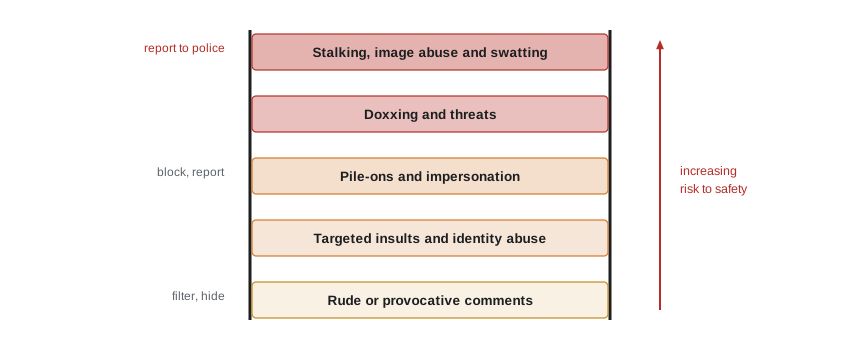
Harassment takes many forms, and the same person may experience several at once.
- Trolling and flaming: deliberately provocative or insulting comments meant to get a reaction.
- Hate and identity-based abuse: attacks based on race, ethnicity, religion, gender, sexual orientation, disability or other characteristics.
- Dogpiling and brigading: many accounts piling onto one target at once, sometimes coordinated in another forum or community.
- Impersonation: fake accounts pretending to be the creator, often to scam fans or damage reputation.
- Doxxing: publishing private information such as a home address, phone number or family details. Lesson 7 covers it in detail.
- Stalking and cyberstalking: repeated, unwanted monitoring or contact that makes a person fear for their safety, online or offline.
- Non-consensual intimate images: sharing or threatening to share intimate images without consent, including manipulated or AI-generated images, sometimes called deepfakes.
- Sextortion: threatening to share intimate images unless the target pays or provides more images. It increasingly targets teenagers and young men.
- Swatting: making a false emergency report so that armed police are sent to someone's address. It is dangerous and illegal.
- Coordinated reporting: mass false reports intended to get a creator's account restricted or removed.
Who is most affected
Anyone can be harassed, but research consistently finds that some groups face more frequent and more severe abuse. A Pew Research Center survey published in 2021 found that 41 % of US adults had personally experienced online harassment and that about a quarter had experienced more severe forms such as physical threats, stalking or sustained harassment. People were especially likely to say they had been targeted because of their politics, gender, race or ethnicity, religion or sexual orientation. Research on women journalists by UNESCO and the International Center for Journalists, published in 2021, found that nearly three-quarters of respondents had experienced online violence. Creators who are women, racialized, LGBTQ+, disabled or who discuss politics or identity often report similar patterns.
These patterns matter for two reasons. They show that harassment is not caused by the target's behaviour, and they help creators and their teams anticipate higher risk, for example when a video about a contested topic is likely to attract coordinated abuse.
How harassment harms people
The effects of harassment can be serious and lasting. Common effects include anxiety, fear, low mood, trouble sleeping, hypervigilance, shame and anger. Some people develop symptoms of trauma. Harassment also has practical costs: hours spent moderating and reporting, lost income when creators step back, damaged brand relationships and expenses for security or legal advice. Many targets self-censor, avoiding topics or posting less, which is often exactly what harassers want.
It is common for people around a target to underestimate the harm because it happens on a screen. Online threats and abuse are real experiences that affect real bodies and minds. If you are being harassed, your reaction is valid, and it is reasonable to ask for help.
A calm response framework
In the moment, harassment can feel overwhelming. Having a framework decided in advance makes it easier to respond calmly. One simple framework has five steps: assess, protect, document, report and recover.
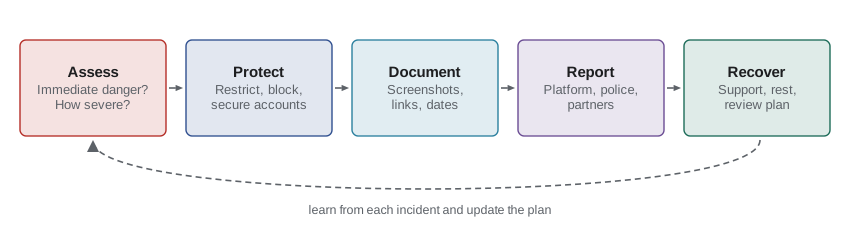
- Assess. Is anyone in immediate danger? Is there a threat of violence, a home address shared or a sign of stalking? If so, contact emergency services. Otherwise, judge how severe and widespread it is.
- Protect. Use platform tools to restrict, block, mute or limit comments; tighten privacy settings; secure accounts with strong passwords and two-factor authentication; and ask a moderator or friend to watch the account.
- Document. Before deleting or blocking, capture evidence: screenshots showing the content, username, date, time and URL; links; and notes on what happened. Store copies safely.
- Report. Report to the platform, and to police for threats, stalking, doxxing, image abuse or extortion. Inform your manager, brand partners or agency if work is affected.
- Recover. Step back, rest and talk to people you trust. Review what happened and update your plan.
Documentation in practice
Good evidence is detailed, organized and preserved. Platforms and police are far more able to act when they can see exactly what was posted, by whom and when. Some harassers delete content quickly, so capture it as soon as you safely can. A simple log can be kept in a spreadsheet with columns for date, time, platform, username or URL, a short description, a link to the screenshot file and what action you took. If reviewing the material is distressing, a trusted person or moderator can keep the log for you.
Worked problem
Estimating the scale of a pile-on
After a video on a contested topic, a creator receives 3,200 comments in 24 hours. A sample of 200 comments contains 46 that break their community rules, including 6 that contain threats. Estimate how many rule-breaking and threatening comments there are in total.
Show solution
- Rule-breaking share: 46 ÷ 200 = 0.23.
- Estimated rule-breaking comments: 3,200 × 0.23 = 736.
- Threat share: 6 ÷ 200 = 0.03.
- Estimated threatening comments: 3,200 × 0.03 = 96.
Answer: About 736 rule-breaking comments, including about 96 threats, which is enough to justify limiting comments, bringing in moderators and documenting the threats for possible reporting.
Worked problem
Scoring severity to decide a response
A creator uses a simple scale. Each incident gets a score from 1 to 3 for severity (insult, sustained abuse, threat), 1 to 3 for spread (one account, several, coordinated) and 1 to 3 for personal information involved (none, general, address or family). Scores of 7 or more trigger police reporting and a full safety review. An incident involves several accounts posting the creator's city and workplace with veiled threats. Score it.
Show solution
- Severity: veiled threats count as 3.
- Spread: several accounts count as 2.
- Personal information: city and workplace count as 2 or 3; take 3 because a workplace is a specific location.
- Total: 3 + 2 + 3 = 8.
Answer: A score of 8, so the creator should document everything, report to the platform and police and carry out a full safety review.
Responding publicly
Creators sometimes feel they must respond publicly to harassment. Usually it is better not to engage directly with harassers, because a reply can amplify the abuse and give it more reach. There are exceptions. A brief statement can help when a false claim is spreading widely, when brand partners or fans need reassurance, or when you want to explain why you are limiting comments. Keep it short, factual and calm, avoid naming individual harassers and consider having a manager or trusted friend read it first. You do not need to justify your boundaries in detail.
Supporting someone who is being harassed
If you are a manager, team member, brand partner or friend of someone being harassed, practical help matters. Offer to take over moderation, keep the evidence log, handle communications with partners or simply check in. Avoid blaming the target or suggesting they should have expected it. Ask what they need rather than assuming. If the harassment includes threats or image abuse, help them report it and encourage them to get support.
Harassment is not a problem any creator should have to handle alone. The next three lessons give you the tools to reduce exposure, filter abuse and use the law and platform processes when needed.
Preparing before harassment happens
The best time to plan a harassment response is before you need it. Preparation can include writing down your severity scale and reporting thresholds, saving links to each platform's reporting tools, setting up a template for your evidence log, choosing who will help you moderate during a pile-on, agreeing with your manager on who will speak to brand partners and drafting a short holding statement. It also helps to identify topics or formats that tend to attract abuse in your niche so that you can tighten comment settings before publishing.
Preparation also includes knowing your own limits. Some creators decide in advance that they will never read comments on certain topics, that a moderator will read everything first during a pile-on or that they will step away from the account for a set period if harassment reaches a certain level. Writing these decisions down when you are calm makes it much easier to follow them when you are upset.
Harassment and brand partners
Harassment can affect brand relationships. Partners may see abusive comments under sponsored posts, or harassers may contact brands directly to try to get deals cancelled. Telling partners early, briefly and factually is usually better than letting them discover it themselves. Explain what is happening, what you are doing about it and whether the sponsored content is affected. Most professional partners understand that harassment is not the creator's fault, and some will help by adjusting comment settings on their own accounts or reporting abusive posts.
Remember too that recovery is part of the response, not an optional extra. After a harassment wave, plan some time away from the account, talk to people who support you and notice any lingering effects on sleep, mood or confidence. If those effects persist, professional support can help.
Common mistakes
MistakeTreating all criticism as harassment.
InsteadLook at target, intent and pattern to tell criticism and harassment apart.
MistakeDeleting abusive content before capturing it.
InsteadScreenshot with username, date, time and URL first, then remove it.
MistakeReplying directly to harassers.
InsteadAvoid engagement; use a short, factual statement only when needed.
MistakeHandling serious threats alone.
InsteadReport threats, stalking, doxxing and image abuse to the platform and police.
MistakeAssuming harassment is not harmful because it is online.
InsteadRecognize real psychological and practical harm and seek support.
Summary and key terms
- Criticism targets the work; harassment targets the person, aims to harm and often repeats.
- Forms include trolling, hate, dogpiling, impersonation, doxxing, stalking, image abuse, sextortion and swatting.
- Women, racialized, LGBTQ+ and politically active people face more frequent and severe abuse.
- Harassment causes psychological, practical and financial harm and often leads to self-censorship.
- A five-step framework: assess, protect, document, report and recover.
- Detailed, timestamped evidence makes platform and police action more likely.
- Avoid engaging harassers; support targets with practical help.
- Harassment
- Behaviour intended to intimidate, humiliate, silence or harm a person.
- Trolling
- Posting provocative content to get a reaction.
- Dogpiling
- Many accounts piling onto one target at once.
- Brigading
- Coordinated harassment organized from another community.
- Impersonation
- Fake accounts pretending to be someone else.
- Doxxing
- Publishing private identifying information without consent.
- Cyberstalking
- Repeated unwanted online monitoring or contact causing fear.
- Sextortion
- Threatening to share intimate images unless demands are met.
- Swatting
- Making a false emergency report to send armed police to someone's address.
- Evidence log
- An organized record of harassment incidents and actions taken.
Practice problems
Work each problem on paper first, then reveal the answer to check.
What three features distinguish harassment from criticism?
Show answer
Target (the person), intent (to harm) and pattern (repetition or escalation).
Name four forms of online harassment.
Show answer
Trolling, hate, dogpiling, impersonation, doxxing, stalking, image abuse, sextortion, swatting.
What share of US adults reported online harassment in Pew's 2021 survey?
Show answer
41 %.
List the five steps of the response framework.
Show answer
Assess, protect, document, report, recover.
What should a screenshot show?
Show answer
The content, username, date, time and URL.
A sample of 100 comments has 15 abusive ones out of 2,000 total. Estimated abusive comments?
Show answer
2,000 × 0.15 = 300.
When should harassment be reported to police?
Show answer
For threats, stalking, doxxing, image abuse, extortion or immediate danger.
Why avoid replying directly to harassers?
Show answer
It can amplify the abuse.
Name two ways to support a harassed colleague.
Show answer
Take over moderation, keep the evidence log, handle partner communications, check in.
What is swatting?
Show answer
A false emergency report sending armed police to someone's address.
Lesson quiz · 5 questions
Score 60% or more to complete this lesson.
Create a free account to save your progress, take quizzes and earn a certificate.