
CRE-350 · Lesson 2 of 12 · 27 min
Workload, algorithms and burnout
Burnout is the most common wellbeing problem creators describe, and it is often misunderstood. It is not the same as being tired after a long week, and it is not a sign that someone lacks passion. It is a response to chronic work stress that has not been successfully managed. This lesson explains what burnout is, why the creator job is so prone to it, how platform algorithms add pressure and how to audit and rebalance a workload before it causes lasting harm.
What burnout is
The World Health Organization's International Classification of Diseases, 11th revision (ICD-11), includes burnout as an occupational phenomenon rather than a medical condition. It describes burnout as a syndrome resulting from chronic workplace stress that has not been successfully managed, with three dimensions: feelings of energy depletion or exhaustion; increased mental distance from one's job, or feelings of negativism or cynicism related to it; and reduced professional efficacy. The WHO is clear that the term refers specifically to the work context and should not be used to describe experiences in other areas of life.
Those three dimensions map closely onto what creators report. Exhaustion shows up as dreading the next upload, struggling to start editing or feeling drained after a stream. Mental distance shows up as resentment toward the audience, the platform or the brand partners, or a loss of interest in ideas that used to excite you. Reduced efficacy shows up as feeling that nothing you make is good enough, missing deadlines or making more mistakes than usual.
Burnout overlaps with, but is different from, depression and anxiety. Burnout is tied to work and often eases with real rest and changes to work. Depression affects most areas of life and does not usually lift just because work changes. Because the symptoms overlap, and because burnout can contribute to depression, anyone whose low mood, hopelessness or loss of interest persists for more than a couple of weeks, or spreads beyond work, should talk to a doctor or mental health professional.
Why the creator job is prone to burnout
Several features of the job feed burnout directly. The first is the absence of a natural stopping point. An office job ends when you leave the building. A creator can always make one more video, answer one more comment or check the analytics one more time. Without deliberate limits, work expands into evenings, weekends and holidays.
The second is the link between output and income. Many revenue sources reward volume: ad revenue grows with views, sponsorships often require a minimum number of posts, and recommendation systems favour accounts that publish consistently. That makes resting feel expensive, even when it is necessary.
The third is emotional labour. Creators are expected to be upbeat, authentic and available, even on days when they feel none of those things. Managing your own feelings to present a consistent persona is tiring work, and the effort is rarely visible to the audience.
The fourth is creative fatigue. Creative work draws on a limited pool of ideas and energy. Producing new concepts several times a week, year after year, without time to rest or take in new experiences, eventually leads to repetition and a sense of running on empty. In the 2025 Billion Dollar Boy survey discussed in Lesson 1, creative fatigue was the most frequently named burnout trigger.
Algorithms and the pressure to post
Platform recommendation systems decide who sees each piece of content. Platforms rarely publish exactly how their systems work, and they change them often, but creators broadly agree on several patterns. Systems tend to reward content that keeps viewers watching, prompts interaction and arrives regularly. Formats the platform is promoting, such as short vertical video at various times, may get extra reach. Changes can cut a creator's reach suddenly, with no explanation.
These patterns create three pressures. The first is frequency pressure: the belief that posting less will be punished, so creators post more than is healthy. The second is trend pressure: chasing whatever format or sound is currently rewarded, even when it does not suit the creator. The third is uncertainty: because the rules are opaque and changing, creators can never be sure whether a drop in views is about their work, the algorithm or chance, which makes it hard to stop worrying.
Some of the folklore about algorithms is exaggerated. Platform spokespeople have repeatedly said that taking a break does not permanently penalize a channel, and many creators have returned from breaks to similar or better results. Short-term dips after a pause are common, but they often reflect the audience's habits rather than punishment. The honest answer is that nobody outside the platforms knows exactly how much consistency matters, and it varies by platform and niche. What is clear is that a schedule you cannot sustain will eventually break, and an unplanned collapse usually costs more than a planned slowdown.
| Pressure | What it looks like | A healthier response |
|---|---|---|
| Frequency | Posting daily because you fear losing reach | Choose a cadence you can sustain for a year and keep a buffer |
| Trends | Copying every new format | Test selectively; keep a core format you enjoy |
| Uncertainty | Checking analytics many times a day | Review metrics on a schedule, such as once a week |
| Comparison | Matching the output of creators with teams | Compare yourself with your own past results |
| Always-on | Replying to comments at midnight | Set reply windows and use moderation tools |
Early warning signs
Burnout usually builds gradually, which makes it easy to miss until it is severe. Watching for early signs gives you time to act. Common signs include:
- Dreading tasks you used to enjoy, especially filming or interacting with your community.
- Taking much longer than usual to start or finish work, or procrastinating more.
- Irritability, cynicism or resentment toward your audience, peers or partners.
- Trouble sleeping, frequent headaches, stomach problems or getting sick more often.
- Feeling that your work is never good enough, or no longer caring whether it is.
- Relying more on caffeine, alcohol or other substances to get through the day or to switch off.
- Withdrawing from friends, family or activities outside work.
One or two of these on a hard week is normal. Several together for weeks are a signal to change something. A simple practice is a weekly check-in: rate your energy, enjoyment and sleep from 1 to 5 every Sunday and note the scores. A downward trend over a month is easier to notice on paper than in your head.
Auditing and rebalancing a workload
Lesson 1 introduced the time audit. Here we take it further by sorting tasks by value and by energy cost. Value means how much the task contributes to your goals, such as growth, income or creative satisfaction. Energy cost means how draining it is for you specifically. Some tasks are high value and energizing, such as filming ideas you love. Some are low value and draining, such as re-editing a video for the fifth time or scrolling comments late at night.
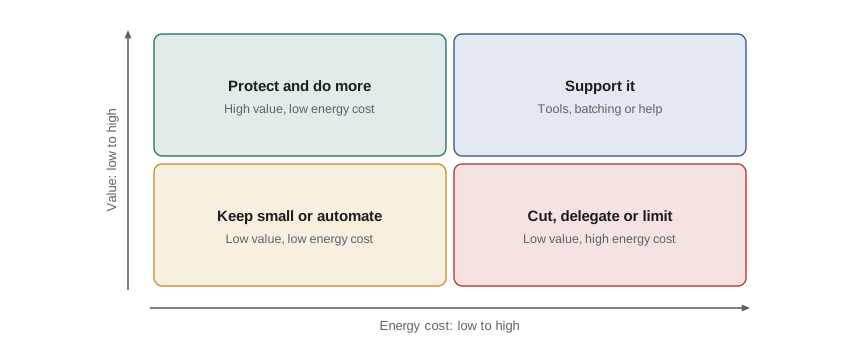
Once tasks are sorted, the options become clearer. Protect the high-value, low-cost work. Support high-value, high-cost work with batching, templates, better equipment or help. Keep low-value, low-cost tasks small or automate them. Cut, delegate or strictly limit low-value, high-cost tasks. The goal is not to eliminate effort but to spend your limited energy where it matters most.
Worked problem
Rebalancing a posting schedule
A creator posts 4 long videos a week, each taking about 10 hours, plus 10 hours of other work, for 50 hours a week. Their data show that 2 of the 4 videos usually get most of the views and income. They want to reach 38 hours a week. If they post 3 videos a week and use 2 saved hours a week to build a buffer, what is their new weekly workload?
Show solution
- Current video time: 4 × 10 = 40 hours; total 40 + 10 = 50 hours.
- New video time: 3 × 10 = 30 hours.
- Add other work and buffer time: 30 + 10 + 2 = 42 hours.
- To reach 38 hours, they need to cut 4 more hours, for example by trimming editing time with templates or reducing comment time.
Answer: 42 hours a week, still 4 hours above the target, so they need a further efficiency change such as an editing template or limited comment windows.
Worked problem
Estimating the effect of outsourcing
Editing takes a creator 15 hours a week. An editor would charge $35 an hour and work 1.2 times slower than the creator at first. The creator would still spend 3 hours a week reviewing edits. How many hours does the creator save, and what does it cost per week?
Show solution
- Editor hours: 15 × 1.2 = 18 hours.
- Cost: 18 × $35 = $630 a week.
- Creator time saved: 15 − 3 = 12 hours.
- Cost per hour saved: $630 ÷ 12 = $52.50.
Answer: About 12 hours saved for $630 a week, or $52.50 per hour of the creator's time, which is worthwhile if those hours produce more than that in income or prevent burnout.
The second example shows why outsourcing is often a resource worth adding even when it is expensive. The calculation should also include the value of rest. An hour saved that becomes an hour of sleep or time with friends has value that does not show up in revenue.
Recovery from burnout
If you are already burned out, rebalancing alone may not be enough. Recovery usually needs real rest, which for many creators means a planned break from posting, combined with changes to the conditions that caused the burnout. Returning to the same workload after a break tends to bring the same result. Lesson 4 covers how to plan and announce breaks, and Lesson 11 covers professional support. If burnout has left you feeling hopeless, or if you have thoughts of harming yourself, please reach out now to a crisis line or a health professional.
In Canada, call or text 9-8-8 at any time for the Suicide Crisis Helpline. Your family doctor can also refer you to mental health services, and many provinces offer free or low-cost counselling programs.
Burnout in teams and partnerships
Burnout is not only an individual problem. Editors, moderators and managers who work to a creator's schedule can burn out too, and a burned-out creator often passes pressure down the line through late changes and rushed deadlines. When a team plans workload together, sets realistic timelines and shares the load during busy periods, everyone is less likely to reach exhaustion. Brand partners can help as well by giving creators enough lead time, keeping revision rounds within the contract and avoiding last-minute requests over weekends and holidays.
Common mistakes
MistakeTreating burnout as ordinary tiredness that a weekend will fix.
InsteadRecognize the three dimensions and address the underlying workload.
MistakeAssuming any break will permanently destroy reach.
InsteadPlan a sustainable cadence and a buffer; short dips after breaks are common and usually recover.
MistakeChecking analytics constantly.
InsteadReview metrics on a fixed schedule to reduce anxiety and noise.
MistakeCutting the tasks you enjoy and keeping the draining ones.
InsteadSort tasks by value and energy cost and cut low-value, high-cost work first.
MistakeReturning from a break to the same workload.
InsteadChange the conditions that caused burnout before resuming.
Summary and key terms
- ICD-11 describes burnout as an occupational phenomenon with exhaustion, mental distance and reduced efficacy.
- Burnout differs from depression, but they overlap; persistent low mood deserves professional attention.
- No stopping point, output-linked income, emotional labour and creative fatigue make creator work burnout-prone.
- Algorithms create frequency, trend and uncertainty pressures, though breaks rarely cause permanent penalties.
- Early warning signs include dread, irritability, poor sleep, withdrawal and increased substance use.
- A value and energy-cost matrix helps decide what to protect, support, automate or cut.
- Recovery needs rest plus changes to the conditions that caused burnout.
- Occupational phenomenon
- A work-related condition that is not classified as a medical illness.
- Exhaustion
- Depletion of physical and emotional energy.
- Mental distance
- Cynicism or detachment from one's work.
- Professional efficacy
- The sense of being effective and competent at work.
- Emotional labour
- Managing one's feelings to present an expected emotional face at work.
- Creative fatigue
- Depletion of ideas and creative energy from continuous production.
- Frequency pressure
- The urge to post more often than is sustainable to satisfy algorithms.
- Value-energy matrix
- A grid sorting tasks by contribution to goals and by how draining they are.
- Weekly check-in
- A short self-rating of energy, enjoyment and sleep used to spot trends.
- Recovery
- Restoring energy through rest and changes to working conditions.
Practice problems
Work each problem on paper first, then reveal the answer to check.
Name the three dimensions of burnout in ICD-11.
Show answer
Exhaustion, mental distance or cynicism, and reduced professional efficacy.
Is burnout classified as a medical condition in ICD-11?
Show answer
No, as an occupational phenomenon.
Give two reasons creator work is burnout-prone.
Show answer
No stopping point, output-linked income, emotional labour, creative fatigue.
What are the three algorithmic pressures?
Show answer
Frequency, trend and uncertainty.
List three early warning signs of burnout.
Show answer
Dread, irritability, poor sleep, withdrawal, more substance use, procrastination.
A creator cuts from 5 to 3 videos at 8 hours each. Hours saved?
Show answer
(5 − 3) × 8 = 16 hours.
An editor costs $40 an hour for 10 hours and saves the creator 8 hours. Cost per hour saved?
Show answer
$400 ÷ 8 = $50.
In the value-energy matrix, what should you do with low-value, high-cost tasks?
Show answer
Cut, delegate or limit them.
Why is returning to the same workload after a break risky?
Show answer
The same conditions tend to cause burnout again.
When should persistent low mood be checked by a professional?
Show answer
If it lasts more than a couple of weeks or spreads beyond work.
Lesson quiz · 5 questions
Score 60% or more to complete this lesson.
Create a free account to save your progress, take quizzes and earn a certificate.