
CRE-302 · Lesson 2 of 12 · 28 min
Platform revenue programs
Platform revenue programs are the most familiar way for creators to earn: the platform shares part of the money it makes from advertising, subscriptions or virtual goods with the creators whose content attracts the audience. They are attractive because they require no selling: once a creator qualifies, money arrives in proportion to views or engagement. They are also the least controllable stream, because the platform sets the eligibility rules, the revenue share, the rates and the payment terms, and can change any of them. This lesson surveys the main types of platform programs, the eligibility and revenue-sharing structures that are common at the time of writing (October 2026), the way payments flow, and how to treat platform revenue within a wider business. Program details change often, so treat the figures here as examples to check against each platform's current help pages rather than permanent facts.
Types of platform program
Platform programs fall into several broad types:
- Ad revenue sharing: the platform places ads before, during or alongside content and pays the creator a share of the net ad revenue. YouTube's Partner Program (YPP) is the best-known example; Facebook in-stream ads and some podcast hosting platforms offer similar models.
- Subscription revenue sharing: the platform shares part of the revenue from its own paid subscription, such as YouTube Premium, based on how much subscribers watch each creator's content.
- Creator funds and bonus pools: the platform sets aside a pool of money and distributes it based on views, engagement or other metrics. Such funds have often been introduced to attract creators to a new format and later replaced or reduced.
- Performance-based rewards programs: programs that pay per qualified view or engagement for content meeting quality or length criteria, such as TikTok's Creator Rewards Program, which at the time of writing rewards eligible videos longer than one minute.
- Virtual gifts and tips sold by the platform: viewers buy platform currency and send gifts during live streams or on posts; the platform keeps a share and converts the rest to creator earnings (Lesson 7 and CRE-250).
- Channel memberships and subscriptions sold within the platform: viewers pay monthly for perks, with the platform keeping a share (Lesson 6).
- Shopping and affiliate programs run by the platform: commissions on products tagged in content, such as YouTube Shopping or TikTok Shop affiliate commissions (Lesson 4).
A single platform may offer several of these at once, each with its own eligibility rules.
Eligibility thresholds
Most programs set thresholds based on followers, watch time or views, plus compliance with policies and residence in a supported country. At the time of writing, YouTube's Partner Program has two tiers. Fan funding features (memberships, Super Chat, Super Thanks) become available at 500 subscribers, three public uploads in the last 90 days, and either 3,000 public watch hours in the last 365 days or 3 million public Shorts views in the last 90 days. Full ad revenue sharing requires 1,000 subscribers and either 4,000 public watch hours in the last 365 days or 10 million public Shorts views in the last 90 days. In August 2026, YouTube announced changes taking effect on 1 February 2027: new creators will be able to join ad revenue sharing with 8,000 valid public watch hours in 365 days or 20 million Shorts views in 90 days, and ongoing Shorts revenue sharing will require 10 million qualified Shorts views in the past 90 days, while existing partners and fan funding thresholds are unaffected. These announcements illustrate how quickly and how significantly program rules can change.
Thresholds on other platforms differ. TikTok's Creator Rewards Program has required at least 10,000 followers and 100,000 video views in the last 30 days, with an adult account in a supported country. Facebook and Instagram monetization tools have their own follower, engagement and policy requirements, and have changed names and structures several times. Twitch's Affiliate and Partner programs (CRE-250) set requirements for followers, broadcast days and average viewers. Each platform also lists supported countries; Canadian and US creators are eligible for most major programs, but not every feature launches in every country at the same time.
| Program type | Example | Paid on | Typical control by creator |
|---|---|---|---|
| Ad revenue sharing | YouTube Partner Program | Share of net ad revenue | Content, length, ad placement |
| Subscription revenue sharing | YouTube Premium | Share of watch time by subscribers | Low |
| Rewards or bonus pool | TikTok Creator Rewards | Qualified views and engagement | Low to moderate |
| Virtual gifts | Live stream gifts | Gifts converted at platform rates | Moderate: live engagement |
| In-platform memberships | Channel memberships | Monthly fees minus platform share | High: perks and pricing tiers |
| Shopping commissions | YouTube Shopping, TikTok Shop | Percentage of sales | Product choice |
Revenue shares
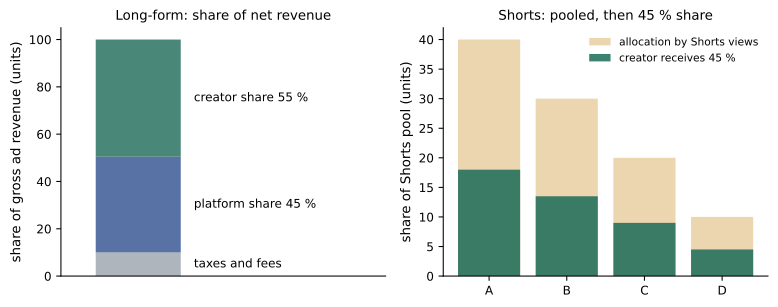
Revenue sharing splits net revenue between the platform and the creator. At the time of writing, YouTube shares 55 % of net ad revenue from ads shown on or around long-form videos with the creator. For Shorts, ad revenue from the Shorts feed is pooled, an allocation is made to creators based on their share of eligible Shorts views after deducting music licensing costs where music is used, and creators receive 45 % of their allocation. YouTube's August 2026 announcement also described Premium and Premium Lite revenue being paid out in the same 55 % long-form and 45 % Shorts proportions. Memberships and Super Chat typically pay creators 70 % of net revenue after taxes and app store fees on YouTube. Other platforms publish different shares or, for rewards programs, do not publish a fixed share at all, paying an amount per qualified view that varies with factors such as originality, audience location and engagement.
Net revenue is what remains after the platform deducts items such as taxes, app store fees, refunds and, for some programs, music licensing. Creators rarely see the gross figure, so it is more useful to track what they actually receive per thousand views (Lesson 3).
Worked problem
Comparing Shorts and long-form earnings
A creator's long-form videos earn $3,300 of net ad revenue in a month, and their Shorts allocation from the pooled revenue is $1,200. Using a 55 % long-form share and a 45 % Shorts share, what does the creator receive?
Show solution
- Long-form: $3,300 × 0.55 = $1,815.
- Shorts: $1,200 × 0.45 = $540.
- Total: $1,815 + $540 = $2,355.
Answer: About $2,355 for the month.
Policies and advertiser-friendly content
Platform revenue depends on complying with platform policies, which go beyond the community guidelines that apply to all users. Monetization policies generally require original content or meaningful transformation of others' content, prohibit reused or mass-produced content, and restrict monetization of material that advertisers consider unsuitable, such as graphic violence, strong profanity, adult themes, controversial topics or harmful acts. On YouTube, videos receive a monetization status, often shown as a yellow icon when ads are limited; creators can request human review if they believe a decision is wrong. Self-certification, where a creator rates their own content against the advertiser-friendly guidelines, improves accuracy over time if the ratings are honest. Repeated violations can lead to demonetization of a channel. Creators who cover sensitive topics, such as news, health or history, should learn exactly what the guidelines allow, because context, framing and the placement of strong language within a video often make the difference.
Copyright and Content ID
Copyrighted material can redirect earnings. When YouTube's Content ID matches music, footage or other material, the rights holder can choose to block the video, track it, or monetize it by running ads and taking the revenue. A creator who uses a popular song in a video may find that all ad revenue goes to the music rights holder. Some claims can be disputed, for example when the creator has a licence or the use is a fair dealing (Canada) or fair use (US) case, though such disputes require care. Using licensed music libraries, original music or platform-provided audio libraries avoids most problems. Rights management is covered in more depth in CRE-330 and in earlier production courses.
Payments, taxes and payout accounts
Platforms pay creators through accounts such as Google AdSense for YouTube, with payment thresholds (for example a minimum balance before payout) and payment schedules, usually monthly. Platforms collect tax information. US-based platforms paying non-US creators may withhold US tax on earnings from US viewers unless the creator submits tax forms; Canadian creators can usually claim a reduced rate under the Canada–US tax treaty by submitting a W-8BEN form, and Canadian businesses may need a different form. US creators submit a W-9. Platform earnings are taxable income in both countries and must be reported. These rules are introduced only briefly here; CRE-330 covers creator taxation in detail.
For Canadian creators, platform earnings are business or self-employment income reported to the Canada Revenue Agency. Whether GST/HST applies to payments from foreign platforms depends on the nature of the supply and the creator's registration status; services supplied to non-residents are often zero-rated, but the details belong in CRE-330 and with an accountant.
The risks of platform dependence
Platform programs carry specific risks. The platform can change thresholds, revenue shares, rates or eligible formats at any time, sometimes with only a few months' notice. Algorithm changes can cut views and revenue overnight. Policy decisions can demonetize individual videos or whole channels, sometimes in error. Bonus funds have often been introduced generously and then reduced or ended. Payment can be delayed or withheld during reviews. Rates fall at certain times of year (Lesson 3). Because of these risks, many creators treat platform revenue as a base that rewards consistent publishing, while building other streams and owned channels, such as email lists and websites, that do not depend on a single company's decisions.
Getting more from platform programs
Within the rules, creators can improve platform earnings in several ways:
- Meet thresholds steadily rather than chasing a single viral moment, since eligibility depends on sustained watch time or views.
- Make content advertisers value, in topics and formats that attract higher-paying ads (Lesson 3).
- Use all eligible features: memberships, Super Thanks, shopping tags and Premium revenue are additional sources within the same program.
- Avoid copyright claims by using licensed or original audio and footage.
- Self-certify honestly and appeal incorrect monetization decisions promptly.
- Keep tax forms up to date to avoid unnecessary withholding.
- Read program announcements and help pages regularly; a change announced months in advance gives time to adapt.
Platform revenue is valuable, but it should be one strand of a business rather than its foundation.
Comparing platforms
Creators who publish on several platforms should compare their programs on more than headline payouts. Relevant factors include the revenue share or payout per view, eligibility thresholds, the formats that earn (long-form, short-form, live, posts), how predictable payouts are, the countries supported, payment thresholds and timing, and how much control the creator has over monetization settings. A platform with a lower payout per view may still be worthwhile if it brings growth, sponsorship opportunities or audience members who later join a membership. Conversely, a platform with generous bonuses may be worth less if those bonuses are temporary.
Platform programs also differ in how they treat reposted content. Most require original content, and many penalize content that has simply been reuploaded from another platform with watermarks or without changes. Creators who repurpose content across platforms usually remove watermarks, adapt the format and edit for each platform's audience, which both respects policies and performs better.
Worked problem
Comparing payouts across two platforms
A creator posts the same one-minute video on two platforms. Platform X pays an effective $0.05 per thousand views and the video gets 1,200,000 views. Platform Y pays an effective $0.60 per thousand qualified views and the video gets 300,000 qualified views. Which pays more for this video?
Show solution
- Platform X: 1,200,000 / 1000 × $0.05 = $60.
- Platform Y: 300,000 / 1000 × $0.60 = $180.
Answer: Platform Y pays $180 against $60, despite a quarter of the views, which shows why payout per view matters as much as view counts.
Reading program announcements
Platforms announce major program changes through official blogs, creator newsletters, help centre updates and creator-focused channels. When a change is announced, useful questions are: when does it take effect; who is affected (new creators, existing partners, certain formats or countries); which metrics change; and what happens to creators who no longer meet new requirements. YouTube's August 2026 announcement, for example, gave existing partners continued eligibility while raising the bar for new applicants and for ongoing Shorts revenue sharing from February 2027. A creator relying on Shorts revenue would need to check whether their channel reaches 10 million qualified Shorts views in 90 days, and plan accordingly. Reading the primary announcement, rather than relying on second-hand summaries, avoids misunderstandings.
Account security and good standing
Platform revenue depends on the creator's account remaining secure and in good standing. Hijacked accounts are a common problem for creators: attackers use phishing emails disguised as sponsorship offers or copyright notices to steal login sessions, then use the channel for scams, which can lead to suspension. Two-step verification, separate business email addresses, careful handling of unexpected attachments, and limited access for team members protect the account. Keeping a record of community guideline and copyright strikes, and resolving them promptly, protects monetization status.
Common mistakes
MistakeTreating published thresholds and shares as permanent.
InsteadCheck current help pages; programs change often.
MistakeUsing popular music without a licence.
InsteadUse licensed or original audio to keep ad revenue.
MistakeIgnoring tax forms required by platforms.
InsteadSubmit them to avoid unnecessary withholding.
MistakeRating your own content optimistically.
InsteadSelf-certify honestly to build accuracy.
MistakeBuilding the whole business on one platform program.
InsteadTreat it as one strand alongside owned channels.
Summary and key terms
- Platforms share ad, subscription and gift revenue through several program types.
- Eligibility thresholds depend on followers, watch time, views and policy compliance.
- At the time of writing, YouTube shares 55 % of long-form and 45 % of Shorts revenue.
- Advertiser-friendly policies and copyright claims affect earnings.
- Payment accounts, tax forms and withholding must be set up correctly.
- Programs, rates and rules change; dependence is a risk.
- Use platform revenue as one strand of a diversified business.
- Partner program
- A platform program that shares revenue with eligible creators.
- Revenue share
- The percentage of net revenue paid to the creator.
- Net revenue
- Revenue after taxes, fees and other deductions.
- Creator fund
- A pool of money distributed to creators by metrics.
- Rewards program
- A program paying for qualified views or engagement.
- Demonetization
- Removal or limitation of ads on content.
- Self-certification
- A creator rating their own content against policy.
- Content ID
- YouTube's system for matching copyrighted material.
- Withholding tax
- Tax deducted from payments before they are paid.
- W-8BEN
- US form a foreign individual uses to claim treaty rates.
Practice problems
Work each problem on paper first, then reveal the answer to check.
Name four types of platform program.
Show answer
Ad sharing, subscription sharing, rewards or funds, gifts, memberships, shopping.
Current YouTube long-form ad share for creators?
Show answer
55 % of net ad revenue, at the time of writing.
Creator share of a $2,000 Shorts allocation at 45 %?
Show answer
$900.
What did YouTube announce for February 2027?
Show answer
New entry thresholds and a 10M Shorts view requirement for Shorts sharing.
What happens when Content ID matches a song?
Show answer
The rights holder may block, track or take the ad revenue.
What does a yellow icon on YouTube indicate?
Show answer
Limited or no ads on a video.
Which form do Canadian individuals use for treaty rates?
Show answer
W-8BEN.
Why have creator funds been unreliable?
Show answer
They are often reduced or ended.
Name two ways to raise platform earnings.
Show answer
Use all features, avoid claims, advertiser-friendly topics, honest self-certification.
Where are creator taxes covered in depth?
Show answer
CRE-330.
Lesson quiz · 5 questions
Score 60% or more to complete this lesson.
Create a free account to save your progress, take quizzes and earn a certificate.