
CRE-302 · Lesson 1 of 12 · 28 min
The creator revenue mix
Creators earn money in more ways than ever before, but most of them earn very little, and the ones who build lasting businesses rarely rely on a single source of income. A creator who earns everything from one platform's ad program is exposed to every change in that platform's rules, rates and recommendation system; a creator who earns from ads, affiliate links, memberships, products and services can survive the loss of any one of them. This course looks at each revenue stream in turn: how it works, what it pays, what it costs, what the rules are, and how it fits with the others. This first lesson introduces the revenue mix as a whole: the main categories of creator income, the economics that link them, how revenue relates to audience size and depth, the costs that turn revenue into profit, and a framework for thinking about which streams suit which creators. CRE-101 introduced how creators earn money in broad terms; this course goes into the detail needed to plan and run each stream.
The main categories of creator income
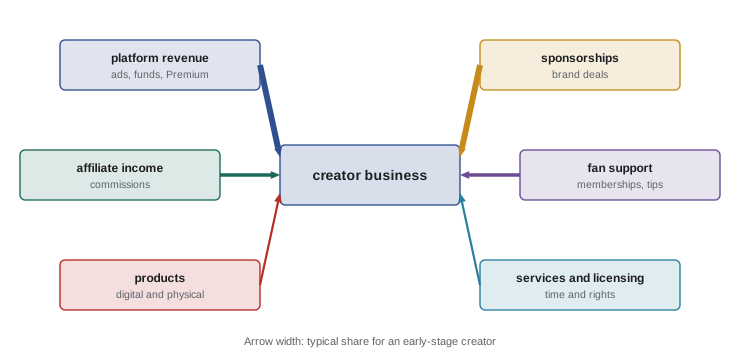
Creator income falls into a handful of broad categories, each with a different relationship between the creator, the audience and the money:
- Platform revenue: payments from the platform itself, usually a share of advertising or subscription revenue earned around the creator's content, plus bonuses, funds and programs. The audience pays indirectly, by watching ads or paying for a platform subscription.
- Advertising and sponsorships sold directly: brands pay the creator to mention, feature or integrate products. The audience pays nothing, but its attention is what the brand buys.
- Affiliate and commission income: the creator earns a percentage when viewers buy through tracked links or codes.
- Direct fan support: memberships, subscriptions, tips, gifts and crowdfunding, where audience members pay the creator directly for access, perks or simply to support the work.
- Products: digital products such as templates, presets, e-books and courses, and physical products such as merchandise or a creator-led brand.
- Services and licensing: consulting, freelance production, speaking, workshops, and licensing content or intellectual property to others.
Each category scales differently. Platform ad revenue grows roughly in proportion to views; sponsorship income depends on the size and fit of the audience; direct support and products depend on how deeply a smaller number of people value the creator; services are limited by the creator's own time.
Breadth and depth of an audience
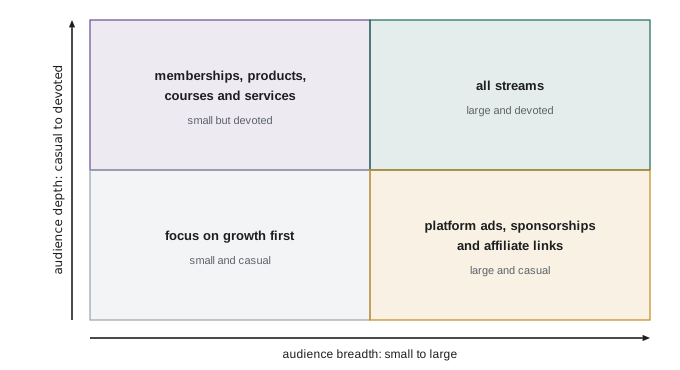
A useful way to understand the revenue mix is to separate the breadth of an audience, how many people see the work, from its depth, how much a smaller group cares about it. Breadth drives platform revenue, sponsorship rates and the reach of affiliate links; depth drives memberships, products, courses, tips and services. A gaming streamer with a modest but devoted audience may earn more from subscriptions and gifts than a viral short-form creator with ten times the views, while a broad entertainment channel may earn most of its income from ads and sponsorships. Most creators find that depth-based income grows as the creator's relationship with the audience grows, and is more stable, because it depends on people the creator knows rather than on an algorithm. The writer Kevin Kelly's 2008 essay "1,000 True Fans" popularized the idea that a creator could make a living from a relatively small number of people who will buy whatever they make; the precise number varies enormously, but the principle that depth can substitute for breadth is central to creator business strategy.
| Revenue stream | Mainly driven by | Typical stability | Creator time needed |
|---|---|---|---|
| Platform ad revenue | Breadth: views and watch time | Variable, seasonal | Low beyond making content |
| Sponsorships | Breadth and audience fit | Lumpy, deal by deal | Moderate: sales and production |
| Affiliate income | Breadth and purchase intent | Variable | Low to moderate |
| Memberships and tips | Depth: loyalty and community | Fairly stable, recurring | Moderate: perks and community |
| Products and courses | Depth and trust | Spiky around launches | High upfront, lower later |
| Services and licensing | Expertise and reputation | Depends on demand | High, limited by hours |
Revenue, costs and profit
Creators often talk about revenue, but what pays the rent is profit: what remains after costs. Different streams carry very different costs. Platform revenue has almost no direct cost beyond producing content, though production itself can be expensive. Sponsorships may require extra production time, travel and agent or manager commissions, typically 10 to 20 % of the deal. Affiliate income costs little. Memberships require time to deliver perks and platform fees of roughly 5 to 12 %. Digital products have low marginal costs once made but substantial creation and marketing costs. Physical products carry the costs of manufacturing, inventory, shipping, returns and payment processing, which can consume most of the revenue. Services trade the creator's time for money. A full picture also includes overheads shared across streams: equipment, software, editors and assistants, accounting, insurance and taxes.
Here \(R_i\) and \(C_i\) are the revenue and direct costs of each stream \(i\). Comparing streams by their contribution, \(R_i - C_i\), rather than by revenue alone, often changes which ones look most attractive.
Worked problem
Comparing two months
A creator earns $6,000 in a month from ad revenue with no direct costs, $5,000 from a sponsorship with a 15 % manager commission and $800 of extra production costs, and $4,000 of merchandise sales with product, shipping and fee costs of $2,900. Overheads are $2,500. What is the monthly profit, and which stream contributes most?
Show solution
- Ad revenue contribution: $6,000 − $0 = $6,000.
- Sponsorship contribution: $5,000 − ($750 commission + $800) = $3,450.
- Merchandise contribution: $4,000 − $2,900 = $1,100.
- Total contribution: $6,000 + $3,450 + $1,100 = $10,550; minus overheads $2,500 gives $8,050 profit before tax.
Answer: About $8,050 before tax; ad revenue contributes most, and merchandise, despite $4,000 of revenue, contributes only $1,100.
How income is distributed among creators
Creator incomes follow a highly skewed distribution. A small fraction of creators earn most of the money, and the median creator earns little or nothing. This pattern, often described as a power law or long tail, appears on every platform and in surveys of creators, though the exact figures vary by source and change over time. The implications are practical: plan finances on realistic, median expectations rather than stories of exceptional success; treat early income as a bonus while keeping other work; and value streams that grow with depth of audience, which do not require being in the top fraction. CRE-101 discussed the realities of creator income in more detail. Monetization does not create an audience; it converts the value an audience already finds in the work into income. Monetizing too aggressively, too early, can damage trust and slow growth.
Choosing streams that fit
Not every stream suits every creator. Helpful questions include:
- What does the audience value: entertainment, information, skills, community, identity?
- What would the audience pay for directly, and what would they rather get free?
- Which products or brands are a natural fit for the content and the audience's needs?
- How much time does each stream require, and does it compete with making content?
- What does the creator enjoy and do well: selling, teaching, designing products, community management?
- Which platform programs are available in the creator's country and niche?
- What are the risks: platform dependence, inventory, reputation, legal obligations?
An educational creator teaching photography might combine ad revenue, affiliate links for equipment, a preset pack, a course and occasional workshops. A comedy sketch channel might rely on ads, sponsorships and merchandise. A podcast might combine host-read ads, a premium feed and live shows. A craft creator might sell patterns, kits and a membership with monthly tutorials.
Sequencing monetization
Revenue streams tend to be added in a rough sequence as an audience grows. Early on, before platform programs are available, affiliate links and small digital products may be the only options, and sometimes the best focus is simply growing the audience. As views grow, platform programs and sponsorships open up. As a loyal community forms, memberships and direct support become viable. Larger launches such as courses or product lines usually work best once the creator understands exactly what the audience wants and has an email list or other owned channel (CRE-301). Each new stream should be tested on a small scale, measured, and kept only if it earns its place. Adding too many streams at once spreads effort thinly and confuses the audience about what the creator stands for.
Trust as the underlying asset
Every revenue stream draws on the same underlying asset: the audience's trust. Viewers watch sponsored segments, click affiliate links, subscribe to memberships and buy products because they believe the creator is honest and that what they recommend is good. Undisclosed advertising, low-quality products, aggressive upselling or promoting things the creator does not use can earn short-term revenue at the cost of long-term trust, which is far harder to rebuild than to spend. Disclosure laws (Lesson 4 and CRE-320) protect audiences, but the commercial reason for honesty is just as strong: creators who protect trust usually earn more over time.
Course overview
Lesson 2 covers platform revenue programs; Lesson 3, the economics of ad revenue; Lesson 4, affiliate marketing; Lesson 5, an overview of sponsorships, which CRE-310 covers in depth; Lesson 6, memberships and subscriptions; Lesson 7, fan funding, tips and crowdfunding; Lesson 8, digital products; Lesson 9, courses and education; Lesson 10, merchandise and physical products; Lesson 11, services, licensing and speaking; and Lesson 12, building a diversified business model, with a capstone monetization plan. Contracts, business structures and taxes are introduced where relevant and covered fully in CRE-330.
Tracking the revenue mix
A revenue mix can only be managed if it is measured. A simple monthly record, kept in a spreadsheet or accounting tool, lists every payment by stream and source: platform payouts, sponsorship invoices, affiliate network payments, membership payouts, product sales, service invoices and licensing fees. Alongside revenue, the record notes direct costs for each stream and shared overheads. Over a year, this record shows which streams are growing, which are seasonal, which take the most time, and which contribute the most profit. It also makes tax time far easier, because income and expenses are already sorted, and it gives sponsors, lenders or business partners credible evidence of a stable business.
Useful figures to track each month include total revenue, contribution by stream, profit after overheads, the share of revenue from the largest stream, revenue per thousand views across all streams, and hours spent on each stream. Revenue per hour is especially revealing: a stream that earns well but takes enormous time may be less attractive than a smaller stream that runs almost by itself. Many creators also record the audience metrics that drive each stream, such as views, email subscribers, members and conversion rates, so that changes in revenue can be traced to their causes.
Revenue per view across all streams
Platform dashboards report RPM for platform revenue only, but a creator can calculate a broader figure: total revenue from all streams per thousand views. A channel with a modest ad RPM of $4 might earn another $6 per thousand views from affiliates, $5 from sponsorships and $3 from products, for a total of $18 per thousand views. This all-streams figure shows the real value of each view and helps decide how much effort to put into growth compared with monetization. It also shows why two channels with the same views can have very different businesses.
Worked problem
All-streams revenue per thousand views
A channel gets 500,000 views in a month and earns $2,000 from ads, $1,500 from affiliates, $3,000 from a sponsorship and $1,000 from product sales. What is its all-streams revenue per thousand views, and what share comes from ads?
Show solution
- Total revenue: $2,000 + $1,500 + $3,000 + $1,000 = $7,500.
- Per thousand views: $7,500 / 500 = $15.
- Ads share: $2,000 / $7,500 ≈ 27 %.
Answer: About $15 per thousand views, of which ads provide only about 27 %.
Business structure and professional help
As revenue grows, creators face questions about business structure, such as whether to remain a sole proprietor or incorporate, how to pay themselves, and how to register for sales taxes. These choices affect tax, liability and administration, and the right answer depends on income level, province or state, and personal circumstances. CRE-330 covers these topics, and an accountant familiar with creator businesses can help. Hiring help, such as an editor, a manager or a bookkeeper, is another business decision: it costs money but frees time for the work only the creator can do, and it is often the step that allows a creator business to grow beyond one person's hours.
Common mistakes
MistakeRelying on a single platform's ad revenue.
InsteadBuild several streams so no single change is fatal.
MistakeComparing streams by revenue alone.
InsteadCompare contribution after direct costs.
MistakePlanning finances on exceptional success stories.
InsteadPlan on realistic median expectations.
MistakeMonetizing aggressively before an audience trusts you.
InsteadBuild value and trust first, then add streams that fit.
MistakeLaunching many streams at once.
InsteadAdd, test and measure one stream at a time.
Summary and key terms
- Creator income comes from platforms, sponsorships, affiliates, fans, products and services.
- Breadth of audience drives ads and sponsorships; depth drives memberships and products.
- Contribution after direct costs matters more than revenue.
- Creator incomes are highly skewed; plan on realistic expectations.
- Choose streams that fit the audience, the content and the creator's strengths.
- Add streams in sequence and test each one.
- Trust is the asset every stream depends on.
- Revenue mix
- The combination of income streams a creator uses.
- Platform revenue
- Payments from a platform, such as ad revenue shares.
- Affiliate income
- Commission earned on sales through tracked links.
- Direct fan support
- Payments from audience members, such as memberships and tips.
- Audience breadth
- How many people see a creator's work.
- Audience depth
- How strongly a group of people value a creator.
- Contribution
- Revenue minus the direct costs of a stream.
- Overheads
- Costs shared across streams, such as equipment and software.
- Power law
- Distribution where a few earn most of the total.
- True fans
- People who will buy most of what a creator makes.
Practice problems
Work each problem on paper first, then reveal the answer to check.
Name the six main categories of creator income.
Show answer
Platform revenue, sponsorships, affiliate, fan support, products, services and licensing.
Which streams are driven mainly by audience depth?
Show answer
Memberships, tips, products, courses and services.
What is a stream's contribution?
Show answer
Its revenue minus its direct costs.
Contribution of $3,000 merch sales with $2,100 costs?
Show answer
$900.
Typical manager commission on sponsorships?
Show answer
About 10–20 %.
What does a skewed income distribution mean for planning?
Show answer
Plan on median, not exceptional, outcomes.
Who popularized the idea of 1,000 true fans?
Show answer
Kevin Kelly, in 2008.
Name two questions for choosing streams.
Show answer
What the audience values, what fits, time needed, what you enjoy, risks.
Why add streams one at a time?
Show answer
To test, measure and avoid spreading effort thinly.
What asset do all streams depend on?
Show answer
The audience's trust.
Lesson quiz · 5 questions
Score 60% or more to complete this lesson.
Create a free account to save your progress, take quizzes and earn a certificate.