
CRE-301 · Lesson 9 of 12 · 25 min
Designing a community: purpose, rituals, roles and onboarding
A community does not form simply because a creator opens a chat server. People stay when they find purpose, belonging, useful contributions and relationships with other members. These things can be designed. Community design draws on social psychology, the experience of online community managers since the early bulletin boards, and research on how groups form norms. This lesson covers defining a community's purpose, writing values and guidelines, designing the first experience of new members, building rituals and traditions, creating roles and recognition, encouraging members to contribute, shifting from creator-centred to member-centred communities, managing growth and subgroups, and the role of the creator as host.
Purpose comes first
Every community needs a clear purpose that answers why members should be there rather than somewhere else. A purpose describes who the community is for and what members do or achieve together. Compare "a Discord for my fans" with "a place where beginner woodworkers share projects, ask questions and get friendly feedback every week". The second tells potential members whether they belong, what to do when they arrive and how to judge whether a post fits. Purpose also guides decisions about channels, rules, events and moderation. Communities built purely around the creator often struggle once the novelty of access wears off, because members have little to do with each other; communities built around a shared interest, goal or identity can sustain themselves.
A useful exercise is to complete the sentence: "This is a community for [who] to [do what] so that [outcome]." Test the purpose with founding members and revise it until it is specific enough to exclude some people.
Values and guidelines
Values describe how members treat each other and what the community stands for; guidelines translate values into specific expectations. Good guidelines are short, specific and positive where possible, explaining what to do as well as what not to do. They usually cover respect and harassment, discrimination and hate, spam and self-promotion, spoilers and content warnings, privacy and sharing others' information, safety for young members, and how to report problems. They also explain consequences, from reminders to removals. Guidelines should reflect the community's purpose: a critique community may welcome blunt feedback, while a support community for people with chronic illness may prohibit unsolicited medical advice. Platforms' own rules apply in addition to yours.
| Weak guideline | Stronger guideline |
|---|---|
| Be nice. | Critique the work, not the person; start with something that works. |
| No spam. | Share your own projects in the showcase channel, once a week. |
| No drama. | Take disagreements to private messages or ask a moderator to help. |
| Respect privacy. | Do not share screenshots of members' messages outside the server. |
| Be safe. | Adults may not privately message members under 18. |
The first experience
The first few minutes in a community decide whether a newcomer stays. Onboarding is the process of welcoming new members and helping them take a first meaningful step. Effective onboarding includes:
- A welcome message explaining the purpose, the main spaces and the guidelines, briefly.
- A clear first action, such as introducing yourself, sharing a project or choosing interest roles.
- Responses to introductions, ideally from other members, not only the creator.
- A guide to where things are, pinned or in a start-here channel.
- Gradual access in some communities: new members unlock spaces as they participate, which also reduces spam.
Many communities lose most new members before they post once. Measuring the share of newcomers who post within their first week, and improving onboarding to raise it, is one of the most effective ways to grow a community's activity.
Worked problem
Measuring onboarding success
A community gains 600 new members in a month. Of these, 90 post within a week, and after three months 54 of those who posted are still active, compared with 18 of those who did not post. What share of each group is still active, and what does this suggest?
Show solution
- Members who posted in week one: 90; still active: 54, which is 54 / 90 = 60 %.
- Members who did not post: 600 − 90 = 510; still active: 18, which is 18 / 510 ≈ 3.5 %.
- Posting early is associated with much higher retention, although keen members may simply be more likely to do both.
Answer: About 60 % of early posters remain active versus about 3.5 % of others; helping newcomers post early is likely to improve retention, and can be tested by trying a new welcome prompt with half of new members.
Rituals and traditions
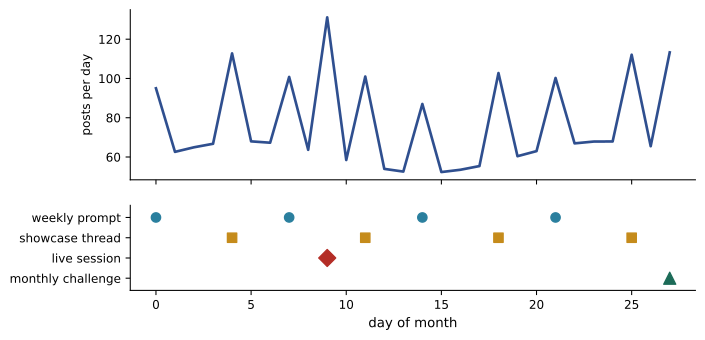
Rituals are recurring activities that give a community rhythm and identity. Examples include weekly threads such as "Show your progress Friday", monthly challenges, live sessions with the creator, seasonal events, annual awards, member spotlights, and in-jokes and celebrations that emerge naturally. Rituals give members a reason to return, lower the barrier to posting by providing prompts, and create shared memories. Consistency matters more than size: a small weekly thread kept for years builds more belonging than a grand event that happens once. Traditions often start spontaneously; noticing and supporting them, rather than imposing everything from the top, makes members feel ownership.
Roles and recognition
As communities grow, members take on roles: welcomers, experts, organizers, artists, moderators, event hosts. Formal roles, shown with labels or colours on many platforms, recognize contributions and make it easier for newcomers to find help. Recognition can be public, such as member spotlights, thank-you posts and awards, or practical, such as early access, input on decisions or invitations to collaborate. Recognition should reward helpful behaviour, not only popularity or spending, so that the culture values contribution. Be careful that status systems do not create cliques that exclude newcomers; rotating spotlights and welcoming roles help.
Encouraging contribution
Healthy communities have many contributors, not just a few. The 90-9-1 pattern from Lesson 1 describes the typical distribution, but design can shift it. Techniques include asking questions that are easy to answer, such as "What are you working on this week?"; offering templates for posts; replying warmly to first posts; creating low-stakes spaces for casual chat; inviting quiet members personally to share their expertise; running collaborative projects; and showing how member contributions shape the creator's work, such as answering community questions in videos. Avoid making participation feel like homework, and accept that many members will mostly read; lurkers often value the community deeply.
From creator-centred to member-centred
Many creator communities begin centred on the creator, with members gathering to hear from and talk to them. This works at first, but it limits scale, because one person cannot respond to everyone, and makes the community fragile, because activity drops whenever the creator is absent. Over time, healthy communities shift so that members help each other, organize events, create content and welcome newcomers. The creator remains an important figure but no longer the only reason members come. Signs of this shift include conversations that continue without the creator, members answering each other's questions, and member-led projects. Encourage it by stepping back deliberately, highlighting member contributions and giving members responsibility.
Growth and subgroups
Growth changes communities. Small communities are intimate: members know each other, and norms are maintained informally. As they grow, newcomers may not share the culture, conversation speeds up, and long-time members may feel the community has lost its character. Strategies for growing well include adding structure gradually, such as topic channels or regional groups, creating smaller subgroups or cohorts where members can know each other, strengthening onboarding to teach norms, and expanding the moderation team before problems arise. Some communities deliberately limit growth or close admissions periodically to preserve quality. There is no single right size; choose one that serves the purpose.
The creator as host
Creators who host communities take on a role similar to a host at a gathering: welcoming people, setting the tone, introducing members to each other and stepping in when someone causes harm. Your behaviour shapes norms more than written guidelines do: if you respond to criticism respectfully, members learn to do the same. Be present consistently but sustainably; announce absences and delegate when needed. Maintain appropriate boundaries with members, especially in paid communities where members may expect personal attention, and with young members, where boundaries are a matter of safety. Hosting a community is rewarding but demanding, and creators should plan for their own well-being (CRE-450).
Founding members and early culture
The first members of a community set its culture. Early members model how to post, how to welcome newcomers and how to disagree; newcomers copy what they see. For this reason, many community builders open first to a small founding group, perhaps 20 to 100 engaged fans, collaborators or patrons, before inviting the public. Founding members can help test channels and guidelines, seed conversations and act as informal welcomers. Recognize their role, for example with a founding-member badge, and involve them in early decisions. Be careful, though, that founders do not become a closed inner circle: invite new voices into visible roles as the community grows.
Listening and adapting the design
Community design is never finished. Watch where conversations naturally happen and where they do not: empty channels confuse newcomers and should be merged or removed, while crowded channels may need splitting. Ask members regularly what they value and what they would change, through short surveys, feedback threads or conversations. Notice the questions newcomers repeatedly ask, and improve onboarding to answer them. When you change structure or guidelines, explain why, invite feedback and give members time to adjust. Communities that feel members have a voice in their design tend to be more committed and more forgiving of mistakes.
Belonging for everyone
Inclusive communities welcome members of different backgrounds, identities, abilities and levels of experience. Design choices affect who feels welcome: guidelines that clearly prohibit discrimination and harassment, moderators who reflect the community's diversity, accessible formats such as captions and screen-reader-friendly posts, events scheduled across time zones, and spaces for beginners as well as experts. Watch for subtle exclusion, such as in-jokes that newcomers cannot follow, a few voices dominating discussions, or dismissive responses to basic questions. Inviting quieter members to share, rotating who leads events, and explicitly valuing different perspectives help everyone feel they belong.
Norms that are taught, not just written
Written guidelines matter, but members learn norms mostly by observing what others do and what happens in response. If rude posts receive attention while thoughtful ones are ignored, members learn that rudeness works. Creators and moderators can teach norms by modelling the behaviour they want, praising good contributions publicly, redirecting off-topic posts kindly, and explaining decisions in terms of the community's purpose. Pinned examples of excellent posts, such as a well-written introduction or a helpful critique, show newcomers what good looks like more effectively than rules alone. Over time, established members take over this teaching, gently guiding newcomers, which is a sign that norms have become part of the culture.
Community size and intimacy
Research on social groups, including the anthropologist Robin Dunbar's work, suggests that people can maintain only a limited number of meaningful relationships, often estimated at around 150. Communities larger than this can still feel close if they are organized into smaller groups, such as channels, cohorts, local chapters or project teams, where members can know each other.
Communities of creators and peers
Some creators host communities not of fans but of peers: other creators, practitioners or professionals in their field who meet to learn from each other. These communities need the same design elements, but members often expect more equal participation, value practical exchange over entertainment and may be more sensitive to self-promotion. Clear rules about sharing work, asking for feedback and promoting services help keep peer communities useful and generous rather than turning them into advertising boards.
Common mistakes
MistakeBuilding a community only around access to the creator.
InsteadGive members a shared purpose and reasons to interact.
MistakeWriting vague guidelines.
InsteadMake guidelines specific, positive and tied to the purpose.
MistakeLeaving newcomers to figure things out alone.
InsteadDesign onboarding with a clear first action.
MistakeLaunching occasional big events only.
InsteadKeep small, consistent rituals.
MistakeRewarding only spending or popularity.
InsteadRecognize helpful contributions.
Summary and key terms
- A specific purpose tells members who belongs and what to do.
- Values become specific guidelines with clear consequences.
- Onboarding with a clear first action raises newcomer retention.
- Consistent rituals give rhythm, prompts and shared memories.
- Roles and recognition should reward contribution.
- Healthy communities shift from creator-centred to member-centred.
- Growth needs structure, subgroups, onboarding and moderation.
- Purpose statement
- Description of who a community is for and what members do.
- Guidelines
- Specific expectations for member behaviour.
- Onboarding
- Welcoming newcomers and guiding a first action.
- Ritual
- Recurring community activity.
- Member spotlight
- Public recognition of a member.
- Contributor ratio
- Share of active members who post.
- Lurker
- Member who reads without posting.
- Member-centred community
- Community sustained by member interactions.
- Subgroup
- Smaller group within a larger community.
- Host
- Person who welcomes members and sets the tone.
Practice problems
Work each problem on paper first, then reveal the answer to check.
Complete the purpose template.
Show answer
A community for [who] to [do what] so that [outcome].
Why should a purpose exclude some people?
Show answer
Specificity helps the right members recognize they belong.
Rewrite "No spam" as a stronger guideline.
Show answer
Share your own projects in the showcase channel once a week.
Name three onboarding elements.
Show answer
Welcome message, first action, responses, guide, gradual access.
Share still active if 40 of 120 early posters remain?
Show answer
About 33 %.
Why are small consistent rituals valuable?
Show answer
They give rhythm, prompts and shared memories.
Contributor ratio for 300 posters among 2,000 active members?
Show answer
15 %.
Name a sign of a member-centred community.
Show answer
Conversations continue without the creator; members help each other.
Name two strategies for growing well.
Show answer
Gradual structure, subgroups, stronger onboarding, more moderators.
Why must creators keep boundaries with members?
Show answer
To manage expectations and protect safety, especially of minors.
Lesson quiz · 5 questions
Score 60% or more to complete this lesson.
Create a free account to save your progress, take quizzes and earn a certificate.