
CRE-301 · Lesson 3 of 12 · 27 min
Growth strategies that last
Advice about growth is everywhere, and much of it is short-lived: posting at a magic hour, using a trending sound, copying a format that worked for someone else last month. Some tactics do produce bursts of reach, but growth that lasts usually comes from a smaller set of durable strategies: a clear promise to a specific audience, consistent quality, content that keeps being found, systems that turn viewers into subscribers, and relationships that bring new people in. This lesson compares durable and fragile growth, explains evergreen and searchable content, consistency and cadence, series and franchises, calls to action that respect the viewer, giveaways and contests and the law that governs them, paid promotion, and the warning signs of growth that is not real.
Durable and fragile growth
Fragile growth depends on conditions you do not control and that change quickly: a single algorithmic boost, a trend, a controversy, a feature that a platform is temporarily promoting. It often brings viewers who came for something other than your core work and leave quickly. Durable growth comes from things that compound: a body of useful or loved work that keeps being discovered, a recognizable identity, a library of searchable content, an email list, and a community that recommends you. A practical test is to ask, for any tactic, whether its effect will still be there in a year. A viral moment can be valuable if you have systems to capture new viewers, such as a pinned invitation, a playlist for newcomers and a newsletter offer, but on its own it rarely changes a channel's trajectory.
| Fragile growth | Durable growth |
|---|---|
| Chasing trends unrelated to your niche | Adapting trends that fit your promise |
| One-off viral hits | Libraries of evergreen and searchable work |
| Controversy and outrage | Trust and reputation |
| Follow-for-follow and engagement pods | Genuine recommendations and collaborations |
| Giveaways with prizes unrelated to your work | Rewards that attract your real audience |
| Single-platform dependence | Discovery on platforms, retention in owned channels |
Evergreen and searchable content
Evergreen content stays relevant for months or years: tutorials, explainers, reviews of enduring products, guides to common problems, and timeless stories. Topical content responds to news and trends and decays quickly. Both have roles. Topical content can bring bursts of attention and show that you are current; evergreen content accumulates views over time and keeps bringing new people to your channel long after publication. Searchable content is designed to match what people look for, using clear titles, descriptions and spoken keywords (CRE-201). A balanced mix, for example a weekly evergreen piece and occasional topical responses, combines immediate and long-term growth.
Worked problem
Comparing evergreen and topical content
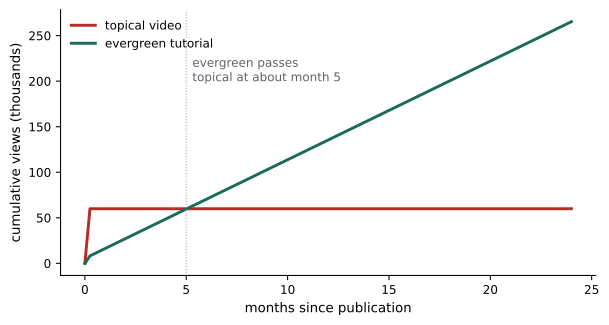
A topical video gets 60,000 views in its first week and almost nothing afterwards. An evergreen tutorial gets 8,000 views in its first week and then about 2,500 views a week steadily from search for two years. Which has more total views after one year and after two years?
Show solution
- Topical video: about 60,000 views in total.
- Evergreen after one year: 8,000 + 51 × 2,500 = 135,500 views.
- Evergreen after two years: 8,000 + 103 × 2,500 = 265,500 views.
Answer: The evergreen tutorial passes the topical video within about five months and reaches roughly 135,500 views after one year and 265,500 after two.
Consistency and cadence
Consistency means delivering on your promise reliably, in quality, theme and timing. It trains your audience to expect new work, helps platforms understand what your content is about, and builds habits in viewers. Cadence is the frequency of publishing. More is not always better: a cadence you cannot sustain leads to declining quality, burnout and gaps that undo the benefits (CRE-350). Choose a cadence based on the time each piece genuinely needs, the expectations of your format and platform, and your life outside creating. Batch production, content calendars and a buffer of finished work protect consistency during illness, travel and busy periods. Communicate changes in schedule honestly; audiences forgive breaks far more readily than silence.
Series and franchises
Series, recurring formats with a consistent structure and name (CRE-210), are among the strongest growth tools. They give viewers a reason to watch the next episode, make it easier to recommend you ("watch the series where she rebuilds old bikes"), let platforms group your work, and reduce the creative effort of each new idea. Franchises are series that become identities in their own right, with recognizable titles, thumbnails, catchphrases and community traditions. Successful series often begin as experiments: publish a few episodes, look at retention and returning viewers (CRE-202), and invest in the ones that stick.
Calls to action that respect the viewer
A call to action (CTA) invites viewers to take the next step: subscribe, join the newsletter, comment, share or join the community. Effective CTAs are specific, timely and give a reason: "If you want the free checklist from this video, it's in the newsletter, link in the description" works better than a generic "smash that subscribe button". Place CTAs where they make sense, such as after delivering value rather than before it, and limit their number so they do not crowd out the content. Asking for one action per piece, matched to where the viewer is on the engagement ladder (Lesson 1), respects the audience and performs better than a list of demands.
Giveaways, contests and the law
Giveaways and contests can bring a burst of new followers, but they carry two risks. First, prizes that are not related to your work attract people who want free things rather than your content, inflating numbers without real growth. Rewards closely tied to your niche, such as a signed print for a photography channel or a tool you review, attract the right people. Second, contests are regulated, and the rules differ by country, province and state. Platforms also have their own promotion rules, for example requiring that the platform not be presented as a sponsor and that entrants agree to release it from liability.
In Canada, the Criminal Code prohibits lotteries and games of pure chance in which participants pay to enter, which is why Canadian contests typically offer a no-purchase-necessary method of entry and require winners to correctly answer a mathematical skill-testing question before receiving a prize. Under section 74.06 of the Competition Act, contest promotions must adequately and fairly disclose the number and approximate value of prizes, the regional allocation of prizes, any facts that materially affect the chances of winning, such as the odds, and must not unduly delay distribution of prizes. Quebec has additional rules for contests open to its residents, administered by the Régie des alcools, des courses et des jeux, which have included registration and duty requirements for larger prizes and French-language requirements; check the current rules before running a contest open to Quebec residents. Official rules should be written clearly and available to all entrants.
Because contest law is complex and changes, creators running significant promotions, particularly those open to several provinces or states or involving brand sponsors, should use well-drafted official rules and seek professional advice. CRE-320 covers creator law in more depth.
Paid promotion
Platforms let creators pay to promote posts, videos and pages, and newsletters can buy placements in other newsletters. Paid promotion can make sense to test a new format with a larger sample, to promote a product or event with a clear return, or to reach a precise audience. It rarely makes sense simply to buy follower numbers, because paid followers are often less engaged and can lower the engagement rates that platforms use for recommendation. Measure paid promotion by the outcomes you care about, such as cost per email subscriber or cost per paying member, and compare these with the value each new supporter brings (Lesson 7). Never buy fake followers, likes or views, which violate platform rules, mislead brand partners and can lead to penalties.
Worked problem
Is paid promotion worth it?
A creator spends $300 promoting a newsletter sign-up page and gains 240 subscribers. From past data, about 3 % of subscribers eventually buy a $60 course. Ignoring other benefits, does the promotion pay for itself?
Show solution
- Cost per subscriber: $300 / 240 = $1.25.
- Expected buyers: 240 × 0.03 = 7.2.
- Expected revenue: 7.2 × $60 = $432.
- Return: $432 − $300 = $132, before platform and payment fees.
Answer: Yes, modestly: about $432 in expected revenue for $300 spent, so the promotion roughly pays for itself, with subscriber value beyond the course as a bonus.
Growth that is not real
Some apparent growth is illusory or harmful. Bought followers and engagement, engagement pods where groups agree to like each other's posts, follow-for-follow schemes, misleading clickbait and sensational controversy can raise numbers while damaging trust, reach and brand relationships. Platforms detect and suppress inauthentic behaviour, brand partners increasingly audit audiences for fake followers, and audiences notice when a creator chases attention at the expense of honesty. Real growth shows up in metrics that are hard to fake: returning viewers, watch time, saves and shares, newsletter engagement, member retention and comments that reflect genuine interest.
Building a content library that grows
Durable growth often comes from treating your body of work as a library rather than a stream. A library is organized so that newcomers can find what they need, every piece leads to related pieces, and older work keeps being discovered. Practical steps include grouping work into playlists, series and topic hubs; updating titles, thumbnails and descriptions of older pieces that still have value; adding end screens, pinned comments and links that guide viewers from one piece to the next; and refreshing popular evergreen pieces with updated versions when information changes. A creator who publishes 100 pieces and organizes them well may grow faster than one who publishes 300 pieces that each stand alone. Reviewing your library every few months, to see which older pieces still attract views and sign-ups, also reveals which topics deserve new work.
Consistency without burnout
Consistency matters for durable growth because audiences form habits around reliable schedules and platforms reward channels that publish regularly. But consistency does not require daily posting. A sustainable schedule is one you can keep for years, which might be one substantial piece every week or two, supported by smaller posts. Batching production, keeping a backlog of finished pieces for weeks when life intervenes, and planning seasonal breaks in advance help maintain consistency. Announcing breaks openly, rather than disappearing, keeps trust intact. Creators who push unsustainable schedules often burn out and stop entirely, which is far worse for growth than a slower, steady rhythm.
Growth experiments
Durable strategies still benefit from experimentation. Treat new formats, titles, posting times and calls to action as experiments: change one thing at a time, decide in advance what result would count as success, give the experiment enough time and volume to see a real effect, and record what you learn. Platform tools such as thumbnail and title testing make some experiments easy. Keep a simple experiment log with the date, the change, the expected result and the actual result. Over a year, a log of dozens of small experiments becomes a valuable guide to what your particular audience responds to, which no general advice can provide.
Growth that respects the audience
Some growth tactics trade long-term trust for short-term numbers: misleading thumbnails, fake giveaways, engagement bait such as "comment yes to win", follow-for-follow schemes and purchased followers or views. Platforms penalize many of these practices, and audiences notice. Bought followers inflate numbers while lowering engagement rates, which can reduce reach and mislead brand partners, and buying fake engagement may breach platform terms and consumer protection rules. Durable growth comes from earning attention honestly and keeping the promises your titles and thumbnails make.
Honest growth also protects your relationships with brands, collaborators and platforms. Partners increasingly check engagement quality, audience location and growth patterns, and sudden unexplained spikes or very low engagement rates raise questions. A smaller, genuine audience is worth more than a larger, artificial one.
Common mistakes
MistakeChasing every trend.
InsteadAdapt trends that fit your promise and audience.
MistakePublishing only topical content.
InsteadBuild a library of evergreen, searchable work.
MistakeA cadence you cannot sustain.
InsteadChoose a sustainable schedule and keep a buffer.
MistakeRunning contests without official rules.
InsteadFollow contest law and platform rules.
MistakeBuying followers or joining engagement pods.
InsteadGrow through genuine value and recommendations.
Summary and key terms
- Durable growth compounds; fragile growth fades quickly.
- Evergreen and searchable content keeps bringing new viewers.
- Consistency and a sustainable cadence build habits and trust.
- Series and franchises give viewers reasons to return and recommend.
- CTAs work best when specific, timely and limited.
- Contests are regulated differently in Canada and the US.
- Measure paid promotion by outcomes; avoid fake growth entirely.
- Durable growth
- Growth whose effects compound and persist.
- Evergreen content
- Work that stays relevant for a long time.
- Topical content
- Work tied to current events or trends.
- Cadence
- Frequency of publishing.
- Series
- Recurring format with consistent structure and name.
- Call to action
- Invitation to take a specific next step.
- Skill-testing question
- Question winners answer in Canadian contests.
- Sweepstakes
- Prize promotion with chance and a free entry method.
- Engagement pod
- Group that artificially boosts each other's posts.
- Inauthentic behaviour
- Fake or coordinated activity to inflate metrics.
Practice problems
Work each problem on paper first, then reveal the answer to check.
What test separates durable from fragile tactics?
Show answer
Whether the effect will still be there in a year.
Evergreen views after 26 weeks: 5,000 first week then 1,000 a week?
Show answer
30,000.
Why is a buffer of finished work useful?
Show answer
It protects consistency during busy periods.
Why do series help growth?
Show answer
They give reasons to return and make recommendation easier.
Where should a CTA usually go?
Show answer
After delivering value, one per piece.
Why should prizes relate to your niche?
Show answer
To attract your real audience.
What elements make a promotion an illegal lottery?
Show answer
Prize, chance and consideration without a free entry route.
Cost per subscriber for $450 spent and 300 sign-ups?
Show answer
$1.50.
Why avoid bought followers?
Show answer
They violate rules, mislead brands and hurt engagement.
Name two hard-to-fake growth metrics.
Show answer
Returning viewers, watch time, saves, retention, newsletter engagement.
Lesson quiz · 5 questions
Score 60% or more to complete this lesson.
Create a free account to save your progress, take quizzes and earn a certificate.