
CRE-250 · Lesson 2 of 12 · 27 min
Formats and show design for live
A stream that is just "going live and seeing what happens" can work for an established personality, but most successful streams are designed. Show design means choosing a format, structuring a stream into segments with a rhythm, building recurring features that regulars look forward to, planning schedules and lengths, and giving each stream a clear promise. Good design does not mean rigid scripting: live shows need room for spontaneity and audience input. It means a reliable framework within which spontaneity can happen. This lesson covers live formats, the stream promise, segment structure, openings and endings, recurring features and rituals, schedules and stream length, designing for different categories, and planning documents such as run sheets.
Live formats
Common live formats include:
- Solo play or work streams: the streamer plays a game, makes art, codes or cooks while talking to chat. The activity provides structure and something to watch; the personality provides the reason to stay.
- Just chatting and talk shows: conversation is the content, often with reactions, news, guests or topics submitted by viewers.
- Interview and panel shows: guests join remotely or in person, with a host guiding discussion (CRE-220).
- Tutorials and workshops: teaching a skill live, with questions answered in real time.
- Co-working, study and ambient streams: quiet streams where viewers work alongside, often with timers and lo-fi music.
- Events: launches, tournaments, award shows, charity marathons and premieres, with higher production and planning.
- Challenge and subathon streams: goals, timers extended by subscriptions or donations, and escalating challenges.
- Live shopping: demonstrating and selling products with links and limited-time offers.
- Performance: music, comedy, DJ sets and live art.
Many streamers mix formats across a week, for example two gaming days, one talk show and one community game night.
The stream promise
Every stream should have a promise: a clear answer to "why should I watch this stream now?" The promise appears in the stream title, the category, the thumbnail or preview, and the first minutes of the stream. Examples include "First playthrough of a new game, no spoilers", "Building a desk from scratch in one stream", "Q&A with a guest who left a tech job to farm", or "100 subs = I eat the hottest sauce". A strong promise is specific, honest and repeatable as a format. Vague titles such as "Stream" or "Chilling" give potential viewers no reason to click, especially in a directory full of alternatives. Titles can also change during a stream as the activity changes, which helps viewers who arrive later understand what is happening.
| Weak title | Stronger title | Why it is stronger |
|---|---|---|
| Gaming | Blind run of the new survival game: can we last 10 nights? | Specific game, stakes, curiosity |
| Chatting with chat | Reacting to your worst kitchen renovation photos | Clear activity and participation |
| Art stream | Painting a commission live, start to finish | Defined goal and payoff |
| Q&A | Ask a pharmacist anything (no personal medical advice) | Expertise and honest boundaries |
Segment structure
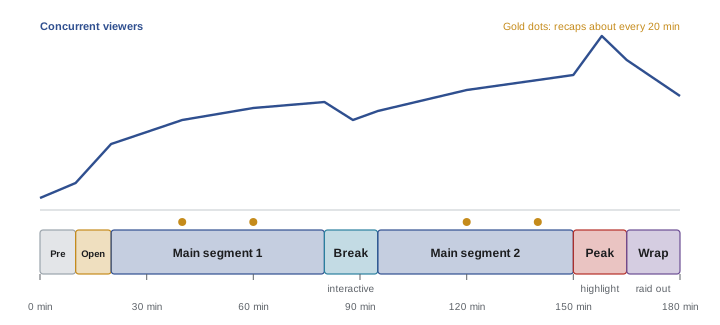
Long streams hold attention through segments: distinct parts with their own focus, each lasting perhaps 15 to 60 minutes. A typical structure for a three-hour stream might be:
- Pre-show (5–10 minutes): a starting-soon screen with music and chat open, letting viewers arrive and notifications spread.
- Opening (5–10 minutes): greeting, the promise for today, schedule reminders and quick news.
- Main segment 1 (45–60 minutes): the core activity.
- Break or interactive segment (10–15 minutes): chat questions, polls, community game or recap.
- Main segment 2 (45–60 minutes): continuing or a new activity.
- Highlight or climax: the boss fight, the reveal, the challenge, the guest.
- Wrap-up (5–10 minutes): thanks, recap, next stream, and a raid to another channel (Lesson 8).
Viewers come and go throughout, so each segment should be understandable to newcomers, with frequent short recaps: "We are trying to finish this painting before the end of the stream; chat chose the colours earlier."
Openings and endings
The first minutes matter for two audiences: regulars arriving from notifications, and newcomers deciding whether to stay. Effective openings greet chat warmly, state the promise and plan, start the activity quickly, and avoid long technical fiddling on air. Starting-soon screens let viewers gather but should not run too long; five to ten minutes is common. Endings should be deliberate rather than abrupt: thank viewers and supporters, recap what happened, tell viewers when the next stream is and what it will be, and send the audience to another streamer with a raid or host. A consistent ending ritual builds community and reduces the drop in viewers when a stream ends without warning.
Recurring features and rituals
Recurring features give regulars something to anticipate and newcomers a sense of a community with its own culture. Examples include a weekly segment ("Fan Art Friday", "Tech news Tuesday"), a regular opening phrase or greeting, chat games and predictions, channel point redemptions that trigger on-stream effects, a running joke or mascot, viewer games where chat plays with the streamer, and milestone celebrations. Rituals should feel natural to the streamer and inclusive to viewers; in-jokes that exclude newcomers can make a chat feel closed. Periodically explaining rituals to new viewers keeps them welcoming.
Schedules
A published schedule lets viewers plan to attend and builds habits. Consistency matters more than volume: three reliable streams a week at the same times generally build an audience better than irregular daily streams. Choose times when your target audience is available, considering time zones: a streamer in Vancouver targeting viewers in eastern Canada and the United States might stream earlier in the evening than one in Toronto. Platform analytics show when viewers are online (Lesson 11). Publish the schedule on the channel, social profiles and community spaces, announce changes in advance, and use platform schedule features where available. Building in rest days and holidays from the start avoids burnout (Lesson 11).
Worked problem
Choosing a stream time across time zones
A streamer in Halifax (Atlantic time) wants to reach viewers across Canada and the United States, with most viewers in Eastern time and a significant group in Pacific time. When could a three-hour evening stream start?
Show solution
- Atlantic time is 1 hour ahead of Eastern time and 4 hours ahead of Pacific time.
- A start at 9 p.m. Atlantic is 8 p.m. Eastern and 5 p.m. Pacific.
- Ending at midnight Atlantic is 11 p.m. Eastern and 8 p.m. Pacific.
- This covers Eastern prime time and Pacific early evening, though it ends late for the streamer.
Answer: Starting around 9 p.m. Atlantic (8 p.m. Eastern, 5 p.m. Pacific) balances both audiences; check analytics and adjust.
Stream length
How long should a stream be? Longer streams give more opportunities to be discovered in directories and more time for viewers in different time zones to drop in, and some audiences prefer long sessions. But long streams are exhausting, harder to keep interesting, and may not suit every format. Talk shows and tutorials often work at 60 to 120 minutes; gaming and creative streams commonly run three to six hours; events and marathons run longer with planning and breaks. Start with a length you can sustain with energy, and adjust based on audience retention and your wellbeing. Quality and consistency outweigh sheer hours.
Designing for categories
Different categories reward different design choices:
- Gaming: choose games for both enjoyment and discoverability; new releases attract viewers but crowded categories make small channels hard to find; niche games may offer better visibility.
- Just chatting: conversation needs topics, prompts and visual interest, such as reaction content, a well-designed set or a co-host.
- Creative: show the work clearly with good camera angles and lighting, explain the process, and celebrate finished pieces.
- Education: plan learning objectives, visuals and examples, leave time for questions, and provide resources afterward.
- IRL: plan routes, safety and permissions (Lesson 12) and have backup connectivity.
Run sheets and planning documents
A run sheet is a simple plan for a stream: the promise, segments with rough timings, key talking points, guests and their arrival times, scenes and assets needed, sponsor reads or required disclosures, and notes for moderators. For regular streams, a template run sheet takes a few minutes to fill out and greatly improves flow. For events, run sheets become detailed cue sheets coordinating several people. Share the run sheet with moderators and co-hosts so everyone knows what is coming. After the stream, note what worked and what did not, and adjust the next plan.
Planning for different audience sizes
Formats that work for a large audience do not always work for a small one. A streamer with five viewers can hold a conversation with every person in chat, while a streamer with five thousand viewers needs structured segments, moderators and participation tools to keep chat useful. Designing formats for the audience you have now, rather than the audience you hope to have, produces better streams. As a channel grows, segments can shift from conversation to polls, from individual questions to curated question segments, and from viewer games with everyone to random draws.
| Audience size | Format choices that work | Things to avoid |
|---|---|---|
| Under 10 viewers | Conversation, narration, personal greetings | Long silent stretches, complex polls |
| 10 to 100 viewers | Regular segments, small viewer games, recurring features | Ignoring regulars or newcomers |
| 100 to 1,000 viewers | Structured segments, moderated questions, events | Reading every message |
| Over 1,000 viewers | Show-like production, producers, scheduled interaction | Unmoderated participation |
Seasons, series and themed weeks
Some streamers organize their content into seasons or series, such as a twelve-week playthrough, a monthly art challenge or a themed week of cooking streams. Series give viewers a reason to return, make promotion easier, give natural break points for rest and allow formats to be tried and retired without disappointing anyone. A season might end with a special event or a finale, followed by a planned week off before the next season begins.
Planning segment timing
A run of show allocates time to segments, but live shows rarely run exactly to plan. Build in buffers and decide in advance which segments can be shortened or dropped. A simple method is to plan for about 85 % of the stream length and leave the rest as flexible time for chat, technical problems and moments that are going well.
Worked problem
Allocating a two-hour talk stream
A streamer plans a two-hour talk stream with a news segment, a viewer question segment, a guest interview and a closing game. How could the time be allocated with a buffer?
Show solution
- Planned time: 0.85 x 120 minutes = about 102 minutes; buffer about 18 minutes.
- Opening and hook: 8 minutes.
- News segment: 20 minutes.
- Viewer questions: 20 minutes.
- Guest interview: 30 minutes.
- Closing game and raid: 24 minutes.
- Drop or shorten the closing game first if the interview runs long.
Answer: About 102 planned minutes across five segments, an 18-minute buffer, and a clear decision about which segment flexes.
Experimenting with formats
Formats should evolve. Try one change at a time, such as a new segment, a different start time or a different opening, and run it for several streams before judging it, since single streams vary for many reasons. Ask the community for feedback, check average watch time and returning viewers (Lesson 11), and be willing to retire formats that no longer work. Long-running streamers often say their best formats came from experiments that started as one-off ideas.
Formats and accessibility
Format choices also affect who can follow a stream. Recaps after breaks help viewers who arrive late, written segment titles on screen help viewers who are watching with the sound off, and predictable structures help neurodivergent viewers and viewers watching in a second language. Announcing intense moments such as jump scares or flashing effects in advance, and offering content notes in the title for difficult subjects, lets viewers decide whether to watch.
Titles and stream information
The title, category and tags are part of the format, because they are what potential viewers see in directories and notifications before deciding to click. A good title says what is happening in this stream specifically, such as "First time in the final dungeon, blind run" or "Painting a winter cabin, Q and A at 8", rather than a generic "Live now". Update the title when the stream changes segments, and keep it honest: misleading titles bring clicks but lose viewers and trust quickly, and some platforms treat them as spam.
Common mistakes
MistakeVague titles such as "Stream".
InsteadWrite a specific, honest promise.
MistakeOne unbroken activity for six hours.
InsteadPlan segments, breaks and highlights.
MistakeEnding abruptly.
InsteadThank, recap, announce next stream and raid.
MistakeIrregular streaming times.
InsteadPublish and keep a consistent schedule.
MistakeIn-jokes that exclude newcomers.
InsteadExplain rituals and keep the community welcoming.
Summary and key terms
- Formats range from solo play to talk shows, workshops, events and live shopping.
- Each stream needs a specific, honest promise in its title and opening.
- Segments, recaps and planned highlights hold attention.
- Openings start quickly; endings thank, recap, announce and raid.
- Recurring features and rituals build community.
- Consistent schedules matter more than volume.
- Run sheets organize streams and coordinate helpers.
- Stream promise
- The reason a viewer should watch now.
- Segment
- A distinct part of a stream with its own focus.
- Starting-soon screen
- Holding screen before a stream begins.
- Recap
- Brief summary for viewers who just arrived.
- Subathon
- Stream extended by subscriptions or donations.
- Channel points
- Platform rewards viewers earn and redeem.
- Run sheet
- Plan of a stream's segments and cues.
- Ritual
- Recurring moment that builds community.
- Category
- Platform grouping such as a game or just chatting.
- Co-working stream
- Stream where viewers work alongside the host.
Practice problems
Work each problem on paper first, then reveal the answer to check.
Name four live formats.
Show answer
Solo play, talk show, interview, tutorial, co-working, events, subathons, shopping, performance.
What is a stream promise?
Show answer
The specific reason to watch this stream now.
Improve the title "Art stream".
Show answer
For example: Painting a commission live, start to finish.
Why recap frequently?
Show answer
Viewers arrive throughout the stream.
What should an ending include?
Show answer
Thanks, recap, next stream, raid.
Give two examples of recurring features.
Show answer
Weekly segment, greeting, chat games, channel point redemptions.
Why is consistency more important than volume?
Show answer
It builds viewing habits.
9 p.m. Atlantic is what time in Pacific?
Show answer
5 p.m.
Typical length for a tutorial stream?
Show answer
About 60–120 minutes.
What goes on a run sheet?
Show answer
Promise, segments, timings, guests, scenes, sponsor reads, moderator notes.
Lesson quiz · 5 questions
Score 60% or more to complete this lesson.
Create a free account to save your progress, take quizzes and earn a certificate.