
CRE-250 · Lesson 11 of 12 · 27 min
Growth, repurposing, analytics and wellbeing
Streaming can become a hobby, a side business or a career, and at every level it rewards planning: knowing what is working, turning live content into recorded content that brings new viewers, building a sustainable schedule, and protecting physical and mental health over years rather than months. Burnout is common among streamers because the format invites long hours, constant availability and comparison with others. This lesson covers growth strategies, repurposing streams into clips and videos, live analytics, setting goals, building a team, the economics of time, physical health, mental health and boundaries, and planning breaks and longevity.
Growth strategies
Growth on live platforms comes from a combination of strategies:
- Discovery outside the stream: short-form clips on TikTok, Reels and Shorts, highlights and long-form edits on YouTube, posts in relevant communities, and collaborations (Lesson 8) bring new viewers.
- Category choices: streaming games or topics where you can be found, rather than only the most crowded categories.
- Consistency: a reliable schedule and recognizable format (Lesson 2).
- Retention: giving viewers reasons to stay longer and return, through community, segments and recurring features.
- Conversion: turning viewers into followers, followers into regulars, and regulars into supporters, with gentle calls to action rather than constant requests.
- Networking: raids, co-streams and friendships with peers.
Avoid tactics that platforms prohibit or that damage trust, such as viewbots, follow-for-follow schemes, misleading titles or spam in other channels. Viewbotting, inflating viewer counts with fake viewers, violates platform rules and can lead to bans.
Repurposing streams
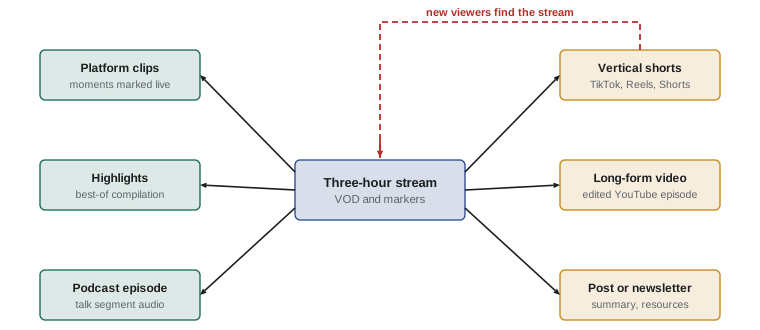
A single stream can produce many pieces of content:
- Clips: short moments captured by the streamer, moderators or viewers, shared on the platform and social media.
- Vertical shorts: the best moments reframed for TikTok, Reels and Shorts, with captions and a hook (CRE-210).
- Highlights and compilations: edited collections of the best moments.
- Long-form videos: edited versions of the stream, such as a full playthrough condensed into episodes or a talk show segment as a standalone video (CRE-211).
- Podcasts: audio from talk-format streams (CRE-240).
- Posts and newsletters: written summaries, recipes, tutorials or resources from the stream.
Editors, clip tools and AI-assisted clipping services can find highlights, but human judgement about what is genuinely interesting and appropriate remains important. Repurposed content must also respect music licensing and the rights of guests and viewers who appear on stream.
Live analytics
Platform analytics show how streams perform. Useful metrics include average and peak concurrent viewers; hours watched; unique viewers; new followers per stream; chatters and chat messages; average watch time; returning versus new viewers; where viewers come from (directory, recommendations, raids, external links, notifications); and income metrics. Look at trends over weeks rather than single streams, and compare similar streams: the same game on different days, or different segment structures. Retention graphs, where available, show when viewers leave, for example during long breaks or certain segments. Analytics answer questions such as which times and days bring most viewers, which categories bring new viewers, and whether a new format retains people. CRE-202 covers analytics methods in depth.
| Question | Metric to check | Possible action |
|---|---|---|
| Are new people finding me? | New viewers, traffic sources | More clips and shorts, different categories |
| Do people stay? | Average watch time, retention | Stronger openings, segments, recaps |
| Do people come back? | Returning viewers, follows | Consistent schedule, community features |
| Which streams work best? | Average viewers by stream type | Do more of what works |
| Is income sustainable? | Revenue per hour, sources | Diversify, reduce costs |
Setting goals
Goals keep a channel focused. Useful goals are specific and within the streamer's control: stream three times a week for three months, post two clips after every stream, collaborate once a month, improve average watch time by 10 %. Outcome goals such as reaching affiliate or partner status, a number of followers or a level of income are motivating but depend partly on luck and platform changes, so pair them with process goals. Review goals monthly and adjust.
Worked problem
Planning toward a partner threshold
A streamer averages 30 concurrent viewers and wants to reach a platform's partner requirement of 75 average viewers over 30 days. If average viewers grow by about 8 % per month through clips and collaborations, roughly how many months will it take?
Show solution
- Growth model: \(V_n = 30 \times 1.08^n\).
- Solve \(30 \times 1.08^n \ge 75\): \(1.08^n \ge 2.5\).
- \(n \ge \ln 2.5 / \ln 1.08 \approx 0.916 / 0.077 \approx 11.9\).
- About 12 months, if growth is steady, which is rarely the case in practice.
Answer: Roughly a year at 8 % monthly growth, which shows why patient process goals matter more than deadlines.
Building a team
As channels grow, streamers often add help: moderators (Lesson 9), video editors for clips and VODs, thumbnail and graphic designers, a manager or agent for sponsorships, a producer for events, and community managers for Discord and social media. Start with the tasks that take the most time or cause the most stress. Pay fairly, agree terms in writing, give clear guidelines and respect boundaries. Many creators work with freelancers before hiring employees. CRE-401 covers building creator teams.
The economics of time
Streaming hours are only part of the work. Preparation, setup, promotion, editing, community management, sponsor communication and administration can double the time spent. Calculating effective hourly income, total income divided by all hours worked, gives a realistic picture: a streamer earning $1,000 a month for 80 hours of streaming and 80 hours of other work earns about $6.25 per hour before expenses and taxes. This does not mean streaming is not worthwhile, since many people stream for enjoyment, community and creative satisfaction, but it helps make informed decisions about time, quitting other work and investing in equipment.
Physical health
Long hours of sitting, screen time, talking and irregular schedules affect health. Practical habits include an ergonomic setup with a supportive chair, desk and monitor at eye level; standing or moving during breaks; regular breaks every hour or so to stretch, rest eyes (for example looking at something distant for 20 seconds every 20 minutes) and drink water; voice care through hydration, warm-ups and not shouting for hours (CRE-220); sensible meals rather than snacking on stream; and protecting sleep by avoiding very late streams every night where possible. Marathon and subathon streams can be particularly risky; plan rest and limit their length and frequency.
Mental health and boundaries
Streamers report pressures such as constant comparison with others, fear of losing viewers when taking breaks, harassment, the emotional labour of always being "on", isolation and blurred boundaries between work and home. Healthy practices include setting fixed streaming hours and days off; not checking analytics or social media constantly; having a life and relationships outside streaming; separating streaming space and personal space where possible; using moderators so you do not have to read every negative comment; talking with other streamers who understand the work; and seeking professional support when needed. A persona or "stream self" can help some people keep boundaries, but it should not require pretending to feel well when you are not. Viewers generally respect honest communication about breaks.
Planning breaks and longevity
Many long-running streamers schedule regular breaks: a week or two off several times a year, announced in advance, with clips or recorded content continuing in the meantime. Communities usually survive breaks better than streamers fear, especially when moderators keep community spaces active. Planning for longevity also means building income streams and skills that do not depend entirely on being live, such as recorded content, products and business skills, and recognizing that interests and life circumstances change. Some streamers move on to other careers, using the skills they developed in communication, production, community management and business.
Turning a stream into clips efficiently
Repurposing works best with a routine. During the stream, mark moments with a hotkey or stream marker, and ask moderators to create clips of highlights. After the stream, review the markers rather than the whole VOD, select the best few moments, and edit them into shorts and highlights while the stream is fresh. Many streamers batch editing once or twice a week. Keeping a simple log of which clips perform best on which platform helps choose future moments.
Worked problem
Estimating repurposing time
A streamer streams 4 times a week for 3 hours. They want 3 shorts per stream and one weekly highlight video. If each short takes 20 minutes and the highlight takes 2 hours, how much editing time is needed per week, and what is the total weekly workload including streaming?
Show solution
- Shorts: 4 x 3 = 12 shorts x 20 minutes = 240 minutes = 4 hours.
- Highlight: 2 hours.
- Editing total: 6 hours per week.
- Streaming: 4 x 3 = 12 hours.
- Total: 18 hours, before preparation and community work.
Answer: About 6 hours of editing a week, bringing the total to about 18 hours before preparation, which may justify hiring an editor as the channel grows.
Choosing what to measure
Analytics dashboards show dozens of numbers, and checking all of them can become stressful. Choose a few key metrics tied to current goals and review them on a schedule, for example weekly. A streamer focused on discovery might track new viewers and clip views; one focused on community might track returning viewers and chatters; one focused on income might track revenue per hour.
| Goal | Key metric | Review frequency |
|---|---|---|
| Discovery | New unique viewers, clip and short views | Weekly |
| Retention | Average watch time | Weekly |
| Community | Returning viewers, chatters | Monthly |
| Income | Revenue per hour, income mix | Monthly |
| Wellbeing | Hours worked, days off taken | Weekly |
Comparison and realistic expectations
Streaming success is distributed very unevenly: a small number of channels attract a large share of viewers, while most streams have few viewers. This is a feature of the platforms rather than a judgement of the streamer. Comparing your channel with the largest streamers, or with peers who had a lucky viral moment, is discouraging and rarely useful. Compare your channel with its own past instead, and celebrate improvements in skill, consistency and community.
Planning a sustainable week
A sustainable schedule includes streaming, preparation, editing, community time, admin and rest. Writing a weekly plan with all of these, rather than only stream times, shows whether the workload is realistic. Many part-time streamers find that three or four streams a week, with one or two days completely off, is sustainable alongside work or study.
| Day | Activity | Hours |
|---|---|---|
| Monday | Stream and clip markers | 3.5 |
| Tuesday | Editing shorts, admin | 2 |
| Wednesday | Stream | 3.5 |
| Thursday | Day off | 0 |
| Friday | Collaboration stream | 3.5 |
| Saturday | Highlight edit, community time | 3 |
| Sunday | Day off | 0 |
Knowing when to change direction
Sometimes a channel stops being enjoyable or stops growing despite steady work. Signs that change may be needed include dreading streams, persistent exhaustion, declining interest in the content or a format that no longer fits. Options include changing format or category, reducing the schedule, taking a longer break, or moving toward recorded content. Changing direction is a normal part of a creative career rather than a failure.
Delegating and saying no
As opportunities grow, so do requests for time: collaborations, interviews, events, sponsor calls and community requests. Not every opportunity is worth taking. A simple filter is to ask whether an opportunity fits the channel direction, whether it is fairly paid or genuinely valuable, and whether there is time to do it well without giving up rest. Delegating tasks to editors, moderators or a manager frees time for the work only the streamer can do: being live, creating and making decisions. Delegation needs clear instructions, examples of what good work looks like and regular feedback, and it works best when the people helping are trusted and fairly paid.
Community and peer support
Streaming can feel isolating, especially for streamers who work alone at home. Peer groups of streamers, online and in person, offer advice, collaboration and understanding of the specific pressures of the work. Many cities have creator meetups, and conventions and online communities connect streamers across categories. Sharing honestly with peers about numbers, workload and stress reduces the sense that everyone else is succeeding effortlessly.
Longevity is also helped by learning outside the stream. Courses, workshops and practice in editing, design, writing, business and public speaking make streaming more effective and open doors to related work such as production, community management, teaching and marketing. These transferable skills protect a creator against changes in platforms and audiences that no single channel can control.
Common mistakes
MistakeUsing viewbots or follow-for-follow schemes.
InsteadGrow through clips, collaboration and consistency.
MistakeNever repurposing streams.
InsteadTurn streams into clips, shorts and videos.
MistakeJudging success by single streams.
InsteadLook at trends over weeks.
MistakeCounting only streaming hours.
InsteadInclude all work hours in hourly income.
MistakeStreaming every day with no breaks.
InsteadSchedule rest days and planned breaks.
Summary and key terms
- Grow through discovery, consistency, retention, conversion and networking.
- Repurpose streams into clips, shorts, videos, podcasts and posts.
- Use analytics trends to make decisions.
- Pair outcome goals with process goals you control.
- Build a team gradually, starting with the biggest burdens.
- Calculate effective hourly income across all work.
- Protect physical and mental health and plan breaks for longevity.
- Viewbotting
- Inflating viewer counts with fake viewers.
- Clip
- Short captured moment from a stream.
- Repurposing
- Turning content into other formats.
- Hours watched
- Total viewing time across viewers.
- Average concurrent viewers
- Mean number watching at once.
- Process goal
- Goal about actions within your control.
- Outcome goal
- Goal about results such as followers.
- Effective hourly income
- Income divided by all hours worked.
- Burnout
- Exhaustion from prolonged stress.
- Subathon
- Stream extended by support, often very long.
Practice problems
Work each problem on paper first, then reveal the answer to check.
Name three growth strategies.
Show answer
Clips, categories, consistency, retention, conversion, networking.
What is viewbotting?
Show answer
Inflating viewer counts with fake viewers.
Name four repurposing outputs.
Show answer
Clips, shorts, highlights, long-form, podcasts, posts.
Which metric shows whether people come back?
Show answer
Returning viewers.
Why pair outcome and process goals?
Show answer
Outcomes depend partly on luck; processes are controllable.
Months to grow from 40 to 80 viewers at 10 % per month?
Show answer
About 7.3 months.
Effective hourly income for $1,200 over 150 hours?
Show answer
$8.
What is the 20-20-20 habit?
Show answer
Every 20 minutes, look 20 feet (about 6 m) away for 20 seconds.
Name two mental health practices.
Show answer
Fixed hours, days off, limited analytics checking, support networks.
How can a community survive breaks?
Show answer
Announce in advance, keep clips and community spaces active.
Lesson quiz · 5 questions
Score 60% or more to complete this lesson.
Create a free account to save your progress, take quizzes and earn a certificate.