
CRE-210 · Lesson 9 of 12 · 25 min
Trends, remixing and collaboration features
Short-form platforms are built for remixing. Videos respond to other videos, sounds spread across thousands of creators, formats evolve as each person adds a twist, and memes travel from platform to platform within days. Participating in trends can introduce a creator to new audiences and make content feel current, while remix features such as duets, stitches, green screen and replies let creators build on each other's work. But trends move fast, can dilute a creator's identity, and raise questions of credit, copyright and taste. This lesson covers how trends form and spread, types of trends, spotting trends early, adapting trends to your niche, remix and collaboration features, crediting and copyright, collaborations with other creators, and when to skip a trend.
How trends form and spread
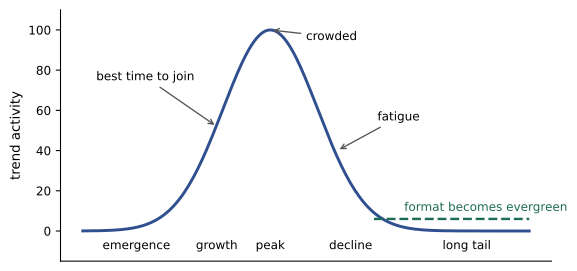
A trend begins when a piece of content, a sound, a format, a joke, a challenge or a visual style, is copied and adapted by others. Early adopters, often creators in a particular community, see the original and add their own versions; recommendation systems notice that many videos with the same sound or format are engaging well and show them to more people; and as more creators join, the trend spreads to new communities, often changing as it goes. Most trends follow a curve: slow emergence, rapid growth, a peak, and a decline as audiences tire of it. The life cycle can be as short as a few days or last several months. Some trends become lasting formats that remain useful long after the original moment, such as "get ready with me" videos or "day in the life" formats.
Types of trends
Trends take several forms, and recognizing the type helps you decide how to participate:
- Sound trends: a song, audio clip or voice recording used across many videos, often with a typical action or punchline.
- Format trends: a structure or template, such as "things I wish I knew before...", "rating... out of 10", or a particular sketch setup, that creators fill with their own content.
- Visual or editing trends: a transition, effect, filter, camera movement or editing style.
- Challenge trends: an activity people attempt and film, ranging from dances to cooking or fitness challenges.
- Meme and topical trends: jokes, phrases or reactions tied to news, entertainment or internet culture.
- Aesthetic trends: visual styles, colour palettes and moods that shape many creators' content.
- Hashtag and campaign trends: trends promoted by platforms or brands around a hashtag.
Spotting trends early
The most effective time to join a trend is usually during its growth phase, when audiences are interested and the format still feels fresh. Ways to spot trends early include watching your own feed attentively, since the recommendation system often shows emerging trends to engaged users; checking platform tools such as trending sound lists, creator centres and trend reports that some platforms publish; following creators who are known for starting trends in your niche; noticing when several unrelated creators use the same sound or format within a few days; and following culture beyond the platform, such as music releases, television, sport and events. Speed matters: a trend spotted on Monday may be crowded by Friday. Many creators keep a running list of possible trends and adapt one or two that fit each week.
Adapting trends to your niche
Copying a trend exactly adds little; adapting it to your niche, expertise or personality makes it yours and connects it to your audience. Ask how the trend's format could express something about your topic. A dance trend might become a demonstration of correct lifting form for a fitness creator; a "things that just make sense" format might become "kitchen tools that just make sense" for a cooking creator; a meme about procrastination might become a joke about a specific profession's experience. The best adaptations are recognizable as part of the trend, so viewers who know it enjoy the reference, but distinctive enough to stand on their own for viewers who do not.
Worked problem
Adapting a format trend
A trending format shows people listing "things I'll never do again" with quick cuts and a popular sound. A personal finance creator wants to participate. How could they adapt it?
Show solution
- Keep the recognizable elements: the format's title, pacing and sound, if licensed for their account type.
- Make it niche: "Money mistakes I'll never make again", with five specific, relatable examples.
- Add value: include a quick tip or the better alternative for each mistake in on-screen text.
- Keep personality: tell each mistake briefly from personal experience.
- End with a prompt connecting to their pillars: "Which one have you made? I'll cover the fix for the top answer."
Answer: Use the format and sound but fill it with five personal money mistakes plus fixes, then prompt comments that lead to future videos.
Remix and collaboration features
Platforms provide built-in tools for building on others' videos, though names and availability vary and change:
- Duets or remixes: placing your video side by side with another, reacting, singing along or adding to it.
- Stitches: clipping the first few seconds of another video and following it with your own response, a common way to answer questions, add expertise or continue a story.
- Green screen: using another video, image or webpage as a background while you comment on it.
- Replies to comments with video: answering a viewer's comment, which appears on screen, with a new video.
- Collaborative posts: joint posts that appear on both creators' profiles and are shown to both audiences.
- Templates and effects created by other users.
Creators can usually control whether others may remix their content. Remix features are powerful for adding expertise, such as a doctor stitching a health claim to correct misinformation, and for community, but they should be used respectfully: mocking ordinary people, piling on, or stitching to harass can cause real harm and breach platform rules.
| Feature | What it does | Good uses |
|---|---|---|
| Duet or remix | Side-by-side with another video | Reactions, collaborations, sing-alongs |
| Stitch | Opens with a clip of another video | Answering, correcting, continuing |
| Green screen | Uses content as a background | Commentary on articles, images, videos |
| Comment reply video | Shows a comment and answers it | Q and A, community building |
| Collaborative post | Appears on both profiles | Joint content with other creators or brands |
Credit and copyright
Trends rely on reuse, but reuse has limits. Platform remix features operate within the platform's terms, which typically grant other users permission to remix content through those features. Taking another creator's video, downloading it and reposting it as your own, or reproducing their original concept, script or choreography closely without credit, is different: it can infringe copyright, breach platform rules and damage your reputation. Good practice is to credit the original creator of a format or sound when known, especially when the trend started with a small creator; use platform features rather than downloading and re-uploading; avoid reusing copyrighted film, television or music clips beyond what licences and fair dealing or fair use allow (CRE-130 Lesson 11); and respect requests from creators not to use their work. Many trends started by Black creators, LGBTQ creators and creators from other marginalized communities have spread without credit, and audiences increasingly notice and value proper attribution.
Collaborating with other creators
Collaborations introduce each creator to the other's audience and can be creatively energizing. Effective collaborations happen between creators with overlapping or complementary audiences and values, combine both creators' strengths, and give both audiences something they enjoy. Collaboration formats include joint videos filmed together, duets and stitches between accounts, challenges passed between creators, interviews, and series in which creators appear in each other's content. Agree in advance who will post what, how credit and collaborative post features will be used, how any income will be shared, and how each creator's brand will be represented. CRE-301 covers growth through collaborations in more depth.
When to skip a trend
Not every trend is worth joining. Skip trends that do not fit your niche or values; that you discover after they have peaked; that would require you to mock others, reinforce stereotypes or share private information; that involve dangerous challenges, which have caused serious injuries and deaths and which platforms remove; that rely on music you cannot license for your account type; or that would confuse your audience about what you offer. A creator who joins every trend can lose their distinct identity, while one who selectively adapts trends that fit builds recognition. Balancing trend content with evergreen content (Lesson 2) keeps an account resilient when trends slow.
Trends across platforms
Trends often start on one platform and spread to others, sometimes changing as they move. A sound that trends on TikTok may appear on Instagram Reels days later, and formats that start on one platform may be adapted to the culture of another. Watching multiple platforms helps creators spot trends early and understand how they are evolving. However, platform-specific features, such as sound libraries, remix tools and effects, mean that participating in the same trend may require different approaches on each platform. Music licensed on one platform may not be available on another, particularly for business accounts.
Brands and trends
Brands increasingly participate in trends, sometimes successfully, sometimes awkwardly. Creators working with brands are often asked to adapt trends for sponsored content, which can work well when the trend fits the brand and the creator's style, and the music is cleared for commercial use. Forced trend participation, such as a corporate account using a meme incorrectly or long after it has peaked, is quickly mocked by audiences. Creators can add value to brand partnerships by advising on which trends fit and how to adapt them authentically.
Cultural sensitivity and appropriation
Trends often draw on particular cultures, communities, dialects, music and dances. Participating respectfully means understanding the origin and meaning of a trend, crediting the communities and creators who started it, and avoiding uses that mock, stereotype or strip cultural practices of their meaning. Some trends use language or styles specific to communities, such as African American Vernacular English or Indigenous cultural elements, and using them without understanding or credit can be hurtful. When unsure, research the trend's origin, listen to members of the community and consider whether your participation adds value or simply borrows.
Creating trends
Some creators start trends rather than follow them. Trends often begin with original sounds, catchphrases, simple formats that others can easily adapt, or challenges that invite participation. Designing content that is easy to remix, with a clear template, a memorable sound and room for personal variation, increases the chance that others will build on it. Creators cannot guarantee that something will trend, but making remixable content, enabling remix features and responding to people who use your sound or format can help a small trend grow.
Responding to people who use your content
When others duet, stitch or use your sound, responding can build community: thanking them, featuring good responses, or replying with a follow-up. If someone uses your content in a harmful, misleading or harassing way, platforms provide tools to report it, restrict remixing of your videos, or block accounts. Deciding in advance how you will handle negative remixes, and protecting your wellbeing, helps you respond calmly rather than reactively.
Trend journals
Keeping a simple trend journal, noting trends you saw, when you first noticed them, whether you participated, how you adapted them and how the videos performed, helps you learn which kinds of trends suit your account. Over time, it shows patterns in timing and fit that make future decisions faster and more confident.
Finally, remember that audiences value creators who participate in trends with care, credit and creativity more than those who simply chase every one.
Common mistakes
MistakeCopying trends exactly.
InsteadAdapt them to your niche and voice.
MistakeJoining trends after they have peaked.
InsteadSpot rising trends early.
MistakeDownloading and reposting others' videos.
InsteadUse remix features and credit creators.
MistakeStitching to mock ordinary people.
InsteadUse remix features respectfully.
MistakeJoining dangerous or off-brand trends.
InsteadSkip trends that do not fit or could cause harm.
Summary and key terms
- Trends spread as creators copy and adapt content, then peak and decline.
- Trend types include sounds, formats, visuals, challenges, memes and aesthetics.
- Join during the growth phase by watching feeds, tools and creators closely.
- Adapt trends to your niche so they are recognizable and distinctive.
- Duets, stitches, green screen, comment replies and collaborative posts enable remixing.
- Credit originators and respect copyright and platform rules.
- Skip trends that do not fit, are past their peak or could cause harm.
- Trend
- Content pattern copied and adapted by many creators.
- Format trend
- A reusable structure filled with new content.
- Challenge
- An activity people attempt and film.
- Duet
- Side-by-side response to another video.
- Stitch
- Video opening with a clip of another video.
- Green screen effect
- Using content as a background.
- Collaborative post
- Post appearing on several creators' profiles.
- Trend life cycle
- Emergence, growth, peak and decline.
- Attribution
- Crediting the original creator.
- Meme
- Idea or joke that spreads and mutates online.
Practice problems
Work each problem on paper first, then reveal the answer to check.
Describe the trend life cycle.
Show answer
Emergence, growth, peak, decline, sometimes evergreen.
Name four types of trends.
Show answer
Sound, format, visual, challenge, meme, aesthetic, hashtag.
When is the best time to join a trend?
Show answer
During its growth phase.
Name two ways to spot trends early.
Show answer
Watch your feed, trend tools, trend-setting creators, cross-creator patterns.
Why adapt rather than copy trends?
Show answer
It adds value and connects to your audience.
What does a stitch do?
Show answer
Opens with a clip of another video, then your response.
Give a good use of stitches.
Show answer
Correcting misinformation with expertise.
Why credit trend originators?
Show answer
Fairness, reputation and avoiding infringement.
What should collaborators agree in advance?
Show answer
Posting, credit, income sharing, brand representation.
Name two reasons to skip a trend.
Show answer
Off-niche, past peak, harmful, dangerous, unlicensed music.
Lesson quiz · 5 questions
Score 60% or more to complete this lesson.
Create a free account to save your progress, take quizzes and earn a certificate.