
CRE-210 · Lesson 1 of 12 · 25 min
Anatomy of a short video
Short-form vertical video has become the dominant format on social media. TikTok, Instagram Reels, YouTube Shorts, Facebook Reels and Snapchat Spotlight all serve full-screen vertical clips in endless feeds, and for many people, especially younger audiences, they are the main way of discovering creators, products, music and news. A good short video looks simple, but it is a tightly engineered piece of communication: every second must earn the next, and the whole must deliver a clear payoff before the viewer swipes away. This course builds on CRE-120 (scripting), CRE-130 (smartphone production) and CRE-201 (how recommendation systems work) and focuses on the craft of making short videos that hold attention. This first lesson takes a short video apart: its building blocks, the attention economy it lives in, common lengths and structures, what viewers want from short-form content, and how to analyse videos you admire.
The short-form environment
Short videos are watched in feeds where the next video is always one swipe away. Viewers do not choose to watch a particular video in advance, as they might with a long YouTube video or a film; the platform chooses for them, and they decide almost instantly whether to stay. This has several consequences for creators:
- The first second matters enormously. A viewer who swipes away in the first second or two has not seen your idea at all.
- Every moment competes with the next video. A slow passage, a repeated point or an unclear sentence invites a swipe.
- The video must make sense with or without sound, because many people scroll with sound off, and with or without context, because most viewers have never seen your account before.
- Completion and rewatching matter, because platforms use them as signals of satisfaction (CRE-201).
- Viewers often watch dozens of videos in one session, so distinctive, memorable content stands out more than generic content.
Despite this intensity, short-form audiences are not simply impatient. They will happily watch a two-minute story, a three-part tutorial or a detailed explanation if it is well paced and rewarding. The challenge is not to be short, but to be worth every second.
Building blocks of a short video
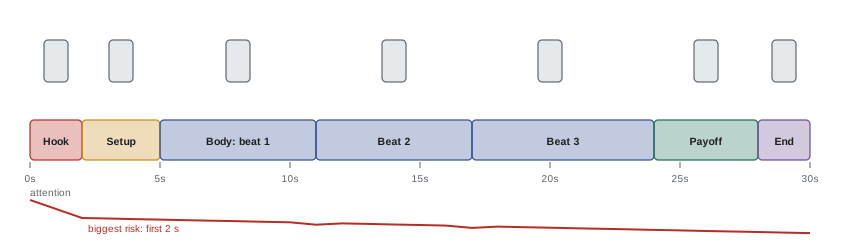
Most effective short videos contain the same basic elements, even when they look very different:
- The hook: the opening one to three seconds that stops the scroll and gives the viewer a reason to keep watching (Lesson 3).
- The setup or context: a quick framing of what the video is about and why it matters, often combined with the hook.
- The body or value: the main content, whether a story, demonstration, tip, joke, transformation or argument, delivered in tightly paced beats.
- The payoff: the moment that delivers on the hook's promise, such as the result of a recipe, the punchline, the reveal or the answer.
- The ending: a clean finish that may loop back to the start, invite a comment or follow, or point to related content.
Supporting all of these are visual elements, sound and music, on-screen text and captions, and the caption and cover that frame the video in the feed and on the profile.
How long should a short video be?
Platforms have steadily extended the maximum length of short videos. At the time of writing in late 2026, YouTube Shorts accepts vertical videos of up to three minutes, Instagram Reels allows up to three minutes when recorded or uploaded as Reels, and TikTok allows uploads far longer than its original 15- and 60-second limits, with up to an hour for uploaded videos. These limits change, so check current platform documentation. Maximum length is not a target, however. The best length is the shortest one that fully delivers the idea. Many successful short videos fall between about 15 and 60 seconds; tutorials, stories and explainers may run one to three minutes when they hold attention throughout. A useful discipline is to write or edit a video, then ask what would be lost by cutting each second; if nothing would be lost, cut it.
| Video type | Typical length | Why |
|---|---|---|
| Joke, reaction, quick tip | 7–20 seconds | One idea, fast payoff, encourages rewatches |
| Tutorial or how-to | 30–90 seconds | Steps need time to follow |
| Storytime or narrative | 45 seconds – 3 minutes | Tension and payoff need space |
| Product demonstration | 15–45 seconds | Show the problem, solution and result |
| Explainer or commentary | 45 seconds – 2 minutes | Argument needs evidence and conclusion |
What viewers want from short videos
People watch short videos for many reasons, and identifying which need a video serves helps shape it. Common viewer motivations include:
- Entertainment: humour, surprise, drama, satisfying visuals, music and dance.
- Learning: tips, tutorials, explanations, life hacks and quick facts.
- Inspiration: transformations, achievements, aesthetics, travel and motivation.
- Connection: relatable experiences, community in-jokes, personal stories and creators they feel they know.
- Information: news, product reviews, recommendations and opinions.
- Relaxation: calming, repetitive or sensory content, such as cooking, cleaning, crafts and nature.
Most successful videos serve one primary motivation clearly, often with a secondary one: an educational video that is also funny, or an entertaining video that teaches something along the way. Videos that try to serve every motivation at once usually serve none well.
Common short-form structures
Several structures recur across platforms because they work:
- List or tips: "three mistakes", "five tools", delivered quickly with a strong first item and a strong last item.
- Before and after or transformation: a starting state, the process compressed, and the result, with the result often teased in the hook.
- Problem and solution: a relatable problem stated, then solved, ideal for products and tips.
- Storytime: a personal or observed story told with tension and a payoff.
- Demonstration or process: showing how something is made or done, often with satisfying visuals and minimal speech.
- Reaction or commentary: responding to another video, a news story or a trend, adding perspective.
- Sketch or skit: a short scripted scene, often with the creator playing several characters.
- Point-of-view (POV): a scene filmed as if the viewer were a participant.
- Myth versus fact or "things you didn't know": challenging an assumption.
Lesson 4 examines these structures in more detail and how to tell stories in under a minute.
Analysing short videos
The fastest way to improve is to study short videos deliberately rather than watching them passively. Choose videos in your niche that performed well relative to their creators' usual results, and break them down:
- What happens in the first second? What is seen, heard and written?
- How quickly does the video reach its main content?
- How many cuts are there, and how long is each shot on average?
- What role do text, music and sound effects play?
- Where is the payoff, and how is the ending handled?
- Does the video loop? Does it invite comments or shares?
- What could be removed without losing anything?
Write the timeline of the video second by second, as in the worked example below. Over time, you will build an internal library of techniques that you can adapt to your own content. The aim is to understand why something works, not to copy it.
Worked problem
Breaking down a cooking short
A 28-second recipe video has 1.2 million views on an account that usually gets 50,000. Its timeline is: 0–1 s close-up of cheese stretching from a toasted sandwich with text "the 5-minute sandwich I make every week"; 1–3 s creator says "you only need four ingredients"; 3–22 s fast cuts of each step with text labels; 22–26 s slow-motion cut through the sandwich; 26–28 s creator takes a bite and nods, video loops. What made it work?
Show solution
- Hook: the payoff image (cheese pull) is shown first, with a specific, useful promise in text.
- Setup: the "four ingredients" line lowers the barrier and creates curiosity.
- Body: fast, labelled steps keep momentum and make the recipe easy to follow without sound.
- Payoff: the slow-motion cut delivers the satisfying visual promised in the hook.
- Ending: the bite and quick end create a natural loop back to the opening image.
Answer: A visual payoff used as the hook, a specific promise, fast labelled steps, a satisfying slow-motion payoff and a looping end.
Short-form and long-form together
Short videos are often part of a larger strategy. They can introduce new viewers to a creator, who may then watch longer videos, subscribe to a newsletter or buy a product. Clips from long videos, podcasts and live streams can become shorts, and successful shorts can inspire longer, deeper videos. However, short and long form require different craft: a long video's slow build-up, extended context and detailed explanation rarely work when simply trimmed into a short. Lesson 12 discusses repurposing and how to adapt content between formats. Some creators work exclusively in short form, building large audiences and businesses around it; others use it as a discovery tool. Both approaches are valid, depending on your goals and your audience (CRE-110).
Course overview
The rest of the course follows the process of creating short videos. Lesson 2 covers ideas and concepts; Lesson 3, hooks; Lesson 4, structure and storytelling in short time frames; Lesson 5, shooting for the edit; Lesson 6, pacing and editing for retention; Lesson 7, on-screen text, captions and graphics; Lesson 8, sound, music and voice; Lesson 9, trends, remixing and collaboration features; Lesson 10, series and recurring formats; Lesson 11, analytics, iteration and sponsored short-form content; and Lesson 12, workflow, repurposing and a capstone series of short videos.
A brief history of short-form video
Short video is not new. Television advertising has used 15- and 30-second spots for decades, and music videos, trailers and comedy sketches compressed stories long before social media. Online, Vine, launched in 2013, popularized six-second looping videos and launched the careers of comedians and musicians who learned to tell jokes in seconds; it closed in 2017. Snapchat Stories, launched in 2013, and Instagram Stories, launched in 2016, made vertical, ephemeral video a daily habit. Musical.ly, a lip-sync app, was acquired by ByteDance and merged into TikTok in 2018, and TikTok's full-screen, recommendation-driven feed transformed the format worldwide. Instagram Reels followed in 2020 and YouTube Shorts in 2020 and 2021, and by the mid-2020s, short vertical video was a central format on nearly every major social platform. Each generation of platforms changed the craft: Vine rewarded loops, Stories rewarded intimacy, and recommendation feeds rewarded hooks, retention and shareability.
Why the format keeps growing
Short-form video suits how people use phones: in brief moments, held vertically, often with sound off. It requires little commitment from viewers, which makes discovery easy, and recommendation systems can learn quickly what each viewer enjoys because they collect many signals from each short session. For creators, the barrier to entry is low: a phone and an idea are enough. For platforms and advertisers, short video keeps audiences engaged and creates inventory for advertising between videos. These forces together explain why short-form continues to expand, even as platforms also encourage longer videos and live content.
Short-form genres
Short-form spans many genres, each with its own conventions. Comedy and sketches rely on timing, characters and punchlines. Education and explainers rely on clarity, accuracy and strong visual examples. Food, beauty, fashion and home content rely on satisfying visuals, transformations and practical tips. Fitness and wellness rely on demonstrations and motivation, with particular responsibility for safety and accuracy. Gaming, sports and entertainment rely on highlights, reactions and commentary. News and commentary rely on speed, credibility and sourcing. Art, music and dance rely on performance and process. Studying the conventions of your genre, and the best creators in it, is the starting point for finding what you can add.
Watching like a creator
Most people watch short videos as consumers, swiping instinctively. Creators benefit from watching deliberately for part of their time: noticing what made them stop, how long they stayed, what made them share or comment, and what made them swipe away. A simple habit is to save every video that makes you stop scrolling into a private collection with a one-line note about why. After a month, the collection becomes a personal course in what works for you as a viewer, which is often a good guide to what will work for your audience.
Common mistakes
MistakeTreating the maximum length as a target.
InsteadMake videos as short as the idea allows.
MistakeStarting with greetings or introductions.
InsteadOpen with the hook and the most compelling element.
MistakeTrying to serve every viewer motivation at once.
InsteadServe one primary need clearly.
MistakeMaking videos that need sound or context to understand.
InsteadDesign for sound-off viewing and new viewers.
MistakeCopying successful videos without understanding them.
InsteadBreak them down to learn why they work.
Summary and key terms
- Short videos compete in feeds where the next video is one swipe away.
- Hook, setup, body, payoff and ending are the core building blocks.
- Maximum lengths have grown, but the best length is the shortest that delivers.
- Viewers seek entertainment, learning, inspiration, connection, information or relaxation.
- Lists, transformations, problem-solution, stories and demonstrations are common structures.
- Second-by-second breakdowns reveal why videos work.
- Short and long form complement each other but need different craft.
- Short-form video
- Vertical video, usually under three minutes, shown in feeds.
- Hook
- Opening seconds that stop the scroll.
- Payoff
- The moment that delivers on the hook's promise.
- Loop
- An ending that flows naturally back to the start.
- Beat
- A distinct unit of action or information.
- Completion rate
- Share of viewers who watch to the end.
- Rewatch
- A viewer watching the video again.
- POV video
- Scene filmed as if the viewer were a participant.
- Breakdown
- Second-by-second analysis of a video.
- Repurposing
- Adapting content for another format.
Practice problems
Work each problem on paper first, then reveal the answer to check.
Why does the first second matter so much?
Show answer
Viewers who swipe immediately never see the idea.
Name the five building blocks of a short video.
Show answer
Hook, setup, body, payoff, ending.
What is the best length for a short video?
Show answer
The shortest that fully delivers the idea.
Typical length for a quick tip?
Show answer
About 7–20 seconds.
Name four viewer motivations.
Show answer
Entertainment, learning, inspiration, connection, information, relaxation.
Name three common structures.
Show answer
List, transformation, problem-solution, storytime, demonstration.
Why design for sound-off viewing?
Show answer
Many people scroll with sound off.
What questions guide a breakdown?
Show answer
First second, pace, cuts, text, sound, payoff, ending.
Why compare performance to a creator's usual results?
Show answer
It identifies genuine outliers.
Why can't long videos simply be trimmed into shorts?
Show answer
Their pacing and structure differ.
Lesson quiz · 5 questions
Score 60% or more to complete this lesson.
Create a free account to save your progress, take quizzes and earn a certificate.