
CRE-210 · Lesson 2 of 12 · 25 min
Ideas and concepts for short form
Production quality and editing matter, but the idea matters more. A brilliant idea filmed simply on a phone will usually outperform a mediocre idea with perfect lighting and editing. Short-form creators need a steady supply of ideas, because successful accounts often publish several times a week, and they need a way to judge which ideas are strong before investing time in them. This lesson covers what makes a short-form idea strong, sources of ideas, idea banks and capture habits, angles that make familiar topics fresh, testing ideas before filming, matching ideas to your niche and audience, and avoiding the common traps of chasing every trend or repeating yourself.
What makes a strong short-form idea
Strong short-form ideas tend to share several qualities:
- They can be understood quickly. If the idea needs a long explanation, it may suit a long video better.
- They have a clear payoff: a result, an answer, a laugh, a surprise or an emotional moment.
- They are specific. "How to save money" is vague; "the $20 grocery shop I make every Sunday" or "the one setting that halved my phone bill" is specific and visual.
- They connect to something the audience already cares about: a problem, a desire, a curiosity or an identity.
- They have a reason to be shared: viewers send videos that are useful to a friend, express something about themselves, or make others laugh.
- They are visual or can be made visual. Short-form is a visual medium; ideas that can be shown rather than only told usually perform better.
- They fit your niche and voice, so that viewers who enjoy the video will want more from you (CRE-110).
A simple test is to try describing the idea in one sentence that would work as on-screen hook text. If you cannot, the idea may need sharpening.
Sources of ideas
Ideas come from many places. Productive sources include:
- Your audience: comments, questions, direct messages, polls and frequently asked questions. A question asked once is often shared by many silent viewers, and replying to comments with videos is a built-in feature on several platforms.
- Your own experience: mistakes you made, things you learned, routines, opinions and stories from your work or life.
- Search and suggestions: search bars on TikTok, YouTube and Instagram show what people are looking for, and autocomplete suggestions reveal common questions (CRE-201 Lesson 8).
- Other creators: not to copy, but to notice gaps, angles they missed, and formats that could suit your niche.
- Trends and culture: trending sounds, memes, events, holidays, seasons and news (Lesson 9).
- Adjacent fields: techniques and formats from other niches applied to yours, such as a cooking-show format for explaining software.
- Your past content: topics that performed well can be revisited with new angles, deeper detail or updates.
| Source | Example | Strength |
|---|---|---|
| Comments and questions | "How do you keep your sourdough starter alive on holiday?" | Proven demand, built-in audience |
| Personal experience | The mistake that cost you a client | Authentic, distinctive |
| Search suggestions | Autocomplete for "how to clean..." | Reveals search demand |
| Other niches | A "tier list" format for houseplants | Fresh twist on familiar topics |
| Seasonal moments | Back-to-school, tax season, first snow | Timely relevance |
| Past winners | Part two or an updated version | Known audience interest |
Capturing ideas
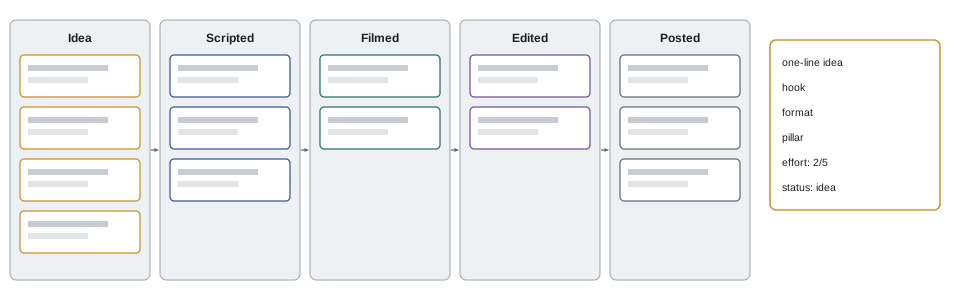
Ideas arrive at inconvenient times: in the shower, on a walk, while watching other videos. Creators who succeed over the long term have reliable systems for capturing them. An idea bank can be as simple as a notes app or as structured as a spreadsheet or project management board. Useful fields include the idea in one sentence, the hook, the format or structure, the content pillar it belongs to (Lesson 10), the effort required, any references, and a status such as idea, scripted, filmed, edited or posted. Saving videos that inspire you into a dedicated collection on each platform helps too, with a note about what specifically you liked. Reviewing the idea bank weekly, choosing the strongest ideas and discarding weak ones keeps it useful rather than overwhelming.
Finding a fresh angle
Most topics have already been covered by someone. What makes a video stand out is its angle: the specific perspective, framing or twist that makes it fresh. Techniques for finding angles include:
- Narrowing: from "budget travel" to "how to eat well in Lisbon for $15 a day".
- Contrasting: "what I expected versus what I got", "beginner versus expert".
- Reversing: "the worst way to...", or arguing against common advice, honestly.
- Personalizing: telling the topic through your own experience or a specific story.
- Quantifying: "I tested 10 cheap umbrellas in a storm".
- Changing the format: explaining a topic as a sketch, a POV, a tier list, a game or a "day in the life".
- Raising the stakes: a time limit, a budget limit or a challenge.
- Updating: "what changed in 2026" for topics that evolve.
An angle should be honest; exaggerating claims or inventing conflict to create a hook damages trust (Lesson 3).
Worked problem
Turning a generic idea into a strong angle
A fitness creator wants to make a video about "stretching for beginners". How could the idea be sharpened into a stronger short-form concept?
Show solution
- Narrow the audience: people who sit at a desk all day.
- Make it specific and visual: "the 60-second stretch routine I do at my desk every afternoon".
- Add a payoff: show the difference in range of motion before and after a week, honestly measured.
- Choose a format: a real-time follow-along, so viewers can do it with you.
- Test the hook text: "Sitting all day? Do this for 60 seconds."
Answer: A specific, follow-along 60-second desk routine for office workers, with an honest before-and-after payoff and a clear hook.
Testing ideas before filming
Because short videos are relatively quick to make, many creators test ideas by simply publishing them. Still, some quick checks save effort. Search the topic on each platform to see how others have approached it and how audiences responded. Write the hook and the payoff first; if either is weak, the idea needs work. Explain the idea to a friend in one sentence and notice whether they react with interest. Post a text version or poll in stories or community posts and see which options attract responses. Consider effort versus likely return: an idea that takes a day to film should have a strong case for performing well, while quick ideas can be tested freely. Some platforms let creators show reels to non-followers first as trials (CRE-201), which reduces the risk of testing new formats in front of existing followers.
Matching ideas to your niche and audience
An idea can perform well and still harm an account if it attracts the wrong audience. A finance creator's video that goes viral for a joke unrelated to finance may bring followers who are not interested in the creator's usual content, reducing engagement on future videos and confusing the recommendation system about who the account is for. Ideas should usually fit your content pillars and voice, or at least connect back to them. This does not mean every video must be narrowly on topic; showing personality, behind-the-scenes moments and occasional experiments helps audiences connect. But a consistent core makes it easier for viewers to know why they follow you and for the platform to find the right audience.
Effort, frequency and quality
Short-form creators face constant pressure to post frequently. Platforms reward consistency to some extent, because more videos create more chances to reach new viewers and keep audiences engaged, but frequency without quality produces forgettable content and exhausts creators (CRE-350). A sustainable balance depends on the type of content: quick reactions and tips may be produced daily, while carefully produced sketches or tutorials may be made weekly. Mixing low-effort and high-effort formats in a schedule helps. Many creators find that a smaller number of well-conceived videos performs better than a large number of rushed ones.
Avoiding idea traps
Common traps include chasing every trend regardless of fit, which dilutes identity; repeating the same idea until audiences tire of it, sometimes called format fatigue; relying entirely on one source of ideas, such as trends, which leaves you stuck when trends slow; making content only for other creators rather than for your audience; and copying another creator's concept closely, which may infringe their work and harms your reputation. Keeping a balance of evergreen ideas, which remain relevant for months or years, and timely ideas, which capture moments, gives an account both stability and energy.
The value equation
A useful way to judge an idea is to weigh what viewers get against what the video asks of them. Viewers give attention, typically 15 to 60 seconds; in return, they expect entertainment, information, emotion or usefulness. Ideas with a high value-to-time ratio, such as a surprising fact in ten seconds or a genuinely useful trick in thirty, perform well because viewers feel rewarded. Ideas that ask for a minute of attention to deliver a modest payoff struggle. When refining an idea, ask how to increase the value, make the payoff stronger or more surprising, or reduce the time needed, cutting setup and context.
Idea generation sessions
Many creators set aside regular time for generating ideas rather than waiting for inspiration. Effective sessions might start by reviewing recent comments and questions, analytics for the best-performing videos, saved inspiration and trend lists, then brainstorming freely without judging, aiming for quantity, perhaps thirty ideas in thirty minutes. Afterwards, rate each idea on audience interest, fit with your niche, strength of hook and payoff, and effort, and move the best into the idea bank with hooks drafted. Techniques such as listing every question a beginner in your niche might ask, every mistake you have made, every tool you use, or every myth you could correct produce many ideas quickly.
Ideas from constraints
Constraints spark creativity. Challenges such as a budget limit, a time limit, a single ingredient, one location, one lens, or no speaking can turn ordinary topics into engaging videos, because they create stakes and force inventive solutions. Constraints also make series easy: "Cooking with $10" or "One-minute sketches" can run for many episodes. When stuck, choose a constraint and see what ideas it suggests.
Respecting people in your ideas
Some ideas involve other people: friends, family, partners, colleagues, customers or strangers. Ideas built on embarrassing people, revealing private information, filming people without consent or making children the centre of content raise serious ethical and sometimes legal concerns (CRE-130 Lesson 12, CRE-320). A good practice is to ask whether the people featured would be happy with the video if they saw it, and whether you would be comfortable if roles were reversed. Many popular formats, such as street interviews and family content, can be done respectfully with consent and care.
Keeping ideas aligned with goals
Every idea should serve a goal: growing reach, deepening loyalty, showing expertise, supporting a product or simply enjoying the craft. When reviewing the idea bank, label each idea with its main goal, and check that the week's plan includes a balance. Ideas that serve none of your goals, however clever, can be saved for later or given away to collaborators. This discipline keeps an account focused and makes it easier to explain your content to brands and partners.
Retiring ideas
Not every idea in the bank deserves to be made. Ideas that have sat unused for months, that no longer fit your direction, or that others have covered better can be removed. A lean idea bank is easier to use than a long list of stale notes.
Common mistakes
MistakeStarting from vague topics.
InsteadSharpen ideas into specific, visual concepts with clear payoffs.
MistakeRelying on memory to keep ideas.
InsteadUse an idea bank and review it weekly.
MistakeFilming before writing the hook and payoff.
InsteadWrite both first to test the idea.
MistakeChasing viral ideas that do not fit your niche.
InsteadConnect ideas to your pillars and audience.
MistakePosting rushed content just to keep a streak.
InsteadBalance frequency with quality and sustainability.
Summary and key terms
- Strong ideas are quick to grasp, specific, visual, shareable and on-niche.
- Comments, experience, search, other niches, seasons and past winners provide ideas.
- An idea bank with clear fields keeps ideas organized.
- Angles such as narrowing, contrast, quantifying and format changes make topics fresh.
- Write the hook and payoff first to test an idea.
- Ideas should attract the audience you want to keep.
- Balance frequency, effort and quality, and avoid idea traps.
- Idea bank
- Organized collection of content ideas.
- Angle
- Specific perspective that makes a topic fresh.
- Evergreen content
- Content that remains relevant over time.
- Timely content
- Content tied to a moment or trend.
- Content pillar
- Recurring theme in an account's content.
- Format fatigue
- Audience tiring of a repeated format.
- Reply video
- A video responding to a viewer comment.
- Share trigger
- Reason a viewer would send a video to someone.
- Effort rating
- Estimate of production work for an idea.
- Trial reel
- A reel shown first to non-followers.
Practice problems
Work each problem on paper first, then reveal the answer to check.
Name four qualities of strong short-form ideas.
Show answer
Quick to grasp, specific, clear payoff, visual, shareable, on-niche.
What is a simple test for an idea?
Show answer
Describe it in one sentence that works as hook text.
Name three sources of ideas.
Show answer
Comments, experience, search, other creators, trends, past content.
What fields might an idea bank include?
Show answer
Idea, hook, format, pillar, effort, status.
Give an example of narrowing.
Show answer
From budget travel to eating well in one city on a budget.
What should be written before filming?
Show answer
The hook and the payoff.
Why can an off-niche viral video be harmful?
Show answer
It attracts followers who do not want your usual content.
What is format fatigue?
Show answer
Audiences tiring of a repeated format.
Why balance evergreen and timely ideas?
Show answer
Stability plus energy.
Why mix low- and high-effort formats?
Show answer
To sustain frequency without burnout.
Lesson quiz · 5 questions
Score 60% or more to complete this lesson.
Create a free account to save your progress, take quizzes and earn a certificate.