
CRE-201 · Lesson 8 of 12 · 25 min
Search and discoverability
Recommendation feeds push content to people; search lets people pull content they want. Search behaviour on social platforms has grown enormously: many people, especially younger users, search TikTok, YouTube, Instagram and Pinterest for recipes, product reviews, travel ideas, tutorials and news, alongside or instead of traditional search engines. Search traffic is valuable because it comes from people actively looking for something, and content that ranks for popular searches can attract viewers for years. This lesson covers how platform search works, keyword research, optimizing titles, captions, descriptions and spoken words, YouTube search, TikTok and Instagram search, Pinterest, the relationship with Google and AI search, and building search-friendly content libraries.
How platform search works
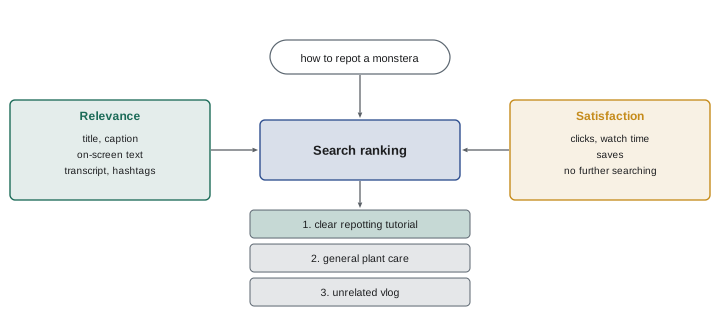
Platform search engines match queries with content using several kinds of signals:
- Relevance: how well the content matches the query, based on titles, captions, descriptions, hashtags, on-screen text, transcripts of speech, and visual analysis.
- Quality and satisfaction: how people who searched similar queries responded to the content, such as clicks, watch time, saves, and whether they kept searching afterward, which suggests they did not find what they needed.
- Freshness: for time-sensitive queries, such as news or trends, newer content may be preferred.
- Personalization: the searcher's history, language, location and interests.
- Authority and trust: for some topics, especially health, news and finance, platforms raise content from authoritative sources and reduce misinformation.
Search results also include features such as suggested queries, related searches, and filters by format, date and type.
Keyword research
Keyword research means finding the words and phrases people actually use when searching for content like yours. Tools and techniques include:
- Autocomplete: typing the start of a query into YouTube, TikTok, Instagram or Pinterest search and noting the suggestions, which reflect popular searches.
- Platform research tools: YouTube Studio's research tab shows what a channel's viewers and others search for, including "content gaps" where demand exceeds supply; TikTok has offered creator search insights showing trending searches in some markets; Pinterest Trends shows rising searches.
- Related searches and comments: questions viewers ask in comments often reveal search terms.
- Third-party keyword tools that estimate search volume, though their data for social platforms is approximate.
- Google Trends, for comparing interest in topics over time and by region.
Look for queries with meaningful demand that match your expertise, and for specific long-tail phrases, such as "how to make sourdough starter without a scale", where competition is lower and searchers know exactly what they want.
| Keyword type | Example | Characteristics |
|---|---|---|
| Head term | sourdough | Huge demand, intense competition, vague intent |
| Mid-tail | sourdough starter | Clearer intent, moderate competition |
| Long-tail | sourdough starter without a scale | Lower volume, specific intent, easier to rank |
| Question | why is my sourdough flat | Problem-solving intent, good for tutorials |
| Comparison | sourdough vs yeast bread | Decision intent, good for reviews |
Optimizing titles, captions and descriptions
Once you know the terms people use, include them naturally where platforms look:
- Titles (YouTube, Pinterest, podcasts): put the main keyword early, in a title that is also compelling for people, not just search engines.
- Captions (TikTok, Instagram, Threads): describe the content clearly in the first lines, using the words people search for, rather than vague phrases.
- Descriptions (YouTube, podcasts, Pinterest): provide a short summary with keywords, chapters or timestamps, and relevant links.
- On-screen text: platforms read text in videos, so a clear title card such as "3 easy weeknight pasta recipes" helps.
- Spoken words: transcripts are analysed, so saying the topic clearly in the first seconds helps both viewers and search.
- Alt text and file names: help image search and accessibility.
- Hashtags: on most platforms, a few relevant hashtags help categorization, but they are a minor factor compared with captions and content.
Avoid keyword stuffing, the repetition of keywords unnaturally, which reads poorly, may be treated as spam, and does not help on modern platforms.
Worked problem
Rewriting a caption for search
A creator posts a video showing how to repot a monstera plant with the caption "new home for this beauty 🌿 #plantmom". How could the caption and video be improved for search?
Show solution
- Identify likely searches: "how to repot a monstera", "monstera soil mix", "when to repot monstera".
- Rewrite the caption: "How to repot a monstera without stressing it: the soil mix I use, pot size and when to repot."
- Add on-screen text in the first second: "How to repot a monstera".
- Say the topic aloud early: "Here's how I repot my monstera."
- Keep one or two relevant hashtags, such as #monstera and #houseplants.
Answer: Use the searched phrases in the caption, on-screen text and speech, describe the content specifically, and keep hashtags minimal.
YouTube search
YouTube is one of the largest search engines in the world. Its search ranking considers relevance (title, description and video content), engagement (how viewers who searched similar terms responded) and quality signals. Videos that answer a query directly and satisfy searchers tend to rank and keep ranking. Chapters, created by timestamps in the description, help viewers navigate and can appear in search results as key moments. YouTube videos also appear in Google search results, often for how-to and review queries, bringing additional traffic. Search-oriented videos tend to be evergreen, accumulating views for years, which is why many educational and review channels build substantial libraries of search-optimized content.
TikTok and Instagram search
TikTok has invested heavily in search, adding a search bar to the For You page, suggested searches beneath videos ("Others searched for"), and search results that combine videos, accounts, sounds, photos and shopping. Captions, on-screen text, spoken words and hashtags all help TikTok understand what videos are about. Instagram has also expanded search, including keyword search across posts and Reels, and has said that captions and alt text help content appear. For creators, this means that clear descriptions of content, rather than vague or purely clever captions, help their videos be found long after they are posted. Search-driven views on short-form platforms are often more evergreen than feed views.
Pinterest and visual search
Pinterest combines keyword search with visual search: users can select part of an image to find visually similar pins and products, and Pinterest Lens lets them search with a phone camera. Pins rank by relevance to keywords in titles, descriptions and board names, image understanding, quality, and engagement such as saves and clicks. Pinterest favours fresh pins, new images rather than repeated pins of the same image, and content that leads to high-quality landing pages. Seasonal planning matters: people search for holiday, wedding and seasonal ideas weeks or months in advance, so pins should be published early enough to gain traction.
Google, AI search and the wider web
Content on social platforms increasingly appears in traditional search engines: YouTube videos, TikTok videos, Reddit threads, Pinterest pins and Instagram posts can appear in Google results, sometimes in dedicated sections for short videos or discussions. Google and other search engines have also introduced AI-generated summaries and answers, such as AI Overviews, which draw on web content and may cite sources, and chatbots such as ChatGPT, Gemini, Claude and Perplexity answer questions using web content. These developments change how people find information: some queries are answered without clicking through to sources, reducing traffic to websites, while content that is clear, authoritative and well structured is more likely to be cited. For creators, maintaining a website or blog with clear, original information, transcripts and descriptions can complement platform content and make expertise visible to both search engines and AI systems.
Building a search-friendly library
Search rewards libraries of content that answer many related questions. Creators can plan content around clusters of topics: a core video or post on a broad question, such as "how to start running", linked to more specific pieces, such as "running shoes for beginners", "how to avoid shin splints" and "first 5K training plan". Linking these together through playlists, descriptions, pinned comments and websites helps viewers find related content and helps platforms understand the creator's expertise. Updating older content, such as refreshing titles, descriptions and thumbnails, or making new versions of popular tutorials when information changes, keeps the library current. Over time, a search-friendly library provides a steady base of views that is less volatile than feed-driven reach.
Search intent and content format
Different searches call for different formats. A person searching "how to tie a tie" wants a short, clear demonstration; someone searching "best laptops for students" wants a comparison with criteria and options; someone searching "what happened at the summit" wants recent, reliable news. Matching content to search intent is as important as matching keywords: a long, rambling video may rank briefly for a quick-answer query but will lose viewers and ranking if it does not deliver what searchers want. Looking at the top results for a query reveals the format and depth that satisfy searchers, and where there is room to do better.
Updating and refreshing content
Search-friendly content benefits from maintenance. Information becomes outdated, products change and new questions emerge. Creators can update titles, descriptions and thumbnails of older videos to reflect current terms; add pinned comments or description notes with corrections; create updated versions of popular tutorials and link them from the originals; and refresh blog posts with new information. Platforms and search engines often favour fresh, accurate content for topics that change, so regular updates protect a library's value.
Local and multilingual search
Search is shaped by location and language. A query such as "best brunch" returns local results; content that names specific places, neighbourhoods and cities can reach local searchers. Creators targeting audiences in several regions, such as Canada and the United States, may need to consider differences in terminology, spelling and product availability. Multilingual creators can reach additional audiences with captions, translated titles and descriptions, or separate content in each language; YouTube and other platforms support multiple-language metadata and audio tracks, which can broaden discovery.
Search and trust
For sensitive topics such as health, finance, law and news, platforms apply stricter quality standards in search, raising authoritative sources and sometimes adding information panels from trusted organizations. Creators covering these topics build credibility by citing reliable sources, being transparent about their qualifications, distinguishing opinion from fact, and avoiding exaggerated claims. Search visibility in these areas depends heavily on demonstrated expertise and trustworthiness, and misleading content may be demoted or removed.
Measuring search performance
YouTube Studio shows the share of views from YouTube search and the top search terms that led to each video; TikTok and Instagram analytics show some search-driven views; Pinterest analytics show impressions and saves from search; and Google Search Console shows how websites perform in Google search. Tracking which queries bring viewers, and how those viewers behave, guides future content and reveals unexpected opportunities, such as questions viewers are asking that no one has answered well.
Search on short-form platforms versus Google
Short-form search results differ from traditional search. They favour recent, visual, personal and entertaining content, while Google favours comprehensive, authoritative pages for many queries. Young people often search TikTok for restaurant recommendations, outfit ideas or quick tips because they value seeing real people's experiences. Creators can serve both by making short, searchable videos that answer specific questions and longer, detailed content on YouTube or websites that covers topics comprehensively and links back to short videos.
Search as a long-term asset
Unlike feed reach, which fades within days, search visibility can grow over time as content accumulates positive signals and links. Creators who invest steadily in search-friendly content often find that older posts become a dependable source of new viewers, providing stability when feed reach fluctuates.
Combining these practices, clear intent, specific language, honest descriptions and regular updates, gives content the best chance of being found by the people who need it, now and in the future.
Common mistakes
MistakeWriting vague, clever captions only.
InsteadDescribe content clearly with searched phrases.
MistakeStuffing keywords and hashtags.
InsteadUse keywords naturally and a few relevant hashtags.
MistakeTargeting only broad head terms.
InsteadInclude specific long-tail and question queries.
MistakeIgnoring spoken words and on-screen text.
InsteadState the topic clearly in speech and text.
MistakePublishing seasonal pins too late.
InsteadPublish weeks or months ahead.
Summary and key terms
- Search lets people pull content they want; social search has grown greatly.
- Platforms rank search by relevance, satisfaction, freshness, personalization and authority.
- Keyword research uses autocomplete, research tools, comments and trends.
- Titles, captions, descriptions, on-screen text and speech help platforms understand content.
- YouTube, TikTok, Instagram and Pinterest each have distinct search features.
- Google and AI search increasingly surface and summarize social content.
- Search-friendly libraries of related content provide stable, long-term views.
- Search intent
- What a searcher wants to accomplish.
- Keyword
- Word or phrase people search for.
- Long-tail query
- Specific, lower-volume search phrase.
- Autocomplete
- Suggested completions reflecting popular searches.
- Content gap
- Topic with high demand and little content.
- Keyword stuffing
- Unnatural repetition of keywords.
- Chapters
- Timestamped sections of a YouTube video.
- Visual search
- Searching with images rather than text.
- AI Overview
- AI-generated summary in search results.
- Topic cluster
- Group of related content around a core topic.
Practice problems
Work each problem on paper first, then reveal the answer to check.
Name four signals platform search uses.
Show answer
Relevance, satisfaction, freshness, personalization, authority.
How can autocomplete help?
Show answer
It reveals popular search phrases.
What is a long-tail query?
Show answer
A specific, lower-volume search phrase.
Name three places to include keywords.
Show answer
Titles, captions, descriptions, on-screen text, speech.
Why avoid keyword stuffing?
Show answer
It reads poorly and may be treated as spam.
What do YouTube chapters do?
Show answer
Help navigation and appear as key moments in search.
Name a TikTok search feature.
Show answer
Others searched for suggestions or search bar.
What is Pinterest Lens?
Show answer
Searching with a phone camera.
How do AI search tools affect creators?
Show answer
Some queries answered without clicks; clear sources may be cited.
What is a topic cluster?
Show answer
Related content around a core topic, linked together.
Lesson quiz · 5 questions
Score 60% or more to complete this lesson.
Create a free account to save your progress, take quizzes and earn a certificate.