
CRE-201 · Lesson 5 of 12 · 25 min
Instagram, Facebook and Threads
Meta's apps, Instagram, Facebook and Threads, together reach several billion people, and many creators build significant parts of their business on them. Meta has published more information about its ranking systems than many platforms, including explanations from Instagram's leadership, system cards describing how feeds rank content, and transparency reports required by regulators. This lesson examines how Instagram ranks its different surfaces, connected and unconnected content, the role of Explore, Stories and the main feed, Facebook's shift toward recommendations, Threads and text-based posts, originality and recommendation eligibility, account status and controls, and practical implications for creators.
One app, many rankings
Instagram has explained that it does not have a single algorithm. Each surface, the feed, Stories, Explore, Reels and search, has its own ranking system tuned to how people use it. In Stories, people mostly want to see updates from friends and accounts they follow closely, so ranking emphasizes relationships, viewing history and how often people view those accounts' stories. In the main feed, a mix of followed accounts and recommendations is ranked by predicted interest, including likelihood of liking, commenting, saving, tapping the profile and spending time on the post. Explore is designed for discovery, recommending content from accounts people do not follow based on what they and similar people have engaged with. Reels, as Lesson 3 explained, emphasizes entertainment and discovery, with sends and watch time important for new audiences.
| Instagram surface | Main purpose | Emphasized signals |
|---|---|---|
| Feed | Updates and recommendations | Likes, comments, saves, time spent, relationships |
| Stories | Close connections, daily updates | Viewing history, relationship, interactions |
| Explore | Discovery of new accounts | Engagement by similar people, interests |
| Reels | Entertainment and discovery | Watch time, sends, likes, originality |
| Search | Finding accounts and topics | Query text, names, captions, activity |
Connected and unconnected reach
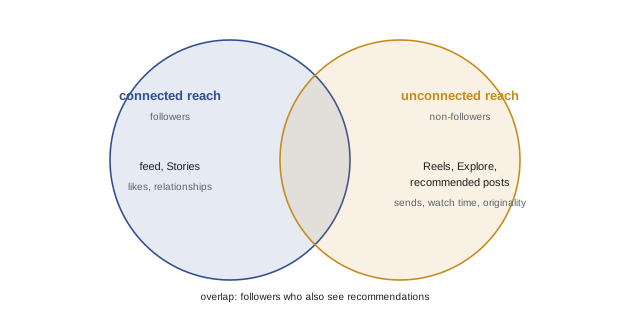
Meta distinguishes between connected content, posts from accounts a person follows, and unconnected content, recommendations from accounts they do not follow. The share of unconnected content in Facebook and Instagram feeds has grown substantially since TikTok's rise. For creators, connected reach is relatively stable but limited by follower count and engagement, while unconnected reach offers growth but depends on recommendation eligibility and performance. Instagram's insights separate followers and non-followers, helping creators see which posts reached new people. Content that strangers would find interesting without knowing the creator, such as clear tutorials, entertaining reels or striking images, tends to travel further through unconnected surfaces, while personal updates suit Stories and followers.
Instagram's guidance on signals
Instagram's head, Adam Mosseri, has given public guidance on what matters for each type of reach. For reaching existing followers, likes and the relationship between viewer and creator are important. For reaching new audiences, sends per reach, how often people share a post privately relative to how many people saw it, and watch time are among the most important signals. Saves indicate lasting value and are associated with carousels and educational content. Instagram has also said that it wants to reward original creators: accounts that repeatedly repost others' content without meaningful changes may be excluded from recommendations, and aggregator accounts may see original sources credited or prioritized instead. Captions, alt text and keywords help with search and understanding, while hashtags have become a minor factor, useful mainly for categorization.
Recommendation eligibility and account status
Instagram and Facebook distinguish between content that is allowed on the platform and content that is eligible to be recommended to non-followers. Recommendations guidelines exclude certain categories from recommendation even when the posts do not violate rules, such as sensitive or low-quality content, some health claims, content from accounts with recent violations, and, by default, political content for people who have not opted in to see it. Instagram's Account Status tool shows creators whether their account or content is eligible for recommendations, lists any violations, and allows appeals. This transparency addresses longstanding creator fears of hidden "shadowbans": if reach suddenly drops, checking account status is the first step (Lesson 10).
Worked problem
Diagnosing a reach drop on Instagram
A fitness creator's reels usually reach about 40,000 accounts, mostly non-followers. For two weeks, reels have reached only about 6,000, mostly followers. What should the creator check?
Show solution
- Open Account Status to see whether the account is currently eligible for recommendations or has any violations, and appeal if a decision seems wrong.
- Check whether recent reels used reposted clips, watermarks or content that might be considered unoriginal.
- Compare recent reels with past successful ones: hooks, length, topic, and sends per reach.
- Check whether recent posts touched topics that may be excluded from recommendations, such as certain health claims.
Answer: Check Account Status first, then originality, content changes and recommendation guidelines, comparing with past successful reels.
Facebook's shift to recommendations
Facebook has moved from a friends-and-family feed toward a feed with much more recommended content, especially videos and Reels, in response to competition from TikTok and changing user habits. Meta has said that a large share of time on Facebook is now spent on recommended content. Facebook pages and creators can reach new audiences through these recommendations, and Facebook has run creator monetization programs based on performance. Facebook's audience is older on average than TikTok's or Instagram's, and its groups remain important for community-based content. Meta also reduced the distribution of news and political content in feeds and, in Canada, blocked news content on Facebook and Instagram from 2023 in response to the Online News Act (Lesson 11), which affects creators and publishers who share news links.
Threads and text-based posts
Threads, launched by Meta in July 2023 and linked to Instagram accounts, is a text-based platform similar to X. Its feed mixes posts from followed accounts with recommendations, ranked by predicted interest, and offers a following feed in chronological order. Threads has connected to the fediverse, the decentralized network of services such as Mastodon, allowing some posts to be seen and followed from other services. For creators, Threads offers a place for conversation, opinion and short updates, often with a lower bar for production than visual platforms. As with all newer platforms, its features and reach dynamics have changed rapidly.
Meta's transparency tools
Meta publishes system cards that describe, in general terms, how ranking works for Facebook feed, Instagram feed, Reels, Stories and Explore, including the kinds of signals used and the predictions made. "Why am I seeing this?" features let users see some of the reasons a post or ad was shown, and users can adjust their feeds by marking posts as interested or not interested, snoozing accounts, choosing favourites, and using chronological following feeds. In the European Union, the Digital Services Act requires very large platforms to offer at least one feed option not based on profiling, and Meta offers non-personalized options there. These tools also give creators insight into how their content may be interpreted and ranked.
Content formats on Instagram
Each format on Instagram serves different goals. Reels drive discovery and reach new audiences. Carousels, multiple images or slides in one post, encourage swiping and saves, and Instagram may show a carousel again with a different first slide to people who scrolled past, giving it a second chance. Single photos suit strong images and personal moments. Stories build daily connection with followers through polls, questions, links and behind-the-scenes content. Live video supports real-time interaction. Broadcast channels let creators message followers directly. Collaborative posts, shared between two accounts, reach both audiences. A balanced mix of formats, suited to the creator's niche, usually performs better than relying on one.
Practical implications
For creators on Meta's platforms, the evidence and public guidance suggest several strategies: make original content and avoid reposting others' material; design reels that people want to send to friends; use carousels and educational posts that people save; build relationships through Stories, comments and messages, which keep followers engaged; check Account Status regularly and follow recommendation guidelines; use captions and alt text that describe content clearly for search and accessibility; and treat hashtags as minor. As on all platforms, the specifics change, so following official creator accounts and help centres for updates is worthwhile.
Meta's ranking at a technical level
Meta has described its ranking systems in engineering blog posts and system cards. For each person and each candidate post, models predict many possible actions, such as liking, commenting, sharing, sending, saving, spending time, hiding and reporting, and combine them into a value score, with weights reflecting how much each action contributes to a good experience. Integrity classifiers predict whether content is likely to violate policies or be low quality, reducing its score. The final ranking also considers diversity, so that a feed does not show too many posts from one account or about one topic in a row. These systems are retrained frequently, and many experiments run at the same time, which is why reach patterns change subtly over time.
Messaging as a social layer
Messaging has become central to how people share content on Meta's apps. Many people now share posts privately with friends in direct messages or group chats rather than publicly in comments, which is why sends are such an important signal. Instagram has introduced features that encourage sharing, such as quick send buttons and shared feeds in group chats. For creators, content designed to be shared privately, such as relatable humour, useful tips for a specific person, or recommendations for an activity with friends, can travel far through messaging networks even if public engagement looks modest.
Creator tools on Meta platforms
Meta offers creators various tools: professional dashboards with insights, branded content tools for disclosing paid partnerships, subscriptions, gifts during live and Reels, monetization programs that change over time, an app for editing Reels, and tools that help brands find creators for partnerships. Each tool comes with eligibility rules, such as follower thresholds and policy compliance. Because Meta adjusts these programs frequently, creators should check current terms in the professional dashboard and help centre rather than relying on older advice.
Facebook groups and pages
Facebook groups remain important for communities around interests, locations and identities, and posts in active groups can reach engaged members reliably. Creators can run their own groups or participate in relevant ones, following each group's rules. Facebook pages, the main presence for businesses and many creators, reach followers and, increasingly, non-followers through recommendations. Some creators find that Facebook audiences respond differently from Instagram audiences, favouring longer videos, personal stories and community discussion.
Practical comparison of Meta surfaces
A creator planning a launch might use Reels to reach new people, carousels to explain details that people save, Stories to talk directly to followers with polls and links, broadcast channels to send updates, Threads for conversation, and Facebook groups or pages for community. Measuring each surface separately in insights shows where new followers and conversions come from.
Political and sensitive content on Meta
Since 2024, Instagram and Threads have by default limited recommendations of political content from accounts people do not follow, while still showing such content from followed accounts, and users can change this setting. Facebook has similar controls. Creators who discuss politics, social issues or current events may therefore find that such posts reach followers normally but are recommended less to new audiences, unless viewers have opted in. Understanding this helps creators interpret reach on political posts and decide how to frame content, for example by focusing on explanation and context.
Reading Instagram insights
Instagram insights show reach split between followers and non-followers, interactions, sends, saves and the surfaces where posts were seen. Comparing these across recent posts reveals which formats and topics reach new people and which mainly serve followers, guiding the mix of content.
Common mistakes
MistakeAssuming Instagram has one algorithm.
InsteadTailor content to each surface's purpose.
MistakeRelying on hashtags for reach.
InsteadFocus on content, sends, saves and clear captions.
MistakeReposting others' content as your own.
InsteadCreate original work or transform it meaningfully.
MistakeAssuming a shadowban without checking.
InsteadCheck Account Status and recommendation eligibility.
MistakeIgnoring Stories and relationships.
InsteadUse Stories and messages to keep followers engaged.
Summary and key terms
- Instagram ranks each surface differently: feed, Stories, Explore, Reels and search.
- Connected reach comes from followers; unconnected reach from recommendations.
- Sends per reach and watch time matter for new audiences; likes for followers.
- Originality is rewarded; reposting can remove recommendation eligibility.
- Account Status shows recommendation eligibility and violations.
- Facebook has shifted toward recommended video; Threads offers text-based conversation.
- System cards, feed controls and regulation increase transparency.
- Connected content
- Posts from accounts a person follows.
- Unconnected content
- Recommended posts from accounts not followed.
- Explore
- Instagram surface for discovery.
- Sends per reach
- Private shares relative to accounts reached.
- Recommendation eligibility
- Whether content can be suggested to non-followers.
- Account Status
- Instagram tool showing violations and eligibility.
- System card
- Meta document explaining how a feed ranks content.
- Carousel
- Post with multiple images or slides.
- Collaborative post
- Post shared on two accounts.
- Fediverse
- Network of interconnected decentralized social services.
Practice problems
Work each problem on paper first, then reveal the answer to check.
What does Stories ranking emphasize?
Show answer
Relationships and viewing history.
What is Explore for?
Show answer
Discovering accounts people do not follow.
Which signal matters most for new audiences on Instagram?
Show answer
Sends per reach, along with watch time.
What happens to accounts that mostly repost?
Show answer
They may be excluded from recommendations.
What does Account Status show?
Show answer
Violations and recommendation eligibility.
What changed about Facebook's feed?
Show answer
Much more recommended content, especially video.
When did Threads launch?
Show answer
July 2023.
What does the DSA require of very large platforms?
Show answer
A feed option not based on profiling.
Why might a carousel get a second chance?
Show answer
Instagram may show it with a different first slide.
Name two Meta transparency tools.
Show answer
System cards, Why am I seeing this, Account Status.
Lesson quiz · 5 questions
Score 60% or more to complete this lesson.
Create a free account to save your progress, take quizzes and earn a certificate.