
CRE-201 · Lesson 4 of 12 · 25 min
YouTube and long-form video
YouTube is the largest long-form video platform and, for many creators, the most durable source of audience and income. Unlike short-form feeds, where a video's life is often measured in days, a good YouTube video can attract viewers for years through search and recommendations. YouTube's recommendation system has been described in research papers and public statements by the company, which makes it one of the better understood, though its details remain private and evolving. This lesson covers YouTube's surfaces and traffic sources, how its recommendations work, click-through rate and the packaging of titles and thumbnails, watch time and viewer satisfaction, sessions and the role of the channel, evergreen and topical content, testing tools, and how long-form and Shorts fit together.
Surfaces and traffic sources
YouTube distributes videos through several surfaces, each shown separately in YouTube Studio's traffic source reports:
- Browse features: the home page, subscriptions feed and other browsing surfaces; for many established channels, the largest source.
- Suggested videos: recommendations shown beside or after other videos, including the up-next autoplay.
- YouTube search: results for queries typed into YouTube.
- Shorts feed: for Shorts.
- Channel pages, playlists and notifications.
- External sources: links from websites, social media, messaging apps and search engines such as Google, which often shows YouTube videos in results.
Different videos depend on different sources: tutorials and how-to videos often rely on search; entertainment and commentary on browse and suggested; and news on notifications and timely browse traffic. Understanding which sources drive each video helps creators decide what to improve.
| Traffic source | What drives it | Typical content |
|---|---|---|
| Browse (home) | Predicted interest of viewers who like similar content | Entertainment, series, broad topics |
| Suggested | Relationship to the video being watched | Related topics, responses, follow-ups |
| Search | Relevance to queries and satisfaction | Tutorials, reviews, explanations |
| Notifications and subscriptions | Subscriber interest and habits | Regular series, loyal audiences |
| External | Links shared elsewhere | Newsworthy, embedded, linked content |
How YouTube recommendations work
YouTube engineers described the core structure of the recommendation system in a 2016 paper on deep neural networks for YouTube recommendations: a candidate generation network selects hundreds of videos from millions using a person's watch and search history, and a ranking network scores them using many features to predict expected watch time. Later papers described multi-task ranking that predicts several objectives at once, including engagement and satisfaction, and methods to reduce biases such as favouring videos simply because they appear in higher positions. YouTube has said publicly that it aims to recommend videos viewers will find valuable, using signals such as clicks, watch time, survey responses about satisfaction, shares, likes and dislikes, and "not interested" feedback, and that it reduces recommendations of borderline content that comes close to violating its policies, and of misinformation in some areas, while raising authoritative sources for news and certain topics such as health.
A widely repeated principle from YouTube's creator guidance is that the system follows the audience: it tries to match each viewer with videos they are likely to watch and enjoy, rather than judging videos in the abstract. A video does not need to appeal to everyone; it needs to appeal strongly to the people who are shown it.
Click-through rate and packaging
On browse and suggested surfaces, a video competes for attention through its packaging: the thumbnail and title. YouTube Studio reports impressions, the number of times thumbnails were shown, and impressions click-through rate (CTR), the share of impressions that led to a view. CTR varies widely by traffic source, topic and channel size; YouTube has said that most channels have CTRs between about 2 and 10 %, and that CTR typically declines as a video is shown to broader, less interested audiences. CTR alone is not a goal: a misleading thumbnail may achieve a high CTR but disappoint viewers, leading to low watch time and negative feedback. Effective packaging promises something specific and compelling, and the video delivers it. Titles and thumbnails work together: the thumbnail conveys emotion, curiosity or a clear visual promise, while the title adds context and keywords without repeating the thumbnail text.
Worked problem
Interpreting CTR as reach grows
A new video has 20,000 impressions with a 9 % CTR in its first day, mostly from subscribers. Over the following week it reaches 400,000 impressions with a 4 % CTR, mostly from browse features. Is the drop a problem?
Show solution
- Early impressions go largely to subscribers and engaged viewers, who are more likely to click.
- As YouTube shows the thumbnail to broader audiences, CTR naturally falls.
- The video is gaining far more total views: 1,800 views on day one versus about 16,000 over the week.
- The key question is whether viewers from browse watch for a good share of the video and respond positively.
Answer: No; falling CTR as impressions widen is normal, and total views are rising. Judge success by views, watch time and satisfaction, not CTR alone.
Watch time, retention and satisfaction
Once a viewer clicks, YouTube measures how long they watch, both in absolute terms and as a percentage of the video, and how they respond afterward: whether they like it, share it, watch more from the channel, leave the platform or tell YouTube they were not interested. Long videos can accumulate a lot of watch time, but only if they hold viewers; a 30-minute video that loses most viewers in the first minute performs poorly. YouTube has emphasized that it is moving beyond watch time toward valued watch time and satisfaction, using surveys and other signals to determine whether viewers felt the time was well spent. For creators, this means structuring videos to deliver on the title's promise quickly, maintaining momentum with clear structure and pacing, and respecting viewers' time rather than padding videos to increase length.
Sessions and the role of the channel
YouTube considers not only individual videos but viewing sessions: whether a video leads people to keep watching other videos, on the same channel or elsewhere, or to leave. Videos that start or extend satisfying sessions may be recommended more. Channels with a clear identity and a library of related videos benefit, because viewers who enjoy one video are likely to enjoy others, and the system can recommend them. End screens, cards, playlists and series that link videos together help viewers continue. Subscribers matter for notifications and the subscriptions feed, and engaged subscribers provide early signals for new uploads, but YouTube has said that subscriber counts do not guarantee reach: each video is still recommended according to viewer response.
Evergreen and topical content
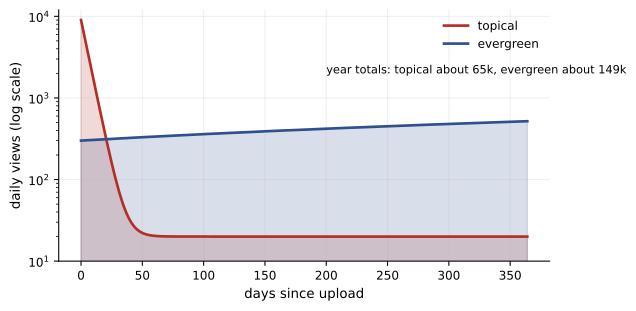
YouTube supports two broad content strategies. Evergreen videos, such as tutorials, explanations, reviews of long-lived products and timeless entertainment, continue to attract search and suggested traffic for years, building a channel's long-term base. Topical videos, about news, trends, new releases or events, can attract large audiences quickly but fade as interest moves on. Many successful channels combine both, using topical videos to attract attention and evergreen videos to sustain views. Analysing the long tail of views, how much of a channel's traffic comes from older videos, reveals how much evergreen value a channel has built.
Testing tools and experiments
YouTube provides tools that help creators test packaging. Test and Compare, available in YouTube Studio, lets creators upload up to three thumbnails (and in some cases titles) for a video; YouTube shows them to different viewers and reports which earned the most watch time share, a more meaningful measure than clicks alone. Analytics offer audience retention graphs with key moments, such as intros where viewers leave and segments they rewatch, comparisons with a channel's typical performance, and research tabs showing what viewers search for. Creators can also run informal experiments by varying one element across several videos, while recognizing that many factors affect each video's performance (Lesson 10).
Long-form and Shorts together
Many creators use Shorts and long-form videos together. Shorts can introduce new viewers to a creator, tease longer videos, or repackage highlights. Long-form videos build deeper relationships and generally earn more advertising revenue per view. YouTube has stated that Shorts and long-form recommendations are handled separately, so a channel experimenting with Shorts should not see its long-form recommendations penalized, though channel analytics will show different audience behaviour for each format. Some creators run separate channels for different formats or audiences; others keep them together for simplicity. The decision depends on whether the audiences overlap and whether Shorts viewers tend to watch the creator's long videos.
Common YouTube myths
Several beliefs about YouTube persist despite the company's explanations and creator experience. Uploading at a specific time does not determine success, though timing can affect early notifications; videos are not punished for being long or short as such, but for failing to hold viewers; deleting and reuploading videos rarely helps and can harm a channel; and tags play only a minor role compared with titles, thumbnails and the video itself. YouTube has also said that taking breaks does not permanently harm a channel, although audiences may need time to return. Lesson 10 discusses how to evaluate claims like these.
Home page personalization
YouTube's home page is highly personalized: two people opening YouTube at the same moment see very different recommendations based on their watch history, subscriptions, searches and responses to past recommendations. A video that performs well with one audience segment may be shown widely to that segment and rarely to others. YouTube has also added features that let viewers shape their recommendations, such as removing videos from their watch history, marking videos as not interested, telling YouTube not to recommend a channel, and pausing watch history. When viewers turn off watch history, the home page shows few personalized recommendations, which affects how creators reach those viewers.
Comments, community and loyalty
YouTube offers features that strengthen relationships between creators and viewers: comments with hearts and pinned replies, community posts with polls, images and updates, memberships with perks, live streams and premieres, and the subscriptions feed. Engaged communities provide early views and positive signals for new uploads, and loyal viewers who watch most videos give the system reliable information. Creators who respond to comments, ask viewers what they want to see, and recognize community contributions build loyalty that supports long-term performance.
Long-form video in other places
YouTube is the dominant long-form platform, but long videos also appear elsewhere. Facebook supports long videos with in-stream ads; TikTok allows long uploads and has tested horizontal formats; X and LinkedIn support long videos for some users; and services such as Vimeo, Nebula, Patreon and creator-owned websites host long-form content with different business models, such as subscriptions. Streaming services such as Netflix and others license content from some creators. Each has different discovery dynamics, but none currently matches YouTube's combination of search, recommendations and advertising revenue for most creators.
Measuring success on YouTube
Because YouTube reports many metrics, creators can easily focus on the wrong ones. Useful measures include views and watch time over time, compared with the channel's typical videos; average view duration and percentage viewed; returning and new viewers; subscriber growth from each video; traffic source mix; and revenue per thousand views for monetized channels. Comparing each video with the channel's own baseline, which YouTube Studio shows as typical performance, is more meaningful than comparing with other channels.
Premieres, scheduling and first hours
YouTube premieres let creators schedule a video to debut at a set time with a countdown and live chat, gathering subscribers to watch together. Premieres can concentrate early views and engagement, though they are not required for success. Scheduling uploads for consistent days helps audiences form habits.
Above all, YouTube rewards channels that understand their viewers and keep serving them well, video after video, which is why consistent quality and a clear identity matter more than any single trick.
Common mistakes
MistakeChasing CTR with misleading thumbnails.
InsteadPackage honestly and deliver the promise.
MistakePadding videos to increase watch time.
InsteadRespect viewers' time and keep momentum.
MistakePanicking when CTR falls as impressions grow.
InsteadJudge by views, watch time and satisfaction.
MistakeUploading unrelated videos with no channel identity.
InsteadBuild a library that links viewers to more content.
MistakeRelying on tags and upload times.
InsteadFocus on packaging, content and audience fit.
Summary and key terms
- YouTube distributes through browse, suggested, search, Shorts, notifications and external links.
- Recommendations combine candidate generation and multi-objective ranking.
- Thumbnails and titles drive clicks; CTR falls naturally as audiences broaden.
- Watch time, retention and satisfaction surveys shape recommendations.
- Sessions, channel libraries and series help viewers keep watching.
- Evergreen and topical videos serve different strategies.
- Test and Compare and analytics support evidence-based improvement.
- Browse features
- Home page and subscription surfaces.
- Suggested videos
- Recommendations beside or after other videos.
- Impressions
- Times a thumbnail was shown.
- Click-through rate
- Share of impressions that became views.
- Packaging
- A video's title and thumbnail together.
- Valued watch time
- Watch time viewers feel was well spent.
- Session
- A continuous period of viewing.
- Evergreen content
- Content that stays relevant for a long time.
- Test and Compare
- YouTube tool for testing thumbnails and titles.
- Borderline content
- Content close to violating policies.
Practice problems
Work each problem on paper first, then reveal the answer to check.
Name four YouTube traffic sources.
Show answer
Browse, suggested, search, Shorts, notifications, external.
What did YouTube's 2016 paper describe?
Show answer
Candidate generation and ranking networks.
What does "the system follows the audience" mean?
Show answer
It matches viewers to videos they will enjoy.
Typical CTR range YouTube cites?
Show answer
About 2–10 %.
Why does CTR fall as impressions grow?
Show answer
Broader audiences are less likely to click.
What does YouTube use beyond watch time?
Show answer
Satisfaction surveys, likes, shares, not interested feedback.
How do end screens and playlists help?
Show answer
They extend sessions on the channel.
Difference between evergreen and topical videos?
Show answer
Evergreen lasts; topical spikes and fades.
What does Test and Compare measure?
Show answer
Watch time share for different thumbnails or titles.
Do tags matter much?
Show answer
Only a little compared with titles, thumbnails and content.
Lesson quiz · 5 questions
Score 60% or more to complete this lesson.
Create a free account to save your progress, take quizzes and earn a certificate.