
CRE-101 · Lesson 9 of 12 · 29 min
Planning your first year
The first year as a creator is mostly about learning: finding out what you enjoy making, what an audience responds to, how long things take, and whether you want to keep going. Most creators who give up do so in the first few months, often because they expected quick results, ran out of ideas, or tried to do too much. A plan does not guarantee success, but it helps you stay consistent, learn deliberately from each piece of content, protect your time, money and wellbeing, and make clear decisions about whether to continue, change direction or stop. This lesson walks through building that plan: goals, a niche hypothesis, content pillars, a realistic schedule, a small budget, experiments and metrics, legal basics, and quarterly reviews.
Start with honest goals
Why do you want to create? Common answers include learning skills for a career, sharing a passion, building a reputation in your profession, earning side income, or building a full-time business. Each implies a different plan. A nurse who wants to educate patients needs credibility and accuracy more than viral reach; a comedian needs to test material frequently; someone hoping for a full-time business needs revenue experiments early.
Good goals are specific, measurable and within your control. "Get 100,000 followers" depends heavily on luck and algorithms. "Publish 48 videos this year, each better than the last in one specific way, and build an email list of 500 people" depends mainly on you, and it builds the skills and assets that make audience growth likely. Many creators set two kinds of goals:
- Process goals (within your control): output, skills practised, experiments run, hours protected for rest.
- Outcome goals (influenced, not controlled): audience size, engagement, income. Treat these as signals to learn from rather than measures of personal worth.
A niche hypothesis
A niche is the combination of topic, audience and angle that makes your content distinct. In the first year, treat your niche as a hypothesis to test rather than a final decision. A useful formula is: I make [format] about [topic] for [audience] who want [benefit], in a way that is different because [angle].
For example: "I make short videos about budget home cooking for university students who want healthy meals under $5, in a way that is different because I cook everything in a dorm kitchen with one pan." This tells you what to make, who it is for, and why someone would choose it over thousands of other cooking channels. CRE-110 covers niche research and personal branding in depth.
Test your niche against three questions: Can you make 100 pieces of content about it without running out of ideas? Is there an audience that searches for or watches this kind of content? Are there ways to earn from it (brands that would sponsor it, products the audience would buy)?
Content pillars and formats
Content pillars are three to five recurring themes or series within your niche. They make planning easier and help audiences know what to expect. For the dorm-cooking creator, pillars might be: weekly meal-prep recipes, "$20 grocery challenge" videos, kitchen equipment on a budget, and quick nutrition explainers. Each pillar can have a repeatable format (a consistent structure, opening and length) that becomes faster to produce with practice.
Choose one primary format for your primary platform (Lesson 3) and plan how each piece will be repurposed for one or two secondary platforms. A typical first-year structure is one main piece per week (a long video, podcast episode or newsletter) plus several short pieces cut or adapted from it.
A realistic schedule
Consistency matters more than volume. Algorithms and audiences both reward creators who publish regularly, and skills improve through repetition. But a schedule you cannot sustain is worse than a modest one you keep. Start by working out how many hours a week you can reliably give, then how long each piece takes (expect your first pieces to take much longer than later ones).
Worked problem
Planning output from available time
Sam has 10 hours a week alongside a job. A long video currently takes 14 hours, and each short takes 1.5 hours. Sam also needs 1.5 hours a week for comments, email and planning. What sustainable schedule fits?
Show solution
- Available for production: \(10 - 1.5 = 8.5\) hours a week, or 17 hours per two weeks.
- One long video every two weeks: 14 hours, leaving 3 hours, enough for two shorts (3 hours).
- Per week: half a long video plus one short.
Answer: One long video every two weeks plus one short a week. As Sam's workflow improves (say to 9 hours per long video), the schedule can move toward weekly long videos. Committing to weekly long videos from the start would require 15.5 hours a week and would likely lead to missed uploads or burnout.
Batching (doing similar tasks together, such as scripting four videos in one session and filming them the next day) saves setup time and creates a buffer of finished content for busy weeks, illness or holidays. Many creators aim to stay two to four pieces ahead of their publishing schedule.
| Day | Task (10 hours per week example) |
|---|---|
| Monday evening | Research and outline (1.5 h) |
| Wednesday evening | Script and plan shots (2 h) |
| Saturday morning | Film main piece and short clips (3 h) |
| Sunday | Edit, thumbnail, captions, schedule posts (2.5 h) |
| Daily, 10 to 15 min | Comments, messages, notes on ideas (1 h total) |
A small, sensible budget
You do not need expensive equipment to start. A recent smartphone, a basic microphone, natural light from a window, and free or low-cost editing software are enough for most formats. Audio quality matters more than video resolution: viewers tolerate imperfect pictures far more than poor sound. Upgrade only when a specific limitation is holding your content back and you have evidence the content is worth investing in.
| Item | Typical cost (CAD) | Priority |
|---|---|---|
| Smartphone you already own | $0 | Essential |
| Lavalier or USB microphone | $30 to $150 | High |
| Phone tripod and mount | $25 to $60 | High |
| LED light or ring light | $40 to $120 | Medium |
| Editing software (free tiers or subscription) | $0 to $30 a month | Medium |
| Website domain and email list (free tiers available) | $0 to $25 a month | Medium |
Keep creator money separate from personal money from the start: a separate bank account, records of every expense and income item, and receipts. This makes taxes simpler and shows clearly whether the activity is paying for itself.
Experiments and metrics
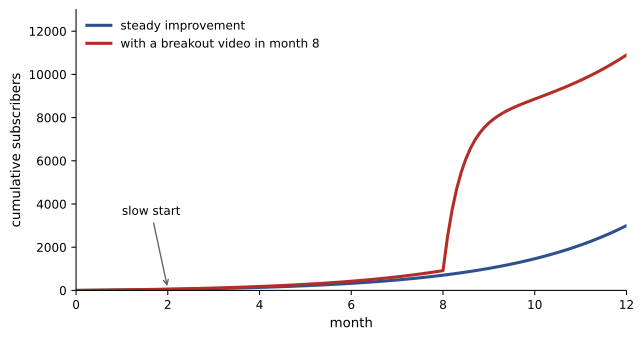
Treat your first year as a series of experiments. Change one thing at a time (topic, title style, thumbnail, hook, video length, posting time, format) and compare results with your recent average. Small sample sizes are noisy, so look for consistent patterns over several pieces rather than reacting to one result.
Choose a few metrics that match your goals and stage:
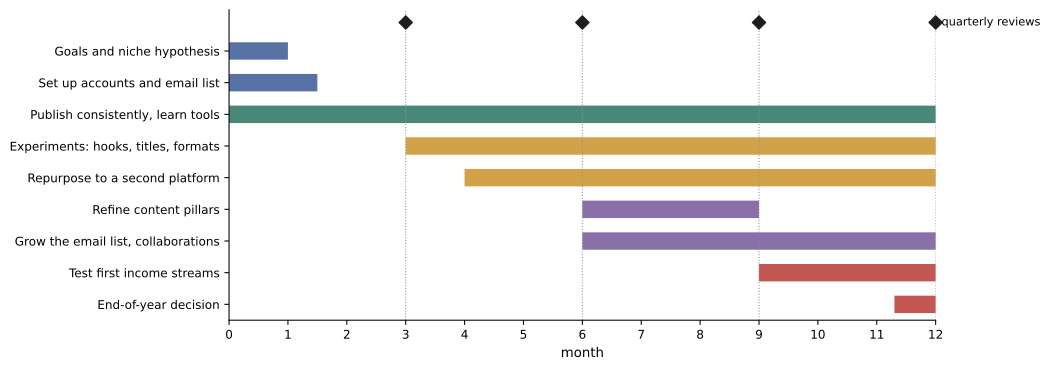
- Early (months 1 to 3): output (pieces published on schedule), production time per piece, and qualitative feedback.
- Growing (months 4 to 9): retention or average view duration, click-through rate on thumbnails or titles, engagement rate, subscriber or follower growth per piece, email sign-ups.
- Monetizing (months 9 to 12): revenue per piece, conversion to email list or products, sponsor interest, RPM.
Worked problem
Reading an experiment
A creator's last eight videos had an average view duration of 3:10 (out of 8 minutes). They try starting with the result first ("here is the finished meal") instead of an introduction, and the next four videos average 4:05. Is this a meaningful improvement?
Show solution
- Change: from 190 s to 245 s, an increase of \(55/190 = 29\%\).
- Consistent? Check whether all four new videos beat the old average, not just one.
- Other factors? Check that topics and lengths were similar.
Answer: If all four beat the old average with similar topics, a 29% gain in watch time is likely meaningful and worth keeping, then testing further. If one video carried the average, keep testing. Higher retention usually leads to more recommendations, so improvements compound.
Own your audience
From the first month, give interested people a way to stay in touch that you control: an email newsletter, a simple website, or both. Offer something useful in exchange for signing up (a recipe pack, a checklist, a free guide). Even a few hundred subscribers are valuable: they are your most engaged fans, they are reachable whatever happens to any platform, and they are the most likely buyers of future products.
Legal and ethical basics
Before publishing, understand a few essentials (CRE-320 covers them fully):
- Copyright: do not use music, clips, images or fonts you do not have the right to use. Platforms detect copyrighted music and may mute videos, divert revenue to rights holders or issue strikes. Use licensed libraries or platform-provided music, and understand that fair dealing (Canada) or fair use (US) are narrow, context-specific exceptions, not general permission.
- Disclosure: label sponsored content, free products and affiliate links clearly, as the Competition Bureau and Ad Standards guidelines expect.
- Privacy and consent: get permission before featuring identifiable people, especially in private settings, and be particularly careful with children.
- Platform rules: read the community guidelines and monetization policies of your platforms; violations can cost an account.
- Health, financial and safety claims: avoid giving advice beyond your qualifications, and add context and sources.
- Contests and giveaways have specific legal rules (CRE-320).
Quarterly reviews and decision points
Every three months, review what happened and decide what to change. A simple review asks:
- Did I meet my process goals? If not, was the plan unrealistic or did something get in the way?
- Which pieces performed best and worst, and what do they have in common?
- What did I learn about my audience from comments, messages and analytics?
- Am I enjoying this? Is it affecting my health, relationships, studies or job?
- What will I keep, change, start and stop next quarter?
At the end of the year, make a clear decision: continue as planned, pivot (change topic, format or platform based on what you learned), scale up (more time or investment, if results justify it), keep it as a hobby, or stop. Stopping is a legitimate outcome; the skills and portfolio you built remain valuable.
Worked problem
An end-of-year decision
After a year of part-time work (about 450 hours), a creator has 1,800 subscribers, a 900-person email list, $1,100 of income and $600 of expenses. Engagement and retention improved steadily in the last two quarters, and they enjoy the work. Their goal was to test whether this could become meaningful side income within three years. What should they decide?
Show solution
- Net income: \(1100 - 600 = \$500\), about $1.11 an hour; not yet meaningful.
- Leading indicators (retention, engagement, a 900-person list) are improving, and the creator is motivated.
- Goal horizon is three years, so year one results are not decisive.
Answer: Continue, with a focus on the strongest pillars and on testing one product or sponsorship offer for the email list in year two, while keeping other income. Set a clear threshold for the end of year two (for example, consistent monthly income of a target amount, or a growth rate in the list) to decide whether to scale up or stop.
Lesson 10 develops the analytics and experiments introduced here, and Lesson 12 turns this plan into the course launch project.
Common mistakes
MistakeSetting only outcome goals like follower counts.
InsteadSet process goals you control alongside outcome signals.
MistakeCommitting to a schedule you cannot sustain.
InsteadBase the schedule on measured production time and available hours.
MistakeBuying expensive equipment before testing content.
InsteadStart with a phone and good audio; upgrade for a specific need.
MistakeChanging many things at once, or reacting to one result.
InsteadTest one change at a time and look for consistent patterns.
MistakeNever reviewing or deciding.
InsteadReview quarterly and make a clear decision at year end.
Summary and key terms
- The first year is mainly for learning skills, audience and your own preferences.
- Set process goals you control and treat outcomes as signals.
- State a niche hypothesis: format, topic, audience, benefit and angle.
- Use three to five content pillars with repeatable formats.
- Plan a sustainable schedule from measured hours; batch to build a buffer.
- Start with minimal equipment, prioritize audio, and keep finances separate.
- Run one-change experiments and track stage-appropriate metrics.
- Build an owned channel early, follow legal basics, and review quarterly.
- Process goal
- A goal about actions within your control, such as output.
- Outcome goal
- A goal about results influenced by others, such as followers or income.
- Niche hypothesis
- A testable statement of format, topic, audience, benefit and angle.
- Content pillar
- A recurring theme or series within a niche.
- Batching
- Doing similar tasks together to save time and build a buffer.
- Buffer
- Finished content ready to publish ahead of schedule.
- Average view duration
- The average time viewers spend watching a video.
- Click-through rate
- The share of people shown a thumbnail or title who click it.
- Pivot
- A change of topic, format or platform based on what was learned.
- Quarterly review
- A structured review every three months to decide what to change.
Practice problems
Work each problem on paper first, then reveal the answer to check.
Rewrite "get 50,000 followers" as a process goal.
Show answer
For example: publish one video a week for 12 months and test a new hook style each month.
Write a niche hypothesis for a cycling repair channel.
Show answer
I make short tutorials about bike repairs for commuters who want to fix common problems at home, different because every fix uses five basic tools.
What three questions test a niche?
Show answer
100 ideas? An audience that seeks it? Ways to earn?
12 hours a week; long piece takes 16 h, shorts 2 h, admin 2 h a week. Sustainable schedule?
Show answer
10 h a week for production: one long piece every two weeks (16 h) plus two shorts per two weeks (4 h).
Why stay ahead of the publishing schedule?
Show answer
A buffer covers illness, busy weeks and holidays without missing uploads.
Which matters more for a beginner: 4K video or clear audio?
Show answer
Clear audio.
Average view duration rises from 2:30 to 3:00. Percentage increase?
Show answer
20%.
Why build an email list in the first month?
Show answer
It is owned, reaches the most engaged fans and survives platform changes.
Name three legal basics to check before publishing.
Show answer
Copyright, disclosure, privacy and consent, platform rules, claims, contest rules.
List the five end-of-year options.
Show answer
Continue, pivot, scale up, keep as a hobby, stop.
Lesson quiz · 5 questions
Score 60% or more to complete this lesson.
Create a free account to save your progress, take quizzes and earn a certificate.