
CRE-101 · Lesson 2 of 12 · 28 min
Audiences, attention and community
Every part of the creator economy rests on one scarce resource: human attention. Platforms compete for it, advertisers pay for it, and creators earn a living only if people choose to spend some of their limited time with their work, again and again. Before looking at platforms (Lesson 3) and algorithms (Lesson 4), this lesson looks at the audience itself: why people watch, read and listen to creators, how attention works and why it is so easily lost, the difference between a passing audience and a loyal one, the relationships audiences form with creators, and how creators build communities. Understanding audiences is not a marketing trick; it is the core of making work that people value.
Why people follow creators
Research on media use, often summarized as "uses and gratifications" theory, asks what needs people satisfy when they choose media. For creator content the main motives are:
- Information and learning: tutorials, reviews, explainers and news commentary that help people do something or understand something.
- Entertainment and escape: comedy, gaming, storytelling and spectacle that pass time pleasantly.
- Social connection: the feeling of spending time with a familiar person, and of belonging to a group of fans who share an interest.
- Identity and self-expression: following creators who reflect who the viewer is or wants to be, in style, values or community.
- Inspiration and aspiration: fitness, travel, craft and lifestyle content that motivates people.
Most successful channels serve more than one need. A woodworking channel teaches techniques (learning), shows satisfying transformations (entertainment) and gathers a community of hobbyists in the comments (connection). Asking "what does my viewer get from this?" is more useful than asking "what do I want to make?" alone, and the best answers combine both.
The economics of attention
In 1971 the economist Herbert Simon observed that "a wealth of information creates a poverty of attention." Today an enormous volume of video, audio, images and text competes for a fixed amount of human time: the average adult in Canada or the US spends several hours a day with digital media, but that time does not grow as content multiplies. The result is intense competition, in which a piece of content often has a second or two to earn a viewer's continued attention before they scroll on.
Several features of attention shape how creators work:
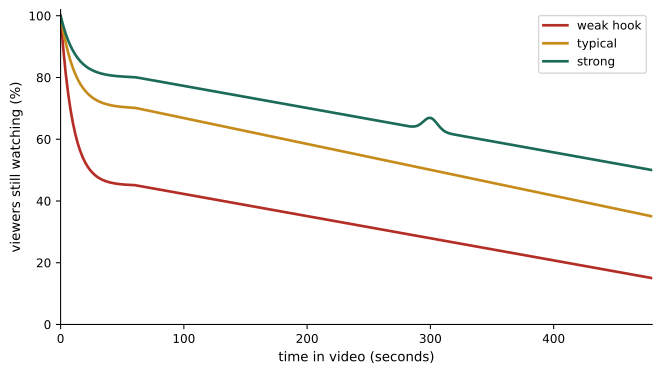
- First impressions decide: thumbnails, titles, the first frame and the first few seconds (the hook) determine whether someone starts and keeps watching.
- Attention decays: retention curves for most videos fall steeply in the first seconds and then more slowly, so every section must earn the next.
- Novelty and curiosity drive attention: an open question, a surprising claim or an unresolved story keeps people watching, a technique called an "open loop".
- Context matters: people scrolling a short-form feed are in a different mode from people choosing a long video on a television in the evening or listening to a podcast on a commute.
Worked problem
What a better hook is worth
A creator's videos are 10 minutes long. Currently 40% of viewers leave in the first 30 seconds, and those who stay watch an average of 6 minutes. A new opening reduces early drop-off to 25%, with the same viewing among those who stay. If 10,000 people start the video, how much total watch time does the change add?
Show solution
- Before: 6,000 viewers stay and watch 6 minutes \(= 36{,}000\) minutes; 4,000 leave after about 15 seconds on average \(= 1{,}000\) minutes; total 37,000 minutes.
- After: 7,500 stay \(= 45{,}000\) minutes; 2,500 leave \(= 625\) minutes; total 45,625 minutes.
- Increase: \(45{,}625/37{,}000 - 1 = 23\%\).
Answer: A better first 30 seconds adds about 23% total watch time from the same number of starts. Because platforms use watch time and retention to decide what to recommend (Lesson 4), the video may also be shown to more people, so the real effect is larger.
Reach versus relationship
Not all audiences are equal. A useful distinction is between reach, how many people see something, and relationship, how much they care about the person who made it. Short-form feeds can deliver enormous reach to strangers who will never remember the creator's name; a podcast or newsletter may reach far fewer people, but those people choose to spend an hour every week with the creator. The writer Kevin Kelly argued in 2008 that a creator can make a living from "1,000 true fans", people who will buy whatever the creator produces, if each spends about $100 a year directly. The precise number varies, but the idea, that depth of relationship can matter more than size, underlies membership, patronage and product businesses (Lesson 5).
| Audience layer | Description | What they do |
|---|---|---|
| Passers-by | see a piece once in a feed or search | view, sometimes like |
| Casual viewers | recognize the creator, watch occasionally | watch when recommended |
| Subscribers and followers | chose to follow | watch regularly, comment sometimes |
| Fans | seek out the creator's work | comment, share, join live streams, recommend to friends |
| True fans and members | invested in the creator | pay, buy products, attend events, defend the creator |
Healthy creator businesses move people down this funnel over time: reach brings in passers-by, consistent quality turns some into regular viewers, and community and direct channels turn some of those into fans and supporters. Followers on a platform are, however, only rented (Lesson 1 described platforms as landlords); converting fans to an email list or membership gives the creator a direct relationship that survives changes to an algorithm.
Parasocial relationships
Viewers who watch the same person talk to the camera week after week often feel they know them, a one-sided bond that psychologists Donald Horton and Richard Wohl named a parasocial relationship in 1956, when it was observed with television hosts. Creator media intensifies it: creators speak directly to viewers, share their homes and lives, respond to comments and appear live. Parasocial bonds are normal and can be positive, providing companionship, motivation and a sense of community. They also explain why creator recommendations are so persuasive and so valuable to brands (Lesson 8).
They create responsibilities and risks. Creators can be tempted, or pressured, to share more of their private lives than is healthy, and some viewers lose sight of the boundary, feeling entitled to the creator's time or attention, or becoming hostile when expectations are not met. Viewers, particularly young ones, can be influenced by creators in ways they do not notice. Responsible creators set boundaries about what they share, are honest about sponsored content and the edited nature of what viewers see, and avoid exploiting viewers' sense of closeness for profit (Lessons 7 and 11).
Community
A community is more than an audience: its members interact with each other, not only with the creator, and share norms, in-jokes and a sense of belonging. Creator communities form in comment sections, live chats, Discord servers, subreddits, membership platforms and in-person meetups. Communities increase loyalty, give the creator ideas and feedback, and can sustain a creator through algorithmic ups and downs. Building one takes deliberate work:
- Give people a reason to talk to each other: shared projects, challenges, questions and recurring formats.
- Respond and participate, especially early, when the creator's presence sets the tone.
- Set and enforce clear rules: communities without moderation are quickly taken over by spam, harassment or toxicity, which drives away most members. Volunteer moderators and moderation tools help as communities grow (Lesson 11).
- Recognize members: featuring their work, naming regular contributors, and acknowledging milestones.
- Keep the community's purpose clear and avoid treating it only as a sales channel.
Worked problem
Where to host a community
A creator teaching beginner guitar has 40,000 subscribers and wants a community where students can share progress and ask questions. Compare YouTube comments, a free Discord server and a paid membership forum.
Show solution
- Comments: no extra platform, but conversations are scattered across videos and hard to sustain.
- Discord: real-time chat and channels for topics, free, popular with younger audiences; needs moderators and can be chaotic as it grows.
- Paid forum: smaller, more committed members and revenue, but fewer people join and the creator must deliver ongoing value.
Answer: A common path is to start a free Discord server for engaged viewers, appoint moderators from among the regulars, and later add a paid tier for structured lessons or feedback. The choice depends on the audience's age and habits and how much time the creator can give.
Knowing your audience
Creators learn about their audiences through several sources:
- Platform analytics: age, gender, location, device, when viewers are online, which videos bring new viewers and which keep returning viewers (Lesson 10 covers analytics in depth).
- Comments and messages: what people ask, what they misunderstand, what they want next.
- Surveys and polls: short questionnaires to email subscribers or community members.
- Search data: what people search for in the creator's topic area, from search suggestions and keyword tools.
- Conversations: talking to a handful of viewers in depth often reveals more than thousands of data points.
A useful exercise is to write a description of one or two representative viewers, sometimes called audience personas: who they are, what they want, what they already know, where and when they watch, and what would make them recommend the creator to a friend. Personas should come from evidence, not assumptions, and be updated as the audience changes.
Audiences in Canada and beyond
Canadian creators work in a distinctive market. The audience is smaller than in the US, so many Canadian creators deliberately serve international audiences, especially in English, while French-language creators serve Quebec, francophone Canada and the wider francophone world, a large market with less competition in many niches. Canadian audiences are valuable to advertisers because of high consumer spending (Lesson 3), and Canadian cultural policy supports some creators through funds and programs, such as the Canada Media Fund, and through rules discussed in Lesson 12. Creators anywhere should remember that audiences in different countries have different languages, holidays, time zones, cultural references and sensitivities, and that subtitles and translations can open large new audiences.
Case study: two creators, one topic
Imagine two creators who both make videos about home cooking on a budget. The first posts every day, chases whatever recipe is trending and asks viewers to like and subscribe at the start of every video. Views spike when a trend hits and fall back when it passes. Comments are mostly one or two words, and almost nobody returns for the next upload unless it happens to match another trend.
The second posts twice a week. Every video solves one specific problem for one kind of viewer: a student with a single pot, a parent feeding four people on a tight weekly budget, a shift worker who needs meals that reheat well. She answers questions in the comments, turns the best ones into future videos and names the viewer who asked (with permission). Her view counts grow more slowly, but returning viewers make up a larger share every month, and her newsletter sign-ups come from people who already trust her.
After a year the first creator has more total views; the second has a smaller audience that watches longer, comes back reliably and buys the meal-planning guide she eventually sells. Neither path is guaranteed, and trends can be a useful way to be discovered. The lesson is that reach brings people in once, while a clear promise to a defined audience gives them a reason to return. Most durable creator businesses mix the two: some content aimed at discovery, and most of it aimed at the people who already chose to follow.
Common mistakes
MistakeMaking content only for yourself without asking what viewers get from it.
InsteadCombine your interests with a clear benefit for the viewer: learning, entertainment, connection or inspiration.
MistakeSpending the first 30 seconds on introductions and housekeeping.
InsteadOpen with the payoff or a compelling question; put greetings and requests later.
MistakeTreating follower count as the measure of the audience.
InsteadTrack depth of relationship: returning viewers, comments, email sign-ups and supporters.
MistakeExploiting viewers' sense of closeness for sales or sharing everything for engagement.
InsteadSet boundaries, be transparent and treat viewers respectfully.
MistakeOpening a community space without rules or moderation.
InsteadSet rules from the start and recruit moderators as it grows.
Summary and key terms
- People follow creators for learning, entertainment, connection, identity and inspiration; good content serves more than one need.
- Attention is scarce; hooks, retention and curiosity determine whether content is watched.
- Reach and relationship differ; deep relationships with fewer people can sustain a creator business.
- Audiences move from passers-by to true fans; direct channels such as email protect that relationship.
- Parasocial relationships make creators persuasive and carry responsibilities and risks.
- Communities form when members interact with each other and need purpose, participation and moderation.
- Analytics, comments, surveys, search data and conversations reveal who the audience is and what it wants.
- Uses and gratifications
- A theory explaining media choices by the needs they satisfy.
- Attention economy
- The competition among media for limited human attention.
- Hook
- The opening seconds of content designed to capture attention.
- Retention
- The share of viewers still watching at each point of a video.
- Open loop
- An unresolved question or story that keeps viewers watching.
- Reach
- The number of people who see a piece of content.
- True fan
- A supporter who will buy or support what a creator produces.
- Parasocial relationship
- A one-sided sense of personal connection to a media figure.
- Community
- An audience whose members interact with each other and share norms.
- Audience persona
- An evidence-based description of a representative viewer.
Practice problems
Work each problem on paper first, then reveal the answer to check.
Name four reasons people follow creators.
Show answer
Learning, entertainment, connection, identity, inspiration.
What did Herbert Simon say about information and attention?
Show answer
A wealth of information creates a poverty of attention.
Why do retention curves fall fastest at the start?
Show answer
Viewers decide quickly whether to keep watching.
Watch time from 5,000 viewers staying 4 minutes and 3,000 leaving at 0.25 minutes?
Show answer
20,000 + 750 = 20,750 minutes.
What is the "1,000 true fans" idea?
Show answer
A creator can live on a modest number of fans who spend directly each year.
Why are followers called rented?
Show answer
The platform controls access to them.
What is a parasocial relationship?
Show answer
A one-sided feeling of knowing a media figure.
What distinguishes a community from an audience?
Show answer
Members interact with each other and share norms.
Name three sources of audience information.
Show answer
Analytics, comments, surveys, search data, conversations.
Why might a French-language creator have an advantage?
Show answer
A large francophone market with less competition in many niches.
Lesson quiz · 5 questions
Score 60% or more to complete this lesson.
Create a free account to save your progress, take quizzes and earn a certificate.