
CON-420 · Lesson 9 of 12 · 25 min
Negotiation and settlement
Most construction claims are resolved by negotiation, not by a decision. Even claims that go to adjudication, arbitration or court usually settle at some point before the final award. Negotiation is therefore the most important dispute resolution skill a construction manager can have, and it is the one most often left to chance. This lesson applies negotiation principles to construction claims. It builds on the general negotiation material in PMP-121 lesson 9 and the business negotiation concepts in BUS-210, and focuses on what is specific to claims: valuing the alternatives, protecting what is said, structuring offers and writing a settlement that ends the dispute.
The aim of a claim negotiation is a settlement that both parties prefer to their alternatives. That sounds obvious, but many claim negotiations fail because one or both sides have not worked out what their alternative actually is, or because they negotiate positions rather than interests, or because the people at the table do not have authority to settle.
Interests, positions and alternatives
A position is what a party says it wants: 'We claim $860,700.' An interest is why it wants it: Kestrel Ridge needs cash to cover subcontractor payments, wants to protect its margin and its reputation with its surety, and would like to bid the city's next recreation centre. The City of Ashford wants to stay within its council-approved budget, avoid an embarrassing public dispute, recover what it can from its consultant and get the pool open. Negotiating interests opens options that negotiating positions does not: a payment schedule that helps Kestrel Ridge's cash flow, a joint approach to Halloway Partners for the design error, or a release that lets the city close the project file.
Each party's best alternative to a negotiated agreement (BATNA) is what it will do if negotiation fails. For a claim, that is usually adjudication, arbitration or litigation, with all their costs, delays and risks. A party should not accept a settlement worse than its BATNA, and should not reject one that is better. The zone of possible agreement lies between the two parties' walk-away points. The skill is in valuing the BATNA honestly.
Valuing the alternative with a decision tree
A decision tree sets out the possible outcomes of the alternative, their probabilities and their values, and calculates an expected value. The probabilities are judgments, ideally informed by legal advice and an honest view of the evidence; the value of the exercise is that it forces those judgments into the open and shows which of them matter.
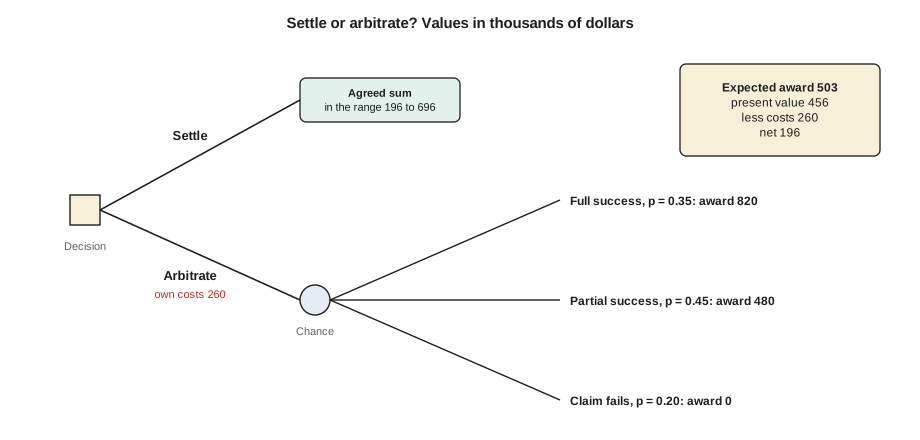
# Kestrel Ridge's view of arbitrating its Ashford claim versus settling (illustrative, in $000)
outcomes = [            # (probability, award including interest)
    ("Full success",    0.35, 820),
    ("Partial success", 0.45, 480),
    ("Claim fails",     0.20,   0),
]
own_costs = 260         # legal, expert and staff costs through a hearing
months = 20             # time to an award
discount = 0.06         # annual cost of money

ev_award = sum(p * a for _, p, a in outcomes)
pv_award = ev_award / (1 + discount) ** (months / 12)
kr_value = pv_award - own_costs
print(f"Expected award {ev_award:,.0f}; present value {pv_award:,.0f}; net of costs {kr_value:,.0f}")

city_costs = 240
city_exposure = pv_award + city_costs
print(f"City's expected cost of arbitrating: {city_exposure:,.0f}")
print(f"Settlement range: {kr_value:,.0f} to {city_exposure:,.0f}")

print("Sensitivity to the chance of full success (partial fixed at 0.45):")
for p_full in (0.20, 0.35, 0.50):
    ev = p_full * 820 + 0.45 * 480
print(f" p(full) = {p_full:.2f}: Kestrel Ridge net {ev / (1 + discount) ** (months / 12) - own_costs:,.0f}")Expected award 503; present value 456; net of costs 196 City's expected cost of arbitrating: 696 Settlement range: 196 to 696 Sensitivity to the chance of full success (partial fixed at 0.45): p(full) = 0.20: Kestrel Ridge net 85 p(full) = 0.35: Kestrel Ridge net 196 p(full) = 0.50: Kestrel Ridge net 308
Kestrel Ridge's expected award is $503,000, worth about $456,000 today if it arrives in 20 months, and about $196,000 after its own costs of arbitration. The city's expected cost of arbitrating is about $696,000 including its own costs. Any settlement between roughly $196,000 and $696,000 leaves both parties better off, on these estimates, than arbitrating. The sensitivity shows that Kestrel Ridge's walk-away value moves by about $110,000 for each 15-point change in the chance of full success, so that judgment deserves the most attention.
Two points are often missed. First, costs are frequently the largest single factor: on claims of a few hundred thousand dollars, the cost of a full arbitration or trial can consume much of what is at stake. Second, the parties are rarely risk-neutral. A small contractor that cannot afford to lose may rationally accept less than the expected value; a public owner may pay more than expected value to avoid a precedent or public criticism. Expected value is a starting point, not the answer.
Costs rules affect the tree. In Canadian courts and in many arbitrations the successful party usually recovers part of its legal costs from the other side, so a strong claim is worth more and a weak one is riskier; the tree can add branches for costs recovered or paid.
Preparing for a claim negotiation
Preparation decides most negotiations. A checklist for a claim negotiation includes the following.
| Step | What to prepare |
|---|---|
| Know the claim | The strongest and weakest events, the evidence for each, and the figures that are hardest to defend |
| Know the other side's case | Their likely defences, their own claims (such as liquidated damages or back-charges) and their pressures |
| Value the alternative | A decision tree with costs and time, and a walk-away point approved in advance |
| Identify interests | Both parties' interests beyond money: cash flow, budget cycles, reputation, future work, precedent |
| Decide the team | People with knowledge and authority; often senior people not involved in the original conflict |
| Plan concessions | What can be conceded, in what order and in exchange for what |
| Agree process | Agenda, documents to exchange, whether a mediator will help, and confidentiality |
Authority matters especially for public owners. A city project manager may not be able to approve a settlement above a certain amount without council or senior management approval. A contractor that negotiates for hours with someone who cannot agree will be frustrated; one that asks at the outset what approval is needed can plan the process. Many contracts' dispute clauses require negotiation between senior representatives before escalating, precisely to bring fresh people with authority to the table.
Protecting what is said
Parties negotiate more openly when they know that offers and admissions will not be used against them if the negotiation fails.
In Canada, settlement privilege protects communications made in a genuine attempt to settle a dispute, whether or not they are marked 'without prejudice'; the Supreme Court of Canada confirmed its scope in Sable Offshore Energy Inc. v. Ameron International Corp., 2013 SCC 37. Marking letters 'without prejudice' is still good practice because it shows the intention. Privilege does not protect facts that exist independently of the negotiation, and there are exceptions, such as proving that a settlement was reached.
Mediation adds a further layer: mediation agreements and the rules of mediation bodies usually make the process confidential, and the mediator can hear each side privately. Lesson 10 discusses mediation in detail.
Making and responding to offers
A claim negotiation usually proceeds by exchanges of offers. Some practical rules help.
- Anchor with justification. An opening position that can be explained, item by item, carries more weight than a round number. Kestrel Ridge's opening at its full claim is credible only because each event is supported.
- Trade, don't give. Each concession should be exchanged for something: a concession on the concrete modified total cost claim for the city's withdrawal of a back-charge, or a lower figure for faster payment.
- Negotiate by event where possible. Agreeing the fill change and the tiling disruption first builds momentum and narrows the gap on the harder items.
- Watch the counterclaims. The city's potential claim for liquidated damages on the contractor-caused days, and its back-charges for cleanup, are part of the negotiation and should be resolved in the same settlement.
- Keep the relationship. On a project still under way, the parties must keep working together. Separating the people from the problem, as negotiation texts put it, is not just good manners; it protects the rest of the project.
Worked problem
Finding the zone of agreement
Kestrel Ridge's walk-away value is about $196,000 and the city's is about $696,000, on the estimates above. The city opens at $150,000 and Kestrel Ridge at $860,700. After exchanges the city offers $420,000 payable within 30 days, and Kestrel Ridge counters at $480,000. The city's cost of money is 4 % and Kestrel Ridge's is 6 %. Suggest a settlement structure that may close the gap.
Show solution
- Both offers are inside the zone of agreement, so a deal is rational for both.
- The gap is $60,000.
- Kestrel Ridge values early payment more than the city does, because its cost of money is higher.
- Offer: $450,000, with $300,000 paid within 15 days and the balance on substantial performance, and the city withdraws its $18,000 cleanup back-charge.
- Both parties sign mutual releases limited to the claims listed in the settlement.
Answer: A structured settlement around $450,000, with early partial payment and the back-charge withdrawn, gives each party more than its alternative and uses the difference in their interests (cash timing) to close the gap.
Writing the settlement
A settlement that leaves room for argument is not a settlement. The written agreement should be drafted carefully, usually with legal advice, and should cover at least the following.
| Term | Purpose |
|---|---|
| Scope of claims settled | Exactly which claims, events and periods are covered; a list is safer than general words |
| Payment | Amount, timing, holdback treatment and any conditions |
| Time | The extension of time granted and the revised substantial performance date, and whether liquidated damages are waived |
| Releases | Who releases whom from what; whether mutual; carve-outs for latent defects, warranties and unknown claims |
| Subcontractor claims | Whether the contractor's settlement includes its subcontractors' pass-through claims, and indemnity if they later claim |
| Liens and proceedings | Discharge of liens or withdrawal of proceedings on payment |
| Confidentiality and admissions | Whether terms are confidential; no admission of liability |
| Third parties | Preserving the owner's rights against its consultant and the contractor's rights against its subcontractors |
The third-party term deserves emphasis on Ashford. The city will want to recover part of the settlement from Halloway Partners. A release of Kestrel Ridge must not accidentally release or prejudice the city's claim against its consultant, and the city should notify Halloway Partners and its insurer before settling, as many professional liability policies require.
After the settlement
Signing the settlement is not the end of the work. The contract administrator should issue the change order or amending agreement that records the agreed sum and extension, update the schedule and the cost report, release or adjust any holdback or retainage as agreed, and close out the claim in the change log with a reference to the settlement. Subcontractors whose claims were included should receive their share promptly and sign their own releases, or the contractor may find itself paying twice. Finally, both parties should hold a short lessons-learned review: which events produced the dispute, which records helped, and what each would do differently on the next project. On Ashford, the city recorded that its tile approval turnaround had caused two of the disputed events and changed its procedure for the next recreation centre.
Common mistakes
MistakeNegotiating without valuing the alternative.
InsteadBuild a decision tree with costs and time, and fix a walk-away point in advance.
MistakeSending people without authority to settle.
InsteadConfirm authority and approval steps at the start.
MistakeMaking concessions without getting anything in return.
InsteadTrade each concession for something of value.
MistakeSettling the claim but forgetting the counterclaims.
InsteadResolve back-charges and liquidated damages in the same settlement.
MistakeSigning a release with vague general words.
InsteadList the claims settled and carve out warranties, latent defects and third-party rights.
Summary and key terms
- Most claims settle; negotiation is the core dispute resolution skill.
- Negotiate interests, not just positions, and know each party's BATNA.
- A decision tree values the alternative using probabilities, awards, costs and time.
- Costs, risk attitude and costs rules often matter as much as the merits.
- Settlement privilege (Canada) and FRE 408 (US) protect genuine settlement communications, with exceptions.
- Trade concessions, negotiate by event and include counterclaims.
- The settlement agreement must define scope, payment, time, releases, subcontractor claims and third-party rights precisely.
- Position
- What a party says it wants in a negotiation.
- Interest
- The underlying need or concern behind a position.
- BATNA
- Best alternative to a negotiated agreement: what a party will do if negotiation fails.
- Zone of possible agreement
- The range between the parties' walk-away points in which a deal is rational for both.
- Decision tree
- A diagram of decisions, chance outcomes, probabilities and values used to calculate expected value.
- Expected value
- The probability-weighted average of possible outcomes.
- Settlement privilege
- Protection from disclosure of communications made in a genuine attempt to settle.
- Release
- A written agreement giving up claims, usually in exchange for payment.
Practice problems
Work each problem on paper first, then reveal the answer to check.
Outcomes: 0.5 chance of $400,000, 0.5 chance of $0; costs $100,000. What is the expected net value?
Show answer
$100,000.
What is the difference between a position and an interest?
Show answer
A position is what a party demands; an interest is why it wants it.
Why should a walk-away point be set before negotiating?
Show answer
To avoid accepting less than the alternative under pressure.
Name two factors besides the merits that affect a claim's value.
Show answer
Costs, time, risk attitude and costs-shifting rules.
What does settlement privilege protect?
Show answer
Communications made in a genuine attempt to settle.
Why negotiate by event?
Show answer
Agreeing easy items builds momentum and narrows the gap.
Why must a public owner's negotiator confirm authority?
Show answer
Settlements above a limit may need council or senior approval.
What should a release carve out?
Show answer
Warranties, latent defects and claims against third parties as appropriate.
How can different costs of money help close a gap?
Show answer
The party valuing early payment more can accept less for faster payment.
Why should the city notify Halloway Partners before settling?
Show answer
To preserve its claim and meet insurance notice requirements.
Lesson quiz · 5 questions
Score 60% or more to complete this lesson.
Create a free account to save your progress, take quizzes and earn a certificate.