
CON-420 · Lesson 1 of 12 · 28 min
Why changes and claims happen
Almost every construction project changes between the day the contract is signed and the day the building is handed over. Owners refine what they want, designers find gaps and conflicts in their own documents, the ground turns out to be different from the borehole logs, suppliers fail, regulators impose new conditions, and the weather does what it likes. A change is not a failure in itself: standard construction contracts are written on the assumption that the work will change, and they give the owner a right to order changes and the contractor a right to be paid and given time for them. Claims and disputes arise when the parties cannot agree whether something is a change, what it is worth or how much time it deserves. This course is about managing that process well, from the first sign of a change to the final resolution of any dispute it causes.
Earlier courses have laid the foundations. CON-220 explained the law of changes, delay, termination and dispute resolution at the level a construction manager needs; CON-350 treated claims as a risk to be allocated, priced and reserved for; CON-310 showed how changes flow into cost reports and forecasts; and CON-210 taught the critical path method that delay analysis depends on. This course goes deeper into procedure and quantification: how to price and document changes, how to give notice that preserves rights, how forensic schedule analysts decide who caused a delay, how delay and disruption damages are calculated, how claims are presented and negotiated, and how each dispute resolution route works in practice. Nothing in it is legal advice; on a real claim, the contract and a construction lawyer decide what applies.
A running example
Throughout the course we follow one invented project. Kestrel Ridge Constructors has a stipulated price contract with the City of Ashford, an invented Ontario municipality, to build the Ashford Regional Aquatic Centre: a 50-metre competition pool, a leisure pool, change rooms, a fitness floor and a long-span steel roof. The contract is a CCDC 2-2020 stipulated price contract with supplementary conditions, the contract price is $42.0 million and the contract time is 22 months. Kestrel Ridge self-performs concrete and general works and subcontracts steel, mechanical, electrical, pool systems and finishes. The consultant is an invented architecture and engineering firm, Halloway Partners. Every number in the example is illustrative.
Four events will drive the example. Early in excavation, Kestrel Ridge finds contaminated fill under the leisure pool that the geotechnical report did not show. Midway through the structure, the steel fabricator's shop drawing review reveals that the roof trusses as designed cannot carry the specified mechanical loads, and the consultant's redesign takes six weeks. At about the same time, Kestrel Ridge's tower crane is out of service for two weeks after a gearbox failure. And late in the job, the owner adds a timing and scoreboard system and changes the tile layout in the competition pool. Each event raises different questions about entitlement, notice, time and money, and together they produce the delay claim we resolve in the capstone.
Why projects change
Changes come from many sources, and the source matters because it often decides who bears the cost. A useful first step on any change is to name its origin honestly.
| Source | Typical examples | Who usually bears the cost |
|---|---|---|
| Owner-directed scope change | Added scoreboard, upgraded finishes, extra rooms | Owner, through a change order |
| Design errors and omissions | Truss capacity shortfall, conflicting drawings, missing details | Owner as against the contractor; the owner may recover from the designer |
| Differing or concealed site conditions | Contaminated fill, rock, buried structures | Usually the owner, under a site conditions clause |
| Regulatory and permit changes | New code requirements, permit conditions, inspector rulings | Depends on the contract; often the owner for changes in law |
| Owner-caused delay and interference | Late approvals, late owner-supplied equipment, restricted access | Owner |
| Contractor problems | Equipment breakdown, poor productivity, subcontractor default | Contractor |
| Neutral events | Unusually severe weather, labour disputes, pandemics | Shared: time usually, money often not |
The 'usual' allocation in the third column is only a starting point. Supplementary conditions often shift risks, for example by making the contractor responsible for verifying site conditions or by excluding weather from extensions. CON-350 showed how risk allocation clauses work; this course assumes you have read the contract before deciding who pays.
Changes, claims and disputes are different things
People on site often use 'change', 'claim' and 'dispute' loosely, but the distinctions matter because each triggers different procedures.
| Term | Meaning | Example on Ashford |
|---|---|---|
| Change | An addition, deletion or alteration of the work that the owner orders or the contract treats as ordered | The scoreboard system |
| Change order | A written instrument signed by both parties agreeing the change, the price adjustment and the time adjustment | Agreed price and time for the scoreboard |
| Change directive | A written instruction from the owner to proceed with a change before price or time is agreed | Instruction to start remediation of contaminated fill |
| Claim | A demand by one party for a change in price or time, or another remedy, that the other party has not agreed | Kestrel Ridge demands an extension and overhead for the truss redesign |
| Dispute | A claim that has been rejected or not resolved within the contract's procedure and is heading to a formal resolution process | The city rejects part of the delay claim; the parties go to mediation |
Most changes never become claims: the parties price them, sign a change order and move on. Most claims never become formal disputes: they are negotiated and settled. The aim of good change management is to keep as many issues as possible at the left of that progression, because each step to the right costs more, takes longer and damages the relationship.
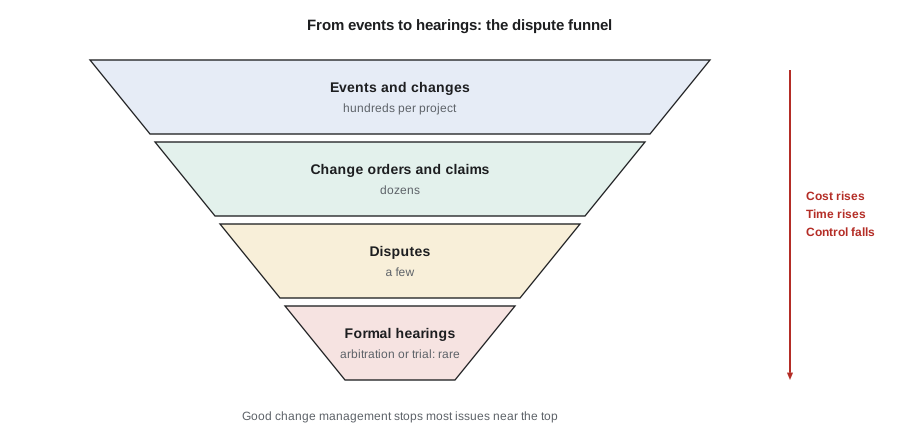
How often and how much
Change is the normal condition of construction, not the exception. Studies of building and infrastructure portfolios routinely find change order totals of a few per cent of contract value on well-planned projects and 10 % or more on complex or poorly defined ones, with renovation and health care projects at the high end. Industry surveys of construction disputes, such as the annual reports published by large claims consultancies, have for years reported average dispute values in the tens of millions of dollars on major projects and average durations of more than a year. The exact figures vary from survey to survey and should be treated as indications rather than facts, but the pattern is consistent: a small number of large disputes absorb a large share of the money and management time.
# Change-order growth across a portfolio of 40 invented building projects
import random, statistics
random.seed(420)
projects = []
for i in range(40):
    value = random.choice([8, 12, 20, 35, 42, 60]) * 1e6     # contract value
    complexity = random.choice(["simple", "typical", "complex"])
    mean = {"simple": 0.03, "typical": 0.06, "complex": 0.11}[complexity]
    growth = max(0.0, random.gauss(mean, mean / 2))            # change orders as a share of value
    projects.append((value, complexity, growth))
for k in ("simple", "typical", "complex"):
    g = [p[2] for p in projects if p[1] == k]
    print(f"{k:<8} n={len(g):>2}  median growth {statistics.median(g):5.1%}  max {max(g):5.1%}")
total_value = sum(p[0] for p in projects)
total_co = sum(p[0] * p[2] for p in projects)
big = sorted(projects, key=lambda p: p[0] * p[2], reverse=True)[:6]
share = sum(p[0] * p[2] for p in big) / total_co
print(f"Portfolio: ${total_value/1e6:,.0f}M of work, ${total_co/1e6:,.1f}M of change orders ({total_co/total_value:.1%})")
print(f"The 6 projects with the most change value hold {share:.0%} of it")simple n=16 median growth 2.9% max 6.5% typical n=12 median growth 5.8% max 10.3% complex n=12 median growth 14.3% max 17.4% Portfolio: $1,264M of work, $79.5M of change orders (6.3%) The 6 projects with the most change value hold 49% of it
The simulation is invented, but it reproduces two features that real portfolio data show. Complexity drives change growth more than size does, and change value is concentrated: a handful of projects account for a large share of the total. For a contractor or owner with many projects, this means that claim management effort should be focused where change is heaviest, and that early warning signs, such as a rising count of pending changes or requests for information, deserve attention.
Why some changes turn into disputes
Research on construction disputes, and the experience of practitioners, point to a fairly stable list of root causes. Few disputes arise from a single event; most grow from a combination of an event, a document that does not deal with it clearly and a breakdown in communication.
| Root cause | How it turns into a dispute |
|---|---|
| Incomplete or conflicting design | Gaps lead to requests for information, redesign and arguments about whether work was included in the price |
| Unclear risk allocation | Both parties believe the other took the risk of site conditions, escalation or delay |
| Failure to give or respond to notice | Rights are lost or contested; the other party says it was surprised |
| Poor records | Neither party can prove what happened, when and at what cost |
| Unrealistic baseline schedule | Delay is blamed on events when the plan could never have been met |
| Low bids and margin pressure | Contractors look to changes and claims to recover losses on the original price |
| Personalities and trust | Small issues escalate because people stop talking; positions harden |
| Slow decisions | Owners defer approving changes or extensions, so costs and delays accumulate |
Several of these causes are within the control of the people running the project. Prompt notice, good records and timely decisions in particular are cheap to get right during construction and very expensive to reconstruct afterwards. Later lessons return to each of them.
The entitlement and quantum split
Every claim has two halves. Entitlement is the question of whether the claimant has a right to any remedy: was there a change, did the contract allocate the risk to the other party, was notice given, did the event actually delay or disrupt the work? Quantum is the question of how much: how many days of extension and how many dollars. Claims are usually analysed, presented and negotiated in that order, because quantum does not matter if there is no entitlement, and because the two often call for different evidence and different experts. Lessons 2 to 5 deal mainly with entitlement and time, lessons 6 to 8 with quantum, and lessons 9 to 12 with resolution.
| Half of the claim | Questions | Typical evidence |
|---|---|---|
| Entitlement | Was it a change? Whose risk? Was notice given? Did it cause delay or extra cost? | Contract, drawings, specifications, correspondence, notices, schedules, daily reports |
| Quantum: time | How many days of extension are deserved? | Baseline and updated schedules, as-built records, schedule analysis |
| Quantum: money | What did the event cost? | Job cost records, payroll, invoices, equipment logs, overhead records, productivity data |
The people involved
Changes and claims involve a wider cast than the day-to-day work. On the contractor's side, the project manager usually owns change management, the superintendent and forepersons produce the field records, the scheduler maintains the schedule that delay analysis will test, and the estimator prices changes. On larger claims, the contractor may bring in claims consultants, forensic schedulers, quantity surveyors and lawyers. On the owner's side, the consultant or architect administers the contract, reviews change pricing and makes initial decisions on claims; the owner's project manager and procurement staff decide on approvals; and a public owner may involve legal, finance and audit functions that have their own rules and timelines.
Under CCDC 2, the consultant has a defined role in interpreting the contract documents and making findings on claims, subject to the dispute resolution procedure in Part 8. Kestrel Ridge's project team will deal mostly with Halloway Partners, but the City of Ashford's own staff and council approvals will shape how fast decisions are made.
A mindset for this course
Two attitudes help throughout. First, treat changes and claims as a normal management process rather than a fight. Prompt pricing, clear notices and good records protect both parties, and a contractor with a reputation for fair, well-documented changes gets faster approvals. Second, think about how an independent decision-maker would see the issue. An adjudicator, arbitrator or judge will read the contract, look at the contemporaneous documents and ask what a reasonable party would have done. Writing every notice, daily report and change request as if that person might one day read it is the single most useful habit for anyone on a construction project.
Worked problem
Classifying the Ashford events
For each of the four Ashford events, identify the likely source of change and whether it is likely to lead to a change order, a claim or a possible dispute, before reading the contract in detail.
Show solution
- Contaminated fill: a concealed site condition; likely a directive followed by a change order once the cost is known.
- Truss redesign: a design error; likely a time and money claim, because the cost of delay will be contested.
- Crane breakdown: a contractor problem; no entitlement to time or money, but it may complicate the analysis of the truss delay.
- Scoreboard and tile layout: owner-directed scope changes; likely change orders, but the tile change may cause disruption that is harder to agree.
Answer: Two events are likely to be settled as changes, one is the contractor's own risk and one, the truss redesign, is the most likely source of a delay claim and possible dispute. The interaction between the truss delay and the crane breakdown will raise the question of concurrent delay.
Common mistakes
MistakeTreating every change as a dispute from the start.
InsteadPrice and document changes promptly; most can be agreed as change orders.
MistakeAssuming the 'usual' allocation of a risk applies.
InsteadRead the contract and supplementary conditions; they often shift risks.
MistakeMixing entitlement and quantum arguments in one undifferentiated letter.
InsteadEstablish entitlement first, then quantify time and money separately.
MistakeLeaving records to be reconstructed after a dispute arises.
InsteadKeep contemporaneous records as if an independent decision-maker will read them.
MistakeQuoting industry dispute statistics as precise facts.
InsteadTreat survey figures as indications; they vary by source and year.
Summary and key terms
- Change is normal on construction projects; standard contracts give the owner a right to change the work and the contractor a right to price and time adjustments.
- A change becomes a claim when the parties cannot agree, and a claim becomes a dispute when the contract procedure does not resolve it.
- The source of a change, such as owner direction, design error, site conditions or contractor problems, usually decides who bears the cost, subject to the contract.
- Change value is concentrated in complex projects and in a small number of large changes.
- Disputes grow from combinations of events, unclear documents, missing notice, poor records and slow decisions.
- Every claim has an entitlement half and a quantum half, analysed in that order.
- Writing every record as if an independent decision-maker will read it is the most useful habit in claims management.
- Change
- An addition, deletion or alteration of the work ordered by the owner or treated as ordered.
- Change order
- A signed agreement on a change, its price adjustment and its time adjustment.
- Change directive
- An owner instruction to proceed with a change before price or time is agreed.
- Claim
- A demand for a change in price or time, or another remedy, that has not been agreed.
- Dispute
- A claim that has not been resolved and is heading to a formal resolution process.
- Entitlement
- The right to a remedy, established by the contract, the facts and compliance with procedures.
- Quantum
- The amount of time or money a claimant can prove it is owed.
- Concealed condition
- A physical condition at the site that differs materially from what the contract indicated or what could reasonably be expected.
- Design error
- A mistake or omission in the contract drawings or specifications.
- Forensic schedule analysis
- The study of schedules and records to determine the causes and extent of delay.
Practice problems
Work each problem on paper first, then reveal the answer to check.
Name four common sources of change on a building project.
Show answer
For example: owner scope changes, design errors, concealed site conditions and regulatory changes.
What is the difference between a change order and a change directive?
Show answer
A change order agrees price and time; a directive instructs the work before they are agreed.
When does a claim become a dispute?
Show answer
When it is rejected or not resolved within the contract's procedure and moves toward formal resolution.
What are the two halves of every claim?
Show answer
Entitlement and quantum.
Why is the 'usual' allocation of a risk only a starting point?
Show answer
Supplementary conditions and specific clauses often shift risks.
Give two root causes of disputes that the project team controls.
Show answer
For example, giving notice and keeping good records.
On Ashford, which event is the contractor's own risk?
Show answer
The crane breakdown.
Why are claims usually analysed for entitlement before quantum?
Show answer
Quantum is irrelevant without entitlement, and each needs different evidence.
What does a portfolio of projects typically show about change value?
Show answer
It is concentrated in complex projects and a few large changes.
What habit does this lesson recommend for writing site records?
Show answer
Write them as if an independent decision-maker might read them.
Lesson quiz · 5 questions
Score 60% or more to complete this lesson.
Create a free account to save your progress, take quizzes and earn a certificate.