
CON-355 · Lesson 12 of 12 · 20 min
Capstone: a safety leadership plan for a new project
This lesson brings the course together. Thornbury has won its next project in the region: Cedar Hollow, the invented five-storey seniors' residence introduced in CON-345, with 96 suites, a single-storey concrete podium for parking and amenity space and four storeys of wood frame above. Dana will be superintendent, Omar will move up to his first project as superintendent on a smaller job, and a new assistant superintendent, Hana Okafor, will join from another contractor. Dana has asked Priya to help him prepare a safety leadership plan for Cedar Hollow before mobilization: not a copy of the Larkspur Commons site safety plan, but a plan for how he and his supervisors will lead safety on the new project, using what they learned.
What the plan is for
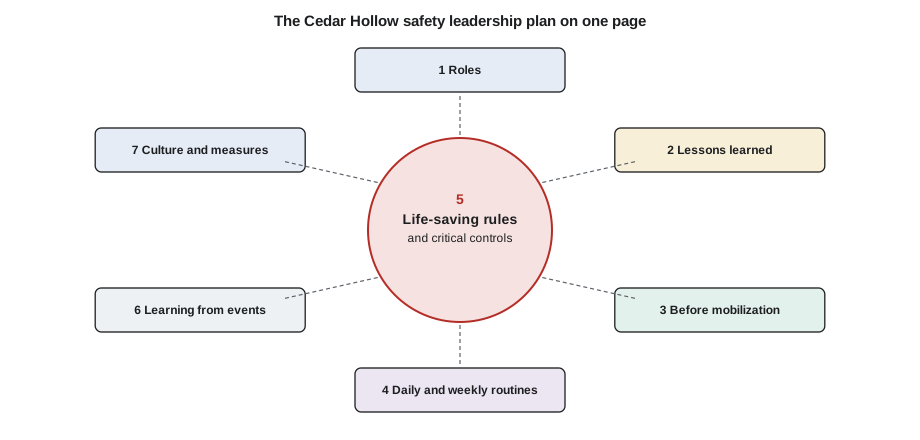
A site safety plan (lesson 3) says what the controls are. A safety leadership plan says what the supervisors will do, personally and routinely, to make sure the controls work and to build the culture from lesson 11. Dana's outline has seven parts, each based on a lesson in this course.
| Part | Question it answers | Lessons |
|---|---|---|
| 1. Legal and contractual roles | Who is prime contractor, who are the qualified persons, and who supervises whom? | 1, 2 |
| 2. Lessons from Larkspur Commons | What went well, what went wrong and what will we do differently? | All |
| 3. Plans and preparation | What must be in place before the first worker arrives? | 3, 4 |
| 4. Daily and weekly routines | What will supervisors do every day and every week? | 5, 6, 7 |
| 5. High-risk work | What are the life-saving rules and critical controls, and how will they be checked? | 9, 10 |
| 6. Learning from events | How will incidents and near misses be reported, investigated and used? | 8 |
| 7. Culture and measures | What will we measure, recognize and model? | 11 |
Part 1: Roles
The owner of Cedar Hollow has designated Thornbury as prime contractor in the CCDC 2 contract. Dana's plan lists the qualified persons for each high-risk activity by role, as Omar did each week on Larkspur Commons: excavation, scaffolds, fall protection plans, rigging and signalling, temporary electrical and hot work. It names Hana as the backup investigator and backup inspector when Dana is away, the gap that showed up in month 10 on Larkspur Commons. It also states plainly that every foreman and lead hand, Thornbury's or a subcontractor's, has supervisor duties for the workers they direct.
Part 2: Lessons from Larkspur Commons
Dana and Priya held a lessons-learned session with Omar, Mei, Ben Kowalski, the site safety committee and three subcontractor foremen. They pulled the data from the year: incidents, high-potential events, near misses by type, inspection findings, corrective action closure and the leading-indicator dashboard. The session produced a short list.
| What happened on Larkspur Commons | What Cedar Hollow will do |
|---|---|
| Fracture through an unsecured duct opening cover (lesson 8) | Frame and guard openings wherever possible; cleated, marked, screwed covers; opening log on each floor from day one |
| Guardrails removed to land materials and not replaced (lesson 7) | Material landing platforms with swing gates on every floor from the start of framing |
| Dropped objects were the top near-miss category (lesson 6) | Deck boards at the building face, tool lanyards above level 2, staging areas on each floor, marked exclusion zone at the base |
| Toolbox talks inconsistent for some subcontractors (lesson 6) | Toolbox talk and action closure in every subcontract's safety requirements; superintendent attends one talk per crew per month |
| Training expiries found late (lesson 4) | Weekly training expiry and assignment report from mobilization |
| Stop-work calls rose sharply after one was publicly thanked (lesson 6) | Recognize good catches and stop-work calls monthly from the first month |
| Backup investigator missing when Omar was away (lesson 11) | Named backups for every critical role |
The list is short on purpose. A lessons-learned exercise that produces fifty actions produces none. Seven specific changes, each with an owner, can actually be carried out.
Part 3: Before the first worker arrives
Dana's plan lists what must be ready at mobilization, so that workers arrive on a site that is already organized for safety rather than one that catches up after the first incident.
- Site safety plan drafted from the Larkspur Commons template and revised for Cedar Hollow's layout, phases and hazard register, with the excavation, podium and tower crane sections complete.
- Prevention through design review completed with the architect and structural engineer: permanent roof anchors, parapet heights that act as guardrails, early stair installation, prefabricated wall panels and the elevator pit and kitchen exhaust shafts framed with guardrails rather than covers.
- Emergency response plan with the site address card, muster points outside the crane swing radius at every phase, rescue plans and equipment for fall arrest, and the first aid assessment.
- Orientation materials translated for the expected crews, with bilingual helpers identified.
- Subcontractor prequalification complete for all high-risk trades, with interviews of the proposed foremen.
- Traffic management and public protection plans for the narrower urban site, which borders an operating care home.
The last item reflects something new. Cedar Hollow is next to an existing care home whose residents walk along the sidewalk beside the site. The public protection plan therefore includes a covered walkway, a full-height hoarding, deliveries restricted to times agreed with the care home and a named contact for residents' families. A supervisor's duty extends to the public, and on this site the public is unusually vulnerable.
Part 4: Daily and weekly routines
The core of the plan is what supervisors will do routinely. Dana writes it as a schedule, because routines that are not scheduled get squeezed out by the day's problems.
| When | Superintendent | Assistant superintendent | Foremen |
|---|---|---|---|
| Start of shift | Site walk before crews start; check high-risk activities for the day | Site walk of the areas not covered by the superintendent | Daily huddle and field-level hazard assessment with the crew |
| Through the day | Five field observations with conversations; present for critical lifts, trench entries and work near lines | Inspections and corrective action follow-up | Crew checks; stop and re-assess when conditions change |
| End of day | Review the day's observations and open actions with the safety coordinator | Update the corrective action log | Make the work area safe; report anything open |
| Weekly | Formal inspection with a worker committee member; coordination meeting with safety first on the agenda; look-ahead check of high-risk activities and qualified or competent persons | Training expiry report; toolbox talk support | Toolbox talk on a topic from the week's work |
| Monthly | Site safety committee; leading-indicator review; recognition of good catches and stop-work calls | Monthly management inspection with the project manager | One worker-led toolbox talk per crew |
Dana checked his own time on Larkspur Commons against this schedule (CON-305 had him track how he spent his days). The safety routines in the table take about an hour and a half of a superintendent's day. The time is found by delegating paperwork, running shorter coordination meetings and planning further ahead, the subjects of CON-305 and CON-335.
Part 5: Life-saving rules and critical controls
For the high-energy hazards that cause most fatalities, the plan sets a short list of life-saving rules, each with critical controls that supervisors check in the field. Breaking a life-saving rule is treated under lesson 2's graduated enforcement at the reckless end, but missing critical controls are first treated as a supervision failure: if a worker is at an edge with no anchor, the question is why no anchor was there.
| Life-saving rule | Critical controls checked in the field |
|---|---|
| Protect against falls at every edge and opening | Guardrails or secured covers in place; anchors installed before work; fall clearance checked; rescue kit and team ready |
| Never go under a suspended load | Exclusion zone marked; signal person in charge; tag lines; inspected rigging |
| Never enter an unprotected excavation | Shield or shoring in place; inspected this shift; egress within reach; spoil back from edge |
| Stay clear of moving equipment unless the operator has seen you | Spotters for reversing; separated routes; swing barricades |
| Verify energy is isolated before work | Lockout applied by each worker; zero energy tested |
| Keep the required distance from power lines | Line voltage known; limits of approach marked; zoning or spotter for equipment |
| Do not work impaired | Fitness for work checked at the huddle; supervisor removes impaired or exhausted workers |
# Planned critical-control checks per week for Cedar Hollow, by phase (illustrative planning numbers)
phases = {
    # phase: {rule: checks per week}
    "excavation and podium": {"falls": 10, "suspended loads": 8, "excavation": 15, "equipment": 10, "energy": 3, "power lines": 5},
    "wood frame":            {"falls": 25, "suspended loads": 15, "excavation": 0, "equipment": 5, "energy": 3, "power lines": 5},
    "finishing":             {"falls": 10, "suspended loads": 3, "excavation": 0, "equipment": 3, "energy": 10, "power lines": 0},
}
supervisors = {"excavation and podium": 3, "wood frame": 5, "finishing": 4}
for ph, checks in phases.items():
    total = sum(checks.values())
    top = max(checks, key=checks.get)
print(f"{ph:22s} {total:3d} checks/week, {total / supervisors[ph]:4.1f} per supervisor; most checks: {top}")excavation and podium 51 checks/week, 17.0 per supervisor; most checks: excavation wood frame 53 checks/week, 10.6 per supervisor; most checks: falls finishing 26 checks/week, 6.5 per supervisor; most checks: falls
The plan spreads the checks across supervisors and phases, with most attention on falls during framing and on excavation and loads during the podium. Each check takes a few minutes and is recorded on the inspection app as present or missing. A missing critical control is corrected on the spot as a class A finding (lesson 7), and every missing control is reviewed at the end of the week to see whether the system needs to change.
Part 6: Learning from events
The plan carries forward the reporting and investigation procedure from lesson 8: immediate notice to WorkSafeBC for serious injuries and other listed events, a preliminary investigation within 48 hours, a full report within 30 days and a corrective action report, with a worker representative on every investigation. It adds that every high-potential near miss gets the same treatment, and that Hana, as the new assistant superintendent, will lead at least one investigation with Priya in the first three months so that she learns the method before it is needed in a hurry.
Part 7: Culture and measures
The plan sets a small dashboard of leading indicators (lesson 11), reviewed monthly with the site safety committee, and makes three commitments about how supervisors will behave. They will ask about safety before schedule in every crew conversation. They will thank every person who raises a concern or stops work, before anything else. And they will never let schedule pressure become a reason to skip a critical control; if the schedule cannot be met safely, the schedule changes. The plan states that recognition will reward good catches, stop-work calls, quality hazard assessments and mentoring, and never injury-free periods.
| Measure | Target | Reviewed |
|---|---|---|
| Near-miss and hazard reports per 100 workers per month | At least 20 by month 3 | Monthly |
| Corrective actions closed on time | 90 percent | Weekly |
| Critical-control checks done and found present | 100 percent done; any missing reviewed | Weekly |
| High-potential events investigated within 48 hours | 100 percent | Monthly |
| Workers oriented and trained before starting | 100 percent | Weekly |
| Supervisor field observations | At least five per supervisor per week | Weekly |
| Recordable and lost-time injuries (lagging) | Tracked, reported and investigated; no target that could discourage reporting | Monthly |
The last row matters. Dana does not set a target for injuries, because a target invites under-reporting. Injuries are counted honestly, every one is investigated, and the leading indicators are what supervisors manage.
Presenting the plan
Dana presented the plan to Thornbury's operations manager, the owner's representative and the subcontractors' project managers at the preconstruction meeting. He kept it to one page plus the tables, and he opened with the fracture on Larkspur Commons, the real story behind several of the changes. The owner's representative, who had worked in health care, asked one question: how would residents of the care home next door be protected? Dana walked through the public protection plan. The question was a reminder that a construction site's safety reaches beyond its fence.
The plan will change as Cedar Hollow proceeds, and Dana has scheduled the first review for the end of the excavation phase. The plan is not the point; the habits it describes are. A superintendent who walks the site before the crews arrive, checks the critical controls, thanks people who speak up, investigates honestly and learns from every event will run a safer site with or without a document. The document makes sure that the habits are planned, shared with the whole supervisory team, and kept when the pressure is on.
Looking back over the course
This course has followed Larkspur Commons through a year of safety leadership. It began with the legal duties of supervisors and the evidence of due diligence, built the systems a supervisor runs every day, from site safety plans and orientations to hazard assessments, toolbox talks, inspections and investigations, covered the high-risk work that causes most serious injuries, and ended with culture. The common thread is that safety on a construction site is led by its supervisors, through the same planning, presence, communication and follow-through that make a site productive and well built. CON-365, Labour Relations and Workforce Management, continues the supervision track with the people side of running a construction workforce.
Common mistakes
MistakeCopying the last project's site safety plan without asking what to change.
InsteadRun a lessons-learned session with real data and carry a short list of specific changes into the new plan.
MistakeLeaving safety routines to fit around the day's problems.
InsteadSchedule daily, weekly and monthly safety routines for each supervisory role.
MistakeSetting a target of zero injuries for the project.
InsteadTrack injuries honestly and manage leading indicators; injury targets invite under-reporting.
MistakeTreating every missing critical control as worker misconduct.
InsteadAsk first why the control was missing, and fix the supervision or planning gap.
MistakeForgetting the public and neighbours in the plan.
InsteadInclude public protection, especially where neighbours are vulnerable, such as residents of a care home.
Summary and key terms
- A safety leadership plan states what supervisors will personally and routinely do to make the controls work and build culture.
- Its parts cover roles, lessons learned, preparation, routines, life-saving rules and critical controls, learning from events, and culture and measures.
- Lessons learned should be few, specific and owned.
- Prevention through design, prequalification, emergency planning and public protection are ready before mobilization.
- Daily, weekly and monthly routines are scheduled for each supervisory role.
- Life-saving rules for high-energy hazards are backed by critical controls checked in the field.
- Leading indicators are managed; injuries are tracked honestly without targets that discourage reporting.
- Safety leadership plan
- A plan stating what supervisors will do routinely to lead safety on a project.
- Lessons learned
- Specific changes drawn from a past project's data and experience, each with an owner.
- Life-saving rule
- A rule for a high-energy hazard whose breach could readily cause a fatality.
- Critical control check
- A field check that a critical control for a high-energy hazard is in place.
- Prevention through design
- Eliminating or reducing hazards through decisions made in design and planning.
- Public protection plan
- The measures that protect people outside the site, such as hoarding, covered walkways and delivery limits.
Practice problems
Work each problem on paper first, then reveal the answer to check.
Why does Dana's lessons-learned list have only seven items?
Show answer
Because a long list produces no action; a few specific, owned changes can actually be carried out.
Name three things that must be ready before the first worker arrives on Cedar Hollow.
Show answer
For example: the site safety plan, the prevention through design review, the emergency response plan, translated orientation materials, prequalified subcontractors and traffic and public protection plans.
How many critical-control checks per week per supervisor are planned during framing?
Show answer
About 10.6 (53 checks across 5 supervisors), with falls receiving the most.
Why does the plan not set a target for injuries?
Show answer
Because injury targets invite under-reporting; injuries are tracked honestly while leading indicators are managed.
What made the public protection plan especially important on Cedar Hollow?
Show answer
The site borders an operating care home whose residents walk past it.
Lesson quiz · 5 questions
Score 60% or more to complete this lesson.
Create a free account to save your progress, take quizzes and earn a certificate.