
CON-355 · Lesson 1 of 12 · 19 min
Supervisor duties under provincial OHS law
On a construction site, the person who most shapes whether workers go home unhurt is not the safety coordinator, the owner or the inspector. It is the supervisor who assigns the work, decides how it will be done and is standing nearby when it happens. This course is about that role. CON-305 introduced the superintendent's job and gave a first overview of supervisors' legal duties, due diligence and personal liability. This course goes further: it treats safety as a core part of supervising construction work and follows the Larkspur Commons team through a year of planning, hazard assessment, inspections, incidents, high-risk work and culture building.
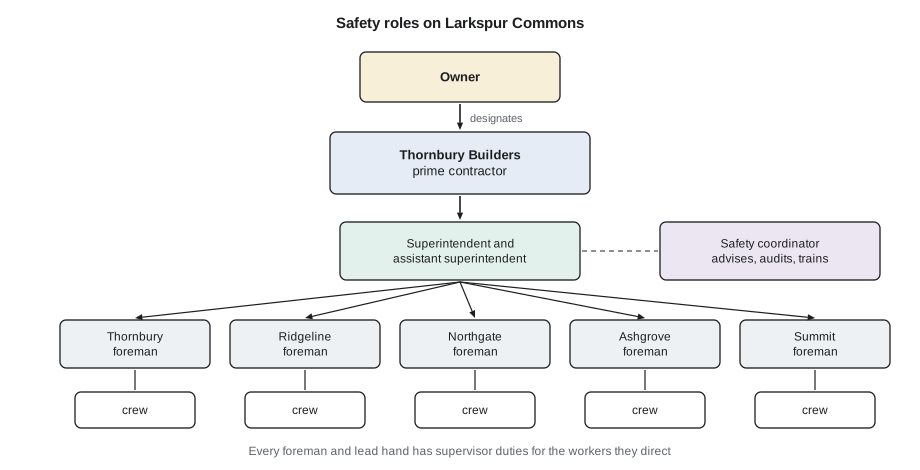
Larkspur Commons is the six-storey building of 112 rental homes over shops in Kelowna, British Columbia, that has run through the whole track: a two-storey concrete podium and four storeys of wood frame, built by Thornbury Builders for about $48 million over 20 months. Dana Whitfield is the superintendent, Omar Haddad the assistant superintendent and Mei Lin the field engineer. For this course Thornbury has added a site safety coordinator, Priya Sandhu, who works across two Thornbury sites. Priya advises, audits and trains; she does not supervise the crews. That distinction is the first lesson of the course: safety is a line responsibility, and the safety coordinator supports the line rather than replacing it.
Who is a supervisor?
Canadian occupational health and safety laws define a supervisor broadly. In British Columbia, the Workers Compensation Act defines a supervisor as a person who instructs, directs and controls workers in the performance of their duties. Ontario's Occupational Health and Safety Act uses a similar test: a person who has charge of a workplace or authority over a worker. The title does not matter. A lead hand who tells three labourers where to set up and what to do next is a supervisor for those workers, whether or not the company calls him one. On Larkspur Commons that means Dana and Omar, every Thornbury foreman and lead hand, and every subcontractor foreman, are supervisors of the workers they direct.
A worker who directs others for a single task is a supervisor for that task. When Omar sends an apprentice carpenter with a journeyman to install guardrails on level 4, the journeyman directs the apprentice's work and is responsible for doing it safely. Thornbury's site rules make this explicit: anyone who directs the work of another worker is expected to know the hazards of that work and to make sure the controls are in place before it starts.
What the law requires of supervisors
British Columbia's Workers Compensation Act sets out general duties for employers, workers, supervisors, owners, prime contractors and suppliers, and the Occupational Health and Safety Regulation fills in the detail. A supervisor must ensure the health and safety of the workers under their direct supervision, know the requirements of the Act and Regulation that apply to that work, ensure the workers know about the hazards and comply with the rules, and consult and co-operate with the joint committee or worker representative. Ontario's OHSA states the duties in a familiar list: ensure workers use the protective devices and procedures the employer requires, advise workers of existing or potential hazards that the supervisor knows about, provide written instructions where prescribed, and take every precaution reasonable in the circumstances for the protection of a worker. The wording differs among provinces, but the core is the same everywhere in Canada.
| Duty | What it means on site | Example on Larkspur Commons |
|---|---|---|
| Know the requirements | Know the rules that apply to the work being supervised | Omar reads the fall protection and excavation requirements before the podium backfill and the level 3 framing start |
| Ensure workers are trained and competent | Do not assign work to someone who has not been trained for it | An apprentice is not sent onto the swing stage until his training is recorded |
| Inform workers of hazards | Tell workers about hazards you know of, or ought to know of | The framing foreman briefs the crew on the open stair shaft before work on level 4 |
| Ensure compliance | See that workers follow procedures and use protective equipment | Dana stops a worker on a ladder near the edge without fall protection |
| Correct hazards | Fix hazards or report them to someone who can | Omar has a missing guardrail section replaced before the area reopens |
| Co-operate with the committee | Work with the joint committee or worker representative | Dana attends the monthly site safety committee meeting and acts on its recommendations |
Prime contractors, controlling employers and multi-employer sites
A construction site has many employers. British Columbia handles that with the prime contractor. On a multiple-employer workplace the owner must designate a prime contractor in writing; if it does not, the owner is the prime contractor. The prime contractor must ensure that the activities of all the employers, workers and others are coordinated, and must establish and maintain a system or process to ensure compliance with the Act and Regulation. Under the CCDC 2 contract for Larkspur Commons, the owner has designated Thornbury as prime contractor, so Dana's team is responsible for coordinating the safety of every trade on site, not only Thornbury's own workers. That does not relieve each subcontractor of its own duties as an employer. Ridgeline Framing still has to train, supervise and equip its own crews; Thornbury has to make sure the pieces fit together.
The practical result is the same in both countries. The general contractor's superintendent cannot say that a subcontractor's unsafe practice is the subcontractor's problem. Dana is expected to notice it, to require it to be corrected, and to follow up if it is not. Lesson 4 covers how Thornbury prequalifies subcontractors and holds them to the site rules.
The competent person and the qualified person
Many sections of the BC Regulation require that particular work be done or checked by a qualified person, defined as someone who has the knowledge, training and experience to perform the duty. Fall protection plans, excavation inspections, scaffold inspections and rigging checks are examples. Other provinces use the term competent person for a similar idea. The supervisor does not have to be the qualified person for every task, but must know when one is needed and make sure one is assigned and has done the work.
| Work on Larkspur Commons | Who must check it | When |
|---|---|---|
| Podium backfill trench for the storm line | Qualified person (excavation) | Daily, after rain and after any event that could change conditions |
| Frame scaffold on the east elevation | Qualified person (scaffold) | Before each shift and after any alteration |
| Leading-edge framing on levels 3 to 6 | Supervisor with a written fall protection plan | Before work starts on each floor and daily |
| Tower crane lifts of wall panels | Qualified rigger and qualified signaller | Each lift; critical lifts planned in advance (CON-325) |
| Temporary electrical distribution | Qualified electrical worker | At installation and at regular intervals |
Each week Omar checks the look-ahead schedule (CON-335) against a simple list: which activities next week need a qualified or competent person, and who it will be. If an activity has no name against it, the activity is not ready.
# Next week's high-risk activities and their designated checker (illustrative)
activities = [
    ("storm line trench, gridline A", "excavation", "Omar Haddad"),
    ("east elevation scaffold raise", "scaffold", "R. Gill (scaffold contractor)"),
    ("level 5 leading-edge framing", "fall protection", "B. Kowalski"),
    ("wall panel picks, levels 5-6", "rigging", "T. Moreau (rigger)"),
    ("roof membrane torch-on, podium", "hot work", None),
    ("temporary power to level 6", "electrical", "Ashgrove Electric lead hand"),
]
ready = [a for a in activities if a[2]]
missing = [a for a in activities if not a[2]]
print(f"{len(ready)} of {len(activities)} activities have a designated checker")
for name, kind, _ in missing:
print(f"NOT READY: {name} ({kind}) has no qualified or competent person assigned")5 of 6 activities have a designated checker NOT READY: roof membrane torch-on, podium (hot work) has no qualified or competent person assigned
The torch-on roofing at the podium had no name because the roofing subcontractor had changed its foreman. Omar phoned the subcontractor that afternoon, and the new foreman's hot work training record was in the site file before the work started.
Workers' rights that supervisors must respect
Workers in every Canadian jurisdiction have three basic rights: to know about hazards, to participate in health and safety through committees and representatives, and to refuse work they have reasonable cause to believe is unsafe. In British Columbia, a worker who refuses unsafe work must report it to the supervisor, who must investigate and either fix the problem or explain why it is safe; if the worker still refuses, the supervisor investigates with a worker representative, and if the matter is still not resolved, a WorkSafeBC officer is called. A worker must not be disciplined for refusing in good faith. A supervisor who responds to a refusal with anger or a threat, or who quietly gives the refuser fewer hours, is breaking the law and teaching the whole crew to stay silent.
Dana's approach to a refusal is simple: thank the worker, stop the task, look at the hazard together, and fix it or explain it. Most refusals on a construction site are not legal disputes. They are a worker telling the supervisor something the supervisor needs to know.
Regulators and where Larkspur Commons sits
Occupational health and safety in Canada is mainly provincial. WorkSafeBC administers both the compensation system and the safety regulation in British Columbia, and its prevention officers inspect construction sites, issue orders and impose administrative penalties. Federally regulated work, such as some interprovincial pipelines and telecommunications, falls under the Canada Labour Code instead, but a residential building in Kelowna is provincial. Thornbury also builds in Alberta, where the OHS Act and Code apply and the compensation board is separate from the safety regulator. Supervisors who move between provinces need to check the local rules; the principles carry over but the details do not.
| Feature | British Columbia (Larkspur Commons) | Ontario (for comparison) |
|---|---|---|
| Regulator | WorkSafeBC | Ministry of Labour, Immigration, Training and Skills Development |
| Main rules | Workers Compensation Act Part 2; OHS Regulation | OHSA; Construction Projects regulation (O. Reg. 213/91) |
| Who coordinates a multi-employer site | Prime contractor | Constructor |
| Supervisor duties | Stated in the Act | Stated in the Act (s. 27) |
This course gives the rules for the Larkspur Commons jurisdiction in detail and mentions others for comparison. HSE-375, Constructor and Supervisor Responsibilities on Construction Projects, in the Safety Training stream, covers the legal framework in more depth for those who need it.
Safety as part of supervising, not an add-on
A supervisor who treats safety as a separate job, something the safety coordinator does on Thursdays, will find that the work is planned without it and the hazards are discovered when someone is hurt. Dana's view, which this course follows, is that a job is not well planned unless it is planned to be done safely, and a crew is not well led unless it is led to work safely. The same habits that produce good schedules and good quality, covered in CON-335 and CON-345, produce safe work: thinking ahead, checking before work starts, setting clear expectations, following up and learning from what goes wrong.
Lesson 2 turns to due diligence: how a supervisor shows, with records and actions, that they took every reasonable precaution. Lessons 3 to 8 cover the systems a supervisor runs every day: site safety plans, orientations, hazard assessments, toolbox talks, inspections and incident investigations. Lessons 9 and 10 cover the high-risk work that causes most serious injuries in construction, and lesson 11 covers safety culture. Lesson 12 puts it all together in a safety leadership plan for a new project.
Common mistakes
MistakeAssuming that only people with the title supervisor have supervisor duties.
InsteadAnyone who directs the work of another worker is a supervisor for that work, whatever their title.
MistakeLeaving safety to the safety coordinator.
InsteadSafety is a line responsibility: the supervisor plans, directs and checks the work; the coordinator advises and audits.
MistakeTreating a subcontractor's unsafe practice as the subcontractor's problem.
InsteadAs prime contractor, the general contractor must coordinate safety across all employers and require hazards to be corrected.
MistakeStarting high-risk work without a designated qualified or competent person.
InsteadCheck the look-ahead each week and name the person for every activity that needs one before it starts.
MistakeReacting to a work refusal as a challenge to authority.
InsteadStop the task, look at the hazard with the worker, and fix it or explain it; never retaliate.
Summary and key terms
- Canadian OHS laws define a supervisor by function and place duties on supervisors directly.
- Anyone who directs another worker's work is a supervisor for that work.
- Core duties are to know the rules, train and inform workers, ensure compliance, correct hazards and co-operate with committees or representatives.
- On a multiple-employer site, the prime contractor must coordinate all employers' activities and maintain a compliance system.
- Qualified persons are required for many high-risk tasks; the supervisor must make sure one is assigned.
- Workers have the rights to know, participate and refuse unsafe work, and must not be disciplined for using them.
- Safety is part of planning and leading the work, not a separate job.
- Supervisor
- A person who instructs, directs and controls workers in the performance of their duties.
- Prime contractor
- The person designated in writing by the owner to coordinate health and safety on a multiple-employer workplace in British Columbia.
- Multiple-employer workplace
- A workplace where workers of two or more employers work at the same time.
- Qualified person
- A person with the knowledge, training and experience to perform a specific duty under the Regulation.
- Right to refuse
- A worker's right to refuse work they have reasonable cause to believe is unsafe, without reprisal.
- Line responsibility
- The principle that safety is managed by the people who direct the work, supported by safety specialists.
Practice problems
Work each problem on paper first, then reveal the answer to check.
A lead hand who directs two labourers is not called a supervisor by his company. Does he have supervisor duties for their work?
Show answer
Yes. The duties follow the function of directing work, not the title.
Who coordinates safety across all the employers on Larkspur Commons, and on what basis?
Show answer
Thornbury, because the owner designated it in writing as prime contractor.
In the look-ahead check, which activity was not ready and why?
Show answer
The torch-on roofing, because no trained hot work supervisor was assigned after the roofer changed foremen.
What does Priya Sandhu do, and what does she not do?
Show answer
She advises, audits and trains; she does not supervise the crews or replace the line supervisors.
A worker refuses to work from a ladder near an unprotected edge. What should Dana do first?
Show answer
Stop the task, look at the hazard with the worker, and fix it or explain why it is safe, without any reprisal.
Lesson quiz · 5 questions
Score 60% or more to complete this lesson.
Create a free account to save your progress, take quizzes and earn a certificate.