
CON-355 · Lesson 10 of 12 · 18 min
High-risk work II: excavation, lifting, electrical and health hazards
Falls are not the only way construction kills. The other leading causes are being struck by vehicles, equipment or falling and swinging loads; being caught in or between objects, including trench collapses; and electrocution. Health hazards such as silica dust kill more slowly and less visibly. This lesson covers how a supervisor leads high-risk work beyond falls on Larkspur Commons: the podium excavation and services trenches, crane and rigging operations, mobile equipment, electrical hazards and the health hazards of cutting, drilling and heat. It builds on HSE-217 (ground disturbance and excavation), HSE-219 (cranes and rigging), HSE-224 (electrical), HSE-242 (silica) and CON-325 (lift plans and temporary works).
Excavations and trenches
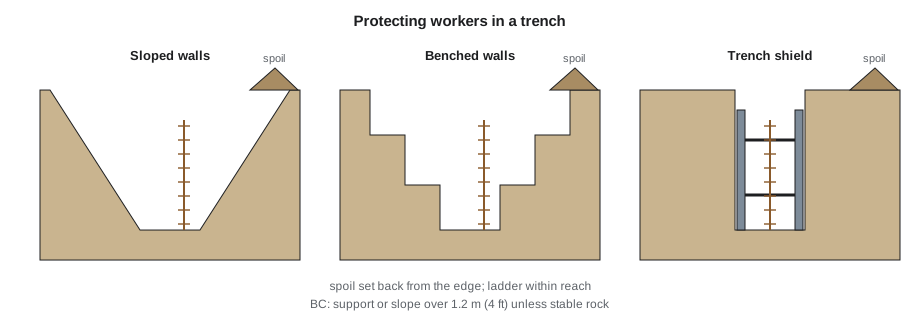
A cubic metre of soil weighs well over a tonne. A trench wall that collapses on a worker can crush or suffocate them in seconds, and rescue is slow and dangerous; many trench deaths include would-be rescuers. Trench collapses are among the most preventable deaths in construction because the controls are well known: slope, bench or shore the walls, keep spoil and equipment back from the edge, provide safe access, inspect daily, and never enter an unprotected trench.
British Columbia's Regulation, in its excavation provisions, requires that before a worker enters an excavation over 1.2 m (4 ft) deep, its walls be sloped, benched, shored or otherwise supported as the Regulation or a professional engineer specifies, unless a qualified person confirms that the ground is stable rock or similar. Underground utilities must be located before ground is disturbed, using BC 1 Call and the utility owners' records, and excavations near utilities must be dug with care and hand or vacuum exposure close to the line. A qualified person must inspect excavations at the start of each shift and after any event that could affect stability, such as rain or nearby vibration.
The storm line trench along gridline A on Larkspur Commons was about 2.4 m deep in sandy silt with a high water table after rain. The excavation plan used a trench shield for the deepest section and benching where space allowed, with spoil kept back on the far side.
# Top width needed to slope a trench at an illustrative ratio (check the Regulation or an engineer for the real requirement)
depth = 2.4               # m
bottom_width = 1.2        # m, for the pipe and bedding
for soil, h_per_v in [("stable, cohesive (illustrative 0.75 : 1)", 0.75), ("average soil (illustrative 1 : 1)", 1.0), ("granular, wet (illustrative 1.5 : 1)", 1.5)]:
    top = bottom_width + 2 * h_per_v * depth
    print(f"{soil:40s} top width {top:4.1f} m")
available = 4.5           # m between the podium wall and the property line
print(f"space available {available} m -> sloping only fits the steepest case; use a trench shield")stable, cohesive (illustrative 0.75 : 1) top width 4.8 m average soil (illustrative 1 : 1) top width 6.0 m granular, wet (illustrative 1.5 : 1) top width 8.4 m space available 4.5 m -> sloping only fits the steepest case; use a trench shield
The calculation shows why trench boxes and shoring are so common on urban sites: there is rarely room to slope the walls back far enough. Dana's rule for the trench was the same as the law's: no one enters until the shield is in place and the competent or qualified person has inspected it that morning, and anyone who sees a crack, a bulge or water seeping from a wall gets out and calls him.
Cranes, rigging and suspended loads
CON-325 covered crane selection, lift plans and critical lifts. A supervisor's daily job during crane work is to make sure the plan is followed at the hook. The key rules on Larkspur Commons are few and absolute.
| Rule | Why |
|---|---|
| No one under a suspended load, ever | Rigging, connections and loads can fail without warning |
| One qualified signal person in charge of each lift, with radio contact | Conflicting signals cause collisions and dropped loads; any worker may give the stop signal |
| Rigging inspected before use by a qualified rigger; damaged slings removed | Sling failure is a leading cause of dropped loads |
| Tag lines on loads that can swing or spin; hands off the load until it is near landing | Workers are crushed between swinging loads and structures |
| Exclusion zones at pickup and landing, marked and enforced | Keeps people out of the drop and swing zone |
| Wind limits from the lift plan and the crane manufacturer, checked on the anemometer | Large panels act as sails |
| Crane stops when the operator cannot see the load or loses signal contact | Blind lifts need a clear communication chain |
Struck-by incidents with loads usually involve a worker who stepped under or beside the load to guide it or to save time. Supervisors who tolerate 'just this once' teach a crew that the rule is flexible. Dana stops any lift where he sees anyone under the load, and the lift does not resume until the foreman has talked to the crew.
Vehicles and mobile equipment
Excavators, loaders, telehandlers, concrete trucks and delivery vehicles share the site with workers on foot. The common pattern in fatal incidents is a vehicle reversing or swinging into a worker in its blind spot. The site traffic plan from CON-325 separates vehicles and pedestrians where possible. Where they cannot be separated, the supervisor's controls are a spotter for every reversing vehicle in shared areas, eye contact rule (workers do not approach equipment until the operator has seen them and signalled), working back-up alarms and cameras, high-visibility clothing, and swing-radius barricades around excavators. Operators must be trained and evaluated on the equipment they use; HSE-218 covers powered mobile equipment in detail.
Electrical hazards
Construction workers are electrocuted mostly by contact with overhead power lines, by faulty temporary power and tools, and by working on circuits they believed were dead. For overhead lines, British Columbia's Regulation sets limits of approach that increase with voltage; for the distribution lines common beside urban sites, up to 75 kV, the minimum distance is 3 m (10 ft), and equipment that could come closer needs an assurance in writing from the utility and specific procedures. On Larkspur Commons, the 25 kV distribution line along the north street was inside the crane's potential reach, so the utility installed insulating covers and the crane was fitted with a zoning system to stop it slewing toward the line.
Temporary power must be installed by qualified electrical workers, protected by ground fault circuit interrupters where the code requires, and inspected regularly. Extension cords are kept off walking surfaces and out of water, and damaged cords are removed from service immediately. Lockout before work on circuits and equipment follows HSE-210. On a site with many trades, the supervisor's key role is to make sure that no one works on a circuit someone else controls without coordinating the lockout.
Silica and other health hazards
Respirable crystalline silica from cutting, grinding and drilling concrete, masonry and stone causes silicosis, lung cancer and other diseases, often decades after exposure. British Columbia applies an occupational exposure limit of 0.025 mg/m3 as an eight-hour average for respirable quartz, and requires an exposure control plan where workers are, or may be, exposed to silica, covering the tasks, controls, training and health monitoring. The controls are well established: water delivered to the blade or bit, tools with dust shrouds connected to vacuums with HEPA filters, and respirators where those controls are not enough.
# Silica exposure from coring and saw-cutting on the podium (illustrative air sampling results)
limit = 0.025                        # mg/m3, 8-hour average (respirable quartz)
samples = [  # (task, minutes, concentration mg/m3)
    ("saw-cutting slab, water feed", 90, 0.040),
    ("coring, shroud and HEPA vacuum", 120, 0.018),
    ("cleanup with HEPA vacuum", 45, 0.010),
    ("other work, no silica", 225, 0.0),
]
twa = sum(m * c for _, m, c in samples) / 480
print(f"8-hour average {twa:.3f} mg/m3 vs limit {limit} -> {'OVER' if twa > limit else 'within limit'}")
worst = max(samples, key=lambda s: s[2])
print(f"highest task: {worst[0]} at {worst[2]} mg/m3 -> respirator and controls reviewed in the exposure control plan")8-hour average 0.013 mg/m3 vs limit 0.025 -> within limit highest task: saw-cutting slab, water feed at 0.04 mg/m3 -> respirator and controls reviewed in the exposure control plan
Other health hazards on Larkspur Commons include noise from saws and nail guns, which is controlled by quieter tools where available, distance and hearing protection; solvents and adhesives in finishing, controlled by product choice and ventilation; and heat. CON-325 covered heat and wildfire smoke planning for the Okanagan summer. The supervisor's role is to apply the heat plan on the hottest days: water, shade, rest breaks that increase as the temperature rises, acclimatization for new workers, early starts, and the authority to stop heavy work. HSE-243 covers heat and cold stress in detail.
Impairment and fatigue
A worker impaired by alcohol, cannabis, other drugs or fatigue is a hazard to themselves and to everyone near them, especially around equipment, edges and loads. CON-305 covered the legal side of impairment policies and accommodation. A supervisor's practical role is to recognize the signs, such as slurred speech, unsteadiness, unusual behaviour, smell or extreme tiredness, to remove the worker from safety-sensitive work immediately and safely, never letting them drive, and then to follow the company procedure, which involves the safety coordinator and human resources. Fatigue deserves as much attention as substances: long weeks of overtime (CON-305) and early starts in summer both increase the risk, and a supervisor who schedules a crew for twelve-hour days on the frame for three weeks has created a hazard.
The supervisor's role in high-risk work
The common thread through all these hazards is that the controls are known and the failures are usually failures of execution: a shield not moved forward with the digging, a worker stepping under a load, a cord left in water, a dust shroud disconnected because it slowed the cut. That is why high-risk work needs the supervisor's presence. Thornbury's rule is that the superintendent or assistant superintendent is on site and checks the controls in person whenever a critical lift, trench entry, hot work at height or work near overhead lines is under way. It is not a guarantee, but it changes what happens when a crew is tempted to take a short cut.
Common mistakes
MistakeEntering a trench to save time before the shield is in place.
InsteadNo entry until the protective system is in place and inspected that day, regardless of how briefly.
MistakeLetting workers guide loads by standing under or beside them.
InsteadUse tag lines, keep hands off until the load is near landing, and stop any lift with anyone under the load.
MistakeAssuming an overhead line is far enough away.
InsteadCheck the voltage and limits of approach, and use utility covers, zoning and spotters where equipment could come close.
MistakeRelying on respirators alone for silica.
InsteadUse water or shrouds with HEPA vacuums first, and respirators only where engineering controls are not enough.
MistakeIgnoring fatigue because there is no test for it.
InsteadPlan hours to avoid long runs of overtime and early starts, and remove visibly exhausted workers from safety-sensitive work.
Summary and key terms
- Beyond falls, the main causes of death are struck-by, caught-in or between, and electrocution.
- BC requires excavations over 1.2 m that workers enter to be sloped, benched or shored, utilities located first, and inspections each shift.
- Crane work depends on absolute rules: no one under a load, one signal person, inspected rigging, tag lines, exclusion zones and wind limits.
- Mobile equipment incidents are prevented by separation, spotters, the eye contact rule and swing barricades.
- Overhead lines have limits of approach that increase with voltage (3 m up to 75 kV in BC); temporary power and lockout need coordination.
- Silica needs an exposure control plan, water or shrouds with HEPA vacuums, and respirators where needed.
- Impairment and fatigue require recognition, removal from safety-sensitive work and planning of hours.
- Protective system
- Sloping, benching, shoring or a trench shield that protects workers in an excavation from collapse.
- Qualified person (excavation)
- A person with the knowledge, training and experience to inspect an excavation and its supports.
- Limit of approach
- The minimum distance workers and equipment must keep from an energized power line, increasing with voltage.
- Exclusion zone
- An area around a lift or operation that workers may not enter while it is under way.
- Exposure control plan
- A written plan for controlling exposure to a hazardous substance such as silica.
- Respirable crystalline silica
- Fine silica dust from cutting, grinding or drilling concrete, masonry and stone, which can cause lung disease.
Practice problems
Work each problem on paper first, then reveal the answer to check.
Why did the storm line trench use a shield rather than sloping?
Show answer
There was not enough space between the podium wall and the property line to slope the walls back far enough.
Name three absolute rules for crane lifts on Larkspur Commons.
Show answer
No one under a load; one qualified signal person in radio contact; tag lines and exclusion zones (also inspected rigging and wind limits).
How was the 25 kV line on the north street dealt with?
Show answer
The utility installed insulating covers and the crane was fitted with a zoning system to stop it slewing toward the line.
In the silica example, was the 8-hour average within the limit? What was the highest task?
Show answer
Yes, about 0.013 mg/m3 against 0.025; saw-cutting with water feed was highest.
What should a supervisor do with a worker who appears impaired on the frame?
Show answer
Remove them from safety-sensitive work immediately and safely, ensure they do not drive, and follow the company procedure with the safety coordinator and HR.
Lesson quiz · 5 questions
Score 60% or more to complete this lesson.
Create a free account to save your progress, take quizzes and earn a certificate.