
CON-340 · Lesson 11 of 12 · 25 min
Choosing a delivery method
By now it should be clear that no delivery method is best in general. Each is a bundle of trade-offs, and the right choice depends on what the owner is trying to achieve, what the project is like, what the market will offer, which risks the owner can manage, and what the owner's own team can do. This lesson brings those factors together into a structured selection process of the kind public owners now use, and looks at how risk allocation differs across methods, a topic CON-350 treats in more depth.
Start with the owner's goals
The first step is to state what success means for this project and rank the goals. Owners often say they want everything: lowest cost, fastest schedule, highest quality, least risk and full control. Forcing a ranking is uncomfortable but essential, because the methods trade these off against each other.
| Goal | Methods that tend to serve it | Methods that tend to conflict with it |
|---|---|---|
| Lowest initial price through competition | Design-bid-build; low-bid design-build | Progressive models, IPD (negotiated price) |
| Earliest completion | Design-build, CMAR, IPD | Design-bid-build |
| Early price certainty | Design-build lump sum, P3 | Agency CM, IPD (target only) |
| Owner control of design | Design-bid-build, agency CM, CMAR | Design-build, P3 |
| Single point of responsibility | Design-build, P3 | Design-bid-build, agency CM |
| Managing high uncertainty and complexity | CMAR, progressive design-build, IPD, alliance | Design-bid-build, lump-sum design-build |
| Life-cycle performance | DBFM or DBFOM P3 | Methods that end at handover |
| Minimizing owner staff effort | Design-build, P3 (after close) | Agency CM, IPD |
Then look at the project, the market and the owner
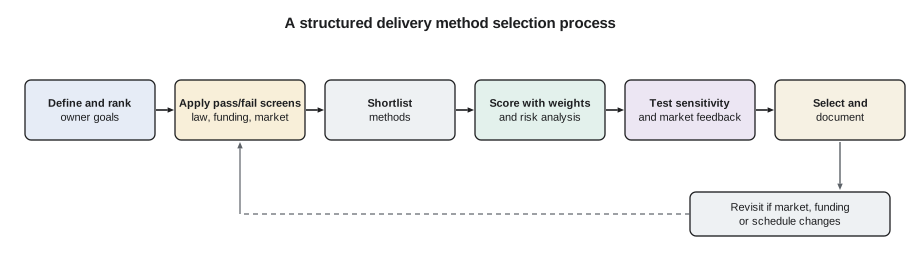
With goals ranked, the owner considers factors that can make a method unsuitable regardless of goals. Some are pass/fail: a method the owner lacks legal authority to use, a funding condition that rules a method out, or a market where no contractor will accept the risk. Others shift the balance.
| Factor | Questions to ask |
|---|---|
| Project complexity | Are there difficult interfaces, existing facilities, phasing, novel systems or major unknowns? |
| Definition of scope | Can requirements be stated clearly now, or will they evolve? |
| Schedule pressure | Is there a fixed deadline, such as an event, funding expiry or regulatory date? |
| Market conditions | How many capable bidders exist? Will they accept fixed-price risk? Are trade markets thin? |
| Owner capacity and experience | Does the owner have staff and advisers for this method? Has it used it before? |
| Legal and funding constraints | Does the owner have authority? Do grant conditions restrict procurement? |
| Life-cycle priorities | Does the owner want the builder to maintain the asset long term? |
| Stakeholder and political factors | Is the project highly visible? Must the process be seen as maximally open? |
Market sounding is valuable here. Before choosing, many public owners meet potential bidders, describe the project and the methods under consideration, and ask how the market would respond. If no general contractor will take fixed-price ground risk on a tunnel, a lump-sum design-build will attract few bids or very high ones. If local trades are fully booked, a construction manager may struggle to get competitive trade prices.
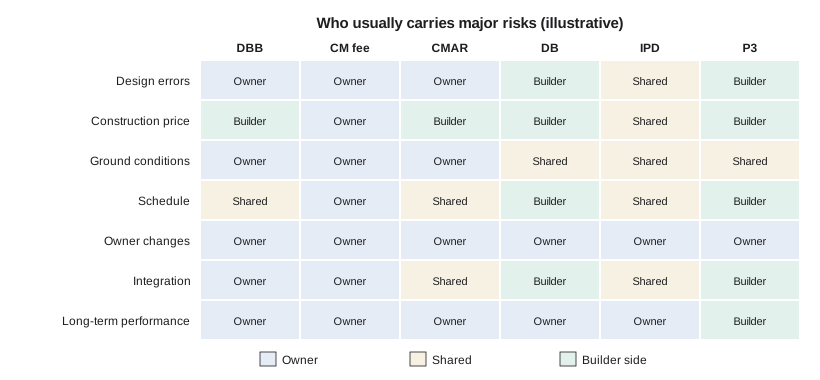
Comparing risk allocation
One way to compare methods is to list the project's main risks, estimate their expected cost, and ask who carries each under each method, and how efficiently. A risk transferred to a party that cannot control it is usually priced at a premium; a risk retained by the owner costs its expected value plus whatever the owner loses through poor management. The aim is not to transfer as much risk as possible, but to give each risk to the party best able to manage it at the lowest cost.
# Expected cost of retained and transferred risk for a $150 million hospital addition (illustrative, $ millions)
risks = {   # risk: expected cost if retained by the owner
    "Design errors and coordination": 6.0, "Construction cost on known scope": 5.0,
    "Ground conditions": 3.0, "Schedule delay": 4.5, "Systems integration": 3.5,
}
# share of each risk transferred to the builder side under each method, and premium charged on transferred risk
methods = {
    "Design-bid-build": ({"Design errors and coordination": 0.0, "Construction cost on known scope": 1.0,
                          "Ground conditions": 0.2, "Schedule delay": 0.5, "Systems integration": 0.3}, 0.30),
    "CM at risk":       ({"Design errors and coordination": 0.3, "Construction cost on known scope": 0.9,
                          "Ground conditions": 0.2, "Schedule delay": 0.5, "Systems integration": 0.5}, 0.25),
    "Design-build":     ({"Design errors and coordination": 1.0, "Construction cost on known scope": 1.0,
                          "Ground conditions": 0.5, "Schedule delay": 0.8, "Systems integration": 0.8}, 0.35),
    "IPD":              ({"Design errors and coordination": 0.5, "Construction cost on known scope": 0.5,
                          "Ground conditions": 0.5, "Schedule delay": 0.5, "Systems integration": 0.5}, 0.10),
}
for m, (transfer, premium) in methods.items():
    retained = sum(v * (1 - transfer[k]) for k, v in risks.items())
    priced = sum(v * transfer[k] for k, v in risks.items()) * (1 + premium)
print(f"{m:17} retained {retained:5.1f} transferred and priced {priced:5.1f} total {retained + priced:5.1f}")Design-bid-build retained 13.1 transferred and priced 11.6 total 24.7 CM at risk retained 11.1 transferred and priced 13.6 total 24.7 Design-build retained 3.1 transferred and priced 25.5 total 28.6 IPD retained 11.0 transferred and priced 12.1 total 23.1
In this invented example the methods' total risk cost differs by a few million dollars, and the method that transfers the most risk is not the cheapest, because the market charges a premium for taking it. IPD looks cheapest here because the shared risk is assumed to be priced with a small premium, which is true only if the collaboration works. The numbers are only as good as the assumptions, but the exercise forces a useful discussion of which risks matter and who should hold them.
A weighted scoring matrix
Most structured selection tools combine pass/fail screens with a weighted scoring matrix. The owner chooses criteria from its goals and factors, weights them, and scores each candidate method against each criterion, usually in a workshop with its advisers. The Project Delivery Selection Matrix developed for transportation projects by the Colorado Department of Transportation and the University of Colorado, which the Federal Highway Administration has promoted, uses this approach, as do guides from the Design-Build Institute of America, the Construction Management Association of America and owners in both countries.
# Weighted scoring of delivery methods with a sensitivity test (illustrative)
import random
random.seed(340)
criteria = {"Schedule": 0.25, "Cost certainty": 0.20, "Owner control": 0.15,
            "Complexity and risk management": 0.25, "Owner capacity fit": 0.15}
scores = {   # 1 (poor) to 5 (excellent) from a selection workshop
    "Design-bid-build": {"Schedule": 2, "Cost certainty": 4, "Owner control": 5, "Complexity and risk management": 2, "Owner capacity fit": 5},
    "CM at risk":       {"Schedule": 4, "Cost certainty": 3, "Owner control": 4, "Complexity and risk management": 4, "Owner capacity fit": 4},
    "Design-build":     {"Schedule": 5, "Cost certainty": 4, "Owner control": 2, "Complexity and risk management": 3, "Owner capacity fit": 3},
    "Progressive DB":   {"Schedule": 4, "Cost certainty": 3, "Owner control": 3, "Complexity and risk management": 5, "Owner capacity fit": 3},
}
def total(m, w):
    return sum(w[c] * scores[m][c] for c in w)
base = {m: total(m, criteria) for m in scores}
for m, t in sorted(base.items(), key=lambda kv: -kv[1]):
    print(f"{m:17} {t:.2f}")
# sensitivity: perturb each weight by up to +/-40 % and renormalize, 2,000 trials
wins = {m: 0 for m in scores}
for _ in range(2000):
    w = {c: v * random.uniform(0.6, 1.4) for c, v in criteria.items()}
    s = sum(w.values()); w = {c: v / s for c, v in w.items()}
    wins[max(scores, key=lambda m: total(m, w))] += 1
print("Share of trials each method ranks first:", {m: f"{n / 20:.0f} %" for m, n in wins.items()})CM at risk 3.80
Progressive DB 3.75
Design-build 3.55
Design-bid-build 3.30
Share of trials each method ranks first: {'Design-bid-build': '0 %', 'CM at risk': '73 %', 'Design-build': '2 %', 'Progressive DB': '25 %'}The base scores put CM at risk first, narrowly ahead of progressive design-build. The sensitivity test shows how often each method stays first when the weights vary: if the leading method wins most trials, the choice is robust; if two methods trade places often, the owner should look harder at the criteria that separate them, or accept that either would be reasonable and decide on other grounds, such as market appetite or staff experience.
Worked problem
Changing one weight
Using the scores above, the owner decides that complexity and risk management should weigh 0.35 and schedule 0.15, keeping the other weights. Which method scores highest now?
Show solution
- Design-bid-build: 0.15×2 + 0.20×4 + 0.15×5 + 0.35×2 + 0.15×5 = 0.30 + 0.80 + 0.75 + 0.70 + 0.75 = 3.30.
- CM at risk: 0.15×4 + 0.20×3 + 0.15×4 + 0.35×4 + 0.15×4 = 0.60 + 0.60 + 0.60 + 1.40 + 0.60 = 3.80.
- Design-build: 0.15×5 + 0.20×4 + 0.15×2 + 0.35×3 + 0.15×3 = 0.75 + 0.80 + 0.30 + 1.05 + 0.45 = 3.35.
- Progressive DB: 0.15×4 + 0.20×3 + 0.15×3 + 0.35×5 + 0.15×3 = 0.60 + 0.60 + 0.45 + 1.75 + 0.45 = 3.85.
Answer: Progressive design-build now edges ahead, 3.85 against 3.80. When results are this close, the matrix has done its job by narrowing the choice; the final decision should rest on the factors the matrix cannot capture well.
Common patterns
Although every project is different, experience suggests some common matches between project types and methods.
| Project type | Methods often chosen | Why |
|---|---|---|
| Simple, well-defined public buildings | Design-bid-build, design-build | Clear scope, competitive market, price competition valued |
| Complex institutional buildings and occupied renovations | CMAR, agency CM, IPD | Builder input, phasing, owner control |
| Highways and bridges with clear performance requirements | Design-build, CM/GC for complex sites | Speed and innovation; CM/GC where risks are uncertain |
| Water and wastewater plants | Progressive design-build, CMAR, design-build | Process complexity, operations during construction |
| Large hospitals with long-term maintenance | DBFM P3, progressive P3, alliance | Life-cycle accountability, large scale |
| Major transit lines and tunnels | Alliance, progressive models, packaged design-build | Integration and ground risk too large for fixed price |
| Private commercial and industrial | Negotiated design-build, CMAR | Speed, relationships, private freedom to negotiate |
Documenting and revisiting the decision
Public owners should record the selection process: goals and weights, screens applied, methods considered, scores, risk analysis, market feedback and the final rationale. The record supports approvals, audits and lessons learned. It also helps if circumstances change. A method chosen in a competitive market may need revisiting if the market tightens; a design-build chosen for speed may need reconsidering if a funding delay removes the schedule pressure. Revisiting a decision before procurement starts is cheap; changing method after a procurement fails is expensive.
After completion, owners that compare outcomes, including cost growth, schedule growth, quality, claims and stakeholder satisfaction, against the reasons a method was chosen build an evidence base for future decisions. Many large public owners now publish such reviews.
Hybrid and packaged approaches
Large programs do not have to use one method for everything. Owners often package a project into several contracts with different methods: early works by design-bid-build, a main building by CM at risk, a central plant by design-build with a performance guarantee, and equipment by owner pre-purchase. Transit agencies commonly split civil works, stations, systems and vehicles into separate packages with different methods. Packaging lets each part use the method that suits its risks, but it creates interfaces between contracts, and someone, usually the owner or its program manager, must manage them. A packaging decision should therefore be scored like a delivery method, with interface risk counted explicitly.
Common mistakes
MistakeStarting from a preferred method and justifying it afterwards.
InsteadRank goals and apply screens before scoring methods.
MistakeTransferring as much risk as possible.
InsteadAllocate each risk to the party best able to manage it at the lowest cost.
MistakeIgnoring the market.
InsteadSound the market on capacity and risk appetite before choosing.
MistakeTreating a close score as a clear answer.
InsteadTest sensitivity and decide close calls on factors the matrix cannot capture.
MistakeNever revisiting the decision.
InsteadRevisit if the market, funding or schedule pressure changes before procurement.
Summary and key terms
- Method selection starts with a ranked statement of the owner's goals.
- Pass/fail screens remove methods that are not legally, financially or practically available.
- Project complexity, scope definition, schedule pressure, market conditions and owner capacity shift the balance among methods.
- Risk should go to the party best able to manage it; transferring risk costs a premium.
- Weighted scoring matrices, with sensitivity tests, structure the comparison.
- Common patterns match methods to project types, but each project needs its own analysis.
- Owners should document the decision, revisit it if conditions change, and review outcomes afterwards.
- Selection criteria
- The factors used to compare delivery methods.
- Pass/fail screen
- A test that eliminates methods not available or suitable regardless of score.
- Market sounding
- Early consultation with potential bidders about a project and its delivery.
- Risk premium
- The amount a party adds to its price for taking a risk.
- Weighted scoring matrix
- A table scoring options against weighted criteria.
- Sensitivity analysis
- Testing how results change when assumptions or weights vary.
- Project Delivery Selection Matrix
- A structured selection tool developed for transportation projects in Colorado and promoted by FHWA.
- Risk allocation
- The assignment of risks to the parties under a contract.
- Owner capacity
- The owner's skills and staff to manage a delivery method.
- Lessons learned
- Documented experience used to improve future decisions.
Practice problems
Work each problem on paper first, then reveal the answer to check.
Why must the owner rank its goals?
Show answer
Because methods trade goals off against each other.
Name two pass/fail screens.
Show answer
Legal authority, funding conditions, market willingness to take the risk.
What is market sounding?
Show answer
Consulting potential bidders before choosing a method and procurement approach.
Why is transferring the most risk not always cheapest?
Show answer
Parties charge a premium for risks they take, especially risks they cannot control.
A method scores 4, 3, 5 on criteria weighted 0.5, 0.3, 0.2. What is its weighted score?
Show answer
2.0 + 0.9 + 1.0 = 3.9.
What does a sensitivity test on weights show?
Show answer
How robust the ranking is when weights change.
Which methods suit complex occupied renovations?
Show answer
CMAR, agency CM or IPD.
Which methods suit major transit lines with large integration and ground risks?
Show answer
Alliance or progressive models, or carefully packaged design-build.
Why document the selection decision?
Show answer
For approvals, audits, lessons learned and revisiting if conditions change.
When is changing the delivery method least costly?
Show answer
Before procurement starts.
Lesson quiz · 5 questions
Score 60% or more to complete this lesson.
Create a free account to save your progress, take quizzes and earn a certificate.