
CON-340 · Lesson 10 of 12 · 25 min
Public sector constraints and policies
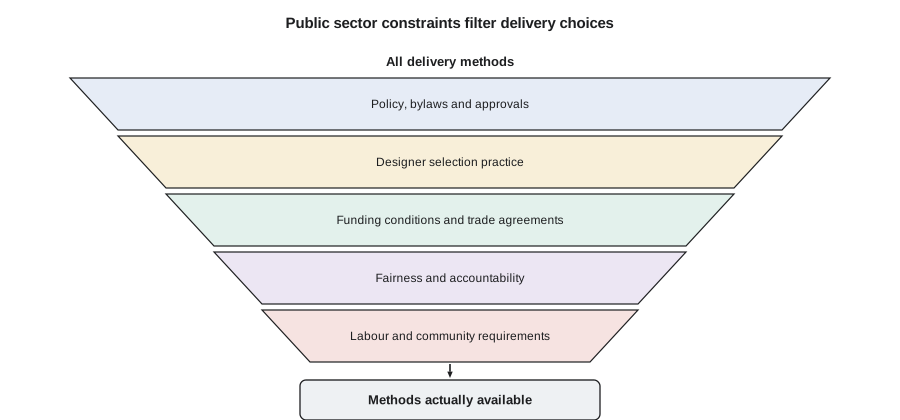
A private developer can choose almost any delivery method it likes, negotiate with any builder it trusts, and change its mind halfway through. A public owner cannot. Public agencies spend taxpayers' money, so they must follow statutes, regulations, trade agreements and internal policies that set how they may select designers and builders, which delivery methods they may use, how they must justify their choice, and how they must document and report it. Those rules strongly shape which delivery methods appear on public projects in each country and each province or state. This lesson explains the main constraints and how they affect the choice and structure of a delivery method. The detailed procurement rules on thresholds, domestic content and social procurement are in CON-330 lesson 10, and tendering law is in CON-220 lesson 3.
Legal authority to use a method
In Canada, public owners generally have broad legal authority to choose a delivery method, subject to their own procurement policies, trade agreement obligations and the duty of fairness under tendering law. There is no general statute that limits a province or municipality to design-bid-build. In practice, though, policy shapes choice: provinces have capital planning frameworks that require business cases and options analysis for major projects, and agencies such as Infrastructure Ontario and Infrastructure BC advise ministries on whether a partnership or another model offers value. Municipal procurement bylaws often require council approval to use anything other than open tendering above set thresholds.
| Constraint | Canada | United States |
|---|---|---|
| Authority to use alternative methods | Generally available; governed by policy and bylaws | Requires statutory authority in many states and owner types |
| Designer selection | Often by scored proposals; qualifications-based selection encouraged by consulting engineers | Brooks Act requires qualifications-based selection for federal A/E services; many states have similar "mini-Brooks" laws |
| Builder selection | Open tendering or scored proposals under policy and trade agreements | Low bid by default; best value where authorized |
| Domestic content | Buy Canadian Policy for federal projects (from December 2025) | Buy American Act, Build America Buy America for federally funded infrastructure |
| Major project justification | Business cases, value-for-money for P3s, Treasury Board and provincial frameworks | Value-for-money where required by state P3 laws; federal requirements for some financing programs |
Selecting designers
Delivery method choice and designer selection are linked. In design-bid-build and construction management the owner hires the designer directly; in design-build the design-builder does. Public owners often must select designers by qualifications rather than price, because the quality of design affects the whole life cost of the asset far more than the design fee does.
In Canada, qualifications-based selection is not generally mandated by statute, and many public owners score both qualifications and fee. Engineering associations and the Association of Consulting Engineering Companies Canada promote qualifications-based selection, and some municipalities and provincial agencies have adopted it for engineering services.
# Qualifications-based selection: rank firms, then negotiate fee with the top-ranked firm (illustrative)
firms = {   # firm: (experience, team, approach, past performance) each out of 25
    "Firm A": (22, 20, 21, 23), "Firm B": (19, 23, 22, 20), "Firm C": (24, 18, 19, 22),
}
ranking = sorted(firms, key=lambda f: sum(firms[f]), reverse=True)
for f in ranking:
    print(f"{f}: {sum(firms[f])}/100")
owner_estimate = 2_400_000          # owner's independent fee estimate
proposed = {"Firm A": 2_650_000, "Firm B": 2_380_000, "Firm C": 2_900_000}
tolerance = 0.08                    # owner policy: agree if within 8 % of its estimate after negotiation
for f in ranking:
    negotiated = proposed[f] * 0.95     # assume negotiation removes about 5 %
    ok = negotiated <= owner_estimate * (1 + tolerance)
    print(f"Negotiate with {f}: proposed {proposed[f]:,}, after negotiation {negotiated:,.0f} -> {'agree' if ok else 'end, go to next firm'}")
    if ok:
breakFirm A: 86/100 Firm B: 84/100 Firm C: 83/100 Negotiate with Firm A: proposed 2,650,000, after negotiation 2,517,500 -> agree
Justifying the delivery method
Public owners increasingly must show why they chose a delivery method, especially for large projects and for P3s. A typical justification includes the project's objectives and constraints, the methods considered, a qualitative comparison against criteria such as schedule, cost certainty, risk transfer, market interest and owner capacity, and for P3s a quantitative value-for-money analysis. Many owners use a two-step screen: a qualitative workshop to shortlist methods, then a quantitative analysis of the shortlist.
# Delivery model screening rules of the kind used in Canadian capital planning (illustrative only)
def screen(capital_cost_m, complexity, long_term_maintenance, revenue_source):
    notes = []
    if capital_cost_m >= 100 and long_term_maintenance:
        notes.append("assess a P3 (DBFM) option with a value-for-money analysis")
    if complexity == "high":
        notes.append("consider progressive or alliance models; test market appetite for fixed-price risk")
    if revenue_source:
        notes.append("discuss co-investment with the Canada Infrastructure Bank")
    if capital_cost_m < 50 and complexity == "low":
        notes.append("design-bid-build or design-build likely efficient")
    return notes or ["compare CM at risk and design-build"]
for proj in [("Regional hospital", 1200, "high", True, False), ("Transit maintenance yard", 180, "medium", True, False),
             ("Fire hall", 18, "low", False, False), ("Water plant with user fees", 320, "high", True, True)]:
print(proj[0] + ":", "; ".join(screen(*proj[1:])))Regional hospital: assess a P3 (DBFM) option with a value-for-money analysis; consider progressive or alliance models; test market appetite for fixed-price risk Transit maintenance yard: assess a P3 (DBFM) option with a value-for-money analysis Fire hall: design-bid-build or design-build likely efficient Water plant with user fees: assess a P3 (DBFM) option with a value-for-money analysis; consider progressive or alliance models; test market appetite for fixed-price risk; discuss co-investment with the Canada Infrastructure Bank
Screens like this are aids, not rules. Their value is in forcing a consistent set of questions so that delivery choices are not made by habit or by whoever argues loudest. Lesson 11 develops a fuller scoring method.
Fairness, transparency and accountability
Every public delivery method must satisfy the same core principles: open and fair competition, equal treatment of bidders, transparency of criteria, protection of confidential information, avoidance of conflicts of interest, and records that support audit. Alternative methods put more strain on those principles because they involve judgment, negotiation and early collaboration.
| Method feature | Fairness risk | Common safeguard |
|---|---|---|
| Best-value scoring | Subjective scores can favour a preferred bidder | Published criteria and weights, trained evaluators, consensus scoring records |
| Commercially confidential meetings (P3, design-build) | One bidder learns something others do not | Same meeting format for all; addenda for general clarifications; fairness monitor |
| Negotiated GMP or progressive price | No competition on price; perceived bias | Open book, independent estimate, audit, competitive trade packages |
| Early contractor involvement | Advisory contractor gains advantage in later bidding | Rules on whether the adviser may bid; disclosure of its work to all bidders |
| Stipends and ideas | Owner uses an unsuccessful bidder's idea without payment | Stipend in exchange for rights to ideas, stated in the RFP |
Canadian public owners often appoint a fairness monitor for complex procurements, particularly P3s and progressive models; the monitor attends evaluations and meetings and publishes a report on whether the process was fair and followed its stated rules. Freedom of information laws apply to public owners' records, subject to protections for confidential commercial information. Bid rigging is a criminal offence under section 47 of the Competition Act.
Funding conditions
Much public construction is funded at least partly by another level of government, and the funding brings conditions. Grant agreements may require particular procurement rules, domestic content, labour standards, environmental reviews, Indigenous consultation, accessibility, climate resilience assessments or reporting. Delivery method choice must fit those conditions: a funding program that pays only for construction costs incurred after an agreement date may not reimburse a progressive development phase; a program that requires competitive low-bid procurement may not allow a negotiated GMP.
Federal infrastructure programs in Canada, administered through Housing, Infrastructure and Communities Canada, typically require recipients to follow open, transparent and competitive procurement consistent with trade agreements, to meet climate lens and community employment benefits reporting where applicable, and in some cases to apply the Buy Canadian Policy. The Canada Infrastructure Bank, by contrast, invests through loans and equity in revenue-generating projects and expects private or institutional co-investment.
Worked problem
Does the funding allow the method?
A city receives a grant covering 40 % of eligible construction costs for a $90 million transit station. The grant reimburses only costs incurred after the grant agreement is signed and requires competitive procurement of construction. The city is considering progressive design-build with a $4 million development phase starting before the agreement, followed by a negotiated GMP. What are the risks?
Show solution
- The development phase cost incurred before the agreement may not be eligible: 40 % × 4 million = $1.6 million of grant at risk.
- A negotiated GMP may not satisfy the competitive procurement condition unless the grant program accepts a competitive selection of the design-builder at the start, with competitively bid trade packages.
- The city should confirm eligibility in writing with the funder before choosing the method.
Answer: Up to $1.6 million of grant on the development phase is at risk, and the whole grant could be at risk if the funder treats the negotiated GMP as non-competitive. Funding conditions can rule out an otherwise suitable method.
Labour and community policies
Public owners increasingly attach labour and community requirements to major projects. Some use project labour agreements, which set terms with building trades unions for the whole project; others require community benefits agreements or community employment plans for local hiring, apprenticeships, Indigenous participation and social procurement. These requirements interact with delivery method. In a P3 or design-build, the owner must write them into the project agreement so that the consortium prices and delivers them; in construction management, the construction manager carries them into every trade package.
In Canada, collective bargaining structures differ by province, and some public owners must use contractors bound to particular unions through historical agreements, which affects the market for any delivery method. Federal community employment benefits reporting and Indigenous procurement targets are discussed in CON-330 lesson 10.
Reporting and audit after award
Public accountability does not end when the contract is signed. Auditors general, inspectors general, councils and boards review how major projects were delivered, and their reports often focus on the delivery choice itself: whether the business case was sound, whether risks transferred were really transferred, whether change orders and claims eroded the expected benefit, and whether lessons were applied to later projects. Owners that keep clean records of their delivery decisions and track outcomes against the original rationale fare much better in these reviews.
| Record | Why auditors ask for it |
|---|---|
| Business case and delivery options analysis | Shows why the method was chosen and what benefits were expected |
| Market sounding notes | Show whether the market supported the chosen risk allocation |
| Evaluation records and fairness reports | Show the procurement followed its published rules |
| Change order and claims logs by cause | Show whether the method delivered the expected cost certainty |
| Post-completion review | Compares outcomes with the business case and records lessons |
For contractors, the practical consequence is that public owners will expect open, well-organized records on any method with negotiated pricing or shared savings, because those records may end up in an audit report.
Common mistakes
MistakeAssuming a public owner can use any method it likes.
InsteadCheck statutory authority, bylaws, policies and funding conditions first.
MistakeSelecting designers on fee alone where law requires qualifications-based selection.
InsteadRank on qualifications, then negotiate a fair fee with the top firm.
MistakeRunning commercially confidential meetings without safeguards.
InsteadUse identical formats for all bidders and consider a fairness monitor.
MistakeStarting a development phase before confirming grant eligibility.
InsteadConfirm in writing that the method and timing meet funding conditions.
MistakeLeaving labour and community requirements out of a P3 or design-build agreement.
InsteadWrite them into the agreement so the consortium prices and delivers them.
Summary and key terms
- Canadian public owners generally have authority to choose methods, shaped by policy, bylaws and trade agreements.
- Qualifications-based selection of designers is encouraged but not generally mandated in Canada.
- Major projects require business cases and justification of the delivery method; P3s require value-for-money analysis.
- Alternative methods need safeguards for fairness, such as published criteria, consistent meetings, fairness monitors and independent estimates.
- Funding conditions can rule out a method or make parts of it ineligible.
- Labour and community requirements must be built into the chosen method's contracts.
- Public records, audit and anti-collusion laws apply to every method.
- Enabling legislation
- A statute giving public owners authority to use a delivery method.
- Qualifications-based selection
- Selecting a designer on qualifications and then negotiating a fee.
- Brooks Act
- The US federal law requiring qualifications-based selection of architects and engineers.
- Business case
- A document justifying a project and its delivery approach.
- Fairness monitor
- An independent observer who reports on whether a procurement was fair.
- Commercially confidential meeting
- A private meeting between an owner and one bidder during procurement.
- Funding conditions
- Requirements attached to grants or financing from another body.
- Project labour agreement
- A project-wide agreement with building trades unions.
- Community benefits agreement
- An agreement setting local hiring, training and social commitments for a project.
- Bid rigging
- Collusion among bidders to set prices or winners, a criminal offence.
Practice problems
Work each problem on paper first, then reveal the answer to check.
Do Canadian provinces generally need specific statutes to use design-build?
Show answer
No; choice is governed mainly by policy, bylaws and trade agreements.
What is qualifications-based selection?
Show answer
Ranking firms on qualifications, then negotiating a fair fee with the top-ranked firm.
Name three items in a delivery method justification.
Show answer
Objectives and constraints, methods considered, comparison against criteria, value-for-money for P3s.
What does a fairness monitor do?
Show answer
Observes the procurement and reports whether it was fair and followed its rules.
Why can early contractor involvement raise fairness issues?
Show answer
The advisory contractor may gain an advantage if it later bids.
A grant covers 30 % of eligible costs. A $5 million development phase is ineligible. How much grant is lost?
Show answer
$1.5 million.
Why must labour and community requirements be written into P3 agreements?
Show answer
So the consortium prices and delivers them.
Which Competition Act section makes bid rigging an offence?
Show answer
Section 47.
Name two safeguards for a negotiated GMP on a public project.
Show answer
Open book, independent estimate, audit, competitive trade packages.
Why might funding conditions rule out progressive design-build?
Show answer
Pre-agreement costs may be ineligible and a negotiated price may not meet competitive procurement rules.
Lesson quiz · 5 questions
Score 60% or more to complete this lesson.
Create a free account to save your progress, take quizzes and earn a certificate.