
CON-340 · Lesson 1 of 12 · 28 min
What a project delivery method is
Before a single drawing is finished, an owner who wants a building, a bridge or a treatment plant has to answer a question that shapes everything that follows: who will design it, who will build it, how they will be chosen, how they will be paid, and how the risks of getting it wrong will be shared. The answer is the project's delivery method. Two hospitals of the same size, with the same budget and the same site, can turn out very differently because one was delivered by design-bid-build and the other by a public-private partnership. The method decides when the builder joins the team, how much the owner controls the design, how soon the price is known, how fast the work can start, and what happens when something goes wrong.
This course looks at the main delivery methods used in North American construction, from the owner's side and from the contractor's side. CON-100 lesson 7 gave a one-page overview. Here we go deeper: how each method is organized and procured, how the contractor is paid, how cost and schedule behave, which standard contracts are used, where the method works well and where it fails, and how owners choose. Contract law and standard forms in general are in CON-220, tendering law in CON-220 lesson 3 and CON-300 lesson 10, buying subcontracts and supply in CON-330, and the detailed allocation of risk, insurance and bonding in CON-350.
Four separate decisions
People often use "delivery method" loosely to mean several different things. It helps to separate four decisions that an owner makes, because they can be combined in many ways.
| Decision | The question it answers | Examples |
|---|---|---|
| Delivery method | How are design and construction organized, and who holds the contracts? | Design-bid-build, construction management for fee, construction management at risk, design-build, integrated project delivery, public-private partnership |
| Procurement method | How are the parties selected? | Low bid, best value, qualifications-based selection, negotiation, two-stage selection |
| Contract type (pricing) | How is the price set? | Stipulated (lump-sum) price, unit price, cost plus a fee, cost plus fee with a guaranteed maximum price, target cost |
| Payment and financing | When and from whose money is the work paid? | Monthly progress payments, milestone payments, payment at completion, private finance repaid by availability payments |
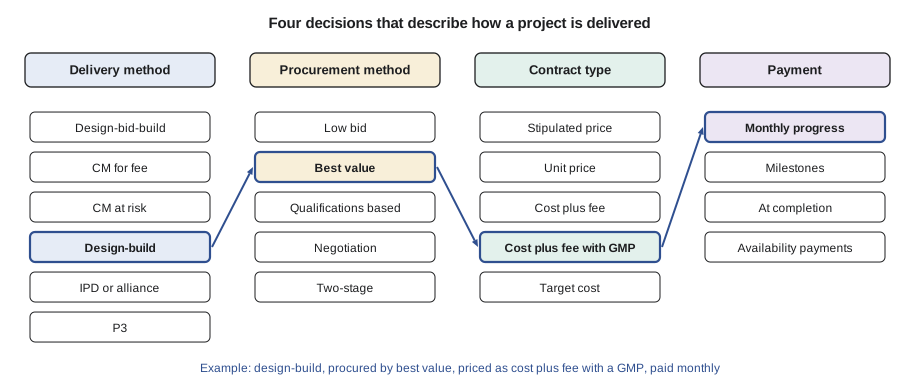
So "design-build" does not by itself tell you whether the design-builder was chosen on price or on qualifications, or whether it is paid a lump sum or its costs plus a fee. A public owner might procure a design-build contract by a two-stage best-value process and pay a stipulated price; a private developer might negotiate a design-build contract with one trusted firm on a cost-plus basis with a guaranteed maximum price. Both are design-build. Keeping the four decisions apart avoids a lot of confusion in meetings, contracts and claims.
The main delivery methods
Most projects in Canada and the United States are delivered by one of six families of methods. The lessons that follow take them one at a time.
| Method | Contracts the owner holds | When the builder joins | Lesson |
|---|---|---|---|
| Design-bid-build (DBB) | One with the designer, one with the general contractor | After design is complete | 2 |
| Construction management for fee (agency CM) | Designer, construction manager as adviser, and each trade contractor | During design | 3 |
| Construction management at risk (CMAR, CM/GC) | Designer and construction manager, who holds the trade contracts | During design | 4 |
| Design-build (DB) | One contract with the design-builder | At the start, or after bridging documents | 5 |
| Integrated project delivery (IPD) and alliancing | One multi-party agreement with designer, builder and key trades | At the start | 6 |
| Public-private partnership (P3) | One project agreement with a private consortium that designs, builds, often finances and maintains | At the start; private partner may operate for decades | 7 |
Each method is a different way of drawing the lines of contract between the owner, the designer and the builder. The simplest way to see the differences is to draw the contracts. In design-bid-build the owner holds two contracts, and the designer and builder have no contract with each other. In design-build the owner holds one. In integrated project delivery the owner, designer and builder sign the same agreement. In a P3 the owner signs with a special-purpose company that itself holds the design, construction and maintenance contracts and borrows money to pay for the work.
What changes from method to method
Delivery methods differ along a handful of dimensions that matter to every owner. Most choices are trade-offs between them.
| Dimension | What it means | Methods strongest on it |
|---|---|---|
| Price certainty at commitment | How well the final cost is known when the owner commits to build | Design-bid-build with complete documents; design-build lump sum; P3 |
| Schedule speed | How early construction can start and how much design and construction overlap | Design-build, CMAR, IPD (fast-tracking) |
| Owner control of design | How much the owner decides the details of the design | Design-bid-build, agency CM |
| Builder input to design | Whether construction knowledge shapes the design before it is fixed | CMAR, design-build, IPD |
| Single point of responsibility | Whether one party answers for both design and construction | Design-build, P3 |
| Collaboration and shared incentives | Whether parties win or lose together | IPD and alliancing |
| Life-cycle accountability | Whether the builder cares how the asset performs for decades | P3 with long-term maintenance |
No method wins on every dimension. The owner who wants to control every detail of the design will struggle to also give one party full responsibility for the result. The owner who wants the earliest possible start must accept that the price will be fixed before the design is finished, or not fixed at all until later. The art of choosing a delivery method, which lesson 11 treats in detail, is to know which dimensions matter most for this project and this owner.
A short history
For most of the twentieth century, public construction in North America was overwhelmingly design-bid-build. The method grew out of public procurement rules that required open, competitive, low-price bidding to prevent patronage, and it fitted a world in which the architect or engineer was the owner's trusted professional and the contractor simply built what was drawn. Construction management emerged in the 1960s and 1970s as projects grew more complex and owners wanted construction expertise during design and the ability to start work before design was finished. Design-build, the oldest method of all if you count the master builders of history, revived strongly from the 1990s, first in private industrial work and then in public highways and buildings. Integrated project delivery appeared in the 2000s, inspired by lean construction and by alliancing in Australia and the United Kingdom. Public-private partnerships for social infrastructure took off in Canada from the early 2000s, led by Partnerships British Columbia and Infrastructure Ontario, and more slowly in the United States, mainly for toll roads, managed lanes and some transit and social infrastructure.
In Canada today, public owners use a wide mix. Infrastructure Ontario's June 2026 market update, for example, lists projects in design-bid-build, design-build, design-build-finance, design-build-finance-maintain, construction management at risk and alliance models, and its transit pipeline includes the Yonge North Subway Extension under an alliance. Municipalities still deliver most of their work by design-bid-build, while large hospitals and transit lines use partnership, alliance or progressive models.
How the method changes the contractor's job
For a construction manager or contractor, the delivery method changes the job far more than the size or type of the project. In design-bid-build the contractor's job begins with a complete set of documents, a short bid period and a price that must be right the first time; the skills that win are estimating accuracy, subcontractor relationships and tight cost control. In construction management the contractor is hired for its judgment during design: estimating at each design stage, constructability review, scheduling, and buying trade packages in sequence. In design-build the contractor leads or partners with a design team and carries the design risk, so it needs design management skills and a strong relationship with its designers. In IPD the contractor shares profit and loss with the owner and designer and must work in an open-book, collaborative way. In a P3 the contractor is one member of a consortium with financiers and a facility manager, under a contract that may run thirty years.
Worked problem
Classifying a project
A regional transit authority hires a contractor during schematic design under a contract that pays a fee for preconstruction services. At 60 % design the contractor negotiates a guaranteed maximum price for construction and then subcontracts all trade work. The contractor was selected by scoring qualifications and fee proposals. Describe the project in terms of the four decisions.
Show solution
- Delivery method: the contractor joins during design and holds the trade contracts at risk, so this is construction management at risk (in transit and highway work often called CM/GC).
- Procurement method: qualifications plus fee, so a best-value selection, not low bid.
- Contract type: cost of the work plus a fee, limited by a guaranteed maximum price.
- Payment: presumably monthly progress payments from the authority's capital budget, since no private finance is mentioned.
Answer: Construction management at risk, procured by best value, priced as cost plus fee with a GMP, paid by progress payments.
A first look at cost and time
Delivery methods affect total project time mostly through overlap. In design-bid-build, design, bidding and construction happen one after the other. Methods that bring the builder in early allow the contractor to buy and start some work, such as site preparation, foundations or long-lead equipment, while the rest of the design is still being finished. That is called fast-tracking. The simple model below compares the three classic sequences for an invented project with twelve months of design and twenty months of construction.
# Simple timeline model (months) for one project under three delivery methods (illustrative)
design, construct = 12, 20
bid_dbb = 3                      # advertise, bid, evaluate, award after design is complete
procure_cm = 2                   # select the construction manager early, during design
procure_db = 4                   # two-stage design-build selection before design starts

dbb = design + bid_dbb + construct
# CMAR: construction starts at 60 % design (packages bid in sequence); 2 months of overlap lost to sequencing
cmar = procure_cm + 0.6 * design + construct + 2
# DB: design-builder starts site work at 40 % design; design time shortened 15 % by working with the builder
db = procure_db + 0.4 * design * 0.85 + construct + 1
for name, t in [("Design-bid-build", dbb), ("CM at risk", cmar), ("Design-build", db)]:
print(f"{name:17} {t:5.1f} months saving vs DBB {dbb - t:4.1f}")Design-bid-build 35.0 months saving vs DBB 0.0 CM at risk 31.2 months saving vs DBB 3.8 Design-build 29.1 months saving vs DBB 5.9
In this illustrative model, construction management at risk and design-build save several months compared with design-bid-build. Real savings depend on the project. Studies comparing methods, such as the Construction Industry Institute and Penn State research in the late 1990s and later research by the Design-Build Institute of America and university groups, generally found design-build and CMAR projects faster on average than design-bid-build, but the samples, definitions and project types vary, and a badly run fast-track can lose all of its theoretical advantage in redesign and changes. Lesson 4 models overlap in more detail.
Who takes which risks
Every method allocates risks differently. The headline risks are the same on every project: the design may be incomplete or wrong, quantities may differ, ground conditions may be worse than expected, prices may rise, permits may be late, the owner may change its mind, and the building may not perform. In design-bid-build, the owner carries design risk because it hired the designer and warranted the drawings to the contractor; the contractor carries price risk on what is shown. In design-build, the design-builder carries most design risk and price risk once the price is fixed. In IPD, the parties share most risks through a common profit pool. In a P3, the private partner carries design, construction, financing and long-term performance risk, and the owner pays only when the asset is available to use. CON-350 explores risk allocation in depth; lesson 11 of this course uses a simple risk matrix to compare methods.
| Risk | Design-bid-build | CM at risk (after GMP) | Design-build (lump sum) | IPD | P3 (DBFM) |
|---|---|---|---|---|---|
| Design errors and omissions | Owner | Owner (mostly) | Design-builder | Shared | Private partner |
| Construction price on known scope | Contractor | CM up to GMP | Design-builder | Shared against target | Private partner |
| Unforeseen ground conditions | Usually owner | Usually owner | Negotiated | Shared | Negotiated, often shared |
| Owner changes | Owner | Owner | Owner | Owner | Owner |
| Long-term maintenance and performance | Owner | Owner | Owner | Owner | Private partner |
The owner's capacity
A method is only as good as the owner using it. Design-bid-build demands that the owner, through its designer, produce complete and coordinated documents. Agency construction management demands that the owner manage many trade contracts. Design-build demands that the owner write a clear performance-based statement of requirements and then resist the urge to redesign the project during review. IPD demands that the owner's staff sit in the big room and make decisions quickly. P3s demand sophisticated legal, financial and technical advisers and long-term contract management. Owners who choose a method they cannot staff often blame the method for failures that were really failures of capacity.
# Rough owner staffing estimate by delivery method for a $120 million project (illustrative full-time equivalents)
fte = {   # (design phase, construction phase)
    "Design-bid-build":          (2.0, 3.0),
    "Agency CM (multiple prime)": (2.5, 4.5),
    "CM at risk":                (2.5, 3.0),
    "Design-build":              (3.0, 2.5),
    "IPD":                       (3.5, 3.0),
    "P3 (DBFM)":                 (5.0, 2.0),   # heavy advisory load before financial close
}
design_months, build_months = 14, 26
for m, (d, c) in fte.items():
print(f"{m:27} {d * design_months + c * build_months:6.0f} person-months")Design-bid-build 106 person-months Agency CM (multiple prime) 152 person-months CM at risk 113 person-months Design-build 107 person-months IPD 127 person-months P3 (DBFM) 122 person-months
The numbers are illustrative, but the pattern is real: methods differ less in total owner effort than in when that effort is needed and what skills it requires. P3s concentrate effort early, in preparing output specifications, risk analysis and procurement; agency CM concentrates it during construction, in managing many trade contracts.
Common mistakes
MistakeTreating "design-build" as if it said how the price is set.
InsteadDescribe the project by all four decisions: delivery, procurement, contract type and payment.
MistakeChoosing a method because it is fashionable.
InsteadChoose from the project's priorities, risks, market and the owner's capacity.
MistakeAssuming fast-tracking always saves time.
InsteadModel the overlap and allow for redesign and change risk; poor fast-tracks lose their advantage.
MistakeAssuming the method transfers all risk.
InsteadRead the contract; every method leaves some risks, such as owner changes, with the owner.
MistakePicking a method the owner cannot staff.
InsteadMatch the method to the owner's skills and resources, or buy them in through advisers.
Summary and key terms
- A project delivery method decides how design and construction are organized and who holds the contracts.
- Delivery method, procurement method, contract type and payment are four separate decisions.
- The six main families are design-bid-build, agency CM, CM at risk, design-build, IPD and alliancing, and public-private partnerships.
- Methods trade off price certainty, speed, owner control, builder input, single responsibility, collaboration and life-cycle accountability.
- Bringing the builder in earlier allows fast-tracking, which can shorten total time if managed well.
- Each method allocates design, price, ground, change and performance risks differently.
- The owner's capacity to run a method is as important as the method itself.
- Project delivery method
- The way design and construction are organized and contracted on a project.
- Procurement method
- The way parties are selected, such as low bid or best value.
- Contract type
- The pricing basis, such as stipulated price or cost plus fee.
- Fast-tracking
- Starting construction before design is complete so the two overlap.
- Single point of responsibility
- One party answering for both design and construction.
- Best value
- Selection on a combination of price and qualitative factors.
- Qualifications-based selection
- Selection on qualifications alone, with price negotiated afterwards.
- Guaranteed maximum price (GMP)
- A ceiling on the cost of the work plus fee that the contractor guarantees.
- Availability payment
- A payment to a private partner that depends on the asset being available and performing.
- Owner capacity
- The skills and resources an owner has to manage a given delivery method.
Practice problems
Work each problem on paper first, then reveal the answer to check.
Name the four decisions that together describe how a project is delivered.
Show answer
Delivery method, procurement method, contract type (pricing) and payment or financing.
How many contracts does the owner hold for design and construction in design-bid-build?
Show answer
Two: one with the designer and one with the general contractor.
Which method gives one party responsibility for both design and construction?
Show answer
Design-build (and, more broadly, a P3).
Can a design-build contract be priced on a cost-plus basis?
Show answer
Yes; the delivery method and the contract type are separate decisions.
What is fast-tracking?
Show answer
Starting construction before design is complete, overlapping the two.
In the timeline model, how long does design-bid-build take with 12 months of design, 3 of bidding and 20 of construction?
Show answer
35 months.
Who normally carries design error risk in design-bid-build?
Show answer
The owner, who hired the designer and provides the drawings to the contractor.
What risk does a P3 transfer that the other methods usually do not?
Show answer
Long-term maintenance and performance (and financing) risk.
Why does a P3 need more owner effort early in the project?
Show answer
Output specifications, risk analysis, financial and legal advice and procurement must be prepared before financial close.
Give one reason an owner might prefer design-bid-build.
Show answer
It gives the owner full control of the design and a firm price on complete documents through open competition.
Lesson quiz · 5 questions
Score 60% or more to complete this lesson.
Create a free account to save your progress, take quizzes and earn a certificate.