
CON-325 · Lesson 5 of 12 · 26 min
Mobile cranes, hoists and other lifting equipment
The tower crane does most of the lifting on Larkspur Commons, but it is not alone. A large mobile crane erects and dismantles it. Boom trucks deliver lumber and drywall. Concrete pumps and placing booms place most of the concrete. A rack-and-pinion hoist carries workers and materials up the building once the wood frame rises. Telehandlers and forklifts move materials around the site. Each piece of equipment has its own capacity, set-up needs, hazards and logistics. This lesson looks at them from the superintendent's point of view: choosing the right equipment, preparing the ground and space for it, scheduling it and integrating it into the logistics plan. HSE-219 covered crane stability and rigging, and HSE-218 covered forklifts and telehandlers in depth.
Mobile cranes on building sites
Mobile cranes are self-propelled cranes that travel to the site and set up on outriggers or tracks. The main types on building sites are all-terrain cranes, which drive on public roads and set up on outriggers; rough-terrain cranes, which work on unpaved sites but need to be trucked in; truck-mounted cranes; and crawler cranes, which travel on tracks and are used for heavy or long-duration lifting but must be assembled on site. Smaller boom trucks and articulating (knuckle-boom) cranes mounted on delivery trucks are common for unloading materials.
On a building site, a mobile crane is usually chosen for a specific job: erecting or dismantling a tower crane, setting steel or precast on a low-rise building, lifting rooftop mechanical units after the tower crane has gone, or doing lifts the tower crane cannot reach. Because mobile cranes are rented by the hour or day with minimum charges and mobilization costs, the work must be planned so that the crane arrives when everything is ready and leaves as soon as possible.
| Equipment | Typical use on a mid-rise site | Key planning issues |
|---|---|---|
| All-terrain crane | Tower crane erection and dismantling, heavy rooftop units | Street closure, outrigger mats, counterweight trucks, utilities under the street |
| Crawler crane | Long-duration heavy lifting on larger sites | Assembly space, ground preparation, transport of components |
| Boom truck or knuckle-boom | Unloading lumber, drywall and trusses | Outrigger space, reach to the landing point, overhead lines |
| Concrete pump and placing boom | Placing concrete in slabs and walls | Pump position, boom reach, outrigger loads, washout |
| Rack-and-pinion hoist | Workers and materials to upper floors | Tie-ins to the building, landings, base enclosure, scheduling |
| Telehandler or forklift | Moving materials on site, loading the hoist | Firm level surfaces, routes separated from pedestrians |
| Mast climbing work platform | Envelope work on facades | Base, tie-ins, loading limits, alternative to scaffolds |
Choosing a mobile crane
Choosing a mobile crane follows the same logic as choosing a tower crane: the heaviest load at the largest radius, with the boom length needed to reach over obstacles, decides the crane. Mobile cranes add complications: the capacity depends on the outrigger extension, the counterweight fitted, the boom length and angle, whether the load is over the side, rear or front of the carrier, and in many cases on the ground support. Crane suppliers usually prepare a lift study showing the crane's position, configuration, radius, capacity and outrigger loads; for critical lifts, this becomes part of the lift plan in lesson 6.
The crane's position on site is often the hardest part. A large all-terrain crane needs a set-up area for its outriggers, space for counterweight trucks to unload, a route in and out, and clearance from overhead lines, buildings and trees for its boom and counterweight swing. On an urban site, this usually means the street, which brings in the road authority, the traffic plan, the buried utilities and the neighbours.
Outriggers, mats and the ground
A crane is only as stable as the ground under it. Outrigger loads on a large crane can reach many tonnes on a single float, and the pressure under an outrigger float with no mat is far higher than most soils, pavements or slabs can carry. Ground failures under outriggers are a common cause of mobile crane overturns. The superintendent's job is to make sure the ground has been assessed by a competent person, usually with input from the geotechnical engineer, and that mats or cribbing spread the load enough.
For the tower crane erection on Larkspur Commons, the assist crane sets up in the street on the south side. The crane supplier's set-up calculation gives the highest outrigger reaction; the geotechnical engineer gives an allowable bearing pressure for the street subgrade below the pavement; and the city's utility records show a storm sewer running under the street.
# Assist crane on the street for the tower crane erection: outrigger pressure and mats (illustrative)
reaction = 765.0          # kN, highest outrigger reaction from the crane supplier's set-up calculation
float_area = 0.80 * 0.80  # m2, outrigger float (pad) supplied with the crane
allowable = 200.0         # kPa, allowable bearing on the street subgrade from the geotechnical engineer
print(f"Pressure under the float alone: {reaction / float_area:,.0f} kPa (allowable {allowable:.0f} kPa)")
need = reaction / allowable
print(f"Minimum effective mat area: {need:.2f} m2")
for w, l in [(1.2, 1.2), (1.5, 1.5), (2.0, 2.0), (2.4, 2.4)]:
    p = reaction / (w * l)
    print(f"  mat {w:.1f} m x {l:.1f} m -> {p:5.0f} kPa  {'OK' if p <= allowable else 'too small'}")
# Buried storm sewer under the street: keep the loaded zone out of its influence (1H:1V spread, simplified)
sewer_depth, sewer_offset = 3.0, 2.6     # m below grade, m from the outrigger centre
mat_half = 1.0                           # half-width of the chosen 2.0 m mat
spread = sewer_depth + mat_half          # edge of a 1:1 load spread at sewer depth
print(f"Load spread reaches {spread:.1f} m from the outrigger centre at sewer depth; sewer at {sewer_offset:.1f} m -> "
+ ("engineer to check the sewer or move the crane" if sewer_offset < spread else "outside the spread"))Pressure under the float alone: 1,195 kPa (allowable 200 kPa) Minimum effective mat area: 3.83 m2 mat 1.2 m x 1.2 m -> 531 kPa too small mat 1.5 m x 1.5 m -> 340 kPa too small mat 2.0 m x 2.0 m -> 191 kPa OK mat 2.4 m x 2.4 m -> 133 kPa OK Load spread reaches 4.0 m from the outrigger centre at sewer depth; sewer at 2.6 m -> engineer to check the sewer or move the crane
The float alone would load the ground at about six times the allowable pressure. Mats about 2 m square bring the pressure within the allowable value, provided they are stiff enough to spread the load over their full area; crane mats are engineered products, and their effective area depends on their thickness and material, so the supplier's mat rating should be used rather than the simple calculation. The storm sewer is within the zone where the outrigger load spreads through the soil, so the city's engineers must confirm that the pipe can take the load, or the crane must move. Dana's team asked the city early; the city's engineer accepted the load with the mats, on condition that the sewer be inspected by camera before and after the erection.
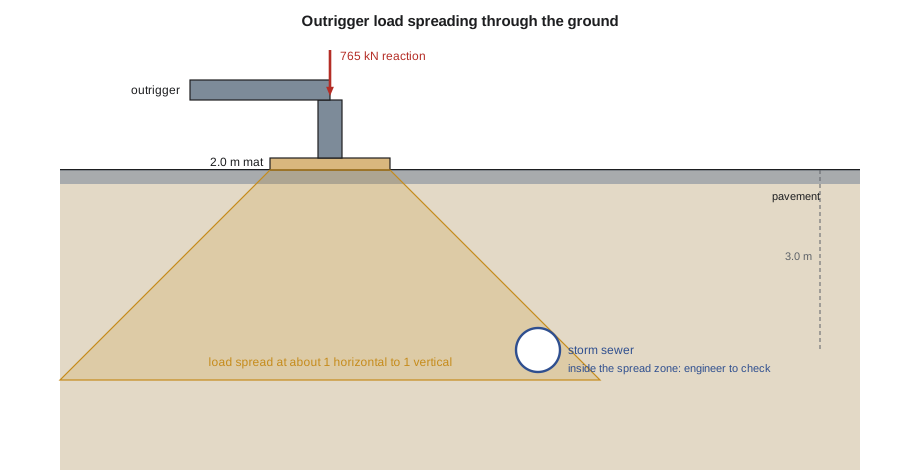
Other ground hazards include recently backfilled excavations, the area next to shoring walls, voids under slabs, basement walls next to the crane, and covers of manholes and vaults. A crane outrigger set on a sidewalk over a basement vault or next to an unshored excavation can fail suddenly. Every set-up needs a site-specific check, not a habit.
Overhead power lines
Contact between a crane, boom truck or concrete pump boom and an overhead power line is one of the deadliest construction hazards. Regulations set minimum approach distances by voltage, and the safest approach is to have lines de-energized, relocated or insulated before work begins. HSE-219 lesson 9 covered the limits of approach and the controls. The logistics plan should show every overhead line within reach of any boom on the site, including the boom trucks of suppliers who deliver only once, and the delivery booking system should flag deliveries that will use a boom near the lines.
On Larkspur Commons, the overhead distribution line in the lane was relocated underground before construction, at the developer's cost, after Dana's team showed that the lane gate, the boom trucks and the tower crane's swing would all bring equipment close to it for twenty months. The relocation took four months to arrange with the utility, which is typical; utility relocations must be started in preconstruction.
Concrete pumps and placing booms
Most concrete on mid-rise buildings is placed by pump. A truck-mounted boom pump unfolds a boom that reaches over the building to place concrete directly, while a line pump pushes concrete through pipes laid to the point of placement. On taller buildings, a separate placing boom may be mounted on the structure and fed by a stationary pump. Pumps need set-up space for their outriggers, access for a stream of ready-mix trucks, a washout area and clearance from overhead lines.
Pump outrigger loads are substantial and the same ground checks apply as for cranes. A boom pump set up on a podium slab or over a backfilled wall must have its outrigger loads checked by the structural or geotechnical engineer. The ready-mix trucks also need a route and a waiting area: a pump placing concrete steadily may need a truck every ten minutes or so, and trucks waiting in the street must be arranged under the traffic plan. On Larkspur Commons, pours over a few hundred cubic metres use the street lane closure, with two trucks discharging into the pump alternately and the next trucks waiting in the closed lane.
Concrete pumps and placing booms have their own standards, such as CSA Z151 in Canada, and operators need training and certification under provincial rules. Pumps must be inspected and maintained, and their booms are subject to fatigue and wear that can lead to sudden failure.
Personnel and material hoists
Once a building rises beyond two or three storeys, workers and materials need vertical transport other than the stairs and the tower crane. The usual solution on mid-rise buildings is a rack-and-pinion hoist: a car or cage that climbs a mast tied to the building, driven by motors engaging a toothed rack. Hoists can carry both people and materials, with landings at each floor protected by gates that open only when the car is there.
Hoist planning starts early. The hoist's mast must be tied to the structure at intervals, so the ties and their anchors must be coordinated with the structure and the envelope. The hoist usually sits in an opening in the facade, which must be left out and closed in later, often one of the last envelope tasks on the job. The base needs a foundation, an enclosure with interlocked gates and a landing area for loading. And the hoist must stay until permanent elevators are available for construction use, which raises questions about the elevators' warranties and protection if they are used early.
In Canada, personnel hoists are covered by provincial regulations and by CSA Z185, the safety code for personnel hoists; installations are inspected and certified before use, and in some provinces elevating devices are regulated by a separate safety authority. Hoist operators must be trained and authorized.
On Larkspur Commons, the hoist is installed on the south face when the framing reaches level 3, with landings at each level and the roof. Omar checked whether one hoist would be enough by calculating the time needed to take the morning crew up and the material trips left in the day.
# Personnel and material hoist on the south face: how long does the morning lift take? (illustrative)
landings = {"L2": 4.8, "L3": 8.4, "L4": 11.4, "L5": 14.4, "L6": 17.4, "Roof": 20.4}   # m above grade
speed = 0.9            # m/s rated hoist speed
door_time = 25         # s to open, load or unload and close at each stop
cage_people = 20       # rated number of persons
crew_by_level = {"L2": 18, "L3": 22, "L4": 26, "L5": 24, "L6": 20, "Roof": 0}         # workers going up at 7:00

def trip_time(stops):
    """Round trip from grade, stopping at the given landings, back to grade (s)."""
    top = max(landings[s] for s in stops)
    return 2 * top / speed + door_time * (len(stops) + 1)

total, trips = 0.0, 0
for level, n in crew_by_level.items():
    while n > 0:
        load = min(n, cage_people)
        total += trip_time([level])
        trips += 1
        n -= load
print(f"Morning lift: {sum(crew_by_level.values())} workers in {trips} trips, {total / 60:.0f} minutes of hoist time")
# What is left for materials in a 9-hour day after the start, lunch and end-of-day people runs?
people_minutes = 3 * total / 60
load_unload = 360      # s to wheel a material load on and off the cage with a pallet jack
material_trip = trip_time(["L4"]) + load_unload
material_trips = (9 * 60 - people_minutes) * 60 / material_trip
print(f"People runs take about {people_minutes:.0f} minutes a day; room for about {material_trips:.0f} material trips of {material_trip / 60:.1f} minutes each")Morning lift: 110 workers in 8 trips, 10 minutes of hoist time People runs take about 30 minutes a day; room for about 70 material trips of 7.3 minutes each
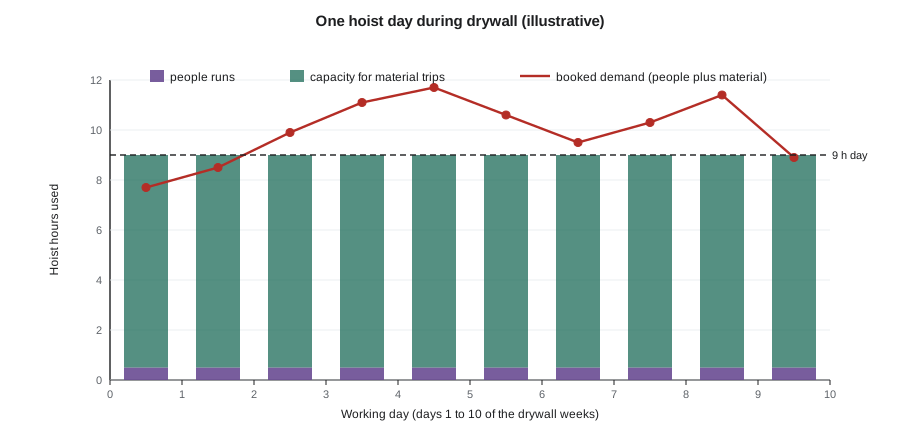
The morning lift is not a problem: about ten minutes of hoist time. But the people runs at the start, lunch and end of day take half an hour, and the remaining capacity is about seventy material trips a day, each taking several minutes because loads must be wheeled on and off. During drywall and finishes, when every floor needs board, fixtures and supplies, demand can exceed that. Omar books hoist slots like deliveries, schedules bulk drywall to be loaded by the tower crane onto loading platforms before the crane leaves, and plans an early or late hoist shift for material if the bookings show a crunch.
Telehandlers, forklifts and small equipment
Telehandlers (telescopic handlers) are the workhorses of many sites. They lift pallets and bundles to upper floors or loading platforms, unload trucks and move materials across rough ground. Their capacity depends heavily on the boom extension and angle, and their load charts must be followed as strictly as a crane's. Some telehandlers can be fitted with winches or jibs to work as cranes, at which point crane rules may apply. Forklifts, pallet jacks and powered buggies handle materials on firm surfaces and inside the building. HSE-218 covered their stability, operation and the pedestrian hazards they create.
The logistics plan should give each piece of equipment a place to work, a route, a parking and refuelling or charging place, and a separation from pedestrians. Equipment that refuels on site needs a fuel storage area with spill containment, away from drains and the building (lesson 9 covers fuel and fire hazards).
Mast climbing work platforms and loading platforms
Mast climbing work platforms are powered platforms that climb masts tied to the building, carrying workers and materials along a facade. They are an alternative to scaffolds for envelope work: windows, cladding and sealants. They can be faster to install and move than a full scaffold, but they need a firm base, tie-ins to the building, careful load management and trained operators. Lesson 8 compares them with scaffolds.
Loading platforms, sometimes called cantilever or retractable platforms, project from a floor edge so that the tower crane can land loads on each floor. They are engineered, installed by trained crews and inspected; the floor edge around them needs fall protection when the platform is open. On Larkspur Commons, two loading platforms are used during the wood frame and drywall to land board and materials directly on each floor, reducing hoist demand.
Scheduling and coordinating equipment
Every piece of lifting equipment on site competes for space and time with the others and with deliveries. The tower crane cannot swing over a boom truck that is unloading; a concrete pump's boom must stay clear of the crane's jib; the hoist landing must be clear when a delivery of drywall is wheeled in. Coordination is done through the daily crane and hoist schedules, the delivery bookings and a standing rule that no equipment is brought to site without the superintendent's knowledge.
Rented equipment is also money. A large mobile crane costs thousands of dollars a day with minimum charges and mobilization; a boom pump costs a similar amount per pour. When the crane or pump arrives and the work is not ready, because the forms are not inspected, the load is not rigged or the street permit has not been posted, the cost is lost. A short readiness checklist the day before each major equipment event, reviewed by the superintendent, is one of the cheapest controls on the job.
Common mistakes
MistakeSetting outriggers on the float pads alone.
InsteadUse engineered mats sized for the outrigger reaction and the allowable bearing pressure, based on a competent assessment of the ground.
MistakeIgnoring buried utilities under a crane set-up in the street.
InsteadCheck utility records and ask the owner to confirm that pipes and vaults can take the load.
MistakeLeaving overhead power lines in place because the work is short.
InsteadPlan de-energizing, relocation or insulation early; utilities need months of notice.
MistakeAssuming one hoist is enough without checking demand.
InsteadCalculate people runs and material trips against bookings, and plan loading platforms or extra shifts for peaks.
MistakeBringing a rented crane or pump to site before the work is ready.
InsteadUse a readiness checklist the day before every major equipment event.
Summary and key terms
- Mobile cranes, boom trucks, pumps, hoists, telehandlers and work platforms each have specific uses, set-up needs and hazards.
- Mobile crane capacity depends on configuration and ground support; suppliers' lift studies feed the lift plan.
- Outrigger pressures far exceed what most ground can carry; engineered mats and a competent ground assessment are needed.
- Buried services, backfill, vaults and excavation edges near outriggers need specific checks.
- Overhead power lines should be de-energized, relocated or insulated, with early utility engagement.
- Concrete pumps need set-up space, ground checks, truck routes and washout areas.
- Hoists need early planning of ties, facade openings, bases and capacity; bookings and loading platforms manage demand.
- Equipment events need coordination and readiness checks to avoid conflicts and lost rental costs.
- All-terrain crane
- A mobile crane that can travel on public roads and set up on outriggers on site.
- Outrigger
- An extendable beam with a float that stabilizes a mobile crane or pump.
- Crane mat
- An engineered timber, steel or composite mat that spreads an outrigger load over a larger area.
- Allowable bearing pressure
- The pressure the ground can safely carry, given by a geotechnical engineer.
- Lift study
- A crane supplier's analysis of crane position, configuration, capacity and outrigger loads for a lift.
- Rack-and-pinion hoist
- A hoist whose car climbs a mast by motors engaging a toothed rack.
- Placing boom
- A boom that places pumped concrete, mounted on a truck or on the structure.
- Loading platform
- An engineered platform projecting from a floor edge to receive crane loads.
Practice problems
Work each problem on paper first, then reveal the answer to check.
Why are mobile cranes usually planned for specific jobs on a tower crane site?
Show answer
They are rented with minimum charges and mobilization costs, so they come for erection, dismantling or lifts the tower crane cannot do.
In the outrigger example, about how many times the allowable pressure did the float alone impose?
Show answer
About six times.
Why should the mat supplier's rating be used rather than the simple area calculation?
Show answer
The effective area of a mat depends on its stiffness, so it may not spread the load over its full area.
What did the city require because of the storm sewer?
Show answer
A camera inspection of the sewer before and after the erection.
Why was the overhead line in the lane relocated?
Show answer
The gate, boom trucks and crane swing would have brought equipment close to it for twenty months.
How many material trips a day did the hoist calculation leave?
Show answer
About seventy.
Name two ways Omar manages hoist demand during drywall.
Show answer
Booking hoist slots, loading drywall onto loading platforms by crane, and adding an early or late hoist shift.
What should a readiness checklist cover before a mobile crane arrives?
Show answer
Ground and mats, permits posted, loads rigged, work ready, exclusion zones, weather and communication.
Lesson quiz · 5 questions
Score 60% or more to complete this lesson.
Create a free account to save your progress, take quizzes and earn a certificate.