
CON-325 · Lesson 10 of 12 · 31 min
Hoarding, neighbours and protecting the public
A construction site sits in the middle of a working city. People walk past it to work and school, drive and cycle beside it, live and work next door to it, and sometimes wander into it. None of them signed up for the hazards of construction, and none of them has been trained, equipped or inducted. The law treats the public very differently from workers: workers accept certain controlled risks as part of their job, while the public is entitled to expect that the site will not hurt them at all. A falling tool that would be a near miss inside the site can kill a pedestrian on the sidewalk, and dust, noise and vibration that a crew wears protection against are imposed on neighbours who never chose them.
This lesson covers how Larkspur Commons protects the people outside the fence: hoarding and fencing, covered ways and overhead protection, protection against falling objects, dust, noise, vibration and light, condition surveys and monitoring of the neighbouring buildings, agreements with neighbours, and the community relations that hold it all together. Lesson 2 covered traffic, sidewalk closures and pedestrian detours, and lesson 3 covered site security; this lesson builds on both. HSE-370 and HSE-373, when built, will cover the safety rules for construction sites and traffic control in more depth, and CON-350 covered the insurance that responds when the public is harmed.
The duty to the public
In British Columbia, the duty to protect the public comes from several sources. Part 8 of the British Columbia Building Code, which follows Part 8 of the National Building Code, sets out safety measures at construction and demolition sites, including barriers and fences around the site, covered ways where work is close to a public way, and the protection of adjoining property. The municipality adds conditions through the building permit, the street use permit and its bylaws on noise, dust and the use of streets. WorkSafeBC's regulation protects workers but also requires employers and the prime contractor to keep hazards from affecting other people at or near the workplace. Above all of this sits the common law of negligence and nuisance: a contractor who fails to take reasonable care for people who may be affected by the work can be sued, and a neighbour whose enjoyment of their property is unreasonably disrupted can seek damages or an injunction.
In practice, the city's inspectors, the fire department, the safety regulator and the neighbours all watch the site edge. A superintendent who treats public protection as a core part of the logistics plan, rather than a set of permit conditions to meet, avoids most of the problems this lesson describes. The standard to aim for is simple: nothing from the site should reach the public, whether it is a falling object, a truck, dust, water, mud, light or noise beyond what the permits allow.
Fences and hoarding
A site fence or hoarding marks the boundary, keeps the public out of the hazards and keeps materials and equipment in. The two words are used loosely, but they describe different things. A fence is usually a temporary chain-link or welded mesh panel system on weighted bases, quick to install and move, which lets people see into the site. Hoarding is a solid barrier, traditionally plywood on a timber frame, that blocks views, contains dust and debris better, resists climbing and provides a surface for signs, project information and sometimes community art.
On Larkspur Commons, the south side facing the retail street has solid plywood hoarding about 2.4 m high along the property line, painted, with project signs, the contractor's contact number, the permit number and a viewing window cut at child height. The east side along the lane has mesh fence panels with privacy screening, so that the gate area stays visible to drivers. The north and west sides, where the site meets the neighbours, have a solid hoarding along the shared property lines to contain dust and debris close to the neighbours' windows. Every gate is self-closing or locked when not in use.
Fences and hoarding must resist wind, especially when covered with screening or signs that catch the wind like a sail. Mesh panels on weighted bases have blown over onto sidewalks and roads in storms; the supplier's instructions limit the screening and the wind speed for each base and bracing arrangement, and higher or more exposed fences need bracing or engineered design. Solid hoarding should be designed for wind like any temporary structure, with posts set or braced to suit the soil, and checked after storms.
Hoarding also has to be kept in good condition. Damaged panels, graffiti, missing signs and gaps under the fence invite trespass and complaints. Children are attracted to construction sites, and courts have long held that contractors must take extra care where children may be drawn to a hazard. The daily site inspection includes a walk of the full perimeter, and the security patrol checks it at night (lesson 3).
Covered ways and overhead protection
Where work above may drop material onto a sidewalk or road that stays open, the public needs overhead protection. A covered way is a roofed walkway over the sidewalk, built of a structural frame with a solid deck strong enough to stop falling debris, solid sides or barriers toward the site, lighting underneath and a clear route wide enough for wheelchairs and strollers. Covered ways are designed by an engineer for the loads they must resist, which include the impact of falling objects and any materials or equipment that might be placed on the deck.
The need for a covered way depends on the height of the work and how close it is to the public route. Work that is high and close to the sidewalk can throw debris further than a low wall at the property line, and wind carries light materials such as insulation, sheathing offcuts and membranes a long way. Codes and permits set the minimum protection; good practice often goes further where the risk is high.
On Larkspur Commons, the building's south face sits about 9 m back from the property line, behind the south laydown strip, and the work on that face rises to about 21 m. The city's permit requires a covered way along the full south frontage while the structure and envelope are being built, with a clear height of at least 2.4 m and a clear width matching the existing sidewalk. The covered way is designed by the shoring and temporary works engineer, built before the first elevated pour, lit at night, inspected weekly and kept clear of stored material. The deck is not used for storage, and no material may be landed on it by crane.
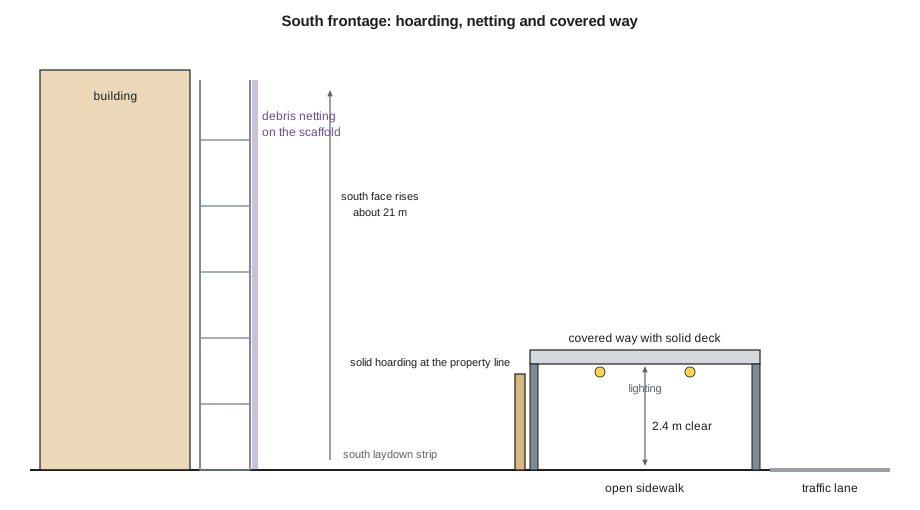
Covered ways interact with the rest of the logistics plan. They narrow the space available for truck unloading on the street, they may conflict with the crane's swing zone and with outrigger positions for mobile cranes, and they must be built before overhead work starts and removed before the final sidewalk and landscaping are built. The covered way's deck also stops pedestrians from seeing the site, so retail tenants on the ground floor of neighbouring buildings may ask for signs showing that their shops are open.
Falling objects
Falling objects are the most direct threat to the public. Tools, fasteners, offcuts, formwork pieces, ice and debris fall from floor edges, scaffolds and the crane. Controls follow the hierarchy, starting with keeping objects from falling at all and ending with keeping people out of the zone where they could land.
- Toeboards and edge protection on floor edges and scaffolds, and screens or debris netting on scaffolds facing public areas.
- Tool lanyards for work at height near the edge, and a rule that nothing is left loose on floor edges, scaffolds or the tops of walls.
- Debris chutes for waste from upper floors, never throwing material down; enclosed chutes where debris drops outside the building.
- Housekeeping on every floor, with daily clean-up and waste bins on each level.
- Wind controls: securing sheathing, membranes, insulation and plastic before high winds, and stopping work with light sheet materials in strong winds.
- Exclusion zones under crane picks and below work at height, with the public kept out by barriers and, where needed, flag persons stopping pedestrians during a lift.
- Overhead protection such as covered ways where exclusion is not possible.
British Columbia's rules require measures to prevent material from falling from work areas and to control areas where material could fall; enclosed chutes or equivalent measures are required when debris is dropped from a height. The superintendent should check the current WorkSafeBC requirements and the building code's Part 8 rules for the exact triggers.
Crane picks over public areas need special care. On Larkspur Commons, the crane's swing over the south street is controlled by the crane's zoning system, which stops the jib from slewing over the street while loaded, except during planned lifts with the sidewalk closed under a street use permit and flag persons at each end. Lesson 4 described the crane's zoning limits, and lesson 6 the lift planning that goes with them.
Dust, mud and water
Construction dust comes from earthworks, cutting, grinding, demolition, sweeping and traffic on unpaved areas. It settles on cars, windows and outdoor furniture, gets into neighbours' homes and businesses, and can carry respirable crystalline silica, which is a serious health hazard. HSE-242 covered silica exposure for workers; the same controls protect the public.
- Water spraying of haul routes, stockpiles and demolition, with a water truck or hoses, avoiding runoff into storm drains.
- Paved or crushed-stone surfaces on access routes, and a wheel wash or rumble grid at the gate (lesson 2).
- Covering stockpiles and loaded trucks.
- Wet cutting and tools with dust extraction, as required for silica control.
- Stopping dusty work in high winds.
- Sweeping the street and sidewalk with a wet sweeper, not dry brooms or blowers.
The City of Kelowna's bylaws and the regional air quality rules regulate dust and the tracking of mud onto streets, and the city can order clean-up at the contractor's cost. Water from the site, including dewatering discharge and wash water, must not carry sediment, concrete wash or other contaminants into storm drains, ditches or Okanagan Lake; the provincial Environmental Management Act and the federal Fisheries Act both apply, and concrete wash water is highly alkaline and toxic to fish.
Mud and gravel tracked onto the street are a traffic hazard for cyclists and motorcyclists and a frequent cause of complaints. On Larkspur Commons, every truck leaving the lane gate passes over a rumble grid, the gate attendant checks wheels and tailgates, and a sweeper truck cleans the lane and the nearest block of the street every afternoon during excavation.
Noise
Construction noise is the most common complaint from neighbours. It comes from equipment engines, backup alarms, concrete pumps, saws, hammers and breakers, deliveries and radios. Unlike dust, noise cannot be wiped off, and noise early in the morning or late in the evening disturbs sleep. Most cities limit the hours of noisy construction; some also set maximum sound levels at the property line.
Kelowna's bylaws limit construction noise to set hours, generally early morning to evening on weekdays and shorter hours on Saturdays, with tighter limits on Sundays and statutory holidays. Work outside those hours, such as a continuous concrete pour or a crane erection on a closed street, needs a permit or exemption from the city and advance notice to neighbours. The superintendent should check the current bylaw and the permit conditions rather than relying on memory, because hours and exemptions change.
Noise controls start with planning: scheduling the noisiest work in the middle of the day, locating generators, compressors and pumps away from the neighbours and behind hoarding or stockpiles, choosing quieter equipment, shutting engines off rather than idling, replacing tonal backup beepers with broadband alarms where safety rules allow, and routing trucks to avoid backing near homes. Solid hoarding helps a little at ground level but not for upper-floor windows. Telling the neighbours in advance when noisy work will happen reduces complaints more than almost any engineering control.
Vibration and neighbouring buildings
Vibration from piling, sheet driving, compaction, breaking concrete and heavy traffic travels through the ground into neighbouring buildings. At low levels it is only annoying, rattling windows and dishes. At higher levels it can crack plaster and masonry and, rarely, damage structures, and it can disturb sensitive equipment such as medical imaging or laboratory instruments. Vibration is measured as peak particle velocity, the maximum speed at which the ground or a building moves as the wave passes.
There is no single legal limit for construction vibration in Canada or the US. Project specifications and monitoring plans set limits based on the type and condition of the neighbouring buildings, often drawing on published guidance such as the German standard DIN 4150-3 or transportation agency manuals. Older masonry and buildings with existing cracks get lower limits than modern reinforced concrete. On Larkspur Commons, the geotechnical engineer set a limit at the wall of the three-storey masonry apartment building on the west side and asked Dana to check which planned activities could exceed it.
# Vibration and noise at the apartment building to the west (illustrative reference values; site measurements govern)
import math
# Ground vibration: peak particle velocity falls with distance, PPV = PPV_ref * (D_ref / D) ** n
sources = {"Vibratory roller": 7.6, "Vibratory sheet or pile driver": 16.0, "Excavator breaking concrete": 2.3}  # mm/s at 7.6 m
n = 1.1                              # attenuation exponent, typical for many soils
limit = 5.0                          # mm/s, limit set for the older masonry apartment building
for name, ref in sources.items():
    ppv = ref * (7.6 / 5.6) ** n     # neighbour's wall is 5.6 m from the building line
    d_ok = 7.6 * (ref / limit) ** (1 / n)
    print(f"{name:<32} PPV at 5.6 m {ppv:5.1f} mm/s  {'OK' if ppv <= limit else 'over'}; limit reached at {d_ok:4.1f} m")

# Noise: a point source drops about 6 dB per doubling of distance
noise = {"Concrete pump": 81, "Excavator": 81, "Jackhammer": 89, "Concrete saw": 90}   # dBA at 15 m
window = 8.0                          # m from the work to the nearest apartment window
for name, l15 in noise.items():
    level = l15 - 20 * math.log10(window / 15.0)
print(f"{name:<15} about {level:4.0f} dBA at the window")Vibratory roller PPV at 5.6 m 10.6 mm/s over; limit reached at 11.1 m Vibratory sheet or pile driver PPV at 5.6 m 22.4 mm/s over; limit reached at 21.9 m Excavator breaking concrete PPV at 5.6 m 3.2 mm/s OK; limit reached at 3.8 m Concrete pump about 86 dBA at the window Excavator about 86 dBA at the window Jackhammer about 94 dBA at the window Concrete saw about 95 dBA at the window
The check shows that a vibratory roller or a vibratory pile driver working at the west building line would exceed the limit at the neighbour's wall, while an excavator breaking concrete would not. The team therefore specified static compaction or a small plate compactor within about 11 m of the west property line, used drilled soldier piles rather than driven sheets on that side (lesson 8), and installed a seismograph on the neighbour's wall with an alarm that texts the superintendent if the reading approaches the limit. The noise check shows levels at the nearest window in the high 80s to mid 90s of decibels, loud enough to disturb anyone inside, which is why the noisiest work is scheduled for the middle of the day and announced in advance.
Condition surveys and monitoring
Before work starts, a pre-construction condition survey records the state of every neighbouring building, sidewalk, road and utility that the work might affect. A surveyor or engineer photographs and videos the inside and outside of each building, noting existing cracks, stains, sloping floors and damage, and installs crack monitors, small gauges glued across existing cracks that show whether a crack opens. The survey is shared with the owner, who is invited to attend. When a neighbour later claims that the work caused a crack, the survey shows whether the crack was already there.
During the work, monitoring tracks movement as it happens. On Larkspur Commons, survey prisms were installed on the shoring wall and on the neighbouring buildings (lesson 8), and the surveyor reads them weekly during excavation, with trigger levels set in the monitoring plan: a review level, at which the engineer reviews the data; an alert level, at which the work method is reviewed and monitoring frequency increases; and an alarm level, at which the work near the point stops until the engineer approves a plan.
# Settlement monitoring of the apartment building to the west: weekly survey readings against trigger levels (synthetic data)
import random
random.seed(325)
triggers = {"review": 10.0, "alert": 15.0, "alarm": 20.0}     # mm of settlement, set in the monitoring plan
points = {"W1": 0.55, "W2": 0.85, "W3": 0.40}                   # mean weekly settlement during excavation, mm
noise = 1.0                                                     # survey precision, plus or minus about 1 mm

def level(v):
    hit = [k for k, t in triggers.items() if v >= t]
    return hit[-1] if hit else "normal"

for name, rate in points.items():
    total, first = 0.0, {}
    for week in range(1, 19):
        rate_now = rate if week <= 12 else rate * 0.2           # excavation and shoring end in week 12
        total += rate_now
        reading = total + random.uniform(-noise, noise)
        lv = level(reading)
        if lv != "normal" and lv not in first:
            first[lv] = (week, reading)
    events = ", ".join(f"{k} in week {w} ({r:.1f} mm)" for k, (w, r) in first.items()) or "no trigger reached"
print(f"{name}: total about {total:4.1f} mm after 18 weeks; {events}")W1: total about 7.3 mm after 18 weeks; no trigger reached W2: total about 11.2 mm after 18 weeks; review in week 11 (10.2 mm) W3: total about 5.3 mm after 18 weeks; no trigger reached
The synthetic readings show the typical pattern: settlement grows during excavation, one point reaches the review level and the rate drops once the excavation and shoring are complete. The survey precision matters: a single reading just over a trigger may be survey noise, so the plan specifies a confirming reading before escalating, while a steady trend toward the next trigger is acted on early. Monitoring data should be plotted against time and against the work being done nearby, so that a jump can be linked to its cause.
Agreements with neighbours
Some parts of the logistics plan need the neighbours' permission. A tower crane's jib swinging over a neighbouring property, even unloaded, enters their airspace; courts in Canada and the US have treated unauthorized crane oversail as trespass and have granted injunctions that stopped cranes. Tiebacks extending under a neighbouring lot (lesson 8), access for scaffolds or protection on the neighbour's side, underpinning of a neighbour's foundation and monitoring equipment on a neighbour's wall all need agreement too.
Agreements are negotiated early, ideally before the building permit is issued, and usually involve the owner, a lawyer on each side and sometimes a payment. A typical crane oversail or access agreement sets out the area and duration, the conditions (for example, no loads carried over the neighbour's roof, while the empty jib may pass over it and weathervane over it out of service, as lesson 4 explained), insurance and indemnity, protection and repair of the neighbour's property, condition surveys, a contact person and how disputes will be resolved. On Larkspur Commons, Thornbury Builders reached agreements with the commercial property owner on the north side for tiebacks and crane oversail of its parking lot, and with the strata corporation of the apartment building on the west side for crane oversail and monitoring on their wall.
In British Columbia, the apartment building is owned by a strata corporation, so the agreement needed approval by its council and, for some terms, a vote of the owners; that takes time and must be built into the preconstruction schedule.
Light, appearance and good neighbour practice
Site lighting for security and for early or late work can shine into bedrooms across the street. Lights should be aimed down and into the site, shielded and switched to motion sensors where possible. The appearance of the site also matters: clean hoarding with clear signs, tidy fences and swept sidewalks tell the public that the site is well run, while graffiti, overflowing bins and mud tell them the opposite and invite complaints about everything else.
Community relations turn neighbours from adversaries into partners. Good practice on Larkspur Commons includes the following.
- A letter and a meeting before work starts, explaining the schedule, the hours, the noisy phases and who to call.
- A named community contact with a phone number and email on the hoarding, who answers within a working day.
- Advance notice, by letter, email or a notice on the door, of noisy work, street closures, crane erection and after-hours pours.
- A complaint log recording each complaint, the response and the follow-up, reviewed at the weekly site meeting.
- Monthly updates on progress, with photos, for the neighbours and the retail businesses on the block.
- Small gestures that matter: cleaning neighbours' windows after a dusty phase, keeping the sidewalk in front of shops clear, and supporting local businesses.
The complaint log is also a management tool. Patterns in the complaints, such as early-morning noise from a particular trade or trucks idling in the lane, point to specific problems the superintendent can fix.
Common mistakes
MistakeTreating public protection as a set of permit conditions to meet at the end.
InsteadPlan hoarding, covered ways and exclusion zones in the logistics plan from the start, and build them before the overhead work begins.
MistakeCovering mesh fence panels with signs and screening without checking wind loads.
InsteadFollow the supplier's limits for screening and bases, brace or engineer higher fences, and inspect after storms.
MistakeUsing the covered way deck to store materials or land loads.
InsteadKeep the deck clear unless the engineer has designed for the load; treat it as a protective structure, not a laydown area.
MistakeStarting excavation without a condition survey of neighbouring buildings.
InsteadSurvey and photograph neighbouring buildings before work starts, install crack monitors and share the record with the owners.
MistakeLetting the crane swing over a neighbour's property without an agreement.
InsteadNegotiate crane oversail, tieback and access agreements early and set the crane's zoning to match them.
MistakeActing on a single noisy monitoring reading, or ignoring a steady trend.
InsteadConfirm readings near a trigger and act early on a trend toward the next trigger.
Summary and key terms
- The public is entitled to expect that the site will not harm it; the duty comes from the building code, permits, safety law and the common law.
- Fences mark and secure the boundary; solid hoarding also contains dust and debris; both must resist wind and be inspected.
- Covered ways protect open sidewalks from falling debris; they are engineered, lit, kept clear and built before overhead work starts.
- Falling-object controls run from toeboards, netting, tool lanyards and chutes to exclusion zones and overhead protection.
- Dust, mud and site water are controlled at the source and kept out of streets and storm drains.
- Noise is limited by bylaw hours; scheduling, equipment location and advance notice reduce complaints.
- Vibration limits depend on the neighbouring buildings; distance checks guide equipment choice and seismographs confirm compliance.
- Condition surveys, monitoring with trigger levels, neighbour agreements and community relations protect both the neighbours and the contractor.
- Hoarding
- A solid temporary barrier around a construction site that keeps the public out and contains dust and debris.
- Covered way
- A roofed, engineered walkway that protects pedestrians on an open sidewalk from falling objects.
- Exclusion zone
- An area kept clear of people because objects could fall or equipment could move into it.
- Peak particle velocity
- The maximum speed at which the ground or a structure moves as a vibration wave passes; the usual measure of construction vibration.
- Pre-construction condition survey
- A recorded inspection of neighbouring buildings and infrastructure before work starts.
- Crack monitor
- A small gauge fixed across a crack to show whether it opens or closes over time.
- Trigger level
- A preset monitoring value at which a defined response, such as review, alert or stopping work, is required.
- Crane oversail
- The swinging of a crane jib over a neighbouring property, which needs the owner's permission.
Practice problems
Work each problem on paper first, then reveal the answer to check.
Why is the duty to the public stricter than the duty to workers?
Show answer
Workers accept controlled risks as part of their job and are trained and equipped; the public has accepted no risk and expects the site not to harm it at all.
Why does the south side of Larkspur Commons have solid hoarding but the lane side mesh fencing?
Show answer
The south side faces the busy retail street, where solid hoarding contains dust and debris and carries signs; the lane side keeps the gate area visible to drivers.
What sets the clear height and extent of the covered way on Larkspur Commons?
Show answer
The city's permit, which requires a covered way along the full south frontage with at least 2.4 m clear height and the sidewalk's full width.
Which activities exceeded the vibration limit at the west neighbour's wall, and what did the team change?
Show answer
Vibratory rolling and vibratory pile driving; they specified static or plate compaction within about 11 m and drilled soldier piles on that side, with a seismograph on the wall.
In the settlement monitoring example, which point reached a trigger, and which level?
Show answer
Point W2 reached the review level in week 11.
Why does the monitoring plan ask for a confirming reading?
Show answer
A single reading just over a trigger may be survey noise; a confirming reading avoids false alarms while trends are acted on early.
Name four items a crane oversail agreement usually covers.
Show answer
Any four of: area and duration, conditions on loads and weathervaning, insurance and indemnity, protection and repair, condition surveys, a contact person, dispute resolution.
Name three good neighbour practices.
Show answer
Any three of: a pre-start letter and meeting, a named contact, advance notice of noisy work, a complaint log, monthly updates, small gestures such as window cleaning.
Lesson quiz · 5 questions
Score 60% or more to complete this lesson.
Create a free account to save your progress, take quizzes and earn a certificate.