
CON-305 · Lesson 3 of 12 · 26 min
Leadership styles and building trust
Ask a crew what makes a good supervisor and you will rarely hear about schedules or software. You will hear things like 'he tells you straight', 'she has your back', 'he knows the work', 'she doesn't play favourites' and 'he listens'. Those comments are about leadership and trust. This lesson introduces the main ideas about leadership styles, explains why no single style works in every situation, and shows how supervisors build, and lose, the trust that makes people willing to follow them. BUS-130 covers leadership theory more broadly; here the focus is on what the theories mean on a construction site.
Leadership and management
Management and leadership overlap, but they are not the same. John Kotter's often-quoted distinction is that management copes with complexity, through planning, budgeting, organizing and controlling, while leadership copes with change, through setting direction, aligning people and motivating them. A superintendent needs both. A site with brilliant planning and no leadership runs smoothly until something goes wrong, and then nobody steps forward. A site with inspiring leadership and no management is enthusiastic and chaotic. The best supervisors manage the work and lead the people.
Leadership is also not limited to people with titles. A journeyperson who speaks up about an unsafe scaffold, an apprentice who suggests a better way to stage material and a subcontractor foreman who helps another trade recover a delay are all showing leadership. One goal of a good supervisor is to encourage that informal leadership throughout the crew.
Styles of leadership
Researchers have described leadership styles in many ways. Kurt Lewin's studies in the 1930s contrasted autocratic leaders, who decide alone and give orders, democratic or participative leaders, who involve the group, and laissez-faire leaders, who leave the group to decide. Later work by James MacGregor Burns and Bernard Bass distinguished transactional leadership, built on clear expectations, rewards and corrections, from transformational leadership, which inspires people with a shared purpose, gives individual attention and challenges them to think and improve. Robert Greenleaf's idea of servant leadership emphasizes the leader's role in removing obstacles and helping others succeed.
| Style | How it works | When it helps on site | Risk if overused |
|---|---|---|---|
| Autocratic or directive | Leader decides and instructs | Emergencies, imminent danger, new workers on high-risk tasks | Resentment, no initiative, people stop raising problems |
| Participative | Leader involves the crew in decisions | Planning sequences, solving recurring problems, safety improvements | Slow decisions; frustration if input is ignored |
| Laissez-faire | Leader leaves decisions to the crew | Rarely; perhaps highly skilled crews on routine work | Drift, unclear standards, safety gaps |
| Transactional | Clear expectations, rewards and corrections | Production targets, quality standards, rules | Minimum effort; people do only what is checked |
| Transformational | Shared purpose, individual attention, challenge | Long projects, building culture, developing people | Can feel hollow without competence and follow-through |
| Servant | Removes obstacles; supports others to succeed | Making work ready, supporting foremen | Can be seen as weak if standards are not held |
Most effective supervisors use several styles. Dana is directive when she sees a worker standing under a suspended load, participative when she asks the framing and mechanical foremen to agree a sequence for the corridor ceilings, transactional when she agrees production targets with Ben's formwork crew and transformational when she talks to the whole site about why Larkspur Commons matters to the families who will live there. The skill is knowing which style a situation needs.
Situational leadership
The most widely taught model of matching style to situation is situational leadership, developed by Paul Hersey and Ken Blanchard from the late 1960s. It describes leader behaviour on two dimensions: directive behaviour (telling people what, how and when) and supportive behaviour (listening, encouraging and involving). Combining high and low levels of each gives four styles.
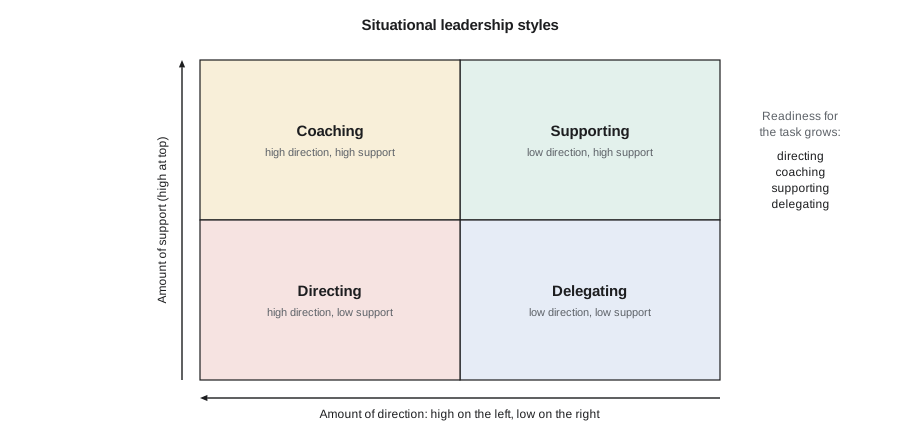
In the directing style (high direction, low support) the leader gives clear, specific instructions and supervises closely; it suits someone new to a task who is keen but inexperienced. In the coaching style (high direction, high support) the leader still directs but also explains, asks for ideas and encourages; it suits someone who has some skill but is discouraged or unsure. In the supporting style (low direction, high support) the leader shares decisions and builds confidence; it suits someone capable who lacks confidence or motivation. In the delegating style (low direction, low support) the leader hands over responsibility; it suits someone who is both skilled and committed.
Two points make the model useful on site. First, readiness is task-specific. An experienced carpenter may be at the highest level for formwork but a beginner at operating a new total station, so the same person needs different styles for different tasks. Second, the goal is to move people toward independence. A supervisor who directs the same capable foreman for years wastes the foreman's ability and their own time.
Situational leadership is popular because it is simple and practical. Research support for its specific predictions is limited and mixed, so treat it as a useful checklist rather than a proven law. The general lesson, that effective leaders adapt to the person and the situation, is well supported.
The worked example applies the model to Ben Kowalski's formwork crew. Dana and Ben rated each crew member's competence and commitment for one task, forming stairs, on a scale of 1 to 5.
# Situational leadership: suggested style for one task (forming the podium stairs)
crew = [  # name, competence 1-5, commitment 1-5 (ratings by the foreman)
    ("Apprentice A (1st year)", 1, 5),
    ("Apprentice B (3rd year)", 3, 2),
    ("Carpenter C", 4, 3),
    ("Carpenter D", 5, 5),
    ("Helper E (new hire)", 1, 3),
]

def style(comp, commit):
    if comp <= 2:
        return "directing" if commit >= 4 else "coaching"
    if comp <= 3:
        return "coaching" if commit <= 3 else "supporting"
    return "delegating" if commit >= 4 else "supporting"

counts = {}
for name, comp, commit in crew:
    s = style(comp, commit)
    counts[s] = counts.get(s, 0) + 1
    print(f"{name:26s} competence {comp} commitment {commit} -> {s}")
print("Styles needed today:", ", ".join(f"{k} x{v}" for k, v in sorted(counts.items())))Apprentice A (1st year) competence 1 commitment 5 -> directing Apprentice B (3rd year) competence 3 commitment 2 -> coaching Carpenter C competence 4 commitment 3 -> supporting Carpenter D competence 5 commitment 5 -> delegating Helper E (new hire) competence 1 commitment 3 -> coaching Styles needed today: coaching x2, delegating x1, directing x1, supporting x1
The result is a reminder that a single crew needs several styles at once. The first-year apprentice is enthusiastic but unskilled and needs clear direction. The third-year apprentice has some skill but low commitment, perhaps after a mistake was criticized in front of others, and needs coaching. Carpenter D can simply be handed the stair forms with the drawings. The labels are only as good as the judgements behind them, and they should be revisited as people develop.
Leading through foremen
A superintendent on a large site cannot personally lead every worker. Leadership flows through the foremen and lead hands, both the general contractor's own and the subcontractors'. That has two consequences. First, the superintendent's main leadership audience is the foremen. How Dana treats them is how they will tend to treat their crews; a superintendent who shouts at foremen in front of workers teaches shouting. Second, the superintendent should avoid bypassing foremen. Giving direction straight to a subcontractor's worker undermines the foreman, causes confusion and, in a unionized or subcontracted setting, can create contractual and labour relations problems. The exception is imminent danger, where anyone should stop unsafe work immediately and the foreman is informed straight afterwards.
What trust is made of
Trust is the willingness to rely on someone and accept some risk because you expect them to act well. A crew that trusts its supervisor will report hazards, admit mistakes, accept difficult decisions and put in extra effort when the schedule needs it. A crew that does not will do only what is checked.
Researchers Roger Mayer, James Davis and David Schoorman proposed in 1995 that people judge trustworthiness on three qualities: ability (can this person do the job?), benevolence (do they care about my interests?) and integrity (do they hold to principles I accept, and do their words match their actions?). David Maister and colleagues later offered a practical trust equation for professional relationships: trustworthiness rises with credibility, reliability and intimacy (feeling safe to share concerns) and falls with self-orientation (the sense that the person is mainly looking after themselves).
| Element | Builds trust on site | Destroys trust on site |
|---|---|---|
| Ability or credibility | Knows the drawings and sequence; gives correct answers or says "I will find out" | Bluffs, gives wrong answers confidently, blames the drawings for own errors |
| Reliability | Does what was promised: the hoist is booked, the material is there | Forgets commitments; says yes to everyone and delivers to nobody |
| Benevolence or intimacy | Asks about people, listens, protects safety, backs the crew when they are right | Ignores concerns; uses private information against people |
| Integrity | Same rules for everyone; honest reports; admits own mistakes | Plays favourites; hides problems; says one thing and does another |
| Low self-orientation | Shares credit; focuses on the project and the people | Takes credit; protects self at the crew's expense |
Trust is built slowly and lost quickly. Many supervisors find it helpful to think of an emotional bank account: every kept promise, fair decision and sign of care is a deposit; every broken promise, public humiliation or unfair decision is a withdrawal, and withdrawals are much larger than deposits. A superintendent who has built trust over months can make a hard call, such as sending a crew home for unsafe behaviour or asking for Saturday work, and keep the crew's respect. One who has not will meet resistance.
Psychological safety
Psychological safety, a term developed by Amy Edmondson, is a shared belief in a team that it is safe to take interpersonal risks: to ask a question, admit a mistake, raise a concern or challenge a decision without being embarrassed or punished. Edmondson's research in hospitals and companies found that teams with high psychological safety reported more errors, not because they made more, but because they talked about them, and learned faster as a result. Google's internal study of team effectiveness, known as Project Aristotle, also found psychological safety to be the most important factor among the ones it studied.
Construction depends on people speaking up. A labourer who notices a missing guardrail, an apprentice who is unsure how to connect a fall arrest lanyard and a foreman who realizes his crew set the anchor bolts in the wrong place all need to feel safe saying so. If the response to bad news is anger or ridicule, bad news stops arriving, and the supervisor learns about problems only when they become incidents or rework. CON-355 and HSE-109 develop psychological safety in the context of safety leadership and psychological health.
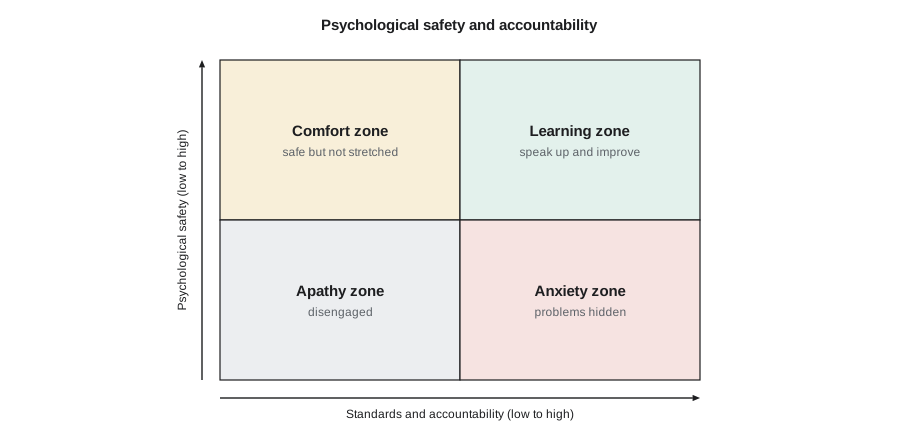
Psychological safety does not mean low standards. Edmondson's framework puts it on one axis and accountability on the other. Low safety with low standards gives apathy. High safety with low standards gives a comfortable crew that does not improve. Low safety with high standards gives anxiety, where people work hard but hide problems. The learning zone combines high safety with high standards. Supervisors build it by asking for input, thanking people who raise problems, responding to mistakes by asking what happened rather than who is to blame, and admitting their own errors.
Worked problem
Responding to bad news
During the end-of-day walk, an apprentice on Ben's crew tells Dana that he cut the wrong length of tie rod for a wall form and that the form was poured anyway. The wall face shows a slight bulge. How should Dana respond?
Show solution
- Thank him for telling her. That sentence matters more than anything else in the conversation, because it determines whether he, and anyone watching, will report the next problem.
- Ask what happened and why, without blame: was the cut list clear, was he trained, was he rushed?
- Assess the consequence with Ben and the field engineer: measure the bulge, check tolerances and decide whether grinding, a repair or engineering review is needed (CON-345).
- Fix the system, for example a pre-pour check of tie spacing, rather than only the person.
Answer: The apprentice learns that reporting is valued, the defect is caught before finishes hide it and a system change reduces the chance of a repeat.
Leading by example
People watch what supervisors do far more closely than they listen to what supervisors say. A superintendent who walks past an unguarded floor opening without acting has just told the whole site that guarding is optional. One who wears all required protective equipment, follows the same sign-in rules as everyone else, arrives on time, keeps calm and admits mistakes sets the standard more effectively than any poster. Some safety programs call this visible felt leadership: leaders being seen on site, engaging with workers and showing through action that they care.
Consistency is part of leading by example. A supervisor whose mood swings from friendly to furious leaves the crew guessing and spending energy managing the supervisor rather than the work. Being predictable, in standards and in temper, is one of the most underrated leadership qualities.
Leading in a crisis
In an emergency, such as a serious injury, a structural failure, a fire or a gas leak, the participative style is the wrong tool. People need clear, calm, specific direction: who calls emergency services, who meets the ambulance at the gate, who stops work and clears the area, who stays with the injured person. A supervisor who has thought through emergencies in advance and practised them (HSE-105 covers emergency planning) can step into the directive style instantly. After the emergency, the style shifts back: debriefing, supporting shaken workers and involving the crew in learning from what happened.
Common mistakes
MistakeUsing the same leadership style with everyone in every situation.
InsteadMatch the style to the person's competence and commitment for the specific task, and to the urgency of the situation.
MistakeBypassing foremen and directing subcontractor workers directly.
InsteadLead through the foremen, except to stop imminent danger, and inform the foreman right away.
MistakeReacting with anger when someone reports a mistake.
InsteadThank them, ask what happened, fix the consequence and the system; anger stops future reports.
MistakeThinking psychological safety means avoiding hard conversations.
InsteadCombine high psychological safety with high standards and clear accountability.
MistakeTelling the crew safety matters while ignoring hazards yourself.
InsteadLead by example; people copy what supervisors do, not what they say.
Summary and key terms
- Management copes with complexity; leadership copes with change. Supervisors need both, and leadership can come from anyone on site.
- Leadership styles range from directive to participative to delegating, and from transactional to transformational and servant leadership.
- Situational leadership matches directing, coaching, supporting and delegating styles to a person's task-specific competence and commitment.
- Superintendents lead mainly through foremen and should avoid bypassing them except in imminent danger.
- Trust rests on ability, benevolence and integrity; it is built slowly through reliability and fairness and lost quickly.
- Psychological safety lets people raise problems and mistakes; combined with high standards it creates a learning zone.
- Leading by example, consistency and a calm directive style in emergencies are core supervisory behaviours.
- Leadership
- Influencing people to work toward shared goals, especially through direction, alignment and motivation.
- Transactional leadership
- Leadership based on clear expectations, rewards and corrections.
- Transformational leadership
- Leadership that inspires through shared purpose, individual attention and intellectual challenge.
- Servant leadership
- Leadership focused on removing obstacles and helping others succeed.
- Situational leadership
- A model that matches directing, coaching, supporting or delegating behaviour to a follower’s readiness for a task.
- Trust
- Willingness to rely on another person and accept some risk because of positive expectations of their behaviour.
- Psychological safety
- A shared belief that it is safe to take interpersonal risks such as speaking up or admitting mistakes.
- Visible felt leadership
- Leaders being present on site and showing through their actions that they care about people and standards.
Practice problems
Work each problem on paper first, then reveal the answer to check.
State Kotter's distinction between management and leadership.
Show answer
Management copes with complexity through planning and control; leadership copes with change through direction, alignment and motivation.
When is a directive style clearly appropriate on site?
Show answer
In emergencies, imminent danger and for new workers on high-risk tasks.
Name the four situational leadership styles.
Show answer
Directing, coaching, supporting and delegating.
Why is readiness described as task-specific?
Show answer
A person can be expert at one task and a beginner at another, so they need different styles for different tasks.
What three qualities did Mayer, Davis and Schoorman identify as the basis of trustworthiness?
Show answer
Ability, benevolence and integrity.
What happens to reporting when supervisors punish people who admit mistakes?
Show answer
Reports stop, so problems surface only as incidents or rework.
What is the learning zone in Edmondson's framework?
Show answer
High psychological safety combined with high standards and accountability.
Give two examples of leading by example on site.
Show answer
Wearing all required protective equipment and stopping to correct a hazard rather than walking past.
Lesson quiz · 5 questions
Score 60% or more to complete this lesson.
Create a free account to save your progress, take quizzes and earn a certificate.