
CON-305 · Lesson 2 of 12 · 28 min
From trades worker to leader
Most construction supervisors come from the tools. A carpenter who is fast, accurate and reliable gets asked to run a small crew; a good foreman gets moved up to general foreman or assistant superintendent. That path has real strengths. Supervisors who have done the work understand it, can spot poor workmanship at a glance and earn instant credibility with tradespeople. But the path also has a trap. The skills that made someone an excellent tradesperson are not the same skills that make an excellent supervisor, and many new supervisors struggle not because they lack ability but because nobody told them the job had changed.
This lesson looks at that transition: how the mix of skills changes as you move up, the common traps new supervisors fall into, how to handle relationships with former peers, how to delegate and manage your time, and how to plan your first months in a supervisory role. It draws on the leadership and organizational behaviour theory in BUS-130 but applies it to the realities of a construction site.
How the skill mix changes
A classic way of thinking about management skills comes from Robert Katz, who in 1955 divided them into three groups. Technical skills are knowing how to do the work: reading drawings, laying out, building formwork, installing conduit. Human skills are working with and through people: communicating, motivating, resolving conflict, building trust. Conceptual skills are seeing the whole: understanding how the parts of the project fit together, anticipating problems, setting priorities and connecting site decisions to cost, schedule and the client's goals. Katz argued that all three matter at every level, but that the mix shifts as people move up. A lead hand relies mostly on technical skill; a superintendent relies much more on human and conceptual skill.
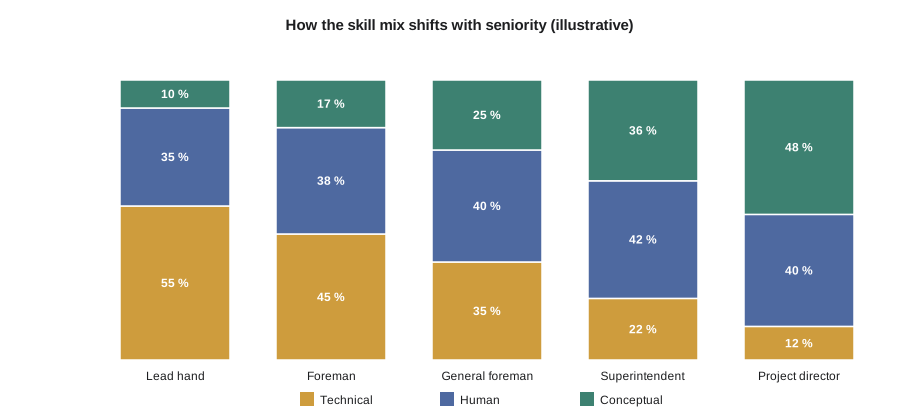
The implication for new supervisors is uncomfortable. The things you are best at, and that got you promoted, become a smaller part of your value. The things you may never have practised, such as having a difficult conversation with a crew member, planning three weeks ahead or explaining a decision to an owner's representative, become a larger part. Many new supervisors respond by retreating to what they know: they pick up the tools, fix the problem themselves and stay busy. That feels productive, but it leaves the crew without direction and the next day unplanned.
Common traps for new supervisors
Experienced superintendents describe the same handful of traps again and again. Recognizing them early makes them easier to avoid.
| Trap | What it looks like | Better approach |
|---|---|---|
| Still a tradesperson | Works on the tools most of the day; plans in the truck at 6 a.m. | Work with the tools only when it serves the crew, such as teaching or a short critical task |
| One of the crew | Avoids correcting friends; lets standards slip to stay liked | Be friendly but fair; set the same expectations for everyone |
| The new boss | Overcorrects with orders, threats and no explanation | Explain the why, listen, and earn authority through competence and fairness |
| Doing it all | Keeps every decision; becomes the bottleneck | Delegate deliberately and develop foremen and lead hands |
| Avoiding conflict | Hopes problems go away; delays hard conversations | Address issues early, privately and specifically (lesson 10) |
| Hiding mistakes | Covers up errors to look competent | Own mistakes quickly; it builds trust and models honesty |
Ben Kowalski, Thornbury's carpenter foreman on Larkspur Commons, fell into the first trap in his first year as a foreman. He was the fastest form-setter on the crew, so when the podium deck formwork fell behind he spent three days setting forms himself. Production rose slightly for those three days, but the rebar deliveries were not coordinated, the shoring layout for the next pour was not checked and two apprentices spent much of the time waiting for direction. Dana's advice to him afterwards was simple: on a crew of twelve, one extra pair of hands adds about 8 % to output; a well-organized day can add much more.
Former peers and new relationships
Being promoted over the people you worked beside is one of the hardest parts of the transition. Former peers may expect special treatment, test the new supervisor's limits or resent the promotion. Some new supervisors try to stay exactly as they were, joining in the jokes, ignoring small rule-breaking and avoiding uncomfortable decisions. Others swing the other way and become distant and harsh to prove they are in charge. Neither works.
A better approach starts with an honest conversation. Many experienced supervisors recommend talking with each former peer early, acknowledging that the relationship has changed, explaining what they will expect and asking for support. It helps to be clear that friendship outside work can continue but that on site everyone will be treated by the same standards. The first time the new supervisor has to correct a friend is a defining moment for the whole crew; handled privately, specifically and fairly, it builds respect. Ignored, it tells everyone the standards are negotiable.
New supervisors also gain new relationships upward and sideways: with the superintendent or project manager, the owner's representative, inspectors, consultants and the supervisors of other trades. These relationships require different behaviour. Upward, the supervisor is expected to bring information and solutions rather than only problems. Sideways, with other trades, the supervisor has no authority and must rely on cooperation and negotiation (lessons 5 and 10).
Earning credibility
Authority comes with the job title, but credibility has to be earned. On a construction site credibility usually rests on four things. Competence: you know the work and the plan. Reliability: you do what you say you will, every time. Fairness: you apply the same standards to everyone and do not play favourites. Care: you visibly look after people's safety and wellbeing and stand up for your crew when they are right. Lesson 3 develops these ideas into a model of trust. For now, notice that three of the four are about behaviour, not knowledge. A brand-new supervisor can be reliable, fair and caring from the first day.
Delegation
Delegation is giving someone else the responsibility and authority to do a task while keeping accountability for the result. It is the main way supervisors multiply their effort, and the main way they develop the next generation of supervisors. New supervisors often resist delegating for understandable reasons: it seems faster to do it yourself, the other person might make a mistake, or you may enjoy the task. But a supervisor who keeps every decision becomes a bottleneck, works impossible hours and leaves nobody ready to step up.
Delegation is not all or nothing. A useful way to think about it is as a ladder of levels, from simply asking someone to look into a problem to handing them full ownership.
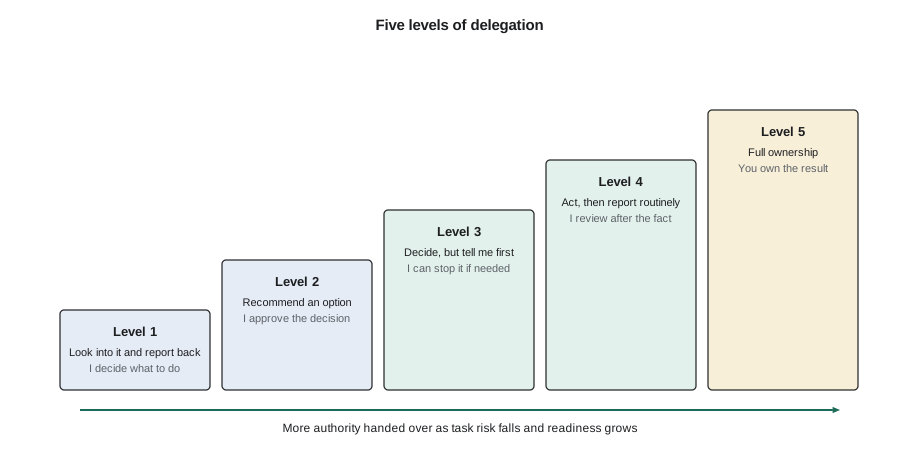
The right level depends on two things: the risk of the task and the readiness of the person. A low-risk task given to a capable person can be delegated at a high level. A high-risk task, such as planning a critical lift or changing a shoring layout, may be delegated only at the recommend level, with the supervisor approving. The single most useful habit is to state the level explicitly. 'Look into the stair formwork problem and tell me what you find' is very different from 'sort out the stair formwork and let me know what you did', and confusion between them causes both duplicated work and nasty surprises.
A good delegation conversation covers the result wanted, why it matters, the limits of authority (budget, time, who to involve), the resources available, when and how to report back and how the work will be checked. It ends with the other person summarizing what they have agreed to do, a simple read-back that lesson 6 returns to.
The worked example scores a list of Dana's tasks to suggest a delegation level. It is a thinking aid, not a formula: the scores are judgements, and the output is a starting point for a conversation.
# Suggest a delegation level (1 = look into it ... 5 = full ownership) for each task.
# risk: 1 (low) to 5 (high); readiness of the person: 1 (new to it) to 5 (fully capable).
tasks = [
    ("Daily housekeeping check, level 3", "Omar", 1, 5),
    ("Order next week's lumber package", "Ben", 2, 4),
    ("Plan the tower crane lift of rooftop units", "Omar", 5, 3),
    ("Run the morning foremen huddle", "Omar", 2, 4),
    ("Resolve a sleeve conflict between plumber and framer", "Mei", 3, 2),
    ("Update the three-week look-ahead", "Mei", 3, 3),
    ("Approve a change to reshoring layout", "Ben", 5, 4),
]
names = {1: "look into it and report", 2: "recommend, I decide", 3: "decide and tell me first",
         4: "act and report routinely", 5: "full ownership"}

def level(risk, ready):
    raw = ready - (risk - 1) * 0.75        # readiness pushes up, risk pulls down
    lv = max(1, min(5, round(raw + 1)))
    if risk >= 5:                          # company rule: high-consequence work is always
        lv = 2                             # prepared by the person and approved by the super
    return lv

for task, who, risk, ready in tasks:
    lv = level(risk, ready)
print(f"{task:52s} {who:5s} risk {risk} ready {ready} -> level {lv}: {names[lv]}")Daily housekeeping check, level 3 Omar risk 1 ready 5 -> level 5: full ownership Order next week's lumber package Ben risk 2 ready 4 -> level 4: act and report routinely Plan the tower crane lift of rooftop units Omar risk 5 ready 3 -> level 2: recommend, I decide Run the morning foremen huddle Omar risk 2 ready 4 -> level 4: act and report routinely Resolve a sleeve conflict between plumber and framer Mei risk 3 ready 2 -> level 2: recommend, I decide Update the three-week look-ahead Mei risk 3 ready 3 -> level 2: recommend, I decide Approve a change to reshoring layout Ben risk 5 ready 4 -> level 2: recommend, I decide
The output delegates routine housekeeping checks fully to Omar, lets Ben order lumber and report routinely, and keeps the crane lift plan and the reshoring change at the recommend level, where Dana approves the final decision. The sleeve conflict goes to Mei at a lower level because she is new to coordinating trades; Dana will coach her through it, which is how readiness grows. The rule that high-consequence tasks are always set at level 2 reflects a company decision, not mathematics. Engineered temporary works, for example, often require a qualified person's review regardless of who prepares the plan (CON-325).
Managing your time
Supervisors live with constant interruptions: radio calls, phone calls, questions in the hallway, inspectors arriving early. Some interruptions are the job. Others are symptoms of missing information or unclear authority, and they can be designed out. A simple tool is the urgent and important matrix, often credited to Dwight Eisenhower and popularized by Stephen Covey. Tasks that are urgent and important, such as an unsafe excavation or a failed inspection, need immediate attention. Tasks that are important but not urgent, such as planning, coaching and fixing recurring problems, are the ones that get squeezed out, yet they prevent future crises. Tasks that are urgent but not important can often be delegated, and tasks that are neither can be dropped.
| Urgent | Not urgent | |
|---|---|---|
| Important | Do now: hazards, failed inspections, critical deliveries, injured worker | Schedule: planning, look-aheads, coaching, fixing recurring problems, relationship building |
| Not important | Delegate or batch: routine questions, most calls and emails, minor requests | Drop or minimize: low-value reports, unnecessary meetings, distractions |
Practical habits help. Batch email and phone messages into a few set times rather than answering every notification. Give foremen the authority and information to answer routine questions themselves. Keep a single running list of open items instead of relying on memory. Hold short, regular check-ins with key people so that questions are saved for those rather than arriving one at a time. And recognize the difference between being busy and being effective.
Learning the business side
Promotion to supervisor usually brings responsibility for cost and schedule, often for the first time. Tradespeople may never have seen an estimate, a cost report or a contract. New supervisors should make a point of learning how the project makes or loses money: how the estimate was built, what unit rates the crew is expected to achieve (lesson 8), how the schedule shows the critical path (CON-210), what the subcontract says about scope and back charges (CON-330) and why a change done without written authorization may never be paid (CON-420). Asking the project manager to walk through the budget and the schedule is a sign of maturity, not ignorance.
Training and support
Formal training helps the transition, and in some places it is required. In Ontario, for example, supervisors must complete basic occupational health and safety awareness training, and several Canadian jurisdictions and many employers require additional supervisor safety training. In the United States, many employers and some states and cities require supervisors to hold an OSHA 30-hour construction outreach card or equivalent, and New York City requires site safety training for workers and supervisors on many projects. Requirements change, so check the current rules for your jurisdiction; lesson 11 and CON-355 cover the legal framework. Beyond compulsory safety training, good companies offer leadership training, mentoring by experienced superintendents and regular feedback.
Worked problem
Planning the first 90 days
Thornbury promotes Omar Haddad from field engineer to assistant superintendent on Larkspur Commons. Dana asks him to draft a 90-day plan. What should it include?
Show solution
- Days 1 to 30, learn: meet each foreman one to one, walk the whole site daily, read the subcontracts for the trades he will lead, review the schedule and the budget with Priya and agree with Dana which decisions are his.
- Days 31 to 60, take ownership: run the morning huddle, own the look-ahead for the wood-frame floors, handle routine coordination between framing, mechanical and electrical, and start a weekly one-to-one with Dana.
- Days 61 to 90, improve: pick one recurring problem, such as late material deliveries to upper floors, and lead its fix; ask foremen for feedback on his supervision; set two development goals with Dana.
- Throughout: keep a learning log, ask questions early, and agree explicitly with Dana on delegation levels.
Answer: A structured plan turns a vague promotion into clear expectations, gives the new supervisor early wins and builds the relationships the job depends on.
Emotional intelligence and self-awareness
Much of the transition is about self-awareness: knowing how you come across, what situations trigger your temper and how your mood affects the crew. The idea of emotional intelligence, popularized by Daniel Goleman in the 1990s, groups skills such as self-awareness, self-regulation, empathy and social skill. Researchers debate how to measure it and how much it adds beyond personality and general ability, but the practical point is not controversial: a supervisor who shouts when stressed, sulks after criticism or ignores how others feel makes the job harder for everyone. Asking for honest feedback, noticing your own patterns and choosing your response rather than reacting are skills that improve with practice.
Common mistakes
MistakeSpending most of the day working with the tools to prove you can still do the work.
InsteadUse your technical skill to teach, check and solve critical problems, and spend most of your time planning, coordinating and leading.
MistakeTreating friends on the crew differently from everyone else.
InsteadTalk early with former peers about the change, then apply the same standards to everyone.
MistakeDelegating vaguely, for example 'deal with it'.
InsteadState the result, the limits, the delegation level, the report-back point and how it will be checked, and ask for a read-back.
MistakeKeeping every decision to avoid mistakes.
InsteadDelegate low-risk tasks at high levels and coach people through higher-risk ones; keep approval of high-consequence decisions.
MistakeAssuming cost and contracts are the project manager's problem only.
InsteadLearn the budget, unit rates, schedule logic and subcontract scope for the work you supervise.
Summary and key terms
- Moving from the tools to supervision changes the job: human and conceptual skills become more important than technical skill.
- Common traps include staying on the tools, staying one of the crew, overcorrecting into a harsh boss, doing everything and avoiding conflict.
- An early, honest conversation with former peers and consistent standards help manage changed relationships.
- Credibility rests on competence, reliability, fairness and care, most of which are behaviours a new supervisor can show from day one.
- Delegation multiplies effort and develops people; choose a level from task risk and personal readiness and state it explicitly.
- The urgent and important matrix helps protect planning and coaching time from constant interruptions.
- New supervisors should learn the business side and use training, mentoring and feedback to build their skills.
- Technical skills
- Knowledge and ability to perform the specific work of a trade or discipline.
- Human skills
- The ability to work with, communicate with and lead people.
- Conceptual skills
- The ability to see the whole project, understand how parts fit together and set priorities.
- Delegation
- Assigning responsibility and authority for a task while keeping accountability for the result.
- Delegation level
- How much decision authority is handed over, from investigating and reporting to full ownership.
- Urgent and important matrix
- A tool that sorts tasks by urgency and importance to decide whether to do, schedule, delegate or drop them.
- Emotional intelligence
- A set of skills including self-awareness, self-regulation, empathy and social skill.
- Credibility
- The trust others place in a person because of their competence, reliability, fairness and care.
Practice problems
Work each problem on paper first, then reveal the answer to check.
Name Katz's three groups of management skills.
Show answer
Technical, human and conceptual.
Why did Ben's three days on the tools not help the podium formwork recover?
Show answer
One extra worker added little output while coordination, checking and direction for the rest of the crew suffered.
What should a new supervisor say to a former peer?
Show answer
Acknowledge the change, explain expectations, ask for support and make clear that everyone will be held to the same standards.
What two factors set the right delegation level?
Show answer
The risk of the task and the readiness of the person.
Which quadrant of the urgent and important matrix is most often squeezed out?
Show answer
Important but not urgent: planning, coaching and fixing recurring problems.
List four elements of a good delegation conversation.
Show answer
The result wanted, why it matters, limits of authority, resources, report-back timing and how it will be checked.
In the delegation example, why does the crane lift plan stay at level 2 even though Omar is fairly capable?
Show answer
It is a high-consequence task; company rules keep such decisions at the recommend level with the superintendent approving.
Give two business topics a new supervisor should learn.
Show answer
For example, the budget and unit rates for the work, and the subcontract scope and change process.
Lesson quiz · 5 questions
Score 60% or more to complete this lesson.
Create a free account to save your progress, take quizzes and earn a certificate.