
CON-305 · Lesson 1 of 12 · 30 min
The superintendent and site supervisor
Every construction project is planned in an office and built in the field. Between the two stands a small group of people whose job is to turn drawings, schedules and contracts into work that is done safely, correctly and on time: the superintendent, the assistant superintendents, the general foremen and the foremen who lead crews. They are the site supervisors. On most projects the quality of that supervision decides more about the outcome than any other single factor. A strong superintendent can rescue a weak schedule; a weak one can lose money on a project that was estimated and bought perfectly.
This course is about that job. It is written for people who are, or will soon be, responsible for leading work on a construction site: tradespeople stepping up to foreman, field engineers moving toward superintendent, and project managers who need to understand what their field partners actually do all day. It concentrates on the human side of the role: leading crews and subcontractors, communicating, planning the day and the week, solving problems, handling conflict and behaving professionally under pressure. The technical tools of supervision are covered in the rest of the site supervision track. CON-315 covers field engineering and layout, CON-325 site logistics, equipment and temporary works, CON-335 trade coordination and short-interval planning, CON-345 quality control and inspection, CON-355 safety leadership, CON-365 labour relations and workforce management, CON-375 project documentation and CON-385 renovation, commissioning and closeout. This course points to those courses rather than repeating them, and it builds on the scheduling methods of CON-210, the lean tools of CON-410, the subcontract management of CON-330 and the organizational behaviour theory of BUS-130.
The running example: Larkspur Commons
Throughout the course we follow one invented project and one invented superintendent. Larkspur Commons is a six-storey rental building in Kelowna, British Columbia, with 112 homes over ground-floor shops. It has a two-storey concrete podium for parking and retail, with four storeys of wood-frame construction above. The owner is the Okanagan Valley Housing Partnership, the general contractor is Thornbury Builders, the contract value is about $48 million and the construction schedule is 20 months. Thornbury self-performs the concrete formwork and rough carpentry with its own carpenters and labourers, and it subcontracts almost everything else: framing above the podium, mechanical, electrical, drywall, roofing, windows, finishes and site services.
The superintendent is Dana Whitfield. Dana started as a carpentry apprentice, ran formwork crews for eight years, became an assistant superintendent and has been a superintendent for six years. She reports to the project manager, Priya Nair, and works with an assistant superintendent, Omar Haddad, a field engineer, Mei Lin, and Thornbury's carpenter foreman, Ben Kowalski, who leads about a dozen carpenters and labourers. At peak, Larkspur Commons will have more than 120 workers on site from 14 subcontractors. Each lesson puts Dana in a real supervision problem and asks what she should do. All names, companies and numbers in the example are invented for teaching.
What site supervisors do
The word supervisor covers several levels. In the general contractor's field organization, the superintendent is the senior person on site and is responsible for the overall execution of the work. On large projects there may be a general superintendent over several area superintendents, and each may have assistant superintendents. Below them, foremen lead crews directly: a carpenter foreman, a concrete foreman, a labour foreman. In many trades a lead hand or working foreman leads a small crew while also working with the tools. Subcontractors have their own foremen and sometimes their own superintendents, who report to their own companies rather than to the general contractor.
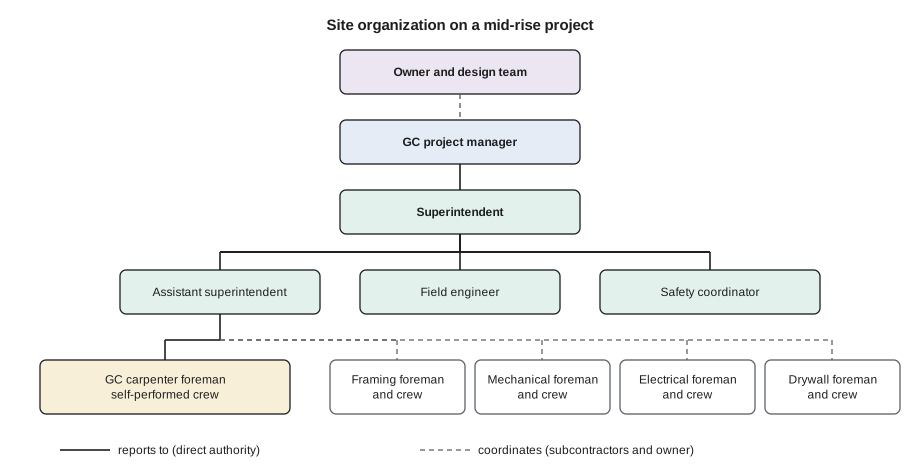
The figure shows an important feature of the job. The superintendent has direct authority over a small number of people, the general contractor's own staff and self-performed crews, but must coordinate and influence a much larger number of people employed by subcontractors. On Larkspur Commons, Dana directly supervises about 15 people and indirectly leads more than 100. Much of this course is about leading people you do not employ.
The superintendent and the project manager
On most general contractor projects, responsibility is split between a project manager, who is usually based partly in the office and manages the contract, money and paperwork, and a superintendent, who runs the site. The split varies from company to company, and in small firms one person may do both jobs. What matters is that the two partners agree on who owns what. Gaps lead to tasks nobody does; overlaps lead to subcontractors getting different answers from different people.
| Area | Project manager usually leads | Superintendent usually leads |
|---|---|---|
| Contract and owner relationship | Contract administration, change orders, owner meetings, claims | Field input to changes, site walk-throughs with the owner and consultants |
| Cost | Budget, cost reports, subcontract payments, forecasting | Productivity and cost of self-performed work, field cost awareness, time and material tickets |
| Schedule | Contract schedule, updates, delay notices | Daily and weekly planning, look-ahead schedules, sequencing, recovery in the field |
| Subcontractors | Buyout, subcontract scope, payments, back charges | Daily direction, coordination, manpower, workmanship and site conduct |
| Safety | Program support, resources, subcontract safety requirements | Site safety leadership, inspections, enforcement, orientation, emergency response |
| Quality | Submittals, specifications, inspection and testing contracts | Workmanship, field inspection, mock-ups, deficiency tracking |
| Documents | RFIs, submittals, correspondence, closeout documents | Daily reports, photos, site diaries, field records, as-built markups |
A healthy project manager and superintendent partnership is one of the strongest predictors of a successful job. The two need to meet often, share information freely and present a united position to the owner and subcontractors, even when they disagreed privately. A superintendent who undermines the project manager in front of a subcontractor, or a project manager who gives field direction without telling the superintendent, damages both of them.
Authority, responsibility and accountability
Supervisors need to understand three related ideas. Responsibility is the duty to get something done. Authority is the power to make decisions and direct resources to do it. Accountability is answering for the result. Trouble starts when they do not match. A superintendent who is held accountable for the schedule but has no authority to direct subcontractor manpower, approve overtime or hold back a payment for poor performance is set up to fail. A good company gives its superintendents authority that matches their responsibilities, writes it down in a job description and backs them when they use it.
Supervisors also carry legal duties, especially for safety. In every Canadian province and territory, occupational health and safety law places specific duties on supervisors, and the Criminal Code can apply when a person who directs work fails to take reasonable steps to prevent bodily harm. In the United States, OSHA standards require employers to designate competent persons for many construction activities, and OSHA's multi-employer citation policy means a general contractor can be cited for hazards created by subcontractors. Lesson 11 maps these duties, and CON-355 and HSE-402 cover safety leadership and supervisor due diligence in depth. For now, the key message is that becoming a supervisor changes your legal position: you can be personally responsible for what happens to the people you direct.
A day in the life
No two days are the same, but most superintendents work to a recognizable rhythm. The figure shows a typical day for Dana on Larkspur Commons during framing and mechanical rough-in.
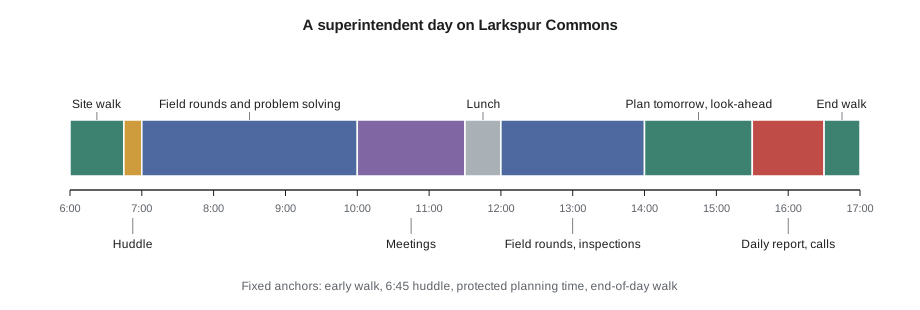
Dana arrives about 45 minutes before the trades. She walks the site alone or with Omar, checking access, housekeeping, temporary protection, weather, deliveries and anything that changed overnight. At 6:45 she meets the foremen for a short coordination huddle: what each crew is doing today, where they will be, what cranes, hoists and laydown areas they need and what hazards overlap. Then she spends most of the morning moving around the site: answering questions, checking work against drawings, resolving conflicts between trades, meeting inspectors and keeping an eye on safety. Late morning or early afternoon is often taken by meetings: the weekly subcontractor meeting, the owner and consultant meeting every two weeks, or a pre-installation meeting for a new trade. The afternoon includes paperwork, planning the next day, updating the three-week look-ahead and writing the daily report. Before leaving, she walks the site again to see what was achieved, check that the site is secure and note what tomorrow needs.
A key skill is protecting time for planning. Superintendents are pulled constantly toward urgent problems, and if they never step back the project is run from one crisis to the next. Many experienced superintendents block a fixed period, often early in the morning or late in the afternoon, when they plan and do not take calls unless there is an emergency.
A week in the life
The week has its own rhythm. Monday often starts with a look at the week's critical work, deliveries and inspections. The weekly subcontractor coordination meeting is usually held mid-week, where foremen review the look-ahead, commit to work for the next week and raise constraints (CON-410 calls this the weekly work plan in the Last Planner System). Thursday or Friday is often when the superintendent updates the three-week look-ahead, confirms next week's manpower with each subcontractor, reviews progress with the project manager and checks the schedule. Friday afternoon is a good time for a longer site walk with the safety coordinator and for preparing the site for the weekend: securing materials, checking temporary heat or dewatering, and confirming who is on call.
| Rhythm | Typical activities | Lesson |
|---|---|---|
| Daily | Early walk, foremen huddle, field rounds, inspections, daily report, end-of-day walk | 6, 7, 8 |
| Weekly | Subcontractor coordination meeting, look-ahead update, manpower confirmation, safety walk, PM review | 7, 8 |
| Every two weeks | Owner, architect and contractor meeting, progress photos, schedule update input | 7 |
| Monthly | Progress claim support, schedule update, safety committee or inspection report, performance reviews of crews | 8, 11 |
| Per phase | Pre-installation meetings, mock-ups, phase planning, trade start-ups and close-outs | 5, 7 |
How supervisors spend their time
Studies of construction supervisors over several decades have found the same pattern: supervisors spend much of their day on unplanned problem solving, searching for information, chasing materials and dealing with interruptions, and less than they would like on planning, coaching and improving the work. The exact numbers vary from study to study and from project to project, so treat any single figure with caution. The useful exercise is to measure your own time. A simple time log for a week, with every activity coded, usually surprises the person who keeps it.
The worked example below analyses a week of Dana's time log. Each entry records an activity category and the minutes spent. The categories separate planned work (planning, coaching, inspections) from reactive work (searching for information, firefighting, chasing deliveries).
# A superintendent's time log for one week (illustrative data)
log = [
    ("site walk", 270), ("huddle", 75), ("field problem solving", 610),
    ("searching for information", 190), ("chasing materials", 160),
    ("meetings", 420), ("planning and look-ahead", 150), ("coaching foremen", 60),
    ("inspections and quality", 230), ("safety rounds", 180),
    ("paperwork and reports", 310), ("phone and email", 345),
]
reactive = {"field problem solving", "searching for information", "chasing materials", "phone and email"}
planned = {"planning and look-ahead", "coaching foremen", "inspections and quality", "safety rounds", "site walk"}

total = sum(m for _, m in log)
print(f"Total logged: {total} min = {total/60:.1f} h over 5 days ({total/300:.1f} h/day)")
for name, mins in sorted(log, key=lambda r: -r[1]):
    print(f"  {name:28s}{mins:5d} min {100*mins/total:5.1f} %")
r = sum(m for a, m in log if a in reactive)
p = sum(m for a, m in log if a in planned)
print(f"Reactive share: {100*r/total:.0f} %   Planned share: {100*p/total:.0f} %")
print(f"Planning plus coaching: {150+60} min = {(150+60)/total*100:.0f} % of the week")Total logged: 3000 min = 50.0 h over 5 days (10.0 h/day) field problem solving 610 min 20.3 % meetings 420 min 14.0 % phone and email 345 min 11.5 % paperwork and reports 310 min 10.3 % site walk 270 min 9.0 % inspections and quality 230 min 7.7 % searching for information 190 min 6.3 % safety rounds 180 min 6.0 % chasing materials 160 min 5.3 % planning and look-ahead 150 min 5.0 % huddle 75 min 2.5 % coaching foremen 60 min 2.0 % Reactive share: 44 % Planned share: 30 % Planning plus coaching: 210 min = 7 % of the week
Dana logged a 50-hour week, and about 40 % of it went to reactive work: problem solving, searching for information, chasing materials and the phone. Only about 7 % went to planning and coaching. That does not mean the reactive work was wasted; much of it was necessary. But each hour spent searching for a drawing revision or chasing a late delivery is an hour that better planning and better systems might have saved. Dana's target for the next month is to double her planning time and cut information-searching time in half by getting Mei to keep the current drawing set and RFI log organized on the site tablet.
Worked problem
Who owns the problem?
On Larkspur Commons, the electrical foreman tells Dana that the owner's representative asked him on site to add four extra receptacles in each shop unit and to 'send the bill later'. What should Dana do?
Show solution
- Recognize that this is a change to the contract scope, which is the project manager's area, and that direction given directly to a subcontractor by the owner bypasses the contract chain.
- Tell the foreman politely not to proceed until he receives written direction through Thornbury, and explain why: unpriced, unauthorized work is a common source of disputes (CON-420).
- Call Priya the same day, describe the request and the quantities, and record it in the daily report.
- At the next owner meeting, raise the issue diplomatically and agree that all changes come through the contractor.
Answer: Dana handles the field side (stopping unauthorized work and recording it) and hands the contract side to the project manager. Both partners stay informed, the owner gets the change it wants through the proper channel and nobody does unpaid work.
What makes an effective superintendent
Ask experienced builders what separates great superintendents from average ones and the answers rarely focus on technical knowledge alone. Technical knowledge is necessary: a superintendent must read drawings, understand sequences, know how trades work and recognize poor workmanship. But the qualities that come up most often are about people and judgement: the ability to plan ahead, to communicate clearly, to earn respect without demanding it, to stay calm under pressure, to make decisions with incomplete information, to hold people accountable fairly and to care visibly about the safety and wellbeing of everyone on site.
Research on construction supervision, including studies by the Construction Industry Institute and university research groups, points the same way. It links supervisor communication, planning, recognition of good work and visible commitment to safety with better productivity and lower injury rates. As with any research, results depend on context, but the direction is consistent. The good news is that most of these qualities are skills, not fixed traits. They can be learned and practised, which is the purpose of this course.
| Quality | What it looks like on site | Where this course covers it |
|---|---|---|
| Planning ahead | Knows what next week needs today; constraints removed before crews arrive | Lessons 7 and 8 |
| Clear communication | Instructions understood the first time; information reaches the people who need it | Lesson 6 |
| Earned respect | People follow because they trust, not only because they must | Lessons 2 and 3 |
| Fair accountability | Expectations clear, performance discussed, good work recognized | Lesson 4 |
| Judgement | Sound decisions under time pressure, with escalation when needed | Lesson 9 |
| Composure | Handles conflict and bad news without losing control | Lesson 10 |
| Integrity | Honest records, fair dealing, legal duties met | Lesson 11 |
| Care for people | Safety, wellbeing and development taken seriously | Lesson 12 and CON-355 |
The changing job
The superintendent's job is changing. Projects are more complex, schedules are tighter and the trades are more specialized. Documents that once lived on paper drawings in the site trailer now live on tablets and in cloud platforms, which brings faster information but also more email, more notifications and more expectations of instant answers (CON-260 covers field management software and reality capture). The workforce is changing too. Both Canada and the United States face long-term shortages of skilled trades. BuildForce Canada's 2026–2035 outlook, released in July 2026, again projects large numbers of retirements, and its residential outlook expects about 135,000 residential workers, about a fifth of that workforce, to retire by 2035. In the United States, Associated Builders and Contractors estimated in January 2026 that the industry needed to attract about 349,000 net new workers in 2026. Crews are younger, more diverse, often multilingual and less willing to put up with the abrasive supervision that older workers sometimes describe as normal. That makes leadership skills more valuable, not less.
Finally, the role carries a heavy personal load. Superintendents work long hours, carry responsibility for other people's safety and are often the person blamed when things go wrong. Lesson 12 looks at stress, wellbeing and mental health in construction, for supervisors as well as crews.
Common mistakes
MistakeAssuming the superintendent's job is mainly technical, so the best tradesperson should automatically become the supervisor.
InsteadTechnical skill is necessary but not sufficient. Promote people who also show planning, communication and people skills, and train them for the new role.
MistakeLeaving the split of duties between project manager and superintendent unspoken.
InsteadAgree explicitly, ideally in writing, who owns contract, cost, schedule, quality, safety and document tasks, and tell subcontractors who to go to for what.
MistakeSpending every hour reacting to problems and never planning.
InsteadProtect a fixed block of planning time each day and measure your own time to see where it goes.
MistakeThinking supervisors are only responsible for their own company's workers.
InsteadSupervisors carry legal duties for the work they direct, and general contractors can be responsible for hazards created by subcontractors.
MistakeLetting subcontractors receive direction from several people.
InsteadKeep one clear chain of field direction and route contract changes through the project manager.
Summary and key terms
- Site supervisors, from superintendent to foreman, turn plans into finished work and strongly influence safety, quality, cost and schedule.
- The superintendent directly supervises a few people but must lead and coordinate many more who work for subcontractors.
- Project managers and superintendents split responsibilities; the split must be explicit and the partners must present a united front.
- Authority should match responsibility and accountability; supervisors carry personal legal duties, especially for safety.
- Superintendent work follows daily, weekly, biweekly and monthly rhythms built around walks, huddles, meetings, planning and records.
- Supervisors spend much of their time reacting; measuring your own time and protecting planning time are first steps to improving.
- Effective superintendents combine technical knowledge with planning, communication, judgement, fairness, composure, integrity and care for people.
- Superintendent
- The general contractor's senior site manager, responsible for the overall execution of the work in the field.
- Assistant superintendent
- A site manager who supports the superintendent, often responsible for an area, phase or set of trades.
- Foreman
- A supervisor who leads a crew directly and plans and checks its daily work.
- Lead hand
- A working supervisor who leads a small crew while also doing the work.
- Project manager
- The person responsible for the contract, budget, schedule, changes and documents, usually working with the superintendent.
- Self-performed work
- Work done by the general contractor's own employees rather than by subcontractors.
- Authority
- The power to make decisions and direct people and resources.
- Accountability
- The obligation to answer for results.
- Look-ahead schedule
- A short-term schedule, usually three to six weeks, that breaks the master schedule into detailed field activities.
Practice problems
Work each problem on paper first, then reveal the answer to check.
Name the levels of site supervision from most senior to least senior on a typical general contractor project.
Show answer
General or area superintendent, superintendent, assistant superintendent, general foreman, foreman, lead hand.
On Larkspur Commons, roughly how many people does Dana supervise directly and how many indirectly at peak?
Show answer
About 15 directly and more than 100 indirectly through subcontractor foremen.
Give two areas normally led by the project manager and two led by the superintendent.
Show answer
PM: contract administration and cost reports. Superintendent: daily field direction and site safety leadership.
Why is it a problem when a superintendent is accountable for the schedule but cannot direct subcontractor manpower?
Show answer
Accountability without matching authority sets the person up to fail and encourages blame instead of action.
What did Dana's time log show and what will she change?
Show answer
About 40 % of her week was reactive and only about 7 % went to planning and coaching; she will protect planning time and get the field engineer to organize drawings and RFIs to cut search time.
An owner's representative directs a subcontractor on site to add work. What are the superintendent's two jobs?
Show answer
Stop unauthorized work and record it in the field, and pass the contract change to the project manager.
List four fixed points in a typical superintendent day.
Show answer
Early site walk, morning huddle, mid-day check or meetings, end-of-day walk and daily report.
Why are leadership skills becoming more valuable in construction supervision?
Show answer
Workforce shortages, a younger and more diverse workforce, tighter schedules and more complex projects make leading people well more important.
Lesson quiz · 5 questions
Score 60% or more to complete this lesson.
Create a free account to save your progress, take quizzes and earn a certificate.