
CON-300 · Lesson 7 of 12 · 25 min
Subcontractor quotes, scope sheets and bid levelling
On a typical building, 70 to 90 % of the general contractor's price is made up of subcontractor and supplier quotes. A general contractor that prices its own work perfectly but carries the wrong subcontract numbers will lose the bid or win a loss. This lesson covers the subcontract side of the bid: building a bidders list, writing scope sheets, receiving and qualifying quotes, levelling them so that they can be compared on an equal basis, choosing which number to carry, and handling packages where no acceptable quote arrives. The buyout of subcontracts after award, with subcontract forms, purchase orders and supply chain management, is the subject of CON-330; insurance, bonding and subcontractor default risk are covered in CON-350.
Building the bidders list
For each package, the estimator invites a list of subcontractors or suppliers to quote. The list balances competition against quality: enough bidders to get a competitive price, but only firms the general contractor would actually hire. Many firms aim for at least three quotes on every significant package and more on the largest ones. Prequalification, either formal (questionnaires, financial statements, safety records, bonding letters) or informal (past performance), should happen before the bid, not after the low number arrives.
| Criterion | What to check | Why it matters |
|---|---|---|
| Capacity | Current backlog and workforce versus the size and timing of this package | An overloaded subcontractor delays the project |
| Financial strength | Financial statements, bonding capacity, payment history | A failing subcontractor is the costliest kind of default |
| Safety | Workers' compensation experience rating, safety program, COR or equivalent certification | The general contractor shares responsibility for site safety |
| Quality and experience | Similar projects, references, licensed trades | Rework and warranty problems cost money and reputation |
| Relationship | Past cooperation, change order behaviour, claims history | Some low bidders recover their price through changes and claims |
On some public projects, the owner requires bidders to list their major subcontractors on the bid form, or bids for certain trades must be submitted through a bid depository (Lesson 10). Both constrain which subcontractors the general contractor can carry and replace later, so the bidders list must reflect those rules from the start.
Writing scope sheets
A scope sheet tells each subcontractor exactly what to include in its price. It is the single most effective tool for reducing scope gaps and overlaps, and it makes levelling much easier because every quote should cover the same work. A good scope sheet lists the specification sections and drawings that apply, then states inclusions and exclusions that the specifications leave ambiguous, especially at the interfaces with other trades (Lessons 5 and 6 listed many of these for mechanical and electrical work).
| Section of scope sheet | Example for a drywall and ceilings package |
|---|---|
| Specification sections | 09 21 16 Gypsum board assemblies; 09 22 16 Non-structural metal framing; 09 51 13 Acoustical panel ceilings; 07 21 16 Blanket insulation in partitions |
| Drawings | A-101 to A-404, partition types on A-501, reflected ceiling plans A-201 to A-204 |
| Specific inclusions | Bulkheads and soffits; installation of access doors supplied by others; deflection heads; acoustic sealant; firestopping at partition heads; taping to the level specified; supply of wood backing in partitions |
| Specific exclusions | Painting; supply of access doors; firestopping of mechanical and electrical penetrations |
| General requirements | Hoisting by own forces or general contractor's crane at set times; daily cleanup; protection of finished work; schedule milestones |
| Commercial terms | Price valid for 60 days; bond required; holdback or retainage per contract; quote to acknowledge all addenda |
Scope sheets should be issued early, with the invitation to quote, and updated when addenda change the work. A scope sheet that contradicts the contract documents can create its own disputes, so it should clarify and allocate, not rewrite the specifications.
Receiving and qualifying quotes
Quotes arrive by email, through bid management platforms, by phone and, on bid day, in the last minutes before closing. Each quote should be logged with the time received, the addenda acknowledged, the scope covered and the qualifications attached. Subcontractors often attach long lists of exclusions and conditions: excluded items, assumed working hours, limits on their liability, payment terms, escalation clauses for volatile materials, or reliance on the general contractor for hoisting, power, cleanup or protection.
The estimator's job is to read every qualification and decide what it costs. An exclusion of 'bonds' on a package where bonds are required means the bond cost must be added. An exclusion of 'cleanup' means the general contractor's labour will do it. An assumption that the general contractor will provide a crane for hoisting may be acceptable if a crane is on site, or may add cost if it is not. A quote that conditions its price on a specific schedule or on material prices at the time of order carries escalation risk back to the general contractor (Lesson 9).
Levelling quotes
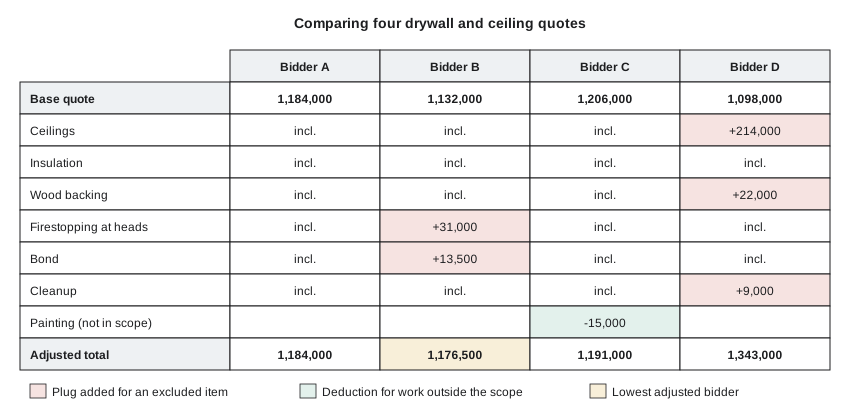
Levelling (also called bid levelling or scope levelling) is the process of adjusting each quote so that all of them cover the same scope, allowing a fair comparison. The usual tool is a levelling sheet: a grid with the scope items down the left side and the bidders across the top. For each bidder, the sheet records whether each item is included, excluded or unclear, and for excluded items it adds a plug: the estimator's best price for that item, either from another bidder's breakdown or from the estimator's own pricing. Items a bidder includes that are not in the scope are deducted if they can be separated.
# Level four drywall and ceilings quotes (all amounts $)
base = {"Bidder A": 1_184_000, "Bidder B": 1_132_000, "Bidder C": 1_206_000, "Bidder D": 1_098_000}
# scope items: plug value used when a bidder excludes the item
plugs = {"Ceilings": 214_000, "Insulation": 38_000, "Wood backing": 22_000,
         "Firestopping at heads": 31_000, "Bond": 13_500, "Cleanup": 9_000}
excluded = {
    "Bidder A": [],
    "Bidder B": ["Bond", "Firestopping at heads"],
    "Bidder C": [],
    "Bidder D": ["Ceilings", "Wood backing", "Cleanup"],
}
extras = {"Bidder C": -15_000}       # includes painting of bulkheads, not in this package
for b, price in base.items():
    adj = sum(plugs[i] for i in excluded[b]) + extras.get(b, 0)
    print(f"{b}: base {price:>10,}  adjustments {adj:>+9,}  adjusted {price + adj:>10,}")
low = min(base, key=lambda b: base[b] + sum(plugs[i] for i in excluded[b]) + extras.get(b, 0))
print("Lowest after adjustment:", low)Bidder A: base 1,184,000 adjustments +0 adjusted 1,184,000 Bidder B: base 1,132,000 adjustments +44,500 adjusted 1,176,500 Bidder C: base 1,206,000 adjustments -15,000 adjusted 1,191,000 Bidder D: base 1,098,000 adjustments +245,000 adjusted 1,343,000 Lowest after adjustment: Bidder B
Bidder D's quote looks lowest by $34,000, but it excludes ceilings, backing and cleanup; after plugs it is the highest. Bidder B becomes the low bidder after adding its bond and firestopping. Without levelling, the estimator would have carried Bidder D's number and been $245,000 short of the full scope on bid day.
Worked problem
Choosing between close quotes
After levelling, Bidder B is $1,176,500 and Bidder A is $1,184,000. Bidder B has never worked for Northline and is currently on two large projects; Bidder A has a strong record with Northline and confirmed capacity. Which number should be carried?
Show solution
- The levelled difference is $7,500, about 0.6 % of the package.
- Bidder B carries capacity and relationship risk that Northline cannot price precisely.
- Many contractors would carry Bidder B's number to stay competitive but note the risk, or carry Bidder A if they judge the risk to exceed the difference.
Answer: There is no single right answer. The decision should be explicit, documented and consistent with the firm's policy on carrying first-time subcontractors, and the bid-day leader should make it, not the clock.
Plugs and single quotes
When no acceptable quote arrives for a package, or only one arrives, the estimator must decide what to carry. A plug is an amount the estimator calculates from its own takeoff and unit costs, from historical cost per unit area, or from a budget price obtained from a subcontractor before bid day. A single quote may be carried as received if it is consistent with history, but a single quote that is far above history may be inflated precisely because the subcontractor suspects it is the only one. Carrying it uncritically can lose the bid; carrying a much lower plug can win a loss. The estimator should document the basis for every plug so that the project team knows which packages are exposed at buyout.
Can subcontractors withdraw their quotes?
A subcontractor's quote is an offer. Ordinarily an offer can be withdrawn before it is accepted. The difficulty is that the general contractor relies on the quote when it submits a bid it cannot withdraw. Courts have developed doctrines to deal with this reliance.
In Canada, the courts have held that a subcontractor whose quote was used by a general contractor in a tender can be bound to it. In Northern Construction Co. v. Gloge Heating and Plumbing Ltd. (Alberta Court of Appeal, 1986), the subcontractor was held to its bid because it knew its price would be relied on in an irrevocable tender, applying the Contract A and Contract B analysis that Lesson 10 explains. Bid depository rules also make subcontract bids irrevocable for a set period. The reciprocal obligation of the general contractor to award to the subcontractor it carried is less settled and depends on the circumstances and any depository rules.
Because these doctrines vary and depend on facts, prudent practice is simple: confirm critical quotes in writing before bid day ends, ask subcontractors to confirm their price and scope after a large gap appears between them and the next bidder, and avoid relying on quotes that are obviously in error.
Bid-day practice for subcontract packages
On bid day, the levelling sheets for the main packages are updated as quotes arrive, often until minutes before closing. Efficient firms prepare the sheets in advance with plugs already filled in, so that each new quote only needs to be entered and its exclusions marked. A bid-day leader makes final carry decisions on the largest packages; others handle the smaller ones. Lesson 10 describes the full bid-day sequence; here the key disciplines are listed.
- Prepare levelling sheets and plugs for every major package before bid day.
- Log every quote with the time, addenda acknowledged and qualifications.
- Call the low bidder on major packages to confirm scope when its price is far below the next bidder.
- Record the bidder carried and the levelled amount on the estimate summary.
- Keep all quotes confidential, during and after the bid.
Common mistakes
MistakeCarrying the lowest quote without levelling it.
InsteadLevel every significant package with plugs for excluded items and deductions for extras before comparing.
MistakeInviting subcontractors you would not hire.
InsteadPrequalify on capacity, finances, safety and quality before bid day.
MistakeIssuing no scope sheets and hoping the specifications are clear.
InsteadIssue scope sheets that clarify inclusions, exclusions and interfaces for each package.
MistakeIgnoring the qualifications attached to a quote.
InsteadRead every exclusion and condition and price what it costs the general contractor.
MistakeCarrying a single high quote because it is the only one.
InsteadCompare it with history and a plug; document the basis for any adjustment.
MistakeAssuming a subcontractor can always be held to an erroneous quote.
InsteadConfirm large outliers before relying on them; legal doctrines depend on the facts.
Summary and key terms
- Subcontract and supplier quotes make up most of a general contractor's bid.
- Bidders lists should be prequalified and give enough competition on each package.
- Scope sheets clarify inclusions, exclusions and interfaces and make levelling easier.
- Every quote's qualifications and exclusions must be read and priced.
- Levelling adjusts quotes to a common scope using plugs and deductions; the low levelled price may differ from the low quote.
- Plugs and single quotes need a documented basis and a check against history.
- Courts can hold subcontractors to quotes relied on in bids, but the details vary by jurisdiction.
- Bidders list
- The subcontractors or suppliers invited to quote a package.
- Prequalification
- Assessing a bidder's capacity, finances, safety and quality before the bid.
- Qualification (of a quote)
- A condition, assumption or exclusion attached to a quote.
- Levelling
- Adjusting quotes to a common scope so they can be compared fairly.
- Levelling sheet
- A grid of scope items and bidders used to level quotes.
- Plug
- An estimated amount added for excluded scope or carried for a package without an acceptable quote.
- Single quote
- The only quote received for a package.
- Promissory estoppel
- A doctrine that can bind a party to a promise another reasonably relied on.
- Listing requirement
- A rule requiring bidders to name subcontractors on the bid form.
- Budget price
- An informal price obtained before bid day to support a plug.
Practice problems
Work each problem on paper first, then reveal the answer to check.
Name four prequalification criteria for subcontractors.
Show answer
Capacity, financial strength, safety record, quality and experience, relationship history.
What should a scope sheet contain?
Show answer
Specification sections, drawings, specific inclusions and exclusions, general requirements and commercial terms.
A quote excludes bonds where bonds are required. What should the estimator do?
Show answer
Add the bond cost as a plug when levelling.
Quote X is $500,000 and excludes $40,000 of scope. Quote Y is $530,000 and includes all scope. Which is lower after levelling?
Show answer
Y: X levels to $540,000.
Quote Z includes $12,000 of painting not in the package. How should it be levelled?
Show answer
Deduct $12,000 if it can be separated from the quote.
Name three sources for a plug.
Show answer
Own takeoff and unit costs, historical cost per unit area, budget prices, other bidders' breakdowns.
Why can a single quote be risky?
Show answer
It may be inflated because the bidder suspects no competition, or it may be incomplete.
What legal doctrine has been used to hold subcontractors to quotes in each country?
Show answer
Contract A and Contract B analysis (Northern Construction v. Gloge Heating), and bid depository rules.
Why should levelling sheets be prepared before bid day?
Show answer
So late quotes can be entered quickly with plugs already in place.
Give two reasons not to automatically carry the lowest levelled quote.
Show answer
Capacity or financial risk, poor relationship history, unclear scope, unrealistic schedule.
Lesson quiz · 5 questions
Score 60% or more to complete this lesson.
Create a free account to save your progress, take quizzes and earn a certificate.