
CON-300 · Lesson 3 of 12 · 29 min
Labour, equipment and productivity pricing
Labour is the most uncertain cost in a contractor's own work. Material prices can be locked in with quotes and equipment rates are published, but how many hours a crew will need depends on the crew, the foreman, the weather, the design, the site and dozens of other factors. CON-200 introduced the labour pricing equation, labour burden, crews and productivity data, and owning and operating costs for equipment. This lesson applies those ideas to a complete bid: building loaded labour rates from current statutory costs, balancing crews, adjusting productivity for the conditions of a particular project, accounting for overtime, shift work and learning, and allocating equipment over the schedule rather than item by item.
The loaded labour rate, revisited
A worker's base wage is only the starting point. The contractor also pays statutory payroll costs, workers' compensation premiums, vacation and holiday pay, and, on unionized work, negotiated benefits such as health and welfare, pension and training funds. Together these are called labour burden. Some components are percentages of wages without limit; others stop once a worker's earnings reach an annual ceiling, so the effective burden percentage depends on how much the worker earns in a year.
For 2026, the main federal payroll costs for an employer outside Quebec are the Canada Pension Plan (CPP) and Employment Insurance (EI) premiums. The employer pays CPP at 5.95 % on earnings between the $3,500 basic exemption and the year's maximum pensionable earnings (YMPE) of $74,600, plus a second tier (CPP2) at 4.00 % on earnings between $74,600 and $85,000. The employer's EI premium is 1.4 times the employee rate of 1.63 %, or 2.282 %, on insurable earnings up to $68,900. Quebec employers pay into the Quebec Pension Plan and Quebec Parental Insurance Plan instead, with different rates. Provincial workers' compensation premiums are set per $100 of insurable earnings by rate group and vary widely by trade and province; employment standards require vacation pay (at least 4 % in most provinces) and pay for public holidays.
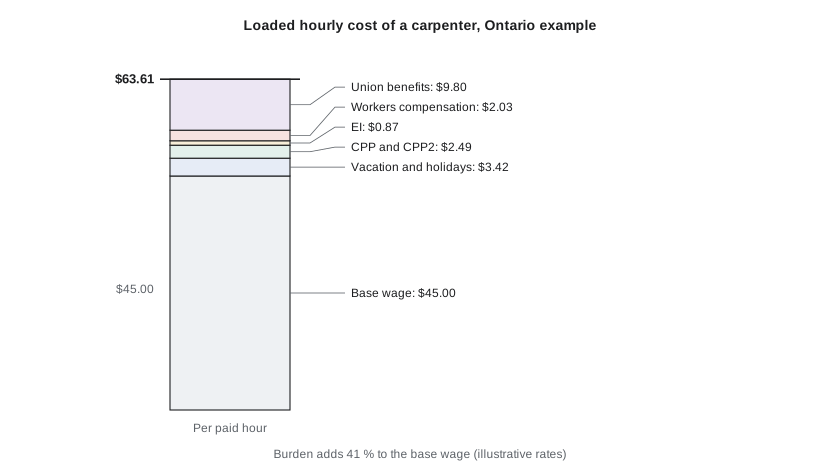
# Effective 2026 employer burden for a carpenter in Ontario (illustrative wage and WSIB rate)
wage, hours = 45.00, 1_800              # $ per hour, paid hours per year
earn = wage * hours
cpp  = 0.0595 * (min(earn, 74_600) - 3_500)
cpp2 = 0.04 * max(0, min(earn, 85_000) - 74_600)
ei   = 0.0163 * 1.4 * min(earn, 68_900)
vac  = 0.04 * earn                      # vacation pay
hol  = 0.036 * earn                     # public holiday pay, about 9 days (assumed)
wsib = 4.50 / 100 * earn                # $ per $100 of insurable earnings (illustrative)
benefits = 9.80 * hours                 # union health, pension and training ($/h, illustrative)
parts = {"CPP": cpp, "CPP2": cpp2, "EI": ei, "Vacation": vac, "Holidays": hol,
         "WSIB": wsib, "Benefits": benefits}
for k, v in parts.items():
    print(f"{k:9s} ${v:>9,.0f}  {v / earn:6.2%}")
total = sum(parts.values())
print(f"Burden   ${total:>9,.0f}  {total / earn:6.2%}")
print(f"Loaded rate ${wage + total / hours:.2f} per paid hour")CPP $ 4,230 5.22% CPP2 $ 256 0.32% EI $ 1,572 1.94% Vacation $ 3,240 4.00% Holidays $ 2,916 3.60% WSIB $ 3,645 4.50% Benefits $ 17,640 21.78% Burden $ 33,500 41.36% Loaded rate $63.61 per paid hour
The output shows that burden adds roughly 40 to 50 % to the base wage for this worker, and that the largest single item is the negotiated benefit package; workers' compensation and the statutory payroll costs come next. Because some items stop at annual ceilings, burden as a percentage is higher early in the year and for lower-paid workers. Estimators normally use an average burden percentage for each trade, updated every January and whenever collective agreements or compensation rates change. Using last year's burden on a bid submitted in February is a classic source of small but certain losses.
Crews and crew balance
A crew rate combines the loaded rates of the workers who normally work together, and sometimes their equipment, into a single cost per crew-hour. The crew must be balanced: the mix of trades and labourers should keep everyone productive. A formwork crew with too few labourers stripping and moving forms leaves carpenters waiting; one with too many leaves labourers idle. Crew composition also affects supervision: a foreman can typically direct six to ten workers effectively, depending on the work.
| Crew | Composition (example) | Typical use |
|---|---|---|
| Concrete formwork | 1 foreman, 4 carpenters, 2 labourers | Wall and column forms |
| Concrete placing | 1 foreman, 1 finisher, 4 labourers, pump on hire | Slab and wall pours |
| Slab finishing | 1 foreman, 3 finishers, power trowels | Slabs on grade and elevated slabs |
| Rough carpentry | 1 foreman, 3 carpenters, 1 labourer | Blocking, backing, temporary protection |
| General labour | 1 working foreman, 3 labourers | Cleanup, protection, material handling |
Worked problem
Building a crew rate
A wall-forming crew consists of 1 foreman at a loaded rate of $92 per hour, 4 carpenters at $78 and 2 labourers at $63. Calculate the crew cost per hour and the cost per square metre of contact area if the crew forms 10.5 m² per crew-hour.
Show solution
- Crew cost = 92 + 4 × 78 + 2 × 63 = 92 + 312 + 126 = $530 per crew-hour.
- Unit labour cost = 530 ÷ 10.5 ≈ $50.48 per m².
Answer: The crew costs $530 per hour and about $50.50 per m² of contact area for labour alone.
Adjusting productivity for the project
Published productivity data and a firm's own history describe average conditions. Every project differs, and the estimator adjusts base productivity with factors that reflect the specific job. Typical adjustments include the following.
| Condition | Effect on productivity | Illustrative adjustment |
|---|---|---|
| Repetitive, simple layout | Faster than average | −5 % to −15 % hours |
| Congested or confined site, limited laydown | Extra handling and waiting | +5 % to +20 % |
| Work at height or over water | Access, fall protection, slower movement | +10 % to +30 % |
| Occupied building or phased work | Restricted hours, protection, moves | +10 % to +25 % |
| Cold weather or winter work | Bulky clothing, heating, shorter days | +10 % to +30 % |
| Hot weather | Rest breaks, heat stress controls | +5 % to +15 % |
| Many trades in the same area (stacking) | Interference, waiting for access | +10 % to +30 % |
| Inexperienced crew or new method | Learning, rework | +10 % to +25 % |
Factors should be applied thoughtfully, not stacked mechanically. A project that is congested, in winter and in an occupied building does not necessarily take 75 % more hours; some effects overlap. The safest practice is to adjust productivity for the specific activities affected, write down the reasons, and compare the resulting hours with completed projects of similar character.
Overtime, shift work and schedule compression
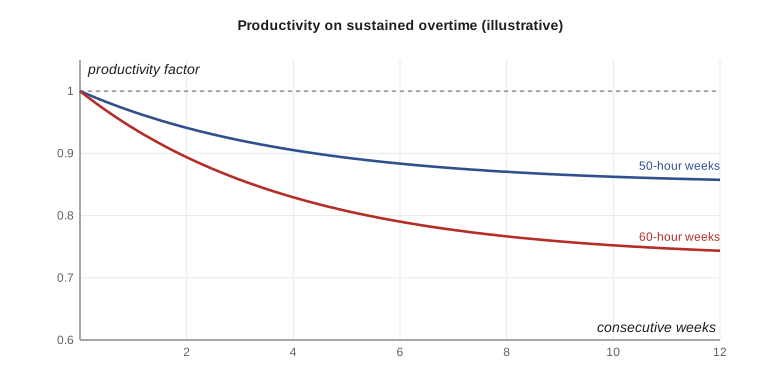
When a schedule is compressed, contractors work longer days, add shifts or add workers. Each option costs more than the hours suggest. Overtime is paid at a premium, typically time and a half or double time depending on the hours, the day and the collective agreement or employment standards. Productivity also falls on sustained overtime because of fatigue, and the loss grows with the number of consecutive weeks. Studies of mechanical and electrical work have reported losses of roughly 10 to 25 % after several weeks of 50- to 60-hour weeks; the figures vary, so estimators should treat them as indicative and rely on their own experience.
Worked problem
The real cost of overtime
A crew's straight-time loaded rate is $500 per crew-hour, of which $380 is wages. For six weeks the crew will work 50 hours per week instead of 40; hours over 40 are paid at time and a half (burden applies to the premium only for some items; assume the premium carries 20 % burden). Assume productivity on all hours falls by 8 % during this period. How much does each week of overtime cost compared with getting the same output at straight time?
Show solution
- Straight-time cost of 40 hours = 40 × 500 = $20,000.
- Overtime hours cost: 10 × (500 + 0.5 × 380 × 1.20) = 10 × 728 = $7,280. Weekly cost = 20,000 + 7,280 = $27,280.
- Output at 92 % productivity = 50 × 0.92 = 46 straight-time equivalent hours.
- Cost of 46 hours at straight time = 46 × 500 = $23,000.
- Extra cost per week = 27,280 − 23,000 = $4,280, about 19 % more for the same output.
Answer: Over six weeks the overtime premium and lost productivity add about $25,700. If the bid documents require an accelerated schedule, that cost belongs in the estimate.
Shift work avoids some of the fatigue but adds shift premiums, lighting, extra supervision and coordination. Adding workers to a fixed area eventually causes crowding, which reduces productivity per worker. All of these effects are why schedule acceleration is expensive and why a bid with an unrealistic schedule often hides a loss.
Learning on repetitive work
When a crew repeats the same task, such as forming identical floors, installing identical bathroom pods or framing identical units, it usually gets faster. A learning curve describes the effect: each time the number of repetitions doubles, the time per unit falls to a fixed fraction of its previous value. An 85 % to 95 % learning rate is common for construction tasks. The first unit takes the longest, so a bid on a repetitive building should price the first floors more conservatively than the later ones, or use an average over all units.
import math
# Learning curve for forming 8 identical floors (first floor takes 1,400 crew-hours)
T1, r, floors = 1_400, 0.90, 8
b = math.log(r) / math.log(2)
times = [T1 * n ** b for n in range(1, floors + 1)]
for n, t in enumerate(times, 1):
    print(f"Floor {n}: {t:7.0f} crew-hours")
print(f"Total {sum(times):,.0f} vs {T1 * floors:,} without learning "
f"({1 - sum(times) / (T1 * floors):.1%} saving)")Floor 1: 1400 crew-hours Floor 2: 1260 crew-hours Floor 3: 1185 crew-hours Floor 4: 1134 crew-hours Floor 5: 1096 crew-hours Floor 6: 1066 crew-hours Floor 7: 1042 crew-hours Floor 8: 1021 crew-hours Total 9,203 vs 11,200 without learning (17.8% saving)
With a 90 % learning rate, eight floors take about 18 % fewer hours than eight times the first floor. An estimator who prices every floor at the first-floor rate will be high; one who prices every floor at the eighth-floor rate will lose money. Learning is also interrupted by changes in design from floor to floor, crew turnover and long gaps between repetitions.
Equipment for the whole job
In a detailed estimate, some equipment is priced with the activity it serves: an excavator in the excavation package, a concrete pump on each pour. Other equipment serves the whole job and is priced on the schedule. Tower cranes, mobile cranes kept on site, hoists, forklifts and telehandlers, site vehicles, generators and temporary heating plants are usually carried in general conditions or in a separate equipment section, priced by the number of weeks or months they will be needed plus mobilization, erection, dismantling and operators.
| Equipment | Pricing basis | Items often missed |
|---|---|---|
| Tower crane | Monthly rental plus operator, for the structural and envelope duration | Foundation, erection and dismantling, electrical service, climbing, inspections |
| Mobile crane on call | Hourly or daily rate with minimum charges | Travel time, rigging crew, permits, matting |
| Personnel and material hoist | Monthly rental plus operator from enclosure to finishes | Tie-ins, landing gates, removal and patching |
| Telehandler or forklift | Monthly rental for duration of use | Fuel, maintenance, certified operator |
| Temporary heat | Weekly fuel and rental over the winter period | Hoarding, fire watch, ventilation |
| Small tools | Percentage of labour | Replacement and theft |
Worked problem
Pricing a tower crane
A six-storey concrete frame needs a tower crane for 34 weeks. Rental is $16,500 per month (4.33 weeks), the operator costs $5,900 per week loaded, the foundation and electrical service cost $68,000, erection and dismantling with a mobile crane cost $54,000, and monthly inspections and maintenance cost $1,400. Calculate the total crane cost.
Show solution
- Months = 34 ÷ 4.33 ≈ 7.85; rental = 7.85 × 16,500 ≈ $129,600.
- Operator = 34 × 5,900 = $200,600.
- Inspections = 7.85 × 1,400 ≈ $11,000.
- Total = 129,600 + 200,600 + 68,000 + 54,000 + 11,000 ≈ $463,200.
Answer: The crane costs about $463,000, and more than 40 % of it is the operator, not the rental. Adding four weeks to the structural schedule would add about $40,000 in rental, inspections and operator time.
Common mistakes
MistakeUsing last year's burden percentage on this year's bids.
InsteadUpdate burden every January and whenever collective agreements, statutory rates or compensation premiums change.
MistakeApplying a single burden percentage to all trades.
InsteadCalculate burden by trade; workers' compensation and benefits differ widely.
MistakeStacking every productivity adjustment factor on top of the others.
InsteadAdjust the affected activities, recognize overlaps, record reasons and check against history.
MistakePricing overtime as hours times the premium rate only.
InsteadInclude the lost productivity of sustained overtime as well as the premium.
MistakePricing every repetitive unit at the first-unit rate (or the last).
InsteadUse a learning curve or an average rate over all repetitions.
MistakePricing a tower crane on rental alone.
InsteadInclude operator, foundation, erection, dismantling, power, inspections and the full duration.
Summary and key terms
- Loaded labour rates add statutory payroll costs, workers' compensation, vacation and holidays and benefits to the base wage.
- Some burden items have annual ceilings, so burden varies by earnings and time of year; use updated trade averages.
- Crew rates combine balanced crews; unit costs are crew cost divided by crew productivity.
- Base productivity is adjusted for site, weather, height, occupancy, congestion and experience, without double counting.
- Overtime costs both a wage premium and lost productivity, which grows with sustained extended hours.
- Learning curves reduce time per unit on repetitive work, typically at 85 to 95 % per doubling.
- Job-wide equipment such as cranes and hoists is priced on the schedule with all associated costs.
- Labour burden
- Employer costs added to base wages: payroll taxes, compensation premiums, vacation, holidays and benefits.
- Loaded labour rate
- Base wage plus labour burden, per hour.
- Crew rate
- The combined loaded cost of a crew per crew-hour.
- Productivity factor
- A multiplier applied to base productivity for project conditions.
- Schedule compression
- Shortening the schedule through overtime, shifts or added workers.
- Learning curve
- A model in which time per unit falls by a fixed ratio each time cumulative units double.
- Learning rate
- The ratio of time per unit after a doubling of repetitions, such as 90 %.
- Stacking of trades
- Many trades working in the same area at once, reducing productivity.
- Mobilization
- The cost of bringing equipment, people and facilities to the site.
- Job-wide equipment
- Equipment serving the whole project, priced on duration rather than per activity.
Practice problems
Work each problem on paper first, then reveal the answer to check.
Name the federal payroll costs an Ontario employer pays on wages.
Show answer
CPP (and CPP2) and EI premiums.
Why does burden as a percentage vary through the year?
Show answer
Some items stop when earnings reach annual ceilings.
A crew has 1 foreman at $90, 3 trades at $80 and 2 labourers at $60. What is the crew rate?
Show answer
90 + 240 + 120 = $450 per hour.
That crew installs 9 m² per hour. What is the labour cost per m²?
Show answer
$50 per m².
List four conditions that reduce productivity.
Show answer
Congestion, height, occupied building, winter, heat, stacking of trades, inexperience (any four).
Why is overtime more expensive than its wage premium suggests?
Show answer
Productivity falls on sustained overtime, so more paid hours are needed for the same output.
With a 90 % learning rate and 1,000 hours for unit 1, how long does unit 2 take?
Show answer
900 hours.
And unit 4?
Show answer
810 hours.
Name four costs of a tower crane besides rental.
Show answer
Operator, foundation, erection and dismantling, electrical service, inspections, climbing.
A crane costs $8,000 per week all-in. What does a three-week schedule overrun add?
Show answer
$24,000.
Lesson quiz · 5 questions
Score 60% or more to complete this lesson.
Create a free account to save your progress, take quizzes and earn a certificate.