
CON-210 · Lesson 8 of 12 · 28 min
Schedule compression: crashing and fast-tracking
Sooner or later every project manager is asked to finish earlier: the owner wants to open before the holiday season, a tenant's lease starts on a fixed date, or the project has fallen behind and liquidated damages loom. Shortening a schedule without changing the scope is called schedule compression. There are two main techniques. Crashing adds resources or money to shorten critical activities. Fast-tracking overlaps activities that would normally be done in sequence. Both cost something, in money, risk or both, and both work only on the critical path. This lesson shows how to compress a schedule systematically, how to find the cheapest days to buy, and how to judge whether compression is worth it.
Only the critical path matters
The first rule of compression is that shortening a non-critical activity does nothing for the finish date. If an activity has 10 days of float, cutting its duration by 5 days simply increases its float to 15. Compression must target the critical path, and as soon as one path is shortened, another path may become critical. Effective compression therefore proceeds one step at a time, recalculating the critical path after each step.
Direct and indirect costs
Project costs split into two kinds that behave in opposite ways as the duration changes.
- Direct costs are the costs of performing the activities: labour, materials and equipment. Shortening an activity usually increases its direct cost, because of overtime premiums, extra shifts, extra equipment, less efficient crews or premium delivery charges.
- Indirect costs are time-related project costs: site supervision, temporary facilities, equipment on standby, insurance, financing, and the contractor's general conditions. They fall as the duration falls.
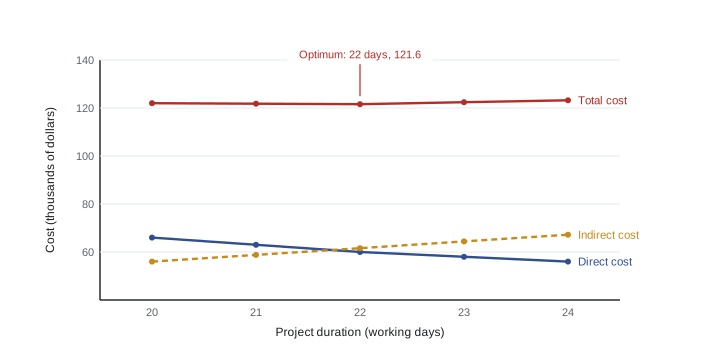
Liquidated damages, or a bonus for early completion, act like indirect costs: each day saved is worth the daily rate. Total cost is the sum of direct and indirect costs, and there is usually a duration at which it is lowest. Compressing beyond that point costs more than it saves, unless there is a separate reason, such as a hard opening date, to finish earlier.
Normal and crash points
For each activity that can be shortened, the planner estimates two points.
- The normal point: the duration and direct cost under the planned, efficient method.
- The crash point: the shortest practical duration and its direct cost, with all reasonable measures applied: overtime, extra crews, additional equipment, faster methods.
Assuming cost rises roughly evenly between the two points, the cost slope is the extra direct cost per day saved.
The cost slope is the price of buying a day on that activity. The cheapest days to buy are on critical activities with the lowest cost slopes.
The crashing procedure
The classic procedure is a simple loop.
- Calculate the critical path and the project duration with normal durations.
- Identify the critical activities that can still be shortened, and their cost slopes.
- Shorten the critical activity, or the combination of activities when there are several critical paths, with the lowest total cost slope, by one day or by as many days as are possible before another path becomes critical.
- Recalculate the critical paths and costs.
- Repeat until the target duration is reached, no further crashing is possible, or the cost of the next day exceeds the indirect cost saved.
When two parallel paths are both critical, shortening the project by a day requires shortening both, so the relevant cost is the sum of one activity's slope on each path, unless an activity common to both paths can be shortened instead.
A worked crashing example
| Activity | Predecessor | Normal days | Normal cost | Crash days | Crash cost | Cost slope per day |
|---|---|---|---|---|---|---|
| A | — | 10 | $20,000 | 8 | $26,000 | $3,000 |
| B | A | 8 | $15,000 | 6 | $19,000 | $2,000 |
| C | A | 6 | $12,000 | 5 | $14,500 | $2,500 |
| D | B, C | 6 | $9,000 | 5 | $13,000 | $4,000 |
Worked problem
Finding the optimum duration
Using the table above, with indirect costs of $2,800 per working day, find the normal duration and cost, the optimum duration, and the cost of compressing to 21 days.
Show solution
- Paths: A–B–D = 10 + 8 + 6 = 24 days (critical); A–C–D = 10 + 6 + 6 = 22 days.
- Normal total cost: direct $56,000 + indirect 24 × $2,800 = $67,200; total $123,200.
- Step 1: the cheapest critical activity is B at $2,000, less than the $2,800 saved per day. Shorten B by 2 days (its crash limit), giving 22 days on both paths. Direct cost rises $4,000; indirect falls $5,600.
- At 22 days: direct $60,000, indirect $61,600, total $121,600.
- Step 2: both paths are now critical. B is fully crashed. Options: A ($3,000, on both paths), D ($4,000, on both paths), or C plus B (B cannot shorten further). The cheapest is A at $3,000, which exceeds the $2,800 saved, so 22 days is the optimum.
- To reach 21 days anyway, shorten A by 1 day: direct $63,000, indirect $58,800, total $121,800, which is $200 more than at 22 days.
Answer: Optimum at 22 days for $121,600. Going to 21 days costs $200 more; going further costs more still.
The example also shows why compression gets more expensive as it goes. The cheapest days are bought first. Each later day costs more, both because the cheaper activities are used up and because more paths become critical and must be shortened together.
Practical ways to crash activities
In the field, crashing means choosing specific measures, each with its own cost and risk.
| Measure | Typical effect | Main risks |
|---|---|---|
| Overtime on existing crews | Fast to arrange; 10 to 25 % more output per week | Premium pay; productivity loss and fatigue after a few weeks |
| Second shift | Can nearly double daily output | Supervision, lighting, noise limits, coordination between shifts |
| Larger or extra crews | More output if space allows | Congestion, learning curve, supply of skilled workers |
| More or larger equipment | Faster earthwork, lifting or concrete placing | Rental cost, site space, mobilization |
| Faster methods or materials | Precast instead of cast-in-place, high-early-strength concrete | Design changes, approvals, cost premiums |
| Expedited procurement | Earlier delivery of long-lead items | Premium freight, fabrication surcharges |
Overtime deserves special caution. Research and industry studies, including work summarized by trade associations and the construction research community, have repeatedly found that sustained scheduled overtime reduces productivity, so that after several weeks of 50- or 60-hour weeks crews produce little more than they did in 40 hours, at much higher cost and with higher accident rates. Short bursts of overtime to recover a specific critical activity work; months of overtime to recover a late project often do not.
Worked problem
Is overtime worth it?
A crew of 10 works 40 hours a week at a loaded rate of $60 per hour. To shorten a critical activity, the contractor considers moving to 50-hour weeks for 4 weeks, with time-and-a-half for the extra 10 hours. Productivity during the extra hours is expected to be 80 % of normal. How many effective hours does the overtime add per week, at what extra cost, and what is the cost per effective hour?
Show solution
- Extra hours per week: 10 workers × 10 h = 100 h.
- Effective output of the extra hours: 100 × 0.80 = 80 effective hours.
- Extra cost per week: 100 h × $60 × 1.5 = $9,000 (simplifying by applying the premium to the whole loaded rate).
- Cost per effective hour: $9,000 ÷ 80 = $112.50, compared with $60 normally.
- Over 4 weeks, overtime adds 320 effective hours, equal to 0.8 weeks of normal crew output, for $36,000.
Answer: About 80 effective hours per week for $9,000, nearly twice the normal cost per hour. Worth it only if the days saved are worth more.
Fast-tracking
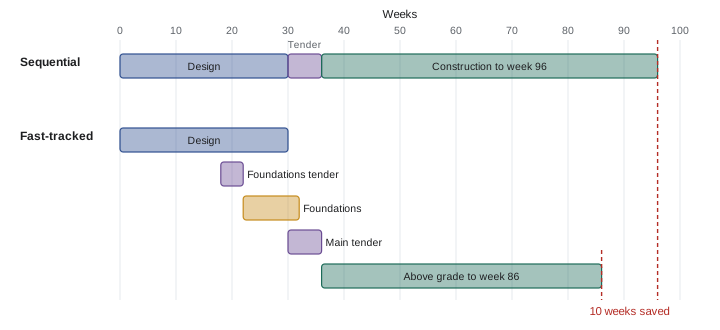
Fast-tracking shortens the schedule by overlapping activities or phases that would normally be done one after another, without necessarily adding resources. Common examples include starting construction before design is complete, so that early packages such as excavation and foundations are tendered and built while later packages are still being designed; starting interior work on lower floors while upper floors are still being framed; and starting procurement of long-lead equipment before the design is final.
Fast-tracking changes finish-to-start logic into start-to-start or finish-to-finish logic with lags. It can save a great deal of time at little direct cost, but it adds risk: work may be built on design information that later changes, causing rework; more trades work in the same space at once; and coordination becomes harder. Contract strategies such as construction management at risk and design-build are often chosen partly to make fast-tracking practical.
Worked problem
Fast-tracking design and construction
A project's design takes 30 weeks, tendering 6 weeks and construction 60 weeks, done in sequence. The owner proposes releasing a foundations package after 18 weeks of design, with 4 weeks of tendering for that package, so foundations can start before the rest of the design is finished. Foundations take 10 weeks, and above-grade construction needs the completed design and tender and the finished foundations. If above-grade work takes 50 weeks, what is the new total duration?
Show solution
- Sequential: 30 + 6 + 60 = 96 weeks.
- Foundations: design release at week 18, tender to week 22, construction weeks 22 to 32.
- Main tender: design complete at week 30, tender to week 36.
- Above-grade work starts at the later of foundations complete (week 32) and main tender complete (week 36): week 36, finishing at week 86.
- Saving: 96 − 86 = 10 weeks, the duration of the foundations taken off the critical path.
Answer: 86 weeks instead of 96, a 10-week saving, at the cost of tendering foundations on incomplete design.
Choosing between crashing and fast-tracking
Crashing buys time with money; fast-tracking buys time with risk. The best approach often combines both, choosing for each critical activity the cheapest and least risky way to save a day. Some useful questions are: Which critical activities have the lowest cost slopes? Which finish-to-start links could safely become overlaps? Can the critical path be changed altogether, by resequencing work or using a different method, such as prefabrication? And is the time really worth what it costs? An owner who needs to open for a school year may value a week saved at hundreds of thousands of dollars; an owner with no hard date may value it at the cost of a week's financing.
Compression and safety
Compressed schedules put more people in less space for longer hours, with more pressure to cut corners. Incident rates tend to rise with fatigue, congestion and haste. A compression plan should include its safety implications: limits on consecutive days and hours, extra supervision on second shifts, lighting and traffic plans for night work, and coordination of overlapping trades. Saving a week is never worth a serious injury, and an injury will often cost more time than the compression saved.
Common mistakes
MistakeShortening non-critical activities to recover time.
InsteadCompress only critical activities and recalculate after each step.
MistakeCrashing the activity with the largest duration first.
InsteadCrash the critical activity with the lowest cost slope first.
MistakeIgnoring parallel critical paths.
InsteadWhen several paths are critical, shorten all of them or a common activity.
MistakeRelying on months of scheduled overtime.
InsteadUse overtime in short bursts; expect productivity loss on sustained overtime.
MistakeFast-tracking without managing design risk.
InsteadRelease packages only when their design is stable and plan for rework risk.
Summary and key terms
- Schedule compression shortens the schedule without changing scope.
- Only critical activities affect the finish; recalculate the critical path after every step.
- Direct costs rise and indirect costs fall as duration shortens; total cost has an optimum.
- Cost slope = (crash cost − normal cost) ÷ (normal duration − crash duration).
- Crash the cheapest critical activity first, and stop when the next day costs more than it saves.
- Sustained overtime loses productivity and raises risk.
- Fast-tracking overlaps work to save time at the cost of added risk.
- Schedule compression
- Shortening a schedule without reducing scope.
- Crashing
- Shortening activities by adding resources or money.
- Fast-tracking
- Overlapping activities or phases normally done in sequence.
- Direct cost
- The cost of labour, materials and equipment to perform an activity.
- Indirect cost
- Time-related project costs such as supervision and temporary facilities.
- Normal duration
- The duration of an activity using the planned, efficient method.
- Crash duration
- The shortest practical duration of an activity.
- Cost slope
- The extra direct cost per day of shortening an activity.
- Optimum duration
- The project duration with the lowest total cost.
- Liquidated damages
- An agreed daily amount payable for late completion.
Practice problems
Work each problem on paper first, then reveal the answer to check.
Normal 12 days at $30,000; crash 9 days at $39,000. What is the cost slope?
Show answer
$9,000 ÷ 3 = $3,000 per day.
Why does shortening a non-critical activity not help?
Show answer
It only increases that activity's float; the critical path still controls the finish.
Indirect costs are $2,500 per day and the cheapest critical cost slope is $1,800. Should you crash?
Show answer
Yes; each day saves $700 net.
Two parallel critical paths have cheapest slopes of $1,500 and $2,000. Cost of one day?
Show answer
$3,500, unless a common activity is cheaper.
Name three practical crashing measures.
Show answer
Any three of: overtime, second shift, extra crews, more equipment, faster methods, expedited procurement.
Why does sustained overtime lose effectiveness?
Show answer
Fatigue and lower morale reduce productivity after several weeks.
What does fast-tracking change in the network logic?
Show answer
Finish-to-start links become overlaps, such as start-to-start with lags.
Give one risk of fast-tracking design and construction.
Show answer
Rework when later design changes affect work already built.
What happens to total cost beyond the optimum duration?
Show answer
It rises, because extra direct cost exceeds indirect savings.
Why should a compression plan address safety?
Show answer
Fatigue, congestion and haste increase incident risk.
Lesson quiz · 5 questions
Score 60% or more to complete this lesson.
Create a free account to save your progress, take quizzes and earn a certificate.