
CON-210 · Lesson 11 of 12 · 34 min
Schedule updates, progress measurement and recovery
A baseline schedule is a forecast made before the work starts. From the first day on site, reality begins to differ from it: some activities start late, some go faster, deliveries slip, changes add work. Updating the schedule is how the project keeps its forecast honest. A good update records what actually happened, re-forecasts what remains, shows whether the completion date is still achievable, and identifies where action is needed. This lesson covers the update process, the data date, methods of measuring progress, delay identification, time impact analysis and recovery schedules.
The update cycle
Most construction schedules are updated monthly, often timed to the progress payment cycle, and many projects also update look-ahead schedules weekly. A typical monthly update follows these steps.
- Set the data date, the date up to which progress is recorded and from which the remaining work is scheduled.
- Collect progress: actual start and finish dates, remaining durations and percent complete for activities in progress, from the superintendent, foremen and trade contractors.
- Record changes: add activities for new scope or changes, adjust logic where the plan has genuinely changed, and note delays and their causes.
- Recalculate the schedule from the data date.
- Compare the update with the baseline and the previous update: has the forecast completion moved? Has the critical path changed? Which activities slipped, and why?
- Write the narrative, explaining progress, the critical path, delays, logic changes and corrective actions.
- Submit and discuss the update with the owner and the team.
The narrative is as important as the schedule file. A reviewer looking at a forecast completion date that has moved two weeks needs to know why: weather, a late delivery, an owner change, or a productivity problem. Without the narrative, the update is a collection of numbers.
The data date
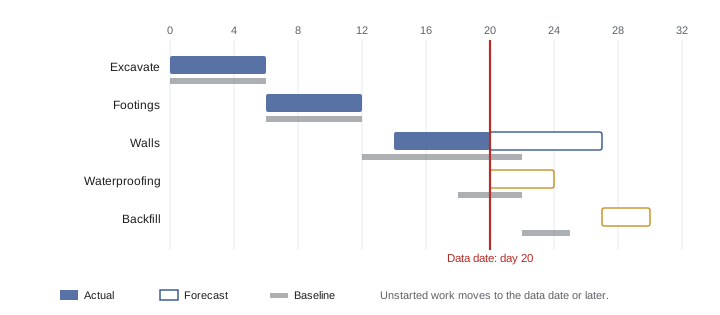
The data date, also called the status date or time-now, divides the past from the future. Everything to its left is history: actual starts, actual finishes, completed work. Everything to its right is forecast: remaining durations scheduled by logic from the data date forward. Two rules follow, and violating either is a common error that the DCMA assessment calls invalid dates.
- No actual date can fall after the data date: work cannot have finished in the future.
- No forecast date can fall before the data date: unfinished work cannot be scheduled in the past.
When an activity was supposed to start before the data date but has not, the update pushes it to start at the data date or later. This is how slippage appears: the forward pass from the data date shows the true remaining schedule.
Measuring percent complete
For activities in progress, the update needs a measure of how much work is done. Several methods are used, chosen according to the type of work.
| Method | How it works | Best for |
|---|---|---|
| Units completed | Quantity installed ÷ total quantity | Repetitive measurable work: concrete, piping, drywall |
| Incremental milestones | Fixed percentages for defined steps | Work with clear steps: equipment set, piped, wired, tested |
| Start/finish (e.g. 0/100 or 50/50) | A set share on start, the rest on finish | Short activities, often under one update period |
| Cost ratio | Cost spent ÷ forecast total cost | Overhead and level-of-effort work such as management |
| Supervisor opinion | Judgement of the person responsible | When nothing better is available; the least reliable |
Percent complete and remaining duration are related but not the same. An activity can be 50 % complete in quantity but need more than half its original duration to finish, because the remaining work is harder, the crew has shrunk or productivity has dropped. Good practice is to estimate the remaining duration directly, by asking how many more working days are needed, rather than calculating it from the percent complete.
Worked problem
Incremental milestones for an equipment installation
A rooftop air-handling unit installation is measured by incremental milestones: set on curb 30 %, ductwork connected 25 %, piping connected 20 %, wired 15 %, started up and tested 10 %. At the update, the unit is set, ductwork is connected and piping is half done. What is the percent complete?
Show solution
- Set on curb: 30 %.
- Ductwork connected: 25 %.
- Piping half done: by strict milestone rules, 0 % until the step is complete; some contracts allow partial credit, giving 0.5 × 20 % = 10 %.
- Strict method: 30 + 25 = 55 %. With partial credit: 65 %.
Answer: 55 % under strict milestones, 65 % if partial credit is allowed. The specification or cost control procedure should say which.
Worked problem
Updating an activity in progress
An activity was planned as 10 working days, from day 12 to day 22. At the data date of day 20 it actually started on day 14 and is 40 % complete by quantity. The foreman estimates 7 more working days are needed. What is the forecast finish, and how late is it?
Show solution
- Actual start: day 14 (to the left of the data date).
- Remaining duration: 7 working days, from the foreman's estimate.
- Forecast finish: data date 20 + 7 = day 27.
- Planned finish: day 22, so the activity is forecast 5 days late.
- Had the remaining duration been calculated from percent complete, it would have been 60 % × 10 = 6 days, finishing on day 26. The foreman's estimate reflects slower progress than planned, and is the better forecast.
Answer: Forecast finish day 27, five days later than planned. Estimate remaining duration directly.
Comparing updates with the baseline
Each update should be compared with the baseline and with the previous update. Useful comparisons include:
- Change in forecast completion date and in float on the critical path.
- Changes in the critical path itself: which activities joined or left it, and why.
- Activities that started or finished late compared with the baseline.
- Planned versus actual progress, by count of activities (as in the DCMA baseline execution index), by labour-hours or by earned value.
- Logic and duration changes made since the previous update, which should be listed and explained in the narrative.
A simple but revealing chart plots the forecast completion date at each update. A line that drifts later month after month, a few days at a time, tells a story that a single update does not.
Earned schedule at a glance
Earned value management, covered in the cost control course (CON-310), measures progress in money or labour-hours. A related technique called earned schedule expresses schedule performance in time units, which many schedulers find easier to interpret. Earned schedule finds the date at which the work actually done should have been done according to the baseline. Comparing that date with the actual time gives a schedule variance in days and a schedule performance index that stays meaningful to the end of the project.
Here ES is the earned schedule, the baseline time at which the current earned value should have been reached, and AT is the actual time elapsed. (In this formula ES means earned schedule, not early start.)
Worked problem
Earned schedule
Twenty weeks into a project, the work completed has a budgeted value that the baseline planned to reach at week 18. What are the schedule variance and schedule performance index in time units?
Show solution
- Earned schedule: 18 weeks. Actual time: 20 weeks.
- SV(t) = 18 − 20 = −2 weeks.
- SPI(t) = 18 ÷ 20 = 0.90.
- At the current rate, the project is delivering 0.9 weeks of planned work per week, so a 50-week baseline would take roughly 50 ÷ 0.90 = 56 weeks unless performance improves.
Answer: SV(t) = −2 weeks; SPI(t) = 0.90. A simple forecast suggests about 56 weeks against a 50-week plan.
Identifying and analysing delays
Not every late activity is a delay to the project, and not every delay is the contractor's responsibility. Delays are usually classified in two ways.
- By effect: critical delays move the completion date; non-critical delays consume float but do not move completion.
- By responsibility: excusable delays, caused by events outside the contractor's control such as owner changes or unusually severe weather, may entitle the contractor to more time; excusable and compensable delays, typically caused by the owner, may also entitle it to money; non-excusable delays, caused by the contractor, entitle it to neither and may expose it to liquidated damages.
- Concurrent delays, where owner-caused and contractor-caused delays affect completion over the same period, are treated differently by different contracts and jurisdictions, and are a frequent subject of dispute.
CCDC 2-2020 Part 6 deals with delays: GC 6.5 provides for an extension of the Contract Time where the contractor is delayed by the owner, the consultant or their agents, by stop-work orders, or by causes beyond the contractor's control such as labour disputes, fire or unusual delay by common carriers, subject to timely written notice. The notice requirements are strictly applied in many cases, so the schedule narrative and correspondence must record delays as they happen.
Time impact analysis
When a change or delay event occurs, many contracts require a time impact analysis (TIA) to support any request for more time. The analysis is prospective: it uses the most recent accepted update, inserts a fragment network, or fragnet, representing the change or delay, recalculates, and measures the effect on completion.
Worked problem
A time impact analysis with a fragnet
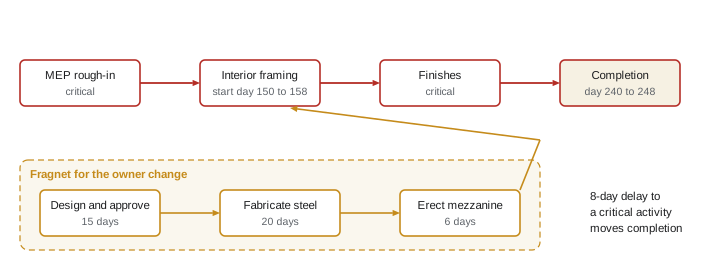
The latest update forecasts completion on working day 240, with 0 days of float on the critical path. The owner issues a change adding a mezzanine. The contractor's fragnet adds three activities: design and approval of mezzanine steel (15 days), fabrication (20 days) and erection (6 days), with erection preceding the interior framing on that floor. Inserted into the update, the fragnet pushes the framing start from day 150 to day 158. Interior framing is on the critical path. What does the analysis show?
Show solution
- Before the fragnet: framing starts day 150, completion day 240.
- After the fragnet: framing starts day 158, an 8-day delay to a critical activity.
- With no float to absorb it, completion moves 8 days, to day 248.
- The time impact analysis supports a request for an 8 working-day extension, subject to the contract's notice and pricing rules. The contractor should also consider whether resequencing could reduce the impact, since many contracts require mitigation.
Answer: The fragnet shows an 8 working-day delay to completion, supporting an 8-day extension request.
Recovery schedules
When an update shows that the project will finish late through the contractor's own delays, or the owner directs acceleration, the contractor prepares a recovery schedule: a revised plan showing how the lost time will be made up. Recovery uses the tools of Lessons 7 to 9: compressing critical activities, resequencing, adding crews or shifts, overlapping work, and changing methods. A credible recovery schedule is specific: it names the activities that will be shortened, the extra resources, the cost, and the risks, and it is checked by the people who must carry it out.
Worked problem
Planning a recovery
An update forecasts completion 12 working days late. The critical path runs through MEP rough-in (remaining 30 days), drywall (25 days) and finishes (20 days). The team proposes: a second electrical crew, cutting rough-in by 6 days; starting drywall on completed floors 5 days earlier through SS logic; and a 6-day finishes work week for 4 weeks, saving 4 days. A near-critical path through exterior cladding has 5 days of float. Does the plan recover the delay?
Show solution
- Savings on the critical path: 6 + 5 + 4 = 15 days, more than the 12 needed.
- But once the critical path is shortened by more than 5 days, the cladding path becomes critical: its float is 5 days, so it limits the recovery to 5 days unless it is also shortened.
- The team must also find 7 more days on the cladding path, or the recovery will deliver only 5 days.
- The plan should be revised to address both paths before it is submitted.
Answer: Not yet. The near-critical cladding path caps recovery at 5 days until it is accelerated too.
Contracts distinguish between acceleration that the contractor undertakes at its own cost to recover its own delays, directed acceleration that the owner orders and pays for, and constructive acceleration, where the owner refuses a justified time extension and so effectively forces the contractor to accelerate. The last is a common source of claims, discussed in CON-420.
Common mistakes
MistakeRecording actual dates after the data date or forecast dates before it.
InsteadKeep actuals to the left of the data date and forecasts to the right.
MistakeCalculating remaining duration only from percent complete.
InsteadAsk how many working days remain and use that estimate.
MistakeChanging logic silently in updates.
InsteadList and explain every logic or duration change in the narrative.
MistakeIgnoring near-critical paths when planning recovery.
InsteadCheck which paths become critical as the critical path is shortened.
MistakeFailing to give timely written notice of delays.
InsteadFollow the contract's notice procedure as soon as a delay is recognized.
Summary and key terms
- Updates record actual progress, re-forecast the remaining work and explain changes.
- The data date separates history from forecast; dates on the wrong side are invalid.
- Percent complete can be measured by units, milestones, start/finish rules, cost ratio or judgement.
- Remaining duration should be estimated directly, not just derived from percent complete.
- Comparisons with the baseline and trend charts reveal gradual slippage.
- Earned schedule gives schedule variance and performance in time units.
- Time impact analyses insert fragnets into the current update; recovery schedules must consider near-critical paths.
- Data date
- The date up to which progress is recorded and from which remaining work is scheduled.
- Schedule update
- A revision of the schedule recording actual progress and revised forecasts.
- Remaining duration
- The working time still needed to complete an activity in progress.
- Incremental milestones
- A progress method that credits fixed percentages for defined steps.
- Earned schedule
- The baseline time at which the work actually completed should have been completed.
- Excusable delay
- A delay caused by events outside the contractor's control that may justify a time extension.
- Non-excusable delay
- A delay caused by the contractor, giving no right to more time or money.
- Concurrent delay
- Overlapping delays caused by different parties affecting completion at the same time.
- Fragnet
- A fragment network representing a change or delay, inserted into a schedule for analysis.
- Recovery schedule
- A revised schedule showing how lost time will be made up.
Practice problems
Work each problem on paper first, then reveal the answer to check.
What is the data date?
Show answer
The date dividing recorded progress from forecast work.
An activity has an actual finish after the data date. What is wrong?
Show answer
Actual dates cannot be in the future; the date is invalid.
Which progress method suits drywall hanging?
Show answer
Units completed, such as boards or area hung.
Milestones of 40 %, 30 %, 30 %; the first two are done. Percent complete?
Show answer
70 %.
Data date day 30; remaining duration 8 days. Forecast finish?
Show answer
Day 38.
ES = 22 weeks, AT = 25 weeks. What is SPI(t)?
Show answer
0.88.
What is the difference between excusable and non-excusable delay?
Show answer
Excusable delays are beyond the contractor's control and may justify more time; non-excusable delays are the contractor's responsibility.
What is a fragnet?
Show answer
A fragment network representing a change or delay, inserted into the schedule to measure its impact.
A recovery plan saves 10 days on the critical path, but a parallel path has 4 days of float. Maximum recovery without work on that path?
Show answer
4 days.
Why must schedule changes be explained in the narrative?
Show answer
So reviewers can understand why the forecast moved and whether the changes are justified.
Lesson quiz · 5 questions
Score 60% or more to complete this lesson.
Create a free account to save your progress, take quizzes and earn a certificate.