
CON-210 · Lesson 3 of 12 · 33 min
Estimating activity durations
Logic tells the schedule what must come first; durations tell it how long everything takes. A beautifully linked network built on guessed durations is still a guess. This lesson shows how construction planners estimate durations from quantities and productivity, choose crew sizes, apply working calendars, allow for weather, and handle activities, such as curing and approvals, whose duration has nothing to do with crews. It builds directly on the quantity takeoff and labour pricing methods of CON-200.
The basic duration equation
For most construction activities, duration follows from three numbers: how much work there is, how fast one crew can do it, and how many crews will work at once.
An equivalent form uses labour-hours, which is how most historical productivity data is stored.
The quantity comes from the takeoff. The productivity comes from the firm's own cost records, trade contractors' experience, or published cost data, adjusted for the conditions of this job. The crew size and number of crews are planning decisions, limited by how many people can work productively in the space and by how many skilled workers the contractor or trade can supply. Durations are normally rounded up to whole working days; nobody plans to finish a wall at 2:15 in the afternoon.
Worked problem
Duration of wall forming
A basement has 420 m² of wall formwork contact area. A forming crew of one foreman, three carpenters and one labourer forms 9.0 m² per crew-hour on similar walls. The crew works 8-hour days. How long will forming take with one crew, and with two crews?
Show solution
- Daily output of one crew: 9.0 m²/h × 8 h = 72 m² per day.
- One crew: 420 ÷ 72 = 5.83 days, rounded up to 6 working days.
- Two crews: 420 ÷ (72 × 2) = 2.92 days, rounded up to 3 working days, if there is room for two crews and enough forms.
Answer: 6 working days with one crew, 3 with two. Doubling crews halves the duration only if space, forms and supervision allow.
Where productivity data comes from
The best productivity data is the contractor's own, collected from completed projects with similar work, crews and methods. A well-run firm records quantities installed and labour-hours spent by cost code on every job, and the estimating and scheduling departments use the results. Other sources include trade contractors, who know their own crews best and should be asked for durations on their work; published cost guides, which give national average productivity for many items; equipment manufacturers' production data; and the scheduler's experience.
Each source has limits. Company records reflect past conditions, which may not match a congested downtown site or a winter start. Published data are averages and need adjustment. Trade contractors may give optimistic durations to win the work or pessimistic ones to protect themselves. The scheduler's job is to compare sources, ask questions and choose a duration the people who will do the work believe in.
| Factor | Effect on productivity | Typical example |
|---|---|---|
| Repetition | Improves as crews learn | Typical floors of a tower after the first few |
| Access and congestion | Reduces when crews interfere | Several trades working in one small room |
| Weather and temperature | Reduces in cold, heat, rain and wind | Masonry in winter under hoarding |
| Overtime | Reduces after several weeks of long hours | Sustained 60-hour weeks |
| Height and hoisting | Reduces with distance from materials | Work on upper floors with one hoist |
| Design complexity | Reduces with many changes of detail | Curved walls, many penetrations |
| Crew experience | Improves with skilled, stable crews | A crew that has worked together for years |
Crew size and the limits of adding people
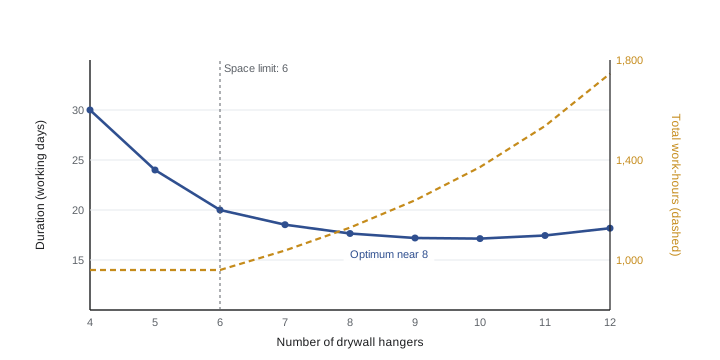
It is tempting to shorten an activity by adding workers, and up to a point it works. Beyond that point, productivity per worker falls. Workers get in each other's way, waiting for materials or hoisting increases, supervision is stretched, and less experienced people are brought in. Every activity has an optimum crew size, and a maximum beyond which adding people adds cost without saving time. On the site, the limiting factor is often space: only so many drywall hangers can work productively on one floor area, and only one crew can work on a roof slope at a time.
Worked problem
Choosing a crew size
Drywall hanging on one floor requires 960 labour-hours. Historical data show that up to 6 hangers work at full productivity on a floor of this size; with 8 hangers, productivity per worker drops by 15 %; with 10 hangers, it drops by 30 %. Workers do 8-hour days. Compare durations for 6, 8 and 10 hangers.
Show solution
- 6 hangers at full productivity: 960 ÷ (6 × 8) = 20.0 days.
- 8 hangers at 85 % productivity: effective labour-hours needed = 960 ÷ 0.85 = 1,129; duration = 1,129 ÷ (8 × 8) = 17.6, rounded to 18 days.
- 10 hangers at 70 % productivity: effective labour-hours = 960 ÷ 0.70 = 1,371; duration = 1,371 ÷ (10 × 8) = 17.1, rounded to 18 days.
- Going from 8 to 10 workers adds 242 labour-hours of cost and saves essentially no time.
Answer: 6 hangers take 20 days, 8 take 18 days, 10 still take 18 days. The optimum lies near 8; more people only add cost.
Activities not driven by crews
Many schedule activities have durations that no crew can shorten. They must still be estimated carefully, because they often lie on the critical path.
- Curing and drying: concrete must reach a specified strength before forms are stripped or loads are applied; slabs must dry before moisture-sensitive flooring is installed, which can take weeks or months for a thick slab.
- Procurement: submittal preparation, review and approval, fabrication and delivery. Long-lead items such as switchgear, generators, elevators and custom curtain wall can take many months.
- Approvals and permits: building permit review, inspections, utility connections, and owner decisions.
- Testing and commissioning: system flushing, balancing, functional testing and training.
Procurement durations are best built as a chain of activities rather than one long bar: prepare submittal, consultant review, resubmit if required, approval, fabrication, delivery. Each link can then be tracked, and the review time the contract allows the consultant, often ten working days or so, can be shown.
Worked problem
A procurement chain for switchgear
Main electrical switchgear must be on site by working day 160. The supplier quotes 18 weeks for fabrication after approved shop drawings, plus 1 week for delivery. Shop drawing preparation takes 3 weeks and the consultant review takes 2 weeks, with an allowance of 1 week for one resubmission. On a 5-day week, what is the latest working day on which the subcontract must be awarded and shop drawing preparation begin?
Show solution
- Total chain: 3 + 2 + 1 + 18 + 1 = 25 weeks.
- In working days: 25 × 5 = 125 working days.
- Latest start: 160 − 125 = working day 35.
- If the electrical subcontract cannot be awarded by about day 35, the switchgear threatens the schedule, so the team should consider early award or a separate equipment purchase order.
Answer: Award and start shop drawings by working day 35, roughly seven weeks after the start of the project.
Calendars
A calendar defines when work can happen: which days are working days, how many hours each day, and which holidays are excluded. Scheduling software assigns a calendar to every activity, and different activities can use different calendars.
- A 5-day calendar of 8 hours per day is typical for most building trades.
- A 6-day or extended-hour calendar may be used for critical work or by contract requirement.
- A 7-day calendar is used for curing, drying and delivery durations that continue over weekends.
- Seasonal calendars stop work that cannot be done in winter, such as asphalt paving or some landscaping, for months at a time.
Holidays vary by province and territory. Canada Day, Labour Day, Christmas Day and New Year's Day are observed everywhere, but Family Day, Saint-Jean-Baptiste Day, Civic Holiday and others vary. Construction collective agreements may add their own holidays, and Quebec's construction industry has two mandatory province-wide construction holiday periods, in summer and at the end of the year, that stop most construction work.
Weather
Weather is the most common cause of lost working days on outdoor construction, and contracts treat it carefully. The usual approach is to estimate the number of working days expected to be lost to adverse weather in each month, from historical climate records and experience, and to build that allowance into the schedule. Contracts often say that the contractor is entitled to more time only for weather that is worse than normal for the location and season.
Canadian contractors use Environment and Climate Change Canada's historical climate data for the nearest station to estimate typical days of heavy rain, snow, extreme cold and high wind by month. Winter construction methods, such as heating and hoarding, concrete accelerators and insulated blankets, let much work continue, but at a cost in money and productivity that the estimate and schedule must both reflect.
Worked problem
Building weather days into a schedule
Exterior work on a project is expected to need 60 working days, mainly in November through January. Climate records suggest that 8 of those days will be lost to severe weather. The contractor works a 5-day week. How many working days and calendar days should the schedule allow for the exterior work?
Show solution
- Working days including weather allowance: 60 + 8 = 68 working days.
- Calendar days at 5 working days per 7 calendar days: 68 × 7 ÷ 5 = 95.2, rounded up to 96 calendar days.
- Holidays during the period, such as those at the end of December, must be added on top.
- Showing the 8 weather days separately, as a weather calendar or a visible allowance, makes it easier to prove later that a winter was worse than normal.
Answer: 68 working days, about 96 calendar days before holidays.
Deterministic and range estimates
Most schedules use a single duration for each activity, called a deterministic duration. It should be the planner's honest best estimate of the most likely time, not a target to motivate crews and not a padded figure to protect the contractor. Hidden padding in every activity makes the schedule long and is usually used up anyway, a pattern described by Parkinson's law, that work expands to fill the time available. Hidden optimism makes the schedule impossible from day one.
Where uncertainty is large, planners estimate a range: an optimistic duration, a most likely duration and a pessimistic duration. These three-point estimates are the basis of the PERT method and of Monte Carlo schedule risk analysis, covered in Lesson 6. Even when the schedule itself uses single durations, recording the ranges helps the team see which activities carry the most risk.
Worked problem
Productivity adjusted for conditions
Historical records show a masonry crew lays 1 m² of 200 mm block wall per 1.1 labour-hours. This job is in winter under heated hoarding, expected to reduce productivity by 20 %, and has many openings, expected to reduce it by another 10 %. The wall area is 640 m² and the crew is 4 masons plus 2 labourers, all counted as labour-hours. How long will the walls take on 8-hour days?
Show solution
- Combined productivity factor: 0.80 × 0.90 = 0.72.
- Adjusted labour-hours per m²: 1.1 ÷ 0.72 = 1.528.
- Total labour-hours: 640 × 1.528 = 978.
- Crew labour-hours per day: 6 × 8 = 48.
- Duration: 978 ÷ 48 = 20.4, rounded up to 21 working days.
Answer: About 21 working days, compared with 15 if historical productivity were used unadjusted.
Documenting the basis of duration
Durations are assumptions, and assumptions should be written down. A basis of schedule document, often required by owners on larger projects, records for each major activity or group the quantity, productivity, crew size, calendar, weather allowance and source. When a duration is challenged in a review, or when the work goes slower than planned and the team must decide whether the plan or the execution was wrong, the documented basis answers the question.
Common mistakes
MistakeGuessing durations without quantities or productivity.
InsteadCalculate durations from takeoff quantities, productivity and crew size.
MistakeAssuming that doubling a crew always halves the duration.
InsteadCheck space, materials, supervision and the optimum crew size.
MistakeShowing procurement as one long bar or leaving it out.
InsteadBreak procurement into submittal, review, fabrication and delivery activities.
MistakeIgnoring weather and holidays in winter schedules.
InsteadApply calendars with holidays and build in expected weather days.
MistakePadding every activity quietly.
InsteadUse honest most likely durations and handle risk openly with ranges and contingency.
Summary and key terms
- Duration = quantity ÷ (crew output per hour × hours per day × crews).
- The best productivity data comes from the firm's own records, adjusted for job conditions.
- Adding workers shortens work only up to an optimum crew size limited by space and supervision.
- Curing, procurement, approvals and testing have durations crews cannot shorten.
- Calendars define working days, hours and holidays for each activity.
- Weather allowances come from climate records and should be visible in the schedule.
- Durations should be honest most likely estimates, with ranges recorded where uncertainty is large.
- Duration
- The working time needed to complete an activity.
- Productivity rate
- Output per crew-hour or labour-hours per unit of work.
- Crew-hour
- One hour of work by a whole crew.
- Optimum crew size
- The crew size that completes work at the lowest cost without wasted labour.
- Calendar
- The definition of working days, hours and holidays for an activity.
- Weather allowance
- Working days set aside in the schedule for expected adverse weather.
- Lead time
- The time from order to delivery of materials or equipment.
- Deterministic duration
- A single best-estimate duration for an activity.
- Three-point estimate
- Optimistic, most likely and pessimistic durations for an activity.
- Basis of schedule
- A document recording the assumptions behind the schedule durations and logic.
Practice problems
Work each problem on paper first, then reveal the answer to check.
Write the duration equation using labour-hours.
Show answer
Duration = quantity × labour-hours per unit ÷ (workers × hours per day).
A crew places 25 units per hour on 8-hour days. How long for 1,000 units?
Show answer
1,000 ÷ 200 = 5 days.
Why might adding a fifth crew not shorten an activity?
Show answer
Lack of space, materials, hoisting or supervision means productivity per worker falls.
Name two activities whose duration is not controlled by crew size.
Show answer
Any two of: curing, drying, procurement, fabrication, permits, inspections, testing.
Why use a 7-day calendar for concrete curing?
Show answer
Curing continues over weekends whether or not crews are working.
50 working days on a 5-day week is about how many calendar days?
Show answer
70 calendar days.
Historical rate 0.5 h/unit; conditions reduce productivity by 25 %. Adjusted rate?
Show answer
0.5 ÷ 0.75 = 0.667 h/unit.
Where can weather data be obtained?
Show answer
From Environment and Climate Change Canada's historical climate records.
A delivery chain is 4 + 2 + 12 + 1 weeks and the item is needed on working day 200. Latest start?
Show answer
19 weeks = 95 working days; latest start is working day 105.
Why document the basis of duration?
Show answer
So assumptions can be reviewed, defended and compared with actual performance.
Lesson quiz · 5 questions
Score 60% or more to complete this lesson.
Create a free account to save your progress, take quizzes and earn a certificate.