
CON-200 · Lesson 5 of 12 · 28 min
Equipment pricing: owning, operating and rental costs
Excavators, loaders, cranes, compactors, lifts, pumps and heaters do much of the heavy work on a construction site. Their cost can be a large share of an item's price, especially in earthwork, where equipment often costs more than labour and materials combined. Estimators price equipment by the hour, day, week or month, and they decide whether to use the firm's own fleet, rent from a dealer or leave the equipment to a subcontractor. This lesson explains how hourly equipment rates are built, how rental and ownership compare, and how equipment production rates turn into unit prices.
Owning and operating costs
An owned machine costs money whether it works or sits in the yard, and it costs more money every hour it runs. Estimators therefore divide equipment cost into two groups.
- Ownership costs: depreciation, interest on the money invested, insurance, licences and property taxes, and storage. They accrue with time, whether or not the machine works.
- Operating costs: fuel, lubricants and filters, repairs and maintenance, tires or undercarriage wear, and wear parts such as bucket teeth and cutting edges. They accrue with each hour of use.
The operator is usually priced separately as labour, using the loaded rate of an operating engineer, because the same operator may run several machines and because collective agreements and prevailing wage rules set operator wages. Some rental rates include an operator; the estimator must check.
| Cost item | Typical basis | Notes |
|---|---|---|
| Depreciation | (Purchase price − salvage value) ÷ useful life in hours | Straight-line is simplest; tax depreciation is different |
| Interest, insurance, taxes | A percentage of average investment per year, divided by hours used per year | Average investment approximated by (purchase price + salvage) ÷ 2 |
| Fuel | Litres or gallons per hour × fuel price | Depends on engine power and load factor |
| Lubricants and filters | A percentage of fuel cost or a manufacturer allowance | Often 10 to 20 % of fuel cost |
| Repairs and maintenance | A percentage of depreciation or a rate per hour | Rises as machines age |
| Tires or tracks, wear parts | Replacement cost ÷ life in hours | Severe in rock and abrasive soils |
Worked problem
Building an hourly rate for a backhoe loader
A backhoe loader costs $185,000 and is expected to be sold for $45,000 after 10,000 operating hours over 10 years. Interest, insurance and taxes total 12 % of average investment per year, and the machine works 1,000 hours a year. It burns 10 litres of diesel per hour at $1.60 per litre. Repairs average 60 % of depreciation, lubricants and filters 15 % of fuel, and tires $1.50 per hour. Calculate the owning and operating cost per hour, excluding the operator.
Show solution
- Depreciation: ($185,000 − $45,000) ÷ 10,000 h = $14.00/h.
- Average investment: ($185,000 + $45,000) ÷ 2 = $115,000. Interest, insurance and taxes: 12 % × $115,000 = $13,800 per year ÷ 1,000 h = $13.80/h.
- Ownership subtotal: $14.00 + $13.80 = $27.80/h.
- Fuel: 10 L/h × $1.60 = $16.00/h; lubricants 15 % × $16.00 = $2.40/h.
- Repairs: 60 % × $14.00 = $8.40/h; tires $1.50/h.
- Operating subtotal: $16.00 + $2.40 + $8.40 + $1.50 = $28.30/h. Total: $27.80 + $28.30 = $56.10/h.
Answer: About $56 per hour before the operator; ownership and operation are roughly equal shares.
The result is very sensitive to utilization. If the backhoe worked only 600 hours a year instead of 1,000, the interest, insurance and tax cost per hour would rise from $13.80 to $23.00, and if its life in hours fell, depreciation per hour would rise too. Idle equipment is expensive, which is why contractors watch fleet utilization closely and rent rather than buy machines they need only occasionally.
Published rates and company rates
Contractors price their own fleet with internal rates calculated as above and updated each year from the equipment accounting records. For work on public projects and for pricing changes, owners and contractors often refer to published rate guides. In Canada, provincial road builders' and heavy construction associations publish equipment rental rate guides, some ministries of transportation publish rates for changes and force account work, and the Blue Book used in the United States is also referenced by some Canadian owners.
Published rates are useful as a check and as a contractual basis for changes, but a bid should be priced with the rates the firm actually experiences, because the purpose of a bid is to forecast the firm's own costs. A firm whose fleet is older, newer or better maintained than average has real costs that differ from published averages.
Renting versus owning
Contractors rent equipment for many reasons: to avoid tying up capital, to get specialized machines for a short period, to avoid maintenance and storage, and to match the fleet to fluctuating workload. Rental rates are quoted by the day, week or month, with the weekly rate typically about three to four times the daily rate and the monthly rate about three times the weekly rate. Rental usually covers ownership and major repairs; the renter pays fuel, daily maintenance, damage beyond normal wear, delivery and pickup, and often a damage waiver or proof of insurance.
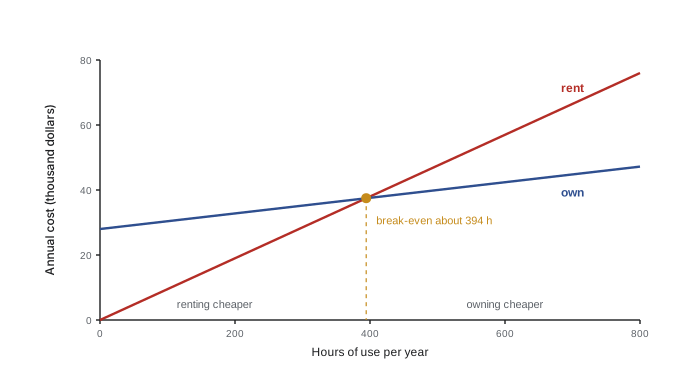
Whether to rent or own depends on how many hours per year the firm will use the machine. Ownership has high fixed costs but lower hourly costs; rental has no fixed cost but a higher rate per hour used. The break-even point is where the two annual costs are equal.
Worked problem
Finding the rent-or-own break-even
Owning a compact excavator costs $28,000 a year in fixed costs (depreciation, interest, insurance and storage) plus $24 per hour to operate, excluding fuel and operator. Renting the same machine costs the equivalent of $95 per hour of use, including repairs but excluding fuel and operator. Above how many hours of use per year is owning cheaper?
Show solution
- Hourly difference between renting and operating an owned machine: $95 − $24 = $71 per hour.
- Break-even: $28,000 ÷ $71 = 394 hours per year.
- Below about 394 hours a year, renting is cheaper; above it, owning is cheaper.
- The firm should also consider capital, the risk of idle time if work dries up, and the convenience of having the machine available.
Answer: About 394 hours per year; owning pays only if the machine will be busy more than that.
Equipment production rates
To price an item, the estimator needs the equipment cost per unit of work, which requires the machine's production rate. For cyclic machines such as excavators and loaders, production per hour is the output of one cycle multiplied by the number of cycles per hour, reduced for the fact that machines do not work every minute of every hour.
- Bucket capacity: the rated heaped capacity of the bucket.
- Fill factor: the share of rated capacity actually carried, which depends on the soil; loose sand fills well, while blasted rock and sticky clay fill poorly.
- Cycle time: the time to dig, swing, dump and return, which depends on depth, swing angle and where the material is dumped.
- Job efficiency: working minutes per hour, often 45 to 50, to allow for operator breaks, waiting for trucks, moving the machine and small delays.
Worked problem
Pricing excavation from production
An excavator with a 1.5 m³ bucket loads trucks with a 25-second cycle. The fill factor is 0.90 and the machine works 50 minutes per hour. The excavation is 2,400 m³ measured in the bank, and the machine costs $185 per hour including the operator. Estimate the hours and the equipment cost per cubic metre. For simplicity, treat the bucket output as bank volume.
Show solution
- Cycles per hour: 3,600 ÷ 25 = 144; at 50 working minutes, 144 × 50 ÷ 60 = 120 cycles.
- Production: 120 × 1.5 m³ × 0.90 = 162 m³ per hour.
- Hours: 2,400 ÷ 162 = 14.8 hours.
- Cost: 14.8 × $185 = $2,741; per cubic metre, $2,741 ÷ 2,400 = $1.14/m³ for loading only.
- Trucking, spreading and compaction are priced separately.
Answer: About 15 hours and $1.14 per cubic metre for excavating and loading.
Production is only as fast as the slowest part of the system. An excavator loading trucks can only work as fast as trucks arrive; if there are too few trucks, the excavator waits, and if there are too many, trucks queue. Estimators balance the fleet by calculating truck cycle time, including loading, travel, dumping and return, and providing enough trucks to keep the loader busy. Lesson 7 returns to earthwork quantities and truck counts.
Small tools, mobilization and standby
Not every piece of equipment is priced by the hour. Small tools such as saws, drills, vibrators and levels are usually priced as a percentage of labour cost, often 2 to 5 %, because tracking them individually is not worth the effort. Mobilization and demobilization, the cost of moving equipment to and from the site with low-bed trailers, permits and set-up, is priced as a lump sum for each machine or for the job. Cranes have their own mobilization costs, including counterweight trucks and assembly crews, which can exceed a day's operating cost.
Standby or idle time is a further consideration. If a machine must be kept on site while waiting for other work, its ownership cost continues even though operating costs stop. Contracts often specify standby rates for changes, commonly a percentage of the ownership rate, and estimators should consider whether the planned sequence will leave expensive equipment idle.
- Price the operator as labour at the loaded rate, separately from the machine, unless the rate includes an operator.
- Include fuel unless the rental or subcontract provides it.
- Add delivery, pickup and set-up for each rented machine.
- Check whether heaters, pumps and generators run around the clock, which multiplies hours and fuel.
- Allow for winter equipment such as ground thaw units, hoarding heaters and snow removal where the schedule requires them.
Common mistakes
MistakeUsing an owned machine's rate without considering utilization.
InsteadCalculate hourly ownership cost from realistic annual hours; idle time raises the rate.
MistakeForgetting the operator or the fuel.
InsteadCheck what each rate includes, and add the operator's loaded rate and fuel when not included.
MistakeAssuming a machine works 60 minutes every hour.
InsteadApply a job efficiency, often 45 to 50 working minutes per hour.
MistakeIgnoring trucking balance in earthwork.
InsteadCalculate truck cycles and provide enough trucks to keep the loading machine busy.
MistakeLeaving out mobilization and delivery charges.
InsteadAdd a lump sum for moving each machine to and from the site.
Summary and key terms
- Equipment costs divide into ownership costs, which accrue with time, and operating costs, which accrue with use.
- Hourly ownership cost depends heavily on how many hours per year the machine works.
- Published rate guides are useful checks and bases for changes; bids use the firm's own costs.
- Renting suits occasional use; owning pays above a break-even number of hours per year.
- Production of cyclic machines = capacity × fill factor × cycles per hour × job efficiency.
- A system is only as fast as its slowest part; balance loaders and trucks.
- Price small tools as a percentage of labour and mobilization as lump sums.
- Ownership cost
- Equipment cost that accrues with time: depreciation, interest, insurance, taxes and storage.
- Operating cost
- Equipment cost that accrues with use: fuel, lubricants, repairs, tires and wear parts.
- Depreciation
- The loss in value of equipment over its life, spread over its hours of use.
- Salvage value
- The expected resale value at the end of a machine's life.
- Utilization
- The share of available time, or the hours per year, that a machine actually works.
- Fill factor
- The share of a bucket's rated capacity actually carried, depending on the material.
- Cycle time
- The time for one complete work cycle, such as dig, swing, dump and return.
- Job efficiency
- Working minutes per hour, allowing for normal delays.
- Mobilization
- Moving equipment, people and facilities to the site and setting up.
- Standby rate
- A reduced rate paid for equipment kept on site but not working.
Practice problems
Work each problem on paper first, then reveal the answer to check.
Name two ownership costs and two operating costs.
Show answer
Ownership: depreciation, interest, insurance, taxes, storage. Operating: fuel, lubricants, repairs, tires.
A machine costs $120,000, salvage $20,000, life 8,000 h. What is depreciation per hour?
Show answer
$12.50/h.
Why does low utilization raise the hourly rate?
Show answer
Fixed ownership costs are divided by fewer hours.
Annual fixed cost $18,000; rent $80/h; owned operating $20/h. What is the break-even?
Show answer
$18,000 ÷ $60 = 300 hours.
A 1.0 m³ (or 1.3 yd³) bucket, fill factor 0.8, 30 s cycle, 50 min/h. What is the production?
Show answer
120 cycles × 50/60 = 100 cycles; 100 × 1.0 × 0.8 = 80 m³/h (or 104 yd³/h).
Why are operators usually priced separately from machines?
Show answer
Operators are labour, with wages set by agreements or wage rules, and may run several machines.
What is a typical job efficiency?
Show answer
About 45 to 50 working minutes per hour.
How are small tools usually priced?
Show answer
As a percentage of labour cost, often 2 to 5 %.
What does a standby rate cover?
Show answer
Ownership cost of equipment kept on site while not working.
Why might a published rate differ from a firm's own rate?
Show answer
The firm's fleet age, utilization and maintenance differ from the average.
Lesson quiz · 5 questions
Score 60% or more to complete this lesson.
Create a free account to save your progress, take quizzes and earn a certificate.