
CON-100 · Lesson 3 of 12 · 25 min
The players: owners, designers, contractors and trades
A construction project brings together a temporary team of organizations, each with its own role, expertise, interests and contract. The owner wants a facility that meets its needs at an acceptable cost and time; the designers turn those needs into drawings and specifications; the contractor organizes the building; specialty trade contractors and suppliers do much of the physical work and provide materials; and regulators, lenders, insurers and the public all have a stake. Construction managers must understand who each player is, what they want, and how they are connected by contracts and responsibilities. This lesson describes the main players and their relationships.
The owner
The owner, sometimes called the client or employer, initiates and pays for the project and will own or operate the result. Owners range from individual homeowners to developers, corporations, school boards, hospitals, universities, municipalities, provincial, state and federal governments, utilities and energy companies. Some owners build often and have large in-house project management departments, such as transportation agencies and large developers; others build once in a generation and rely on consultants. The owner's responsibilities include defining the project's purpose, budget and schedule, securing land, financing and approvals, choosing a delivery method, hiring designers and contractors, making decisions promptly, paying on time, and accepting the completed work. Owners often employ an owner's representative or project manager to act on their behalf.
Designers and consultants
Designers translate the owner's requirements into a buildable design. On building projects, the prime consultant is usually an architect, who leads a team of engineers: structural, mechanical, electrical, civil and sometimes specialists in fire protection, acoustics, building envelope, landscape, interiors and code compliance. On infrastructure projects, the prime consultant is usually a civil engineering firm. Designers prepare drawings and specifications, help the owner obtain permits, often administer the construction contract by reviewing submittals, answering questions, certifying payments and inspecting work for general conformance, and certify completion. They are regulated professionals with duties to protect public safety.
In Canada, architects are licensed by provincial and territorial associations such as the Ontario Association of Architects and the Architectural Institute of British Columbia, and engineers by provincial and territorial regulators such as Professional Engineers Ontario, Engineers and Geoscientists BC and APEGA in Alberta. Only licensed professionals may seal drawings for buildings that require professional design under the building code.
Other consultants include quantity surveyors or cost consultants, who estimate and monitor costs for owners; geotechnical engineers, who investigate soil and groundwater; surveyors; environmental consultants; commissioning agents, who verify that building systems work as intended; and code consultants.
The general contractor and construction manager
The general contractor, often called the GC or prime contractor, takes responsibility for building the project under a contract with the owner. On most building projects, the general contractor self-performs only part of the work, such as concrete or carpentry, or none at all, and subcontracts most trades. Its value lies in organizing and coordinating the work: estimating and bidding, planning and scheduling, buying out subcontracts and materials, managing the site, coordinating trades, controlling cost, quality and safety, administering the contract and closing out the project. A construction manager, in the specific sense of a delivery method, is hired by the owner early, often during design, to provide advice on cost, schedule and constructability and then to manage construction, either as an adviser (construction manager as agent or for fee) or by taking on the risk of building (construction manager at risk). CON-340 explains these arrangements.
In Canada, provincial occupational health and safety laws assign specific duties to the "constructor" (Ontario and several other provinces) or "prime contractor" (British Columbia, Alberta), the party with overall control of a project site, who must ensure that safety measures are carried out and coordinated among all employers on site. Often the general contractor is the constructor, but an owner who hires multiple contractors directly may become the constructor (HSE-375).
Subcontractors and specialty trades
Specialty trade contractors, or subcontractors, perform defined parts of the work under contracts with the general contractor, or sometimes directly with the owner. Typical subcontracts on a building project include excavation and shoring, concrete forming and placing, reinforcing steel, masonry, structural steel, framing, roofing, windows and curtain wall, mechanical (plumbing, HVAC and fire protection), electrical and communications, elevators, drywall and ceilings, flooring, painting, millwork and landscaping. A large project may have fifty or more subcontractors, some of whom in turn hire sub-subcontractors. Subcontractors employ most of the tradespeople on site, own specialized tools and equipment, and often provide detailed shop drawings and installation engineering for their work. The relationships between general contractors and subcontractors are among the most important in construction, shaping coordination, quality, safety and payment.
Suppliers, manufacturers and equipment providers
Suppliers provide materials, products and equipment: ready-mix concrete, rebar, lumber, structural steel, windows, mechanical and electrical equipment, finishes and many more. Some products are supplied to the subcontractor that installs them; others are purchased directly by the general contractor or owner, particularly long-lead equipment such as switchgear, generators, chillers and elevators. Manufacturers supply product data, warranties and sometimes installation supervision. Equipment rental companies supply cranes, aerial work platforms, excavators, temporary power, heat and scaffolding. Supply chain disruptions, price volatility and long lead times can affect project schedules significantly, which is why procurement planning is a core construction management skill (CON-330).
Regulators and authorities having jurisdiction
Many public bodies oversee construction. The authority having jurisdiction (AHJ) for building permits, usually a municipal building department, reviews plans, issues permits and inspects work for compliance with the building code (CON-140). Fire departments review fire protection and life safety systems. Occupational health and safety regulators enforce safety laws and investigate serious incidents. Environmental regulators control erosion, stormwater, contaminated soil, wetlands and emissions. Utilities approve connections for power, gas, water and sewer. Transportation departments issue permits for work in roads. Professional regulators license architects, engineers and, in many places, contractors and trades. Each brings requirements that affect the schedule and must be planned for.
Lenders, insurers, sureties and others
Construction involves many other parties. Lenders finance projects and often appoint cost consultants to monitor progress before releasing funds. Insurers provide builder's risk, liability and professional liability insurance. Sureties issue bonds that guarantee contractors will perform and pay their subcontractors and suppliers (CON-350). Lawyers draft contracts and resolve disputes. Unions represent many tradespeople and negotiate collective agreements (Lesson 9). Neighbours, communities, Indigenous nations and the public are affected by noise, traffic, environmental impacts and the final building, and increasingly expect to be consulted. A construction manager who thinks only about owner, designer and contractor will miss many of the forces that shape a project.
Contracts and communication
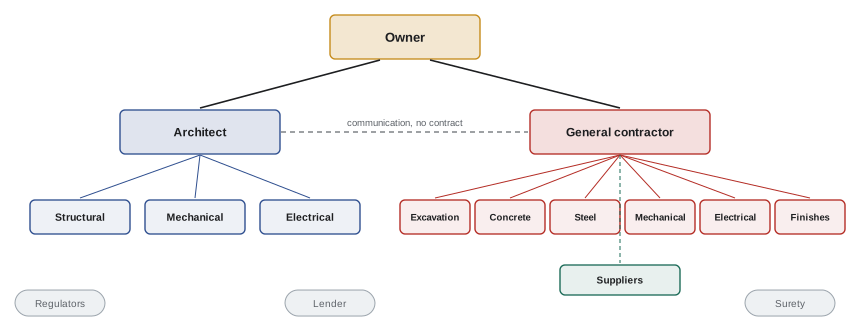
Each relationship on a project is defined by a contract, and the contract determines who is responsible to whom. On a traditional project, the owner has separate contracts with the architect and the general contractor; the architect has sub-consultant agreements with engineers; the general contractor has subcontracts with trades and purchase orders with suppliers. Contracts and communication lines are not the same: the contractor communicates daily with the architect, for example, even though they have no contract with each other, and the architect's authority to give instructions comes from the owner's contracts with both parties. Understanding these relationships tells you who can approve a change, who must be notified of a delay, and who pays whom. Standard form contracts, such as CCDC documents in Canada and AIA and ConsensusDocs documents in the United States, set out these relationships consistently (CON-220).
Worked problem
Who do you ask?
On a design-bid-build school project, the electrical subcontractor finds that a ceiling conflict prevents installing light fixtures where the drawings show them. Who should the subcontractor contact, and how should the question flow?
Show solution
- The subcontractor has a contract with the general contractor, not the architect or owner, so it raises the issue with the general contractor.
- The general contractor issues a request for information (RFI) to the architect, who administers the contract on the owner's behalf.
- The architect consults the electrical engineer and responds with a clarification or, if the change affects cost or time, a proposed change for the owner's approval.
- The general contractor passes the response to the subcontractor and, if a change is approved, prices and documents it through the change order process.
Answer: Subcontractor to general contractor, general contractor to architect via an RFI, architect with engineer to respond, and any change approved by the owner through the change process.
Interests and incentives
Each player has its own interests, which are not always aligned. Owners want quality and certainty at the lowest cost; designers want to realize a design within their fee and protect themselves from liability; general contractors want to complete the work profitably and safely, maintain reputation and win future work; subcontractors want clear scope, timely access to work areas and prompt payment; suppliers want firm orders and payment; regulators want compliance. Many conflicts in construction arise from these differences, especially when contracts allocate risk to parties that cannot control it. Collaborative delivery methods and lean practices (CON-340, CON-410) try to align incentives, but even in traditional projects, good construction managers succeed by understanding what each party needs and building relationships of trust.
Communication and information management
With so many organizations involved, managing information is a central challenge. Every party needs the current drawings and specifications, every question must reach the person who can answer it, and every decision must be recorded and communicated to those affected. Most projects now use a shared project management platform, in which drawings, RFIs, submittals, change documents, meeting minutes and correspondence are stored and tracked, with clear rules on who issues what. Communication protocols set out formal channels, such as written instructions from the consultant to the contractor, alongside informal day-to-day contact between site staff. Clear protocols reduce the risk that someone builds from an outdated drawing or acts on an instruction from a person without authority.
The owner's team in more detail
Large owners often have teams of their own: a project sponsor who holds the budget and makes key decisions; a project manager or owner's representative who runs the project day to day; facility managers and end users, such as nurses, teachers or plant operators, who define requirements and will use the building; and specialists in procurement, legal, finance and information technology. Contractors who understand the owner's internal structure can identify who really makes decisions, involve users at the right time, and avoid surprises when someone new appears late in the project with requirements no one heard about.
Joint ventures and teaming
For very large or specialized projects, firms often combine in joint ventures, sharing resources, risks and profits under a joint venture agreement. A general contractor might team with a specialist tunnelling firm for a transit project, or a local contractor might join a national firm to meet bonding and experience requirements. Design firms and contractors also team for design-build proposals. Joint ventures bring together complementary strengths but require clear governance, decision making and allocation of responsibilities, because partners may have different cultures and systems.
Trust and reputation among the players
Construction is a relationship business. Owners return to contractors who delivered well, general contractors invite subcontractors they trust to bid, and designers recommend builders who solved problems collaboratively. Reputation is built project by project through reliability, honesty, fair dealing and safe performance, and it can be damaged quickly by a single serious failure. For construction managers, understanding the players is the first step; earning their trust is the work of a career.
Common mistakes
MistakeIgnoring regulators until inspections.
InsteadPlan for approvals and inspections from the start.
MistakeAssuming communication lines equal contract lines.
InsteadKnow who has authority under each contract.
MistakeTreating subcontractors as interchangeable.
InsteadBuild relationships; they do most of the work.
MistakeForgetting long-lead suppliers.
InsteadPlan procurement early.
MistakeOverlooking community and Indigenous interests.
InsteadIdentify and engage all affected parties.
Summary and key terms
- The owner initiates, pays for and receives the project.
- Architects and engineers design and often administer contracts.
- General contractors organize and coordinate construction; construction managers advise and manage.
- Subcontractors and suppliers perform most physical work and provide materials.
- Authorities having jurisdiction and other regulators control approvals and inspections.
- Lenders, insurers, sureties, unions and communities also shape projects.
- Contracts define responsibilities; interests differ and must be managed.
- Owner
- Party that initiates and pays for a project.
- Prime consultant
- Lead designer contracted to the owner.
- General contractor
- Party responsible for building the project.
- Construction manager at risk
- Construction manager who guarantees the construction price.
- Subcontractor
- Contractor performing part of the work for another contractor.
- Supplier
- Firm providing materials or equipment.
- Authority having jurisdiction
- Body responsible for enforcing codes and approvals.
- Surety
- Party guaranteeing a contractor's performance and payment.
- RFI
- Request for information to clarify the design.
- Owner's representative
- Person who manages a project for the owner.
Practice problems
Work each problem on paper first, then reveal the answer to check.
Name three owner responsibilities.
Show answer
Define needs, finance, hire designers and contractors, decide, pay.
Who is the usual prime consultant on a building?
Show answer
The architect.
Name three consulting engineers on a building.
Show answer
Structural, mechanical, electrical.
What does a general contractor mainly provide?
Show answer
Organization and coordination of the work.
What is construction manager at risk?
Show answer
A CM who takes on the risk of building, usually with a guaranteed price.
Name four typical subcontracts.
Show answer
Excavation, concrete, steel, mechanical, electrical, drywall.
Why plan procurement of switchgear early?
Show answer
It has long lead times.
What does an AHJ do?
Show answer
Issues permits and enforces codes.
Who answers a subcontractor's design question?
Show answer
The architect, via the general contractor's RFI.
Name a safety duty holder concept in your country.
Show answer
Constructor or prime contractor (CA); controlling employer (US).
Lesson quiz · 5 questions
Score 60% or more to complete this lesson.
Create a free account to save your progress, take quizzes and earn a certificate.