
CMP-325 · Lesson 8 of 12 · 31 min
Functional dependencies and normalization
The ER method of lessons 6 and 7 usually produces sensible tables, but it guarantees nothing: a designer can still put facts in the wrong place and end up storing the same fact many times. Normalization is the formal theory that detects and removes such redundancy. It is built on functional dependencies, statements of the form 'the student number determines the student's name', which capture the real-world rules that make some data redundant. This lesson defines functional dependencies and the reasoning rules for them, shows how to find keys, explains the normal forms from first normal form to Boyce–Codd normal form, and shows how to decompose a bad table into good ones without losing information. The computations are short enough to do by hand and are also implemented in Python here.
Redundancy and anomalies
Consider a single table that a registrar might build from a spreadsheet, recording which student took which section with what grade, together with the student's name and department, the course title, and the department's building.
| student_id | student_name | dept_id | building | course_id | title | grade |
|---|---|---|---|---|---|---|
| 101 | Ava | CS | Athabasca Hall | CMPUT-174 | Introduction to Computing Science | 88 |
| 101 | Ava | CS | Athabasca Hall | CMPUT-272 | Logic and Discrete Structures | 79 |
| 102 | Ben | CS | Athabasca Hall | CMPUT-174 | Introduction to Computing Science | 72 |
| 103 | Chloe | MATH | Central Hall | CMPUT-272 | Logic and Discrete Structures | 91 |
Ava's name and department are stored once for each of her courses; the CS building is stored once for every enrollment of every CS student; each course title is stored once per enrollment. This redundancy wastes space, but its real cost is three kinds of anomaly. An update anomaly: if the CS department moves, every row for every CS student must change, and missing one leaves the data contradicting itself. An insertion anomaly: a new course cannot be recorded until some student enrolls, because every row needs a student and a grade. A deletion anomaly: if Chloe drops CMPUT-272 and that was her only row, we lose the fact that the Mathematics department is in Central Hall. Normalization removes these anomalies by splitting the table so that each fact is stored once.
Functional dependencies
A functional dependency (FD) \(X \to Y\), read 'X determines Y', holds on a relation if any two tuples that agree on all attributes in X also agree on all attributes in Y. In grade_report, student_id \(\to\) student_name holds because a student has one name; course_id \(\to\) title holds; dept_id \(\to\) building holds; and {student_id, course_id} \(\to\) grade holds. An FD is a statement about every legal instance, so, exactly as with keys, it comes from the meaning of the data. Data can refute an FD with one pair of tuples, but cannot prove one.
Keys are a special case: X is a superkey of R exactly when \(X \to R\), that is, X determines every attribute. So FDs generalize keys. Normalization says, roughly, that the only FDs a table should have are those implied by its keys; any other FD means some attribute depends on something that is not a key, and that fact is being repeated.
Reasoning about FDs: Armstrong's axioms and closure
Given some FDs, others follow. If student_id determines dept_id and dept_id determines building, then student_id determines building. William Armstrong's axioms (1974) are a complete set of rules for deriving all implied FDs. Reflexivity: if \(Y \subseteq X\), then \(X \to Y\). Augmentation: if \(X \to Y\), then \(XZ \to YZ\). Transitivity: if \(X \to Y\) and \(Y \to Z\), then \(X \to Z\). Useful derived rules are union (if \(X \to Y\) and \(X \to Z\), then \(X \to YZ\)), decomposition (if \(X \to YZ\), then \(X \to Y\)) and pseudo-transitivity.
In practice we rarely apply the axioms directly. Instead we compute the closure of a set of attributes X, written \(X^{+}\): the set of all attributes that X determines. The algorithm starts with X and repeatedly adds the right side of any FD whose left side is already contained in the result, until nothing changes. Then \(X \to Y\) is implied exactly when \(Y \subseteq X^{+}\), and X is a superkey exactly when \(X^{+}\) contains every attribute.
from itertools import combinations

def closure(attrs, fds):
    """Attribute closure: every attribute determined by attrs under fds."""
    result = set(attrs)
    changed = True
    while changed:
        changed = False
        for lhs, rhs in fds:
            if lhs <= result and not rhs <= result:
                result |= rhs
                changed = True
    return result

def candidate_keys(R, fds):
    keys = []
    for k in range(1, len(R) + 1):
        for combo in combinations(sorted(R), k):
            s = set(combo)
            if closure(s, fds) == R and not any(key <= s for key in keys):
                keys.append(s)
    return keys

def fd(s):  # "A B -> C" to (frozenset, frozenset)
    l, r = s.split("->")
    return frozenset(l.split()), frozenset(r.split())

R = set("student_id student_name dept_id building course_id title grade".split())
F = [fd("student_id -> student_name dept_id"), fd("dept_id -> building"),
     fd("course_id -> title"), fd("student_id course_id -> grade")]

print("closure of {student_id}:", sorted(closure({"student_id"}, F)))
print("closure of {student_id, course_id} is all of R:",
      closure({"student_id", "course_id"}, F) == R)
print("candidate keys:", [sorted(k) for k in candidate_keys(R, F)])closure of {student_id}: ['building', 'dept_id', 'student_id', 'student_name']
closure of {student_id, course_id} is all of R: True
candidate keys: [['course_id', 'student_id']]The closure of student_id contains the student's name, department and building, but not the title or grade, so student_id alone is not a key. The pair {student_id, course_id} determines everything and is the only candidate key. A helpful shortcut for finding keys by hand: any attribute that never appears on the right side of an FD must be in every key, because nothing else can determine it. Here student_id and course_id never appear on a right side, so every key contains both, and since together they are a key, the search ends immediately.
Worked problem
Closure by hand
R(A, B, C, D, E) with FDs A → B, BC → D, D → E. Compute {A, C}+ and decide whether AC is a key.
Show solution
- Start with {A, C}.
- A → B applies because A is in the set: add B, giving {A, B, C}.
- BC → D applies because B and C are in the set: add D, giving {A, B, C, D}.
- D → E applies: add E, giving {A, B, C, D, E}. No further changes.
- The closure is all of R, so AC is a superkey. Neither {A}+ = {A, B} nor {C}+ = {C} is all of R, so AC is minimal: a candidate key.
Answer: {A, C}+ = {A, B, C, D, E}; AC is a candidate key.
The normal forms
Normal forms are conditions on a relation and its FDs, each stronger than the last, that limit redundancy. First normal form (1NF) requires atomic values: no lists or nested tables in a column. The relational model assumes it, and lesson 7's mapping of multivalued attributes achieves it. Second normal form (2NF) forbids partial dependencies, where a non-key attribute depends on only part of a composite key: in grade_report, student_name depends on student_id alone, part of the key {student_id, course_id}, so the table is not in 2NF. 2NF matters only for composite keys and is mostly of historical interest; the two important forms are 3NF and BCNF.
A relation is in Boyce–Codd normal form (BCNF) if, for every non-trivial FD \(X \to Y\) that holds, X is a superkey. In words: every determinant is a key. BCNF eliminates all redundancy that FDs can detect. A relation is in third normal form (3NF) if, for every non-trivial FD \(X \to Y\), either X is a superkey or every attribute in \(Y - X\) is prime, meaning part of some candidate key. 3NF is slightly weaker than BCNF; the extra escape clause exists so that every relation can be decomposed into 3NF without losing the ability to check FDs locally, which BCNF cannot always guarantee.
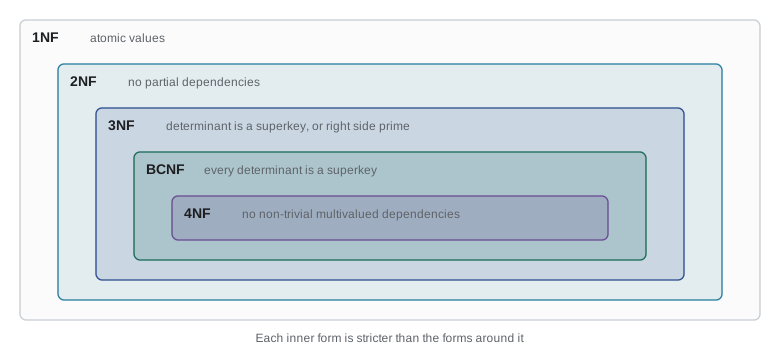
| Normal form | Condition | Violation in grade_report |
|---|---|---|
| 1NF | All values atomic | None (already atomic) |
| 2NF | 1NF and no non-prime attribute depends on part of a candidate key | student_id → student_name (part of the key) |
| 3NF | For every non-trivial X → Y: X is a superkey or Y − X is all prime | dept_id → building (dept_id not a superkey, building not prime) |
| BCNF | For every non-trivial X → Y: X is a superkey | Every FD except the key FD violates it |
Decomposition: lossless and dependency preserving
To normalize, we decompose a relation R into smaller relations whose attributes together cover R. Two properties make a decomposition acceptable. It must be lossless: joining the pieces back together must give exactly the original relation, no more and no fewer tuples. A lossy decomposition creates spurious tuples, false facts, when the pieces are rejoined. And it should be dependency preserving: every FD should be checkable within a single piece, so that the DBMS can enforce it with a key or unique constraint instead of an expensive join on every update.
There is a simple test for a decomposition into two pieces \(R_1\) and \(R_2\): it is lossless exactly when the common attributes \(R_1 \cap R_2\) determine all of \(R_1\) or all of \(R_2\), that is, when the shared attributes are a key of at least one piece. Splitting grade_report into student(student_id, student_name, dept_id) and the rest is lossless because the shared attribute student_id is the key of student. Splitting on a non-key attribute, for instance putting dept_id and grade in one table and the rest in another sharing only dept_id, would be lossy.
from itertools import combinations

def closure(attrs, fds):
    """Attribute closure: every attribute determined by attrs under fds."""
    result = set(attrs)
    changed = True
    while changed:
        changed = False
        for lhs, rhs in fds:
            if lhs <= result and not rhs <= result:
                result |= rhs
                changed = True
    return result

def candidate_keys(R, fds):
    keys = []
    for k in range(1, len(R) + 1):
        for combo in combinations(sorted(R), k):
            s = set(combo)
            if closure(s, fds) == R and not any(key <= s for key in keys):
                keys.append(s)
    return keys

def fd(s):  # "A B -> C" to (frozenset, frozenset)
    l, r = s.split("->")
    return frozenset(l.split()), frozenset(r.split())

def lossless_binary(R1, R2, fds):
    common = R1 & R2
    c = closure(common, fds)
    return R1 <= c or R2 <= c

F = [fd("student_id -> student_name dept_id"), fd("dept_id -> building"),
     fd("course_id -> title"), fd("student_id course_id -> grade")]
good1 = set("student_id student_name dept_id".split())
good2 = set("student_id course_id title grade building".split())
bad1  = set("dept_id grade".split())
bad2  = set("student_id student_name dept_id building course_id title".split())
print("split on student_id lossless:", lossless_binary(good1, good2, F))
print("split on dept_id lossless:   ", lossless_binary(bad1, bad2, F))

# Demonstrate the spurious tuples a lossy split creates
rows = [("Ava", "CS", 88), ("Ben", "CS", 72)]          # (name, dept, grade)
p1 = {(d, g) for n, d, g in rows}                       # (dept, grade)
p2 = {(n, d) for n, d, g in rows}                       # (name, dept)
rejoined = {(n, d, g) for n, d in p2 for d2, g in p1 if d == d2}
print("original rows:", len(rows), " rows after rejoin:", len(rejoined), sorted(rejoined))split on student_id lossless: True
split on dept_id lossless: False
original rows: 2 rows after rejoin: 4 [('Ava', 'CS', 72), ('Ava', 'CS', 88), ('Ben', 'CS', 72), ('Ben', 'CS', 88)]The BCNF decomposition algorithm
To bring a relation into BCNF, find an FD \(X \to Y\) that violates BCNF (X is not a superkey), and split R into \(R_1 = X^{+}\) restricted to R, the attributes X determines, and \(R_2 = R - (X^{+} - X)\), which keeps X so the pieces can be rejoined. Because the shared attributes X are a key of \(R_1\), the split is lossless. Repeat on each piece until all are in BCNF. Different choices of violating FD can give different, equally valid results.
from itertools import combinations

def closure(attrs, fds):
    """Attribute closure: every attribute determined by attrs under fds."""
    result = set(attrs)
    changed = True
    while changed:
        changed = False
        for lhs, rhs in fds:
            if lhs <= result and not rhs <= result:
                result |= rhs
                changed = True
    return result

def candidate_keys(R, fds):
    keys = []
    for k in range(1, len(R) + 1):
        for combo in combinations(sorted(R), k):
            s = set(combo)
            if closure(s, fds) == R and not any(key <= s for key in keys):
                keys.append(s)
    return keys

def fd(s):  # "A B -> C" to (frozenset, frozenset)
    l, r = s.split("->")
    return frozenset(l.split()), frozenset(r.split())

def project(fds, S):
    """FDs implied on attribute subset S (via closures of subsets of S)."""
    out = []
    for k in range(1, len(S)):
        for combo in combinations(sorted(S), k):
            X = set(combo)
            Y = (closure(X, fds) & S) - X
            if Y:
                out.append((frozenset(X), frozenset(Y)))
    return out

def bcnf(R, fds):
    for X, Y in project(fds, R):
        if not closure(X, fds) >= R:                 # X is not a superkey of R: violation
            R1 = closure(X, fds) & R
            R2 = R - (R1 - X)
            return bcnf(R1, fds) + bcnf(R2, fds)
    return [R]

R = set("student_id student_name dept_id building course_id title grade".split())
F = [fd("student_id -> student_name dept_id"), fd("dept_id -> building"),
     fd("course_id -> title"), fd("student_id course_id -> grade")]
for piece in sorted(bcnf(R, F), key=lambda s: sorted(s)):
    keys = candidate_keys(piece, project(F, piece))
print(sorted(piece), " key:", [sorted(k) for k in keys])['building', 'dept_id'] key: [['dept_id']] ['course_id', 'grade', 'student_id'] key: [['course_id', 'student_id']] ['course_id', 'title'] key: [['course_id']] ['dept_id', 'student_id', 'student_name'] key: [['student_id']]
The algorithm separates out the department and its building, the student's name and department, and the course title, leaving an enrollment table keyed by student and course that holds only the grade. Each fact now lives in one place: the CS building appears once, Ava's name once, each title once. All three anomalies disappear. These are, not by coincidence, the department, student, course and enrollment tables of the college database.
When BCNF loses dependencies, and 3NF
BCNF decomposition is always lossless but not always dependency preserving. The classic example is R(student, course, instructor) with the rules that each instructor teaches only one course, instructor \(\to\) course, and that for each course a student has one instructor, {student, course} \(\to\) instructor. The candidate keys are {student, course} and {student, instructor}. The FD instructor \(\to\) course violates BCNF, because instructor is not a superkey, so BCNF splits R into (instructor, course) and (student, instructor). Now the rule {student, course} \(\to\) instructor spans both tables and can be checked only by joining them. R is, however, in 3NF, because course is prime (part of the key {student, course}). Designers then choose between BCNF with an application-level check, or 3NF with a little redundancy and full enforcement by keys.
3NF synthesis is an algorithm that always produces a lossless, dependency-preserving 3NF decomposition: compute a minimal cover of the FDs (single attributes on the right, no redundant attributes on the left, no redundant FDs), create one relation for each FD's attributes, add a relation containing a candidate key if none of them does, and remove relations contained in others. In practice, a design that came from a careful ER model usually needs only small adjustments to reach BCNF or 3NF.
Worked problem
Is it in BCNF? Is it in 3NF?
R(flight, date, gate, pilot) with FDs {flight, date} → gate, {flight, date} → pilot, and {gate, date} → flight (a gate serves one flight per day). Determine the candidate keys and the normal form.
Show solution
- Closures: {flight, date}+ = {flight, date, gate, pilot}, a key. {gate, date}+ = {gate, date, flight, pilot} using gate date → flight then flight date → pilot, also a key.
- Check each FD: the left sides {flight, date} and {gate, date} are both superkeys.
- Every determinant is a key, so R is in BCNF (and therefore also in 3NF).
Answer: Candidate keys {flight, date} and {gate, date}; R is in BCNF.
Beyond BCNF, and when to denormalize
FDs cannot capture every kind of redundancy. If an instructor teaches several courses and independently speaks several languages, a table instructor_course_language stores every combination, repeating each course for every language. This comes from a multivalued dependency, and fourth normal form (4NF) removes it by splitting into (instructor, course) and (instructor, language). Fifth normal form handles still rarer join dependencies. A design built from a clean ER model, with multivalued attributes in their own tables, usually satisfies 4NF automatically.
Normalization optimizes for correct updates. Sometimes a design deliberately accepts redundancy for read performance, called denormalization: storing a running total of copies on loan in the title table, or a precomputed report table, avoids repeated joins and aggregations. Data warehouses use denormalized star schemas on purpose because they are loaded in batches and mostly read. The rule of thumb is to normalize first, measure, and denormalize only specific, measured hot spots, keeping the redundant copy consistent with triggers, scheduled jobs or materialized views, and documenting why.
Common mistakes
MistakeInferring functional dependencies from sample data.
InsteadFDs come from real-world rules. Data can refute an FD but never prove one.
MistakeSplitting a table on a column that is not a key of either piece.
InsteadThat decomposition is lossy and creates spurious tuples when rejoined. The shared attributes must be a key of at least one piece.
MistakeConfusing 3NF and BCNF.
InsteadBCNF requires every determinant to be a superkey; 3NF also allows an FD whose right side consists of prime attributes.
MistakeForgetting to keep the determinant in the second piece when decomposing.
InsteadKeep X in R2 = R − (X+ − X) so the pieces can be joined back on X.
MistakeDenormalizing everything up front for speed.
InsteadNormalize first, measure, then denormalize only proven hot spots, with a mechanism that keeps copies consistent.
Summary and key terms
- Redundant storage causes update, insertion and deletion anomalies; normalization removes them by storing each fact once.
- A functional dependency X → Y means tuples that agree on X agree on Y; FDs come from real-world rules, and keys are FDs that determine everything.
- Armstrong's axioms (reflexivity, augmentation, transitivity) derive all implied FDs; the attribute closure X+ tests implication and superkeys.
- Attributes that never appear on the right side of an FD belong to every candidate key.
- BCNF requires every non-trivial determinant to be a superkey; 3NF also allows FDs whose right side is prime; 2NF forbids partial dependencies.
- Good decompositions are lossless (shared attributes are a key of one piece) and ideally dependency preserving; BCNF is always lossless but may lose dependencies, while 3NF synthesis preserves them.
- 4NF handles multivalued dependencies; denormalization trades update safety for read speed and should be targeted and measured.
- Functional dependency
- A constraint X → Y: tuples equal on X are equal on Y.
- Attribute closure
- X+, the set of all attributes functionally determined by X.
- Armstrong's axioms
- Reflexivity, augmentation and transitivity, a sound and complete set of rules for FDs.
- Prime attribute
- An attribute that belongs to some candidate key.
- Partial dependency
- A dependency of a non-prime attribute on part of a composite key.
- BCNF
- Boyce–Codd normal form: every non-trivial determinant is a superkey.
- 3NF
- Third normal form: for each non-trivial X → Y, X is a superkey or Y − X is all prime.
- Lossless decomposition
- A decomposition whose natural join reproduces exactly the original relation.
- Dependency preservation
- The property that every FD can be checked within a single decomposed relation.
- Denormalization
- Deliberately storing redundant data to speed up reads.
Practice problems
Work each problem on paper first, then reveal the answer to check.
In R(A, B, C) with A → B and B → C, compute A+.
Show answer
{A, B, C}; A is a candidate key.
Name the anomaly: a course cannot be recorded until a student enrolls in it.
Show answer
An insertion anomaly.
Use Armstrong's axioms to show that A → B and B → C imply A → C.
Show answer
By transitivity directly.
R(emp, dept, manager) with emp → dept and dept → manager. Is R in BCNF?
Show answer
No. dept → manager has a determinant that is not a superkey.
Decompose the R of the previous question into BCNF.
Show answer
(dept, manager) and (emp, dept); the shared attribute dept is the key of the first, so the split is lossless.
Is the split of R(A, B, C) into (A, B) and (B, C) lossless when the only FD is A → C?
Show answer
No. The shared attribute B determines neither piece.
Which attributes must be in every candidate key of R(A, B, C, D) with FDs A → B and B → C?
Show answer
A and D, since neither appears on a right side; {A, D} is the key.
What is a prime attribute?
Show answer
An attribute that is part of at least one candidate key.
Why might a designer choose 3NF over BCNF?
Show answer
To keep every FD enforceable within one table (dependency preservation) at the cost of a little redundancy.
Give one example of justified denormalization.
Show answer
A data warehouse star schema, or a stored count of active loans kept in sync by a trigger for a heavily read page.
Lesson quiz · 5 questions
Score 60% or more to complete this lesson.
Create a free account to save your progress, take quizzes and earn a certificate.