
CIV-499 · Lesson 4 of 12 · 19 min
Concept options and multi-criteria evaluation
The most important decisions in a design are made before any member is sized. The choice between a truss and a culvert, or between one span and two, fixes most of the cost, most of the environmental effect and most of the maintenance burden for the next 75 years. Lesson 1 of the construction management course showed the curve: the ability to influence cost is highest at concept and falls steeply after. This lesson develops four genuinely different crossing concepts, evaluates them against weighted criteria agreed with the client, tests how sensitive the result is to those weights, and prepares the recommendation for the concept review.
Generating options
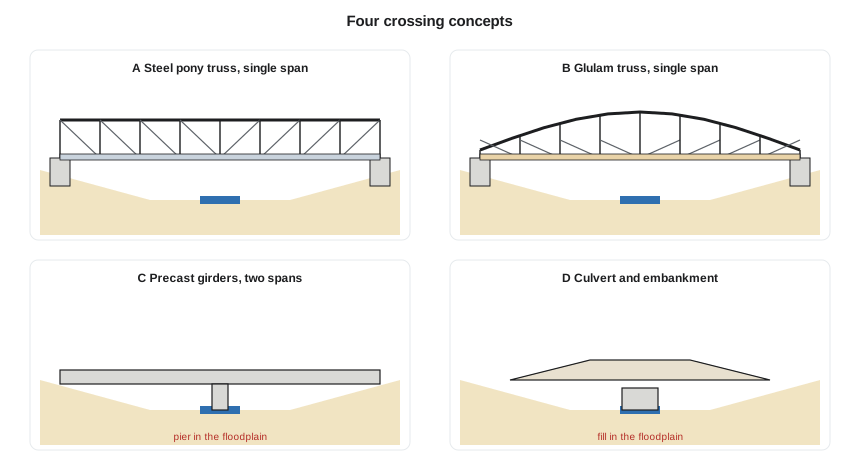
The team's first list has eleven ideas, including a cable-stayed span, a covered bridge and a ford with stepping stones. A short screening against the hard requirements removes most of them: the ford fails accessibility, the cable-stayed span is far over budget for a 36 m crossing, and the covered bridge adds snow and maintenance problems without a clear benefit. Four concepts survive, chosen so that they differ in kind rather than in detail.
| Concept | Description | Main strength | Main weakness |
|---|---|---|---|
| A Steel pony truss | single 36 m span of prefabricated weathering steel trusses, concrete deck | clear span, fast erection, low maintenance | industrial look; embodied carbon of steel |
| B Glulam truss | single span of glued-laminated timber trusses with steel connections, timber or concrete deck | lowest embodied carbon; attractive | higher cost; more inspection and maintenance |
| C Precast girders | two spans of precast concrete girders on a pier in the floodplain | lowest bridge cost per square metre; familiar to contractors | pier in the floodplain; work near the channel |
| D Culvert and fill | large culvert under an embankment carrying the path | cheapest; no bridge maintenance | fills the floodplain; fish passage and permits difficult |
Developing each concept far enough
A concept has to be developed far enough that it can be estimated and compared fairly, and no further. For each of the four, the team draws an elevation and a typical section, sets the span arrangement and approximate member depths from rules of thumb, sketches the abutments or pier, and works out the approach lengths and the effect on the floodplain. A truss of this span is usually about one fifteenth of the span deep; precast girders for an 18 m span are about a metre deep; a culvert must carry the 100-year flow with the embankment above it. These rough sizes are enough to estimate quantities and costs, to draw the floodplain encroachment and to show stakeholders what each option would look like.
The temptation is to develop the favourite concept further than the others, because it is more interesting. That biases the evaluation: a well-developed concept looks more credible and its risks have been thought through, while the others look vaguer and riskier than they really are. The team agrees to spend roughly equal time on each concept and to hold the same level of detail on all four sketches.
Criteria and weights
The criteria come from the requirements and the stakeholder map, and the weights come from a workshop with the client, the roads engineer and the parks maintenance supervisor. The team proposes the criteria; the client sets the weights. That division matters: weighting is a statement of values, and values belong to the people who will pay for and live with the result. The team's job is to make the consequences of those values visible.
| Criterion | Weight | How it is scored |
|---|---|---|
| Capital cost | 0.25 | estimate per concept, scaled 1 to 5 from highest to lowest |
| Embodied carbon | 0.15 | tonnes CO2e from material quantities, scaled 1 to 5 |
| Hydraulics and habitat | 0.25 | effect on floodplain, channel and fish passage, scored 1 to 5 |
| Maintenance | 0.15 | inspection and maintenance effort over 75 years, scored 1 to 5 |
| Constructability | 0.10 | in-water work, access, season, risk, scored 1 to 5 |
| Appearance and community | 0.10 | stakeholder feedback on sketches, scored 1 to 5 |
Two criteria, cost and carbon, are measured quantities; the team converts them to a 1 to 5 scale with the best option at 5 and the worst at 1, so they can be combined with the judged scores. The judged scores are not invented on the spot. Each has a short written rationale: concept C scores 2 for hydraulics because its pier sits in the floodplain and its work area reaches the bank; concept D scores 1 because the embankment fills a third of the floodplain and the culvert needs a fish passage design that the regulators would scrutinise closely.
Estimating cost and carbon at concept stage
Lucas prepares Class 4 estimates for the four concepts from unit costs per square metre of deck for the bridge types, adjusted for span, and from quantities for the culvert and embankment. Each includes the approaches, the trailhead lot and stormwater, which are common to all options but differ slightly in length and grading. The carbon estimate uses material quantities from the concept sketches and typical embodied carbon factors for structural steel, concrete, timber and fill, labelled in the report as indicative. At concept stage the absolute numbers are uncertain, but the differences between options are more reliable than the totals, because the same assumptions apply to all four.
Sustainability rating systems can help structure this part of the evaluation. Envision, from the Institute for Sustainable Infrastructure, has 64 credits in five categories: quality of life, leadership, resource allocation, the natural world, and climate and resilience. It is used in Canada as well as the United States. The team does not seek a formal rating, which the city has not asked for, but uses the credit list as a checklist to make sure the evaluation has not missed anything important.
The weighted evaluation
# Concept evaluation: weighted scores for four crossing options, with a sensitivity test
UNITS = "SI"
SI = UNITS == "SI"
cur = "CAD" if SI else "USD"
f = 1.0 if SI else 0.82                          # cost scale between sites
# options: capital cost (million), embodied carbon (t CO2e), and scores 1-5 on the other criteria
opts = {"A Steel pony truss, single span": dict(cost=2.62, co2=210, hyd=5, maint=4, build=5, look=3),
        "B Glulam truss, single span":     dict(cost=2.88, co2=95,  hyd=5, maint=3, build=4, look=5),
        "C Precast girders, two spans":    dict(cost=2.48, co2=260, hyd=2, maint=4, build=2, look=3),
        "D Culvert and embankment":        dict(cost=2.15, co2=300, hyd=1, maint=3, build=2, look=1)}
w = {"cost": 0.25, "co2": 0.15, "hyd": 0.25, "maint": 0.15, "build": 0.10, "look": 0.10}
def scaled(key, v, best_low=True):
    vals = [o[key] for o in opts.values()]
    lo, hi = min(vals), max(vals)
    return 1 + 4 * ((hi - v) if best_low else (v - lo)) / (hi - lo)
def score(o, wt):
    s = wt["cost"] * scaled("cost", o["cost"]) + wt["co2"] * scaled("co2", o["co2"])
    return s + sum(wt[k] * o[k] for k in ("hyd", "maint", "build", "look"))
print(f"{'Option':34s} {'cost':>6s} {'CO2e t':>7s} {'score':>6s}")
for n, o in opts.items():
    print(f"{n:34s} {o['cost'] * f:6.2f} {o['co2']:7d} {score(o, w):6.3f}")
best = max(opts, key=lambda n: score(opts[n], w))
print(f"\nPreferred with the agreed weights: {best} (costs in {cur} million)")
# sensitivity: move weight from cost to carbon until the ranking changes
for step in range(0, 21):
    d = step * 0.01
    wt = dict(w); wt["cost"] -= d; wt["co2"] += d
    top = max(opts, key=lambda n: score(opts[n], wt))
    if top != best:
        print(f"Ranking changes when carbon weight reaches {wt['co2']:.2f} and cost falls to {wt['cost']:.2f}: {top}")
        break
else:
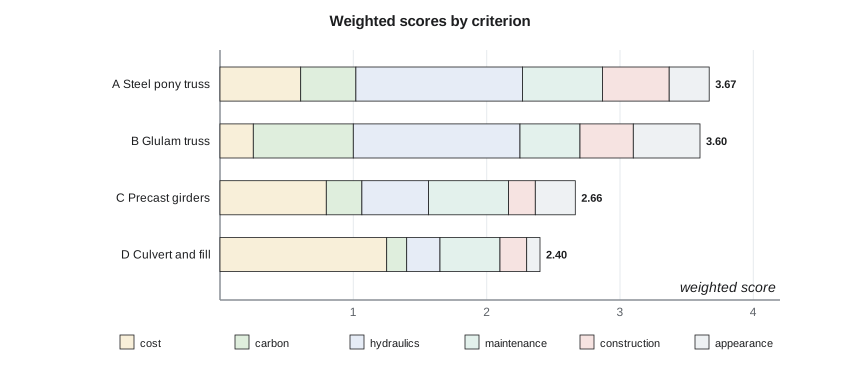
print("Ranking stable over the tested range")Option cost CO2e t score A Steel pony truss, single span 2.62 210 3.670 B Glulam truss, single span 2.88 95 3.600 C Precast girders, two spans 2.48 260 2.665 D Culvert and embankment 2.15 300 2.400 Preferred with the agreed weights: A Steel pony truss, single span (costs in CAD million) Ranking changes when carbon weight reaches 0.17 and cost falls to 0.23: B Glulam truss, single span
The result is close. The steel truss scores 3.67 and the glulam truss 3.60, with the girders and the culvert well behind. Concept D, the cheapest, comes last, which surprises the roads engineer until the team walks through its hydraulic and permit problems. Concept C is let down by the pier in the floodplain, the in-water work it needs and its constructability score.
Sensitivity: is the answer robust?
A ranking that flips when a weight moves by a hundredth is not a strong recommendation, and the team must say so. The script moves weight from cost to carbon in steps of 0.01. The ranking changes when the carbon weight reaches 0.17, against 0.15 agreed at the workshop. In other words, the choice between steel and timber depends on how much the city values embodied carbon relative to capital cost, and a small shift in values would reverse it. Other tests show the ranking is robust to changes in the hydraulics and maintenance weights: A and B both score well on hydraulics because both span the floodplain, and A's lower maintenance score advantage is steady.
Worked problem
Recomputing a weighted score by hand
Concept B scores 1.94 on cost and 5.00 on carbon after scaling, and 5, 3, 4 and 5 on hydraulics, maintenance, constructability and appearance. With the agreed weights, what is its total?
Show solution
- \[0.25(1.94) + 0.15(5.00) + 0.25(5) + 0.15(3) + 0.10(4) + 0.10(5)\]
- \[0.485 + 0.750 + 1.250 + 0.450 + 0.400 + 0.500 = 3.835\]
- The script's value is 3.60, so the hand check must contain an error: the cost scaling for B is 1.00, not 1.94, because B is the most expensive option.
- \[0.25(1.00) + 0.750 + 1.250 + 0.450 + 0.400 + 0.500 = 3.600\]
Answer: With the correct scaled cost, B scores 3.60, matching the script. A hand check that disagrees has done its job: it found the misread input.
Making the recommendation
The team presents both leading concepts at the concept review with the trade-off stated plainly: the steel truss costs about 10 % less and needs less maintenance; the glulam truss has less than half the embodied carbon and is preferred by the community members who saw the sketches. The team recommends concept A, with two conditions that narrow the carbon gap: steel from producers with recycled content and published environmental product declarations, and a deck mix with supplementary cementing materials. It also records that if the city's forthcoming climate policy raises the weight on carbon, concept B should be reconsidered before detailed design begins.
The client accepts concept A at the concept review. The parks maintenance supervisor's comment carries weight: the city has no in-house experience inspecting timber bridges, and a weathering steel truss on a stiff deck is a structure his staff already understand. The decision, its reasons and the sensitivity result are recorded in the design report, so that anyone who later asks why the city did not build in timber can see exactly how the choice was made.
The concept review
At the concept review, the team presents the four concepts, the evaluation and the sensitivity test in 20 minutes, followed by questions. The reviewers' comments are recorded and answered in writing within a week. Three of them shape the next stage. The external reviewer asks for the vibration check to be made early, because a 36 m steel pony truss is close to the range where footbridges become lively. Professor Okonkwo asks for the carbon estimate to include the concrete in the abutments, which the first version omitted for all four concepts. And Marion asks whether the truss could be delivered in two pieces, because the access road to the north abutment is narrow. All three become actions in the work plan for the detailed design.
Practical points
- Generate options that differ in kind, then screen against the hard requirements.
- Let the client set the weights; give each judged score a written rationale.
- Scale measured criteria, such as cost and carbon, consistently across options.
- Test how far each weight must move before the ranking changes, and report it.
- Recommend clearly, with conditions, and record why the alternatives were not chosen.
Common mistakes
MistakeDeveloping four variations of one idea.
InsteadChoose concepts that differ in structure, span arrangement or approach.
MistakeSetting the weights inside the design team.
InsteadWeights express values; agree them with the client.
MistakeReporting a winner without a sensitivity test.
InsteadShow how much the weights must change to reverse the result.
MistakeTreating concept estimates as precise.
InsteadUse them for comparison; the differences are more reliable than the totals.
Summary and key terms
- Concept decisions fix most of a project's cost, impact and maintenance.
- Four concepts were evaluated: steel truss, glulam truss, precast girders with a pier, and a culvert with fill.
- The client set the weights; the team scored and explained each criterion.
- The steel truss scored 3.67 and the glulam truss 3.60; the girders and culvert were well behind.
- The ranking reverses if the carbon weight rises from 0.15 to 0.17.
- Concept A was recommended with low-carbon steel and concrete conditions and accepted by the client.
- Concept
- A distinct way of meeting the requirements, developed far enough to estimate and compare.
- Screening
- Removing options that fail a hard requirement before detailed evaluation.
- Multi-criteria analysis
- A method of comparing options against several weighted criteria.
- Weight
- The relative importance assigned to a criterion, set by the decision maker.
- Sensitivity analysis
- Testing how results change when inputs or weights change.
- Embodied carbon
- Greenhouse gas emissions from producing and transporting construction materials.
- Environmental product declaration
- A verified document reporting the environmental impacts of a product.
- Pony truss
- A truss bridge whose deck runs between trusses that have no overhead bracing.
Practice problems
Work each problem on paper first, then reveal the answer to check.
Concept costs range from 2.15 to 2.88 million. What is the scaled cost score for an option at 2.62 million?
Show answer
1 + 4 × (2.88 − 2.62) / (2.88 − 2.15) = 2.42.
Why is the glulam concept's maintenance score lower than the steel truss's?
Show answer
Timber needs closer inspection for moisture and decay at connections and more frequent protective treatment.
If the client raises the carbon weight to 0.20, which concept is likely to lead?
Show answer
Concept B, since the ranking already changes at 0.17.
What two conditions did the team attach to its recommendation, and why?
Show answer
Low-carbon steel with recycled content and a lower-carbon concrete mix, to narrow the carbon gap with timber.
Lesson quiz · 5 questions
Score 60% or more to complete this lesson.
Create a free account to save your progress, take quizzes and earn a certificate.