
CIV-499 · Lesson 2 of 12 · 20 min
Requirements and design criteria
A requirement that cannot be checked is a hope. The brief says the crossing must be safe for walkers, cyclists and the maintenance vehicle, but safe against what, and checked how? This lesson turns the agreed scope into requirements that are specific, measurable and traceable, and then into a design criteria memo: the single document that states which codes, loads, limits and assumptions govern the design. Once the client and the mentor have agreed to that memo, every calculation that follows refers to it, and any change to it is a scope change that is logged and approved.
What makes a good requirement
Good requirements share a few properties. Each says one thing. Each is stated as a need rather than as a solution, so that it does not quietly rule out options before they are evaluated: 'cross the creek without permanent works in the low-flow channel' leaves room for a truss, a girder or an arch, while 'provide a 36-metre truss' does not. Each can be verified, by calculation, analysis, inspection or test. And each can be traced back to a source: a clause of the brief, a code, a permit condition or a stakeholder comment. When the design review asks why the approach grades are 4.5 % and not 6 %, the answer should be a line in the requirements register, not a recollection of a meeting.
| Weak statement | Better requirement | Verification |
|---|---|---|
| The bridge should be safe for everyone. | Carry the pedestrian load and the maintenance vehicle with the code load factors. | calculation |
| The bridge must be high enough. | Low chord at least the freeboard criterion above the 100-year water level; soffit above the climate-check level. | hydraulic model |
| Make it accessible. | Approach running grades of 5 % or less and cross slopes of 2 % or less, with level rest areas. | profile check, site audit |
| Keep costs down. | Construction cost at the 80th percentile within the capital budget. | estimate with risk range |
| Low maintenance. | Lowest 75-year life-cycle cost among the feasible finishes, with no repainting. | life-cycle cost analysis |
Codes and standards that govern
The crossing is a pedestrian and cyclist bridge on a municipal trail, and in Ontario that places it under CSA S6, the Canadian Highway Bridge Design Code. The edition current at the time of the project is S6:25, published in 2025. S6 includes provisions for pedestrian loads, for structures carrying only pedestrians and cyclists, and for vibration serviceability of light, lively bridges. A dedicated national guideline for pedestrian, cycling and multi-use bridges, CSA S7, is in development with the Transportation Association of Canada; the team notes it and checks with the city whether any draft provisions should be considered. The connecting path and parking lot follow the city's engineering standards and the Ontario accessibility standard for public spaces, and the stormwater design follows the city's standards and the conservation authority's guidance.
The criteria memo records the edition of each document, because codes change and a design must be reproducible. It also records owner requirements that go beyond the code. Owners often set their own values for loads, freeboard or design life where the code leaves a choice, and it is entirely proper for them to do so as long as the memo says who decided and why.
Loads
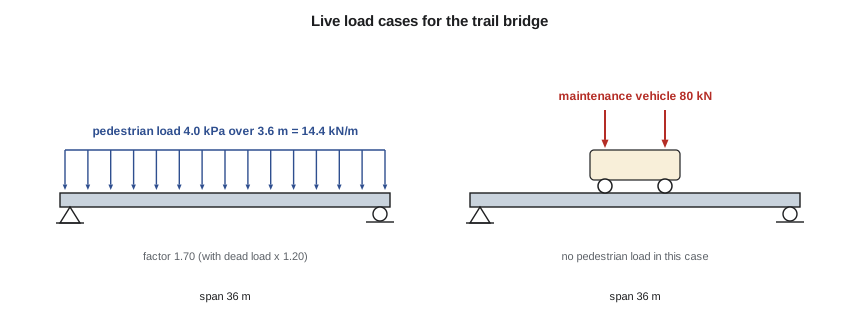
The pedestrian load is a uniform pressure on the walkway, from S6's pedestrian load clause. The city's criteria memo adopts 4.0 kPa over the full 3.6 m clear width, chosen as an upper bound for a crowd-loaded multi-use bridge near a school. The maintenance vehicle is an owner requirement: the parks department's small plow and utility truck, taken as an 80 kN vehicle, not applied together with the crowd. Dead load comes from the structure itself. Wind, snow on the deck between clearings, temperature and the ice and debris forces of a spring flood complete the list, with load factors and combinations from S6.
Serviceability: deflection and vibration
For a pedestrian bridge, strength is rarely the governing problem. Long, light spans tend to be lively: their first vertical natural frequency falls into the range that walking excites, and a bridge that bounces under a jogger feels unsafe even when it is perfectly strong. Codes handle this in two ways. Some set a minimum frequency, usually about 3 Hz for vertical vibration, above the first harmonic of normal walking. Others allow lower frequencies if a calculated acceleration stays within a comfort limit. Deflection limits, such as span/360 under pedestrian load, control a different thing, the visible sag, and do not on their own prevent liveliness.
S6 includes a vibration serviceability check for pedestrian bridges: when the first vertical frequency is below 3 Hz, the acceleration from walkers must stay below a limit that rises with frequency, of the form 0.25 f^0.78 m/s². The team adopts that form, with span/360 for deflection under the pedestrian load, and asks the city whether lateral vibration needs a separate check; for a span of this length and a stiff deck it should not, but the memo says so explicitly.
Hydraulic, accessibility and life criteria
The hydraulic criteria come from the city and the conservation authority: the low chord at least 1.0 m above the 100-year water level, the soffit above the water level for the climate-check flow, which is the 100-year flow increased by a third as in the master plan, and no permanent works in the low-flow channel. Accessibility criteria follow the accessibility standard and the city's trail guidelines: running grades of 5 % or less on the approaches so that no ramp features are needed, cross slopes of 2 % or less, firm and stable surfaces, and a clear width of 3.0 m or more. The design life is 75 years, the S6 design life for bridges, with deck and railings designed for replacement within that period.
The criteria memo as a script
Lucas keeps the governing numbers in a single script, which prints the criteria and the requirements register. Every other calculation imports its values from the same place, so a change to the memo flows through the whole design. The script also checks that every requirement has a verification method, a small test that has caught a missing method on more than one project.
# Design criteria memo for the Kestrel Creek trail bridge, checked against the requirements
UNITS = "SI"
SI = UNITS == "SI"
if SI:
    span, clear_w = 36.0, 3.6                      # m
    ped = 4.0                                     # kPa, city criteria (S6 Clause 3.8.9 basis)
    maint = 80.0                                  # kN maintenance vehicle, city criteria
    defl_lim = span / 360 * 1000                  # mm under pedestrian load
    freeboard = 1.0                               # m above the 100-year water level
    path_grade = 5.0                              # % maximum running grade without ramp features
    print(f"Clear span {span:.0f} m, clear width {clear_w:.1f} m")
    print(f"Pedestrian load {ped:.1f} kPa -> {ped * clear_w:.1f} kN/m on the deck")
    print(f"Maintenance vehicle {maint:.0f} kN (not combined with pedestrian load)")
    print(f"Live load deflection limit span/360 = {defl_lim:.0f} mm")
    print(f"Vertical frequency: check acceleration if f1 < 3.0 Hz (limit 0.25 f^0.78 m/s2)")
else:
    span, clear_w = 120.0, 12.0                   # ft
    ped = 90.0                                    # psf, AASHTO pedestrian bridge guide
    maint = 20.0                                  # kips, H10 for clear width over 10 ft
    defl_lim = span / 360 * 12                    # in.
    freeboard = 3.0                               # ft
    path_grade = 5.0
    print(f"Clear span {span:.0f} ft, clear width {clear_w:.0f} ft")
    print(f"Pedestrian load {ped:.0f} psf -> {ped * clear_w / 1000:.2f} kip/ft on the deck")
    print(f"Maintenance vehicle H10, {maint:.0f} kips (clear width over 10 ft)")
    print(f"Live load deflection limit span/360 = {defl_lim:.1f} in.")
    print(f"Vertical frequency: f1 >= 3.0 Hz, or f1 >= 2.86 ln(180/W) with W in kips")
print(f"Freeboard to the 100-year level: {freeboard:g} {'m' if SI else 'ft'}; soffit above the climate-check level")
print(f"Maximum approach running grade {path_grade:.0f} %; cross slope 2 % maximum")
# requirement register: each requirement needs a verification method
reqs = [("R1", "Carry pedestrians, cyclists and the maintenance vehicle", "calculation"),
        ("R2", "Clear the 100-year flood with freeboard", "hydraulic model"),
        ("R3", "No permanent works in the low-flow channel", "drawing review"),
        ("R4", "Accessible approaches from Ridgeway Road and the pavilion", "profile check, site audit"),
        ("R5", "Trailhead parking with accessible stalls", "layout check"),
        ("R6", "Treat runoff from new hard surfaces", "sizing calculation"),
        ("R7", "75-year design life with low maintenance", "life-cycle cost"),
        ("R8", "Construction cost within the city budget", "estimate"),
        ("R9", "Build within one construction season", "schedule")]
print()
for rid, text, how in reqs:
    print(f"{rid}  {text:58s} verify by: {how}")
untested = [r for r in reqs if not r[2]]
print(f"\n{len(reqs)} requirements, {len(untested)} without a verification method")Clear span 36 m, clear width 3.6 m Pedestrian load 4.0 kPa -> 14.4 kN/m on the deck Maintenance vehicle 80 kN (not combined with pedestrian load) Live load deflection limit span/360 = 100 mm Vertical frequency: check acceleration if f1 < 3.0 Hz (limit 0.25 f^0.78 m/s2) Freeboard to the 100-year level: 1 m; soffit above the climate-check level Maximum approach running grade 5 %; cross slope 2 % maximum R1 Carry pedestrians, cyclists and the maintenance vehicle verify by: calculation R2 Clear the 100-year flood with freeboard verify by: hydraulic model R3 No permanent works in the low-flow channel verify by: drawing review R4 Accessible approaches from Ridgeway Road and the pavilion verify by: profile check, site audit R5 Trailhead parking with accessible stalls verify by: layout check R6 Treat runoff from new hard surfaces verify by: sizing calculation R7 75-year design life with low maintenance verify by: life-cycle cost R8 Construction cost within the city budget verify by: estimate R9 Build within one construction season verify by: schedule 9 requirements, 0 without a verification method
Worked problem
From a pressure to a line load
The pedestrian load is 4.0 kPa on a 3.6 m clear width, and the bridge has two trusses. What line load does each truss carry, before factors?
Show solution
- \[w_L = 4.0 \times 3.6 = 14.4\ \text{kN/m for the deck}\]
- \[w_L / 2 = 7.2\ \text{kN/m per truss, with the load centred}\]
Answer: Each truss carries 7.2 kN/m; an eccentric crowd on one side would load one truss more, which the floor beam design must consider.
Assumptions and their owners
Every design rests on assumptions, and the criteria memo lists them with an owner: the person or organization that confirmed them. The maintenance vehicle weight is confirmed by the parks fleet supervisor. The 100-year flow at the site is taken from the master plan model by Anika Rao. The ground model comes from the earlier borehole program, confirmed by Dr. Kowalczyk as adequate for a concept, with two new boreholes at the abutments to follow. The survey is the city's topographic survey of the valley. When an assumption changes, its owner knows, and the memo is revised and reissued with a revision number and date.
The team also records what it is not assuming. It does not assume that the trail will never carry an emergency vehicle; the city confirms that the bridge is not an emergency route and will be signed and fitted with removable bollards, so a fire truck is not a design load. It does not assume that the creek will stay where it is; the abutments are set back from the active channel because the master plan showed bank movement. Writing these down is how a team avoids discovering its assumptions only when a reviewer asks about them.
When criteria conflict
Criteria sometimes pull against each other, and the memo is the place to settle the conflict before it turns up in a drawing. The freeboard criterion pushes the deck up; the accessibility criterion limits how steeply the approaches can climb to meet it; and the approaches must fit between the road and the creek bank without encroaching on the floodplain. The team works out the deck level from the water levels in lesson 3 and the approach lengths in lesson 8, and finds that both can be met with a 4.5 % approach grade, leaving a little margin below the 5 % limit for construction tolerance. Had the numbers not worked, the memo would have recorded which criterion the client chose to relax, and why.
Practical points
- State each requirement as a need, not a solution, and give it a verification method.
- Record the code editions and the owner's own criteria in a single memo.
- For pedestrian bridges, expect vibration and deflection, not strength, to govern.
- List assumptions with the person who confirmed them.
- Revise the memo formally; never let criteria drift through emails.
Common mistakes
MistakeWriting requirements as solutions, such as a specific bridge type.
InsteadState the need so that options can still be compared.
MistakeChecking only strength for a long, light footbridge.
InsteadCheck the first vertical frequency and, if needed, the walking acceleration.
MistakeUsing whichever code edition is on the shelf.
InsteadRecord the current edition, or the one the owner specifies, in the criteria memo.
MistakeLeaving assumptions implicit.
InsteadList each assumption with its owner and revise the memo when one changes.
Summary and key terms
- Good requirements say one thing, state a need, can be verified and can be traced to a source.
- The bridge follows CSA S6:25, with owner criteria for pedestrian load, maintenance vehicle, freeboard and design life.
- Vibration serviceability usually governs long pedestrian spans; a 3 Hz first vertical frequency is the common threshold.
- Accessibility criteria set running grades of 5 % or less and cross slopes of 2 % or less on the approaches.
- The criteria memo is kept as a script that every other calculation uses.
- Assumptions are recorded with the person who confirmed them.
- Requirements register
- A table of requirements with their source and verification method.
- Design criteria memo
- The document that states the codes, loads, limits and assumptions governing a design.
- Verification method
- How a requirement will be shown to be met: calculation, analysis, inspection or test.
- Pedestrian load
- A uniform live load on a walkway representing a crowd.
- Maintenance vehicle
- A design vehicle representing the light trucks that service a trail bridge.
- Vibration serviceability
- The comfort of users under vibration caused by walking, running or wind.
- First vertical frequency
- The lowest natural frequency of vertical bending of a span.
- Freeboard
- The vertical clearance between a design water level and the underside of a structure.
Practice problems
Work each problem on paper first, then reveal the answer to check.
A 3.0 m wide path is loaded at 4.0 kPa. What line load results?
Show answer
12.0 kN/m.
Rewrite 'use a weathering steel truss' as a requirement.
Show answer
For example: achieve the lowest 75-year life-cycle cost with no repainting during the design life.
Why is a deflection limit not enough to prevent liveliness?
Show answer
Deflection controls static sag; liveliness depends on the natural frequency and the response to footfall, which need a separate check.
The 100-year flow at the site is revised upward by the conservation agency. What happens to the memo?
Show answer
The hydraulic criteria and the flow are revised, the memo is reissued with a new revision, and the water levels and low chord are rechecked.
Lesson quiz · 5 questions
Score 60% or more to complete this lesson.
Create a free account to save your progress, take quizzes and earn a certificate.