
CIV-499 · Lesson 12 of 12 · 18 min
Final review, presentation and reflection
The last weeks of the capstone bring everything together: the corrected calculations, the drawings, the report, the responses to every review comment, and a presentation to the people who will decide what happens next. This lesson follows the team through the final design check, the final review and the presentation, and then asks the question that matters most for your own career: what did the project teach that the earlier courses could not? It ends with the team's handover to the city and with the assessment of individual contributions, which is part of any team project and is worth doing well.
The final design check
Before the final review, the team runs one script that recomputes the governing checks with the corrected dead load and the final dimensions and prints a ratio for each, with 1.0 as the limit. It does not replace the full calculations in the appendices; it is a one-page answer to the reviewer's first question, 'does it all still work?', and a guard against a late change in one place quietly breaking a check somewhere else.
# Final design check summary for the Kestrel Creek trail link, and peer-assessment weighting
import math
UNITS = "SI"
SI = UNITS == "SI"
if SI:
    L, d, A, E, g = 36.0, 2.7, 11800e-6, 200e6, 9.81
    wD, wL, gD, gL = 21.6, 14.4, 1.20, 1.70
    cap = 0.90 * A * 350e3
    EI = E * A * d ** 2
    f1 = math.pi / (2 * L ** 2) * math.sqrt(EI * 1000 / (wD * 1000 / g)) / math.sqrt(1.12)
    defl = 5 * wL * L ** 4 / (384 * EI) * 1.12 * 1000
    checks = [("Bottom chord, factored force / resistance", (gD * wD + gL * wL) * L ** 2 / 16 / d / cap, 1.0),
              ("Pedestrian deflection / limit (100 mm)", defl / 100, 1.0),
              ("3.0 Hz / first vertical frequency", 3.0 / f1, 1.0),
              ("Pile reaction / resistance (6 piles, lesson 6)", (1.20 * (wD * L / 2 + 1450) + 1.70 * wL * L / 2) / (6 * 522), 1.0),
              ("Freeboard required / provided (1.0 m)", 1.0 / (199.20 - 198.18), 1.0),
              ("South approach grade / 5 % (4.5 % built)", 0.045 / 0.05, 1.0),
              ("P80 cost / budget (3.0 million)", 2.885 / 3.0, 1.0)]
else:
    L, d, A, E, g = 120.0, 9.0, 17.2, 29000.0, 32.2
    wD, wL, gD, gL = 1.48, 1.08, 1.25, 1.75
    cap = 0.95 * A * 50.0
    EI = E * A * d ** 2
    f1 = math.pi / (2 * L ** 2) * math.sqrt(EI / (wD / g)) / math.sqrt(1.12)
    defl = 5 * wL * L ** 4 / (384 * EI) * 1.12 * 12
    checks = [("Bottom chord, factored force / resistance", (gD * wD + gL * wL) * L ** 2 / 16 / d / cap, 1.0),
              ("Pedestrian deflection / limit (4.0 in.)", defl / 4.0, 1.0),
              ("3.0 Hz / first vertical frequency", 3.0 / f1, 1.0),
              ("Pile load / allowable (6 piles, lesson 6)", (wD * L / 2 + 390 + wL * L / 2) / (6 * 99), 1.0),
              ("Freeboard required / provided (3 ft)", 3.0 / (653.30 - 650.26), 1.0),
              ("South approach grade / 5 % (4.5 % built)", 0.045 / 0.05, 1.0),
              ("P80 cost / budget (2.46 million)", 2.366 / 2.46, 1.0)]
print(f"First vertical frequency with the corrected dead load: {f1:.2f} Hz")
for n, ratio, lim in checks:
    print(f"{n:48s} {ratio:5.2f}  {'OK' if ratio <= lim else 'FAILS'}")
# peer assessment: each member rates every member (including self) out of 10;
# a member's weighting factor is their average rating divided by the team average, capped at 1.05
ratings = {"Maya": [9, 9, 8, 9], "Kenji": [8, 9, 8, 8], "Amara": [9, 9, 9, 9], "Lucas": [7, 6, 7, 7]}
avg = {k: sum(v) / len(v) for k, v in ratings.items()}
team = sum(avg.values()) / len(avg)
print()
for k, a in avg.items():
    wf = min(1.05, a / team)
print(f"{k:6s} average rating {a:4.2f} weighting factor {wf:4.2f} project mark 84 -> {84 * wf:4.1f}")First vertical frequency with the corrected dead load: 3.20 Hz Bottom chord, factored force / resistance 0.41 OK Pedestrian deflection / limit (100 mm) 0.21 OK 3.0 Hz / first vertical frequency 0.94 OK Pile reaction / resistance (6 piles, lesson 6) 0.85 OK Freeboard required / provided (1.0 m) 0.98 OK South approach grade / 5 % (4.5 % built) 0.90 OK P80 cost / budget (3.0 million) 0.96 OK Maya average rating 8.75 weighting factor 1.05 project mark 84 -> 88.2 Kenji average rating 8.25 weighting factor 1.01 project mark 84 -> 84.6 Amara average rating 9.00 weighting factor 1.05 project mark 84 -> 88.2 Lucas average rating 6.75 weighting factor 0.82 project mark 84 -> 69.3
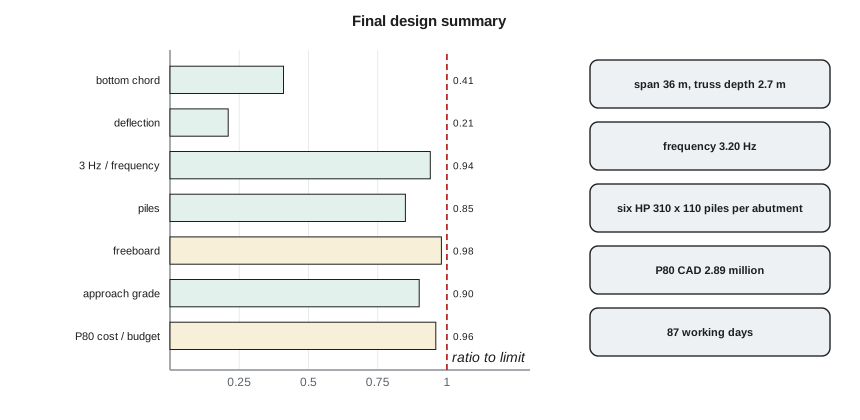
Every check passes. The frequency of 3.20 Hz with the corrected dead load clears 3 Hz with a small margin, which is why the truss depth from lesson 5 matters: at the first trial depth the corrected bridge would have been at about 2.85 Hz and would have failed the acceleration check clearly. The piles work at 85 % of their factored resistance, the freeboard requirement is met with 20 mm to spare, the approach grade is 4.5 % against the 5 % limit, and the P80 cost is 96 % of the budget.
Two of these margins are thin. The freeboard is met by a few centimetres, because the deck level was set from the minimum low chord; the team notes that the engineer of record could raise the deck slightly at little cost if the final hydraulic model gives a higher water level. The cost margin is about 4 %, and the team recommends that the city keep the trailhead parking lot as a separable part of the tender, so that it can be deferred if bids come in high. A good final review presents the thin margins openly, with what can be done about them.
The final review
The final review is held at city hall. The audience is Marion and the roads engineer, the parks maintenance supervisor, Professor Okonkwo, Priya, and an external reviewer, a bridge engineer from another firm whom the course invites each year. The team has 30 minutes to present and 30 minutes for questions. Its presentation follows the structure of a decision, not the structure of the work: the need, the recommendation, why this option, what it costs and when it can be built, what the risks are, and what the city must decide next. The calculations are in the appendix and in a backup set of slides, ready for questions.
Each team member presents the part they led, but Maya opens and closes, and every member can answer questions on every part. That is a deliberate choice: a reviewer who asks the cost lead about the vibration check, and gets a clear answer, learns that the team has worked as a team. The slides are simple. Each has one message, stated as a sentence in the title, such as 'Driven piles avoid opening the artesian till', with one figure that supports it. The team rehearses twice in front of Kestrel Bay staff, who ask harder questions than the reviewers do.
| Reviewer comment | Team response |
|---|---|
| The freeboard margin is very small. What if the final model gives a higher level? | Accepted: the report recommends confirming the level with the full model and raising the deck if needed; the approach grades allow about 100 mm more. |
| Has the lateral frequency been checked? | Accepted: added to the appendix; the lateral frequency with deck bracing is well above the threshold. |
| Why not an integral abutment? | Explained: considered and recommended for evaluation by the engineer of record; outside the team's competence to check. |
| Could the parking lot be smaller? | Not accepted: the parking study supports 32 stalls; the lot is made a separable part of the tender instead. |
| Who maintains the bioretention cell? | Accepted: the parks department, with the maintenance notes in the handover package. |
The external reviewer's written comments arrive a week later. Most are accepted. One is not: the reviewer suggests a lighter timber deck to raise the frequency, but the team shows that the timber deck would need more maintenance, reduce the deck's resistance to the maintenance vehicle and save little cost, and the reviewer agrees. A professional disagreement handled with evidence and courtesy is a good outcome of a review, not a failure.
Handover
The handover package goes to the city with the final report: the drawings marked not for construction, the design criteria memo, the calculations and scripts, the permit table with the agency contacts and the status of each approval, the risk register, the operations and maintenance notes, and a short list of open items for the engineer of record. The city's capital committee decides to include the project in the next year's program, to engage a consulting engineer to complete and seal the design, and to begin the fisheries review and the conservation authority or floodplain approvals using the team's report. Priya's firm is not automatically given the work; the city will procure it in the usual way, and that is how it should be.
Assessing individual contributions
Most capstone courses adjust each student's mark for their contribution to the team, using peer assessment. In this course each member rates every member, including themselves, out of 10 on contribution, quality and reliability, and the weighting factor is each member's average rating divided by the team average, capped at 1.05. The factor is not applied mechanically; the advisor reviews it with evidence from the shared repository, meeting notes and the scope log, and talks with each member.
For this team, Maya, Kenji and Amara have factors at or near the cap, and Lucas's ratings give 0.82. The record shows why: his cost and schedule work fell behind in the second term, and the team raised it at week 12 under the charter, as it had agreed to. A plan was made, and Lucas recovered much of the ground; the final estimate and schedule are sound. After meeting with Lucas and reviewing his repository work, Professor Okonkwo sets his factor at 0.90. The case is an ordinary one, and it shows why the charter and the records matter: they make a difficult conversation fair and specific rather than personal.
Worked problem
Computing a weighting factor
Four members have average ratings of 8.75, 8.25, 9.00 and 6.75, and the project mark is 84. What are the factors and marks, with a cap of 1.05?
Show solution
- \[\bar{r} = (8.75 + 8.25 + 9.00 + 6.75) / 4 = 8.19\]
- \[w = 8.75 / 8.19 = 1.07 \to 1.05;\quad 8.25 / 8.19 = 1.01;\quad 9.00 / 8.19 = 1.10 \to 1.05;\quad 6.75 / 8.19 = 0.82\]
- \[\text{marks} = 84 \times (1.05, 1.01, 1.05, 0.82) = 88.2,\ 84.6,\ 88.2,\ 69.3\]
Answer: The formula gives a starting point; the advisor's review, with evidence, sets the final factor.
Reflection
The course ends with a short individual reflection, and it is worth taking seriously. The capstone teaches things that the earlier courses could only describe. That the hardest part of a design is deciding what the problem is. That the client, the advisor and the mentor want different things, and all of them are right. That vibration, not strength, can set the size of a structure. That a groundwater reading in one borehole can rule out a foundation type. That permits are design inputs. That a checker finding an 8 % error in a load is the system working. That the people who will use a trail know things that no standard contains. And that a good recommendation states its own uncertainty.
It also teaches something about yourself: how you work under a deadline, how you handle disagreement, what you are good at and what you avoid. Maya writes that she learned to delegate the vibration check to Kenji's independent method rather than defend her own. Amara writes about the walk-through with the accessibility committee. Kenji writes about the artesian piezometer, and Lucas about asking for help earlier next time. These are the lessons that carry into practice, where you will spend the next few years as an engineer-in-training, working under engineers like Priya, on projects like this one.
Practical points
- Run one final script that rechecks every governing criterion with the final inputs.
- Present thin margins openly, with what can be done about them.
- Structure the presentation around the decision the client must make.
- Respond to every review comment in writing, with evidence where you disagree.
- Hand over everything the next engineer will need, including open items.
Common mistakes
MistakePresenting the work in the order it was done.
InsteadPresent the need, recommendation, reasons, cost, risks and decisions needed.
MistakeHiding thin margins in the appendix.
InsteadState them in the summary with options to increase them.
MistakeTreating a reviewer's suggestion as an order.
InsteadEvaluate it with evidence; accept, modify or decline with reasons.
MistakeApplying a peer-assessment formula mechanically.
InsteadReview the factor with evidence from the project record and the members.
Summary and key terms
- With the corrected dead load, every governing check passes; the frequency is 3.20 Hz.
- The freeboard and cost margins are thin, and the report says how to increase them.
- The final review is structured around the client's decision, with calculations ready for questions.
- Every reviewer comment receives a written response; one suggestion was declined with evidence.
- The city will engage an engineer of record to complete and seal the design and start the approvals.
- Peer-assessment factors start from a formula and are set by the advisor with evidence.
- Governing check
- The design check closest to its limit for a given element or criterion.
- Margin
- The difference between a design value and its limit, or the ratio's distance below 1.0.
- Final review
- The concluding review of a complete design by the client and independent reviewers.
- Separable part
- A portion of a tender that the owner can award or defer independently.
- Handover package
- The documents given to the owner at the end of a design, including open items.
- Peer assessment
- Team members' ratings of each other's contributions, used to adjust individual marks.
- Weighting factor
- A multiplier applied to a team mark to reflect an individual's contribution.
- Reflection
- A structured review of what was learned and how one worked.
Practice problems
Work each problem on paper first, then reveal the answer to check.
The freeboard provided is 1.02 m against 1.0 m required. What is the ratio, and is it governing?
Show answer
0.98; it is one of the closest checks to 1.0.
A member's average rating is 7.5 against a team average of 8.0. What is the formula factor?
Show answer
0.94, before the advisor's review.
Why does Maya open and close the presentation, but every member answer questions on every part?
Show answer
It gives the presentation one voice and shows the reviewers that the whole team understands the whole design.
What decisions did the city make after the final review?
Show answer
To include the project in next year's program, engage an engineer of record and begin the approvals using the team's report.
Lesson quiz · 5 questions
Score 60% or more to complete this lesson.
Create a free account to save your progress, take quizzes and earn a certificate.