
CIV-499 · Lesson 11 of 12 · 18 min
Professional practice: the design report, drawings, checking and sealing
A design exists for other people only as documents: drawings that a contractor can build from, specifications that say what quality is required, a report that explains what was designed and why, and calculations that a reviewer can follow. This lesson is about producing those documents to a professional standard, checking them independently, and understanding what it means for an engineer to seal them. It also covers the line between a student design and an engineering document that can be used for construction, a line the capstone team must be careful not to blur.
The design report
The design report is the record of the project. Its readers are the client, who wants to know what it is getting and what it costs; the reviewing engineer, who wants to follow the design logic; the regulators, who want to see compliance; and an engineer twenty years from now, who wants to know why the bridge is the way it is before changing it. The team's report has a short executive summary for the first reader and a structure that serves the others.
| Section | Contents |
|---|---|
| Executive summary | what is proposed, cost, schedule, key decisions and open issues, in two pages |
| Scope and requirements | the agreed scope, the requirements register and the design criteria memo |
| Site and data | survey, boreholes, hydrology, utilities, habitat, trail counts, with sources |
| Options and selection | the four concepts, evaluation, sensitivity and the client's decision |
| Design | superstructure, substructure, hydraulics, stormwater, path, parking and crossing |
| Approvals | permit table, conditions and how the design meets them |
| Cost, schedule and delivery | estimate with contingency, schedule, procurement recommendation |
| Risk, safety and life cycle | risk register, safety in design decisions, life-cycle cost, climate test |
| Appendices | calculations, scripts, model results, review comments and responses |
Good reports are written for their readers. Each section starts with its conclusion and then gives the reasoning. Every number in the text matches a calculation in an appendix, and every calculation states its inputs, their sources and the code clauses used. Figures carry captions that say what the figure shows, not just what it is. The report says plainly what the team did not do: the integral abutment option, the second crossing, the full lighting design. Leaving out the limits of a design does not make it look stronger; it makes it dangerous.
The drawings
The drawing set has twelve sheets: a cover with a location plan and drawing list; a general arrangement plan of the whole site; the trail profile; the bridge general arrangement in plan and elevation; truss details with member sizes and tabulated connection forces for the supplier; the floor system and deck; the abutments and piles; bearings and the expansion joint; the parking lot and grading; stormwater and the bioretention cell; erosion and sediment control staging; and standard details for the path, railings and crossing. Each sheet has a title block with the project name, sheet number, revision, date, scale and the names of those who designed, drew and checked it.
Checking
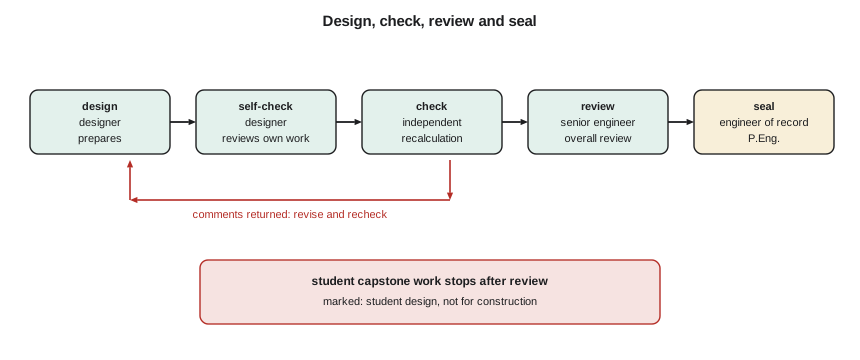
Checking is not reading. An independent check means someone who did not do the work recalculates the important results, preferably by a different method, and compares them with the design. The firm's procedure at Kestrel Bay, which the team adopts, distinguishes three levels. A self-check is the designer's own review before release. A check is a detailed independent recalculation of the key results by a qualified person in the same team. A review is an overview by a senior engineer of whether the design as a whole makes sense, follows the criteria and is complete. The truss, abutments and piles get all three; the parking lot gets a self-check and a review.
Kenji checks Maya's superstructure calculations. Rather than reread her script, he recomputes the chord force by the method of joints with panel loads, the frequency by the Rayleigh method from the deflected shape, and the deflection independently. He also builds the dead load from his own takeoff of the drawings, item by item, rather than accepting the design memo's total.
# Independent check: the reviewer recomputes key design values by a different method
import math
UNITS = "SI"
SI = UNITS == "SI"
if SI:
    L, d, A, E, wD, wL = 36.0, 2.7, 11800e-6, 200e6, 20.0, 14.4
    design = {"chord force (kN)": 1454, "frequency (Hz)": 3.33, "deflection (mm)": 21}
    gD, gL, g = 1.20, 1.70, 9.81
else:
    L, d, A, E, wD, wL = 120.0, 9.0, 17.2, 29000.0, 1.37, 1.08
    design = {"chord force (kips)": 360, "frequency (Hz)": 3.18, "deflection (in.)": 0.97}
    gD, gL, g = 1.25, 1.75, 32.2
# reviewer's own dead load takeoff, item by item
if SI:
    take = {"concrete deck 150 mm, 4.3 m wide": 0.150 * 4.3 * 23.6, "steel form and haunches": 1.0,
            "floor beams and stringers": 1.2, "two trusses with bracing": 2.8,
            "railings with 1.4 m fence": 1.1, "lighting conduit and fixtures": 0.25}
else:
    take = {"concrete deck 6 in., 14 ft wide": 0.5 * 14 * 0.150, "steel form and haunches": 0.07,
            "floor beams and stringers": 0.08, "two trusses with bracing": 0.19,
            "railings with 4.5 ft fence": 0.075, "lighting conduit and fixtures": 0.017}
for k, v in take.items():
    print(f"  {k:36s} {v:7.3f}")
wD_check = sum(take.values())
print(f"Reviewer's dead load {wD_check:.2f} against {wD:.2f} in the design memo ({wD_check / wD - 1:+.1%})\n")
wD_memo, wD = wD, wD_check
# method of joints at midspan of a Pratt truss with 12 panels: chord force from panel loads
n = 12; a = L / n
P = (gD * wD + gL * wL) * a / 2                  # factored panel load per truss
Rr = P * (n - 1) / 2                              # reaction per truss (end half-panels go to the bearings)
Mc = Rr * L / 2 - sum(P * (L / 2 - a * k) for k in range(1, n // 2))
chord = Mc / d
# Rayleigh estimate of frequency from the static deflection shape under self-weight
EI = E * A * d ** 2
xs = [L * i / 200 for i in range(201)]
y = [wD / (24 * EI) * x * (L ** 3 - 2 * L * x ** 2 + x ** 3) * 1.12 for x in xs]
num = sum(wD * yi for yi in y); den = sum(wD * yi * yi for yi in y)
freq = math.sqrt(g * num / den) / (2 * math.pi)
defl = 5 * wL * L ** 4 / (384 * EI) * 1.12 * (1000 if SI else 12)
check = dict(zip(design, (chord, freq, defl)))
print(f"{'quantity':20s} {'design':>9s} {'check':>9s} {'diff':>7s}")
worst = 0
for k in design:
    diff = check[k] / design[k] - 1
    worst = max(worst, abs(diff))
    print(f"{k:20s} {design[k]:9.2f} {check[k]:9.2f} {diff:+7.1%}")
print("Result:", "agrees within the 5 % review tolerance" if worst <= 0.05 else "differs by more than 5 %: resolve before sealing")
if abs(wD / wD_memo - 1) > 0.05:
print("Input check: the memo's dead load is low by more than 5 %; correct it and rerun before sealing")concrete deck 150 mm, 4.3 m wide 15.222 steel form and haunches 1.000 floor beams and stringers 1.200 two trusses with bracing 2.800 railings with 1.4 m fence 1.100 lighting conduit and fixtures 0.250 Reviewer's dead load 21.57 against 20.00 in the design memo (+7.9%) quantity design check diff chord force (kN) 1454.00 1510.99 +3.9% frequency (Hz) 3.33 3.21 -3.7% deflection (mm) 21.00 20.50 -2.4% Result: agrees within the 5 % review tolerance Input check: the memo's dead load is low by more than 5 %; correct it and rerun before sealing
The methods agree: the chord force, frequency and deflection all match within the 5 % review tolerance. But the takeoff finds that the memo's dead load of 20.0 kN/m is about 8 % low. It left out the haunches over the stringers, the taller fence that the accessibility walk-through added to the railings, and the lighting conduit. With the corrected 21.6 kN/m, the frequency falls from 3.33 to 3.21 Hz, still above 3 Hz, and the chord force rises by about 4 %. The results stay within tolerance, but an input error is an input error. Maya corrects the memo, reruns every calculation that uses dead load, and records the change in the revision log. This is exactly what checking is for: not to confirm that the designer's arithmetic is right, but to find the thing nobody noticed.
Worked problem
A Rayleigh frequency check by hand
For a simply supported span, the Rayleigh method with the static deflected shape gives f ≈ 0.18 √(g/δ), where δ is the midspan deflection under the structure's own weight. With the corrected dead load and the 12 % shear term, δ is 31 mm. What frequency results?
Show solution
- \[f \approx 0.18 \sqrt{9.81 / 0.031}\]
- \[f \approx 0.18 \times 17.8 = 3.20\ \text{Hz}\]
Answer: A one-line formula gives a quick sanity check of a frequency. The 0.18 comes from combining the beam frequency formula with the deflection formula; differences of a few percent between quick and detailed methods are normal, while differences of 20 % mean something is wrong.
Sealing and the engineer of record
In Ontario, the Professional Engineers Act and its regulation require final drawings, specifications, plans and reports prepared by a professional engineer for construction to bear that engineer's seal, signature and date. Sealing is a statement that a licensed engineer takes professional responsibility for the document. Professional Engineers Ontario publishes a guideline on the use of the seal. Students and engineers-in-training cannot seal, and a seal must never be applied to work that the engineer did not prepare or directly supervise and review.
The capstone design is a student design. It is excellent work, it has been checked and reviewed, and the city will use it as the basis for its project. But it is not a set of construction documents, and nobody seals it. Every sheet and the report cover carry the words 'student design, not for construction'. If the city proceeds, it will engage a consulting engineer, who will review the student design, take what is useful, complete the design to their own standard and seal the construction documents as engineer of record. Priya makes this point at the first meeting and again before the final review, because the temptation for a client with a good student design is to treat it as finished.
Ethics in the capstone
The professional codes of ethics in both countries put the safety and welfare of the public first, require engineers to act within their competence, and require honesty in reports and statements. The capstone tests these in small ways. The team must not overstate the design's completeness to please the client. It must report the dead load error, not quietly fix it. It must say where its competence ended, as it did with the integral abutment. It must credit the sources of its data and the people who helped, including Kestrel Bay's staff. And it must keep confidential the city's cost information and the suppliers' budget quotations, which were given for the project and not for publication.
Practical points
- Write each report section for its readers, with the conclusion first.
- Make every number traceable from text to calculation to source.
- Check key results independently, by a different method, and build loads from your own takeoff.
- Record what the design does not cover.
- Mark student work as not for construction; only a licensed engineer of record seals construction documents.
Common mistakes
MistakeChecking by rereading the designer's script.
InsteadRecalculate key results by a different method and from independent inputs.
MistakeFixing an error found in checking without recording it.
InsteadCorrect the input, rerun dependent calculations and log the revision.
MistakePresenting a student design as ready to build.
InsteadMark it not for construction; an engineer of record must complete and seal it.
MistakeHiding the limits of the design.
InsteadState what was not done and why; omission is a safety risk.
Summary and key terms
- The design report serves the client, reviewers, regulators and future engineers, with conclusions first and traceable numbers.
- The drawing set has twelve sheets with complete title blocks and revision control.
- Self-check, independent check and senior review are distinct levels of quality control.
- The checker found the dead load 8 % low; the corrected frequency is 3.21 Hz, still above 3 Hz.
- In Ontario, final engineering documents for construction bear the engineer's seal, signature and date.
- The capstone design is marked not for construction; an engineer of record will complete and seal the final design.
- Design report
- The document that records what was designed, why, and on what basis.
- Independent check
- Recalculation of key results by a qualified person who did not do the original work.
- Self-check
- A designer's own review of their work before release.
- Senior review
- An overall review of a design's logic, compliance and completeness by an experienced engineer.
- Revision log
- A record of changes to a document, with dates and reasons.
- Engineer of record
- The licensed engineer who takes professional responsibility for a design.
- Seal
- The stamp a licensed engineer applies to documents to show professional responsibility.
- Title block
- The part of a drawing that identifies the project, sheet, revision and responsible people.
Practice problems
Work each problem on paper first, then reveal the answer to check.
A check finds the frequency within 4 % of the design value but the dead load input 8 % low. What should happen?
Show answer
Correct the input, rerun every dependent calculation and log the revision, even though the result stays within tolerance.
Can Professor Okonkwo seal the student drawings for the city?
Show answer
No. He did not prepare or directly supervise them as engineer of record for construction, and the design is not complete for construction.
Name three things the report should say the design does not cover.
Show answer
The integral abutment option, the second crossing at the swale and the full lighting design.
Why should the checker do an independent takeoff of the dead load?
Show answer
Input errors are invisible to someone who reuses the designer's inputs; an independent takeoff can find them.
Lesson quiz · 5 questions
Score 60% or more to complete this lesson.
Create a free account to save your progress, take quizzes and earn a certificate.