
CIV-341 · Lesson 9 of 12 · 18 min
Axial capacity of single piles
The ultimate axial resistance of a pile is the sum of its shaft resistance and its toe resistance. Calculating either from first principles is harder than it looks, because installation changes the soil around the pile in ways that theory cannot fully describe. Practice therefore relies on methods that combine simple mechanics with empirical factors calibrated against load tests. This lesson presents the total stress (α) method and the effective stress (β) method for shaft resistance, the λ method as a cross-check in clay, and the bearing capacity approach for the toe, and applies them to the 406 mm closed-end pipe pile chosen for the fleet storage building.
The static capacity equation
For a pile of perimeter \(p\) and toe area \(A_t\), the ultimate resistance is
where \(f_s\) is the unit shaft resistance in each layer and \(q_t\) the unit toe resistance. The weight of the pile is usually small compared with these terms and is often neglected, or the toe resistance is taken as a net value. The art lies in choosing \(f_s\) and \(q_t\).
Shaft resistance in clay: the α method
The oldest approach relates the unit shaft resistance in clay to the undrained shear strength through an adhesion factor:
Empirical studies by Tomlinson, the American Petroleum Institute (API) and others show that \(\alpha\) is close to 1 for soft clays and falls for stiffer ones. A widely used form, from the API recommendations for offshore piles, writes \(\alpha\) in terms of the strength ratio \(\psi = s_u/\sigma'_v\):
The α method is simple and well calibrated for driven piles in uniform clays. Its weakness is that shaft resistance in the long term is governed by effective stresses, not by the undrained strength: the clay around a driven pile is remoulded, its pore pressures rise and then dissipate, and its strength recovers over weeks. This recovery, called setup, can increase the capacity of a pile in clay by 50 % or more after driving.
Shaft resistance: the β method
The effective stress method, developed by Burland, Chandler, Meyerhof and others in the 1970s, treats shaft resistance as friction on the pile surface:
where \(K\) is the ratio of horizontal to vertical effective stress at the pile surface after installation and \(\delta\) the interface friction angle. For driven displacement piles in sand, \(K\) is often taken as about 1 to 1.5 and \(\delta\) as about 0.7 to 0.9\(\phi'\); for drilled shafts, \(K\) is closer to \(K_0\). For normally and lightly overconsolidated clays, Burland's form with \(K = K_0 = (1 - \sin\phi')\sqrt{OCR}\) and \(\delta = \phi'\) gives
typically 0.25 to 0.4 for such clays. Fellenius has long advocated the β method for all soils, with β values calibrated on instrumented piles: roughly 0.25 to 0.35 in clay, 0.3 to 0.5 in silt, 0.35 to 0.8 in sand and 0.5 to 1.0 in dense gravel and till. Because it works with effective stresses, the β method also handles the long-term condition, downdrag and the effect of fills and groundwater changes consistently, which is why lesson 10 uses it.
The λ method
Vijayvergiya and Focht proposed in 1972 an average unit shaft resistance over the whole length of a pile in clay, combining total and effective stress:
where \(\bar\sigma'_v\) and \(\bar s_u\) are averages over the embedded length and \(\lambda\) is read from an empirical chart as a function of the penetration, decreasing from about 0.5 for short piles to about 0.15 for very long ones. It was calibrated for long offshore piles in clay and is used here only as a check on the clay layer.
Toe resistance
The toe resistance of a pile is a deep bearing capacity problem. In clay, the undrained toe resistance is \(q_t = 9s_u\), the deep value of \(N_c\). In sand and till, it is written in effective stress terms as
where \(N_t\) is a toe bearing coefficient. In principle \(N_t\) is the deep bearing capacity factor \(N_q^*\) of Meyerhof, Vesić or Janbu, which rises steeply with the friction angle; in practice, field data show that the toe resistance in sand does not increase indefinitely with depth, and \(N_t\) values from about 20 to over 100 are reported, depending on the density and the pile. Many methods limit the unit toe resistance to a maximum, and many engineers prefer to estimate \(q_t\) directly from the CPT tip resistance near the toe, averaged over a zone a few diameters above and below. For a closed-end pipe pile in very dense till, Dr. Kowalczyk adopts \(N_t = 50\), within the typical range for such soils and consistent with dynamic tests on similar piles in the region.
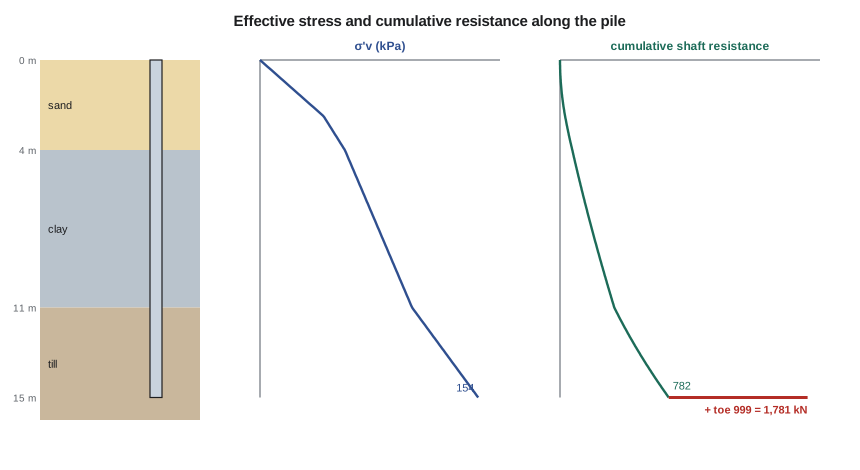
Worked problem
Unit resistances at three depths
Find the unit shaft resistance at 3.0 m in the sand, at the top of the clay (4.0 m) and at 13.0 m in the till, and the unit toe resistance at 15.0 m. Use \(\beta = 0.51\) in the sand and 0.59 in the till, \(s_u = 55\) kPa and the API α.
Show solution
- Sand at 3.0 m, \(\sigma'_v = 18.0(2.5) + 9.99(0.5) = 50.0\) kPa:
- \[f_s = 0.51(50.0) = 25.5\ \text{kPa}\]
- Top of clay, \(\sigma'_v = 60.0\) kPa, \(\psi = 55/60.0 = 0.92\):
- \[\alpha = 0.5(0.92)^{-0.5} = 0.52 \qquad f_s = 0.52(55) = 28.7\ \text{kPa}\]
- Till at 13.0 m, \(\sigma = 200.7 + 21.5(2.0) = 243.7\) kPa, \(u = 9.81(11.5) = 112.8\) kPa, \(\sigma'_v = 130.9\) kPa:
- \[f_s = 0.59(130.9) = 77\ \text{kPa}\]
- Toe at 15.0 m, \(\sigma'_v = 154\) kPa:
- \[q_t = 50(154) = 7710\ \text{kPa}\]
Answer: The till carries about three times the unit shaft resistance of the clay, and the toe pressure is more than two hundred times the shaft resistance in the clay. The till dominates the pile's capacity.
Sofia's script integrates the shaft resistance along the pile with each method, adds the toe resistance and applies the resistance factors or factors of safety.
# Axial capacity of a 406 mm closed-end steel pipe pile driven to 15.0 m (fleet storage building)
from math import pi, sin, tan, radians, sqrt
D, tip = 0.406, 15.0
per, At = pi*D, pi*D**2/4
def stress(z):                                     # total stress, pore pressure, effective stress (kPa)
    s = 18.0*min(z, 2.5) + 19.8*max(0.0, min(z, 4.0) - 2.5) + 18.0*max(0.0, min(z, 11.0) - 4.0) + 21.5*max(0.0, z - 11.0)
    if z <= 4.0: u = 9.81*max(0.0, z - 2.5)
    elif z <= 11.0: u = 14.7 + (93.2 - 14.7)*(z - 4.0)/7.0
    else: u = 9.81*(z - 1.5)                       # artesian till
    return s, u, s - u
su, POP = 55.0, 45.0
beta_sand, beta_till = 1.0*tan(radians(0.8*34)), 1.0*tan(radians(0.8*38))   # K = 1.0, delta = 0.8 phi'
def alpha_api(psi): return min(1.0, 0.5*psi**-0.5 if psi <= 1.0 else 0.5*psi**-0.25)
def beta_clay(se):                                 # (1 - sin phi') tan phi' sqrt(OCR), phi' = 27 deg
    f = radians(27.0); return (1 - sin(f))*tan(f)*sqrt((se + POP)/se)
dz = 0.05; R = {'sand': 0.0, 'clay alpha': 0.0, 'clay beta': 0.0, 'till': 0.0}
z = dz/2; sig_clay = []
while z < tip:
    se = stress(z)[2]
    if z < 4.0: R['sand'] += beta_sand*se*per*dz
    elif z < 11.0:
        R['clay alpha'] += alpha_api(su/se)*su*per*dz; R['clay beta'] += beta_clay(se)*se*per*dz; sig_clay.append(se)
    else: R['till'] += beta_till*se*per*dz
    z += dz
lam = 0.20                                        # lambda read from the published chart for this length (approximate)
sm = sum(sig_clay)/len(sig_clay)
R['clay lambda'] = lam*(sm + 2*su)*per*7.0
Nt = 50.0                                         # toe bearing coefficient, dense glacial till (typical range 30 to 80)
se_tip = stress(tip)[2]; Rt = Nt*se_tip*At
print(f"beta: sand {beta_sand:.2f}, till {beta_till:.2f}; alpha at the top and bottom of the clay "
      f"{alpha_api(su/stress(4.0)[2]):.2f}, {alpha_api(su/stress(11.0)[2]):.2f}")
print(f"Shaft resistance (kN): sand {R['sand']:.0f}; clay by alpha {R['clay alpha']:.0f}, by beta {R['clay beta']:.0f}, "
      f"by lambda {R['clay lambda']:.0f}; till {R['till']:.0f}")
print(f"Toe: s'v = {se_tip:.0f} kPa, qt = Nt s'v = {Nt*se_tip:.0f} kPa, Rt = {Rt:.0f} kN")
Rs = R['sand'] + R['clay alpha'] + R['till']; Ru = Rs + Rt
print(f"Ultimate Ru = Rs + Rt = {Rs:.0f} + {Rt:.0f} = {Ru:.0f} kN  (toe {100*Rt/Ru:.0f} %)")
for phi, how in ((0.4, 'static analysis'), (0.6, 'confirmed by a static load test')):
    print(f"Factored resistance, phi = {phi} ({how}): {phi*Ru:.0f} kN per pile")
As = pi*(406 - 12.7)*12.7; Ac = pi*(406 - 2*12.7)**2/4
Pr = 0.9*350*As/1000 + 0.65*0.85*30*Ac/1000   # rough structural check of the concrete-filled pipe (short column)
print(f"Structural resistance of the filled pipe (roughly) {Pr:.0f} kN -> geotechnical resistance governs")beta: sand 0.51, till 0.59; alpha at the top and bottom of the clay 0.52, 0.70 Shaft resistance (kN): sand 88; clay by alpha 302, by beta 258, by lambda 346; till 392 Toe: s'v = 154 kPa, qt = Nt s'v = 7713 kPa, Rt = 999 kN Ultimate Ru = Rs + Rt = 782 + 999 = 1781 kN (toe 56 %) Factored resistance, phi = 0.4 (static analysis): 712 kN per pile Factored resistance, phi = 0.6 (confirmed by a static load test): 1068 kN per pile Structural resistance of the filled pipe (roughly) 6829 kN -> geotechnical resistance governs
Reading the results
The clay contributes 302 kN by the α method, 258 kN by the β method and 346 kN by the λ method: three methods, three answers within about 15 % of their mean, which is as good as such methods get. The sand adds only 88 kN, and the till 392 kN along its 4 m. The toe in the till carries 999 kN, 56 % of the total ultimate resistance of 1,781 kN. With \(\phi = 0.4\) for a resistance calculated by static analysis, each pile has a factored resistance of 712 kN, and a column with \(P_f = 4025\) kN plus its cap would need six piles. If a static load test confirms the resistance, \(\phi = 0.6\) gives 1,068 kN per pile and four piles suffice. The steel pipe filled with concrete is structurally far stronger than the ground, so the geotechnical resistance governs.
The difference between six piles and four under each of the 24 interior columns is large enough to pay for a load test many times over. Dr. Kowalczyk recommends a static load test on a test pile driven before the production piles, with dynamic testing of the test pile and of a sample of production piles, as lesson 11 describes.
Effects of installation and time
Several effects make the capacity of a real pile differ from the static calculation. In clay, driving remoulds the soil and generates high pore pressures; capacity is lowest at the end of driving and increases as the pore pressures dissipate, over days to months. This setup is measured by restriking piles after a waiting period. In dense sands and some silts, the opposite effect, relaxation, can occur: capacity measured at the end of driving falls in the following days, particularly where the toe is in dense fine sand or shale. Driving also densifies loose sands around the pile and can heave previously driven piles in clay, lifting their toes off the bearing layer; heaved piles must be redriven. Drilled shafts have the opposite problem: drilling relaxes the soil, and poor base cleaning can leave a soft layer under the toe.
Capacity in tension
Piles that resist uplift, from wind on tall buildings, buoyancy of basements or crane outriggers, carry it by shaft resistance alone. Shaft resistance in tension is usually taken as a fraction, often about 70 to 80 %, of that in compression for sands, because the reversal of shear reduces the normal stress on the pile, and the resistance factors for tension are lower than for compression, about 0.3 by static analysis. The weight of the pile adds to the resistance.
Practical points
- Calculate shaft resistance layer by layer with the effective stress profile, including artesian or perched water.
- Use two methods in clay and compare; expect differences of 10 to 20 %.
- Estimate the toe resistance carefully; it often dominates and is the most uncertain term.
- Account for setup in clay and possible relaxation in dense sands and shales.
- Weigh the cost of load testing against the savings from a higher resistance factor or a lower factor of safety.
Common mistakes
MistakeUsing hydrostatic pore pressures in the till at Kestrel Bay.
InsteadUse the artesian pore pressure; it lowers the effective stress and the resistance.
MistakeLetting the toe resistance in sand grow without limit with depth.
InsteadUse realistic Nt values or a limiting toe pressure, or derive it from the CPT.
MistakeJudging the capacity of a pile in clay from its end-of-driving resistance alone.
InsteadRestrike after a waiting period to measure setup.
MistakeUsing the same shaft resistance in tension as in compression in sand.
InsteadReduce it and use the lower resistance factor for uplift.
Summary and key terms
- \(R_u = \sum p f_s \Delta z + q_t A_t\).
- α method in clay: \(f_s = \alpha s_u\), with API \(\alpha = 0.5\psi^{-0.5}\) for \(\psi \le 1\).
- β method: \(f_s = \beta\sigma'_v\); \(\beta = (1 - \sin\phi')\tan\phi'\sqrt{OCR}\) in clay, 0.35 to 0.8 in sand, higher in dense till.
- Toe: \(q_t = 9s_u\) in clay, \(N_t\sigma'_v\) in sand and till.
- The fleet building pile: \(R_u = 1{,}781\) kN, 56 % at the toe; factored 712 kN by analysis, 1,068 kN if confirmed by a load test.
- Unit shaft resistance
- The shear stress mobilized on the pile surface at failure.
- Adhesion factor α
- The ratio of unit shaft resistance to undrained shear strength in the total stress method.
- Bjerrum-Burland β
- The ratio of unit shaft resistance to vertical effective stress in the effective stress method.
- Toe bearing coefficient Nt
- The ratio of unit toe resistance to the vertical effective stress at the toe.
- Setup
- The increase of pile capacity with time after driving, especially in clay.
- Relaxation
- The decrease of pile capacity with time after driving, observed in some dense sands and shales.
- Strength ratio ψ
- The ratio of undrained shear strength to vertical effective stress.
- Interface friction angle
- The friction angle between the pile surface and the soil.
Practice problems
Work each problem on paper first, then reveal the answer to check.
A clay has \(s_u = 40\) kPa and \(\sigma'_v = 80\) kPa. Find the API α and \(f_s\).
Show answer
\(\psi = 0.5\); \(\alpha = 0.5(0.5)^{-0.5} = 0.71\); \(f_s = 28\) kPa.
Find β for a normally consolidated clay with \(\phi' = 25^\circ\).
Show answer
\((1 - 0.423)(0.466) = 0.27\).
A 300 mm closed-end pile has its toe in sand where \(\sigma'_v = 120\) kPa. With \(N_t = 40\), find the toe resistance.
Show answer
\(q_t = 4800\) kPa; \(R_t = 4800(0.0707) = 339\) kN.
Why does the artesian pressure in the till reduce the pile capacity?
Show answer
Higher pore pressure lowers the effective stress, and both the β shaft resistance and the toe resistance depend on it.
Lesson quiz · 5 questions
Score 60% or more to complete this lesson.
Create a free account to save your progress, take quizzes and earn a certificate.