
CIV-341 · Lesson 6 of 12 · 18 min
Settlement on clay and tolerable movements
On the clay at Kestrel Bay, it is consolidation, not bearing, that decides the foundation design. CIV-340 calculated the consolidation settlement of one interior garage footing and found about 60 mm. A building, however, does not sit on one footing. It sits on a grid of footings with different loads, different sizes and different numbers of neighbours, and what damages a building is not so much how far it settles as how unevenly. This lesson reviews the components of settlement on clay, calculates the settlement of every footing on the garage grid, and compares the resulting distortions with the criteria that engineers use to judge whether a structure will be damaged.
Components of settlement on clay
The settlement of a footing on saturated clay has three components.
- Immediate (undrained) settlement occurs as the load is applied, without volume change: the clay distorts at constant volume, bulging sideways under the footing. It is calculated with elastic theory using the undrained modulus \(E_u\) and \(\nu = 0.5\). For stiff overconsolidated clays it may be a significant part of the total; for soft clays loaded well below failure it is usually small, and it is often absorbed in the construction tolerance.
- Primary consolidation settlement occurs as the excess pore pressure dissipates and the clay decreases in volume. It is calculated from oedometer test results, as in CIV-340, and its rate from the coefficient of consolidation.
- Secondary compression continues after the excess pore pressures have dissipated, at a rate that decreases with the logarithm of time, governed by \(C_\alpha\).
The one-dimensional consolidation calculation assumes that the clay compresses only vertically, which is exact under a wide fill but approximate under a footing, where lateral strain also occurs. Skempton and Bjerrum proposed a correction factor, depending on the pore pressure parameter \(A\) and the geometry, that reduces the one-dimensional settlement for overconsolidated clays and slightly for normally consolidated clays. Because the garage footings load the clay mostly in recompression, the uncorrected one-dimensional calculation is somewhat conservative, and Dr. Kowalczyk keeps it, noting the margin.
Consolidation settlement of a footing
The calculation from CIV-340 divides the clay into sublayers. For each, the initial effective stress \(\sigma'_0\), the preconsolidation stress \(\sigma'_p\) and the stress increase \(\Delta\sigma\) at mid-depth give the change in void ratio, and therefore the settlement:
with only the first term when \(\sigma'_0 + \Delta\sigma \le \sigma'_p\). The stress increase from all nearby footings is added by superposition of the Boussinesq solution. Because the clay at Kestrel Bay is lightly overconsolidated, by about 45 kPa, the upper part of the clay beneath a heavily loaded footing passes its preconsolidation stress and compresses along the steep virgin line, while the deeper part stays in recompression. Small differences in load or footing size therefore make large differences in settlement.
Total and differential settlement
Total settlement matters for the connections of services, pipes and ramps to the building, for the clearance under doors and for drainage. Differential settlement matters for the structure and its finishes. It is described by several measures, illustrated in the figure: the differential settlement \(\delta\) between two points, the angular distortion \(\beta = \delta/L\), which is the differential settlement divided by the distance between the points after any rigid-body tilt is removed, the tilt \(\omega\) of the whole structure, and the relative deflection \(\Delta\) of a wall or frame relative to the line joining its ends.
Tolerable movements
How much distortion can a structure take? The answer comes from observations of damaged and undamaged buildings, collected over decades. Skempton and MacDonald in 1956 studied about 100 buildings and found that cracking of walls and partitions began at angular distortions of about 1/300 and structural damage at about 1/150. They suggested design limits that included a margin. In 1963, Bjerrum summarized limits that are still widely quoted:
| Angular distortion β | Effect |
|---|---|
| 1/750 | Limit for machinery sensitive to settlement |
| 1/600 | Danger to frames with diagonal bracing |
| 1/500 | Safe limit for buildings where cracking is not permitted |
| 1/300 | First cracking of panel walls; difficulties with overhead cranes |
| 1/250 | Tilting of tall rigid buildings becomes visible |
| 1/150 | Considerable cracking of panel and brick walls; structural damage to general buildings |
Later work by Burland and Wroth, Boscardin and Cording and others related damage to the tensile strain in the walls, including the effect of horizontal ground strains from excavations, and produced damage categories from negligible to very severe that are used to assess the effect of tunnels and deep excavations on nearby buildings. For design of new buildings, an angular distortion of 1/500 remains the usual target where finishes must not crack, with 1/300 for more tolerant structures.
For total settlement, the observations give empirical links to differential settlement. On clay, Skempton and MacDonald found that an angular distortion of 1/300 corresponded roughly to a differential settlement of 40 mm (1.5 in.) and a total settlement of about 65 mm (2.5 in.) for isolated footings, and somewhat more for rafts. Such correlations are useful when a detailed calculation is not available, but where it is, as at Kestrel Bay, it is better to compute the pattern of settlement directly.
Worked problem
Distortion between an edge and an interior footing
The interior footing at C3 is predicted to settle 62 mm and the edge footing at C1, 7.5 m away, 32 mm. Find the angular distortion and compare it with the 1/500 target.
Show solution
- \[\delta = 62 - 32 = 30\ \text{mm}\]
- \[\beta = \frac{30}{7500} = \frac{1}{250}\]
- This exceeds the 1/500 target and the 1/300 level at which cracking of panel walls begins.
Answer: The soils report checked the distortion between two interior footings, which settle almost equally, and found it acceptable. The edge footings, with lighter loads and fewer neighbours, settle only half as much. That difference is the real problem.
Sofia's script computes the consolidation settlement under every footing on the 4 × 3 bay grid, with corner, edge and interior footings of different sizes and pressures, and searches for the largest angular distortion between adjacent footings.
# Consolidation settlement of every garage footing on the column grid, and angular distortion
from math import log10, pi, sqrt, atan2, copysign
def corner(a, b, z):
    m, n = abs(a) / z, abs(b) / z; s = m*m + n*n + 1
    return copysign(1, a)*copysign(1, b)*(2*m*n*sqrt(s)/(s + m*m*n*n)*(s + 1)/s + atan2(2*m*n*sqrt(s), s - m*m*n*n))/(4*pi)
def rect(q, x1, x2, y1, y2, z):
    return q*(corner(x2, y2, z) - corner(x1, y2, z) - corner(x2, y1, z) + corner(x1, y1, z))
xs, ys, sp = range(5), range(4), 7.5             # 4 bays by 3 bays at 7.5 m
def footing(i, j):
    edge_x, edge_y = i in (0, 4), j in (0, 3)
    if edge_x and edge_y: return 1.8, 190.0      # corner: width (m), net sustained pressure (kPa)
    if edge_x or edge_y: return 2.4, 200.0       # edge
    return 3.0, 215.0                            # interior
fts = [(i*sp, j*sp, *footing(i, j)) for i in xs for j in ys]
Df, Cc, Cr, e0, POP = 2.0, 0.316, 0.047, 1.06, 45.0
def sigma0(z):
    s = 18.0*2.5 + 19.8*1.5 + 18.0*(z - 4.0); u = 14.7 + (93.2 - 14.7)*(z - 4.0)/7.0
    return s - u
def settle(x, y):
    tot = 0.0
    for k in range(7):                           # seven 1 m sublayers, 4.0 to 11.0 m
        z = 4.5 + k; s0 = sigma0(z); spc = s0 + POP
        ds = sum(rect(q, fx - B/2 - x, fx + B/2 - x, fy - B/2 - y, fy + B/2 - y, z - Df) for fx, fy, B, q in fts)
        sf = s0 + ds
        tot += Cr/(1 + e0)*log10(sf/s0) if sf <= spc else (Cr*log10(spc/s0) + Cc*log10(sf/spc))/(1 + e0)
    return 1000*tot
S = {(i, j): settle(i*sp, j*sp) for i in xs for j in ys}
print("Consolidation settlement under each footing (mm); rows are grid lines A to D")
for j in ys:
    print("  " + "  ".join(f"{S[(i, j)]:5.0f}" for i in xs))
worst = max((abs(S[a] - S[b]) / (sp*1000), a, b) for a in S for b in S
            if abs(a[0] - b[0]) + abs(a[1] - b[1]) == 1)
beta, a, b = worst
print(f"Maximum settlement {max(S.values()):.0f} mm, minimum {min(S.values()):.0f} mm")
print(f"Largest angular distortion between adjacent footings: 1/{1/beta:.0f} (footings {a} and {b})")
for lim, txt in ((1/500, 'safe limit against cracking (Bjerrum)'), (1/300, 'first cracking of panel walls'), (1/150, 'structural damage')):
print(f" 1/{1/lim:.0f}: {txt} -> {'within' if beta <= lim else 'exceeds'}")Consolidation settlement under each footing (mm); rows are grid lines A to D
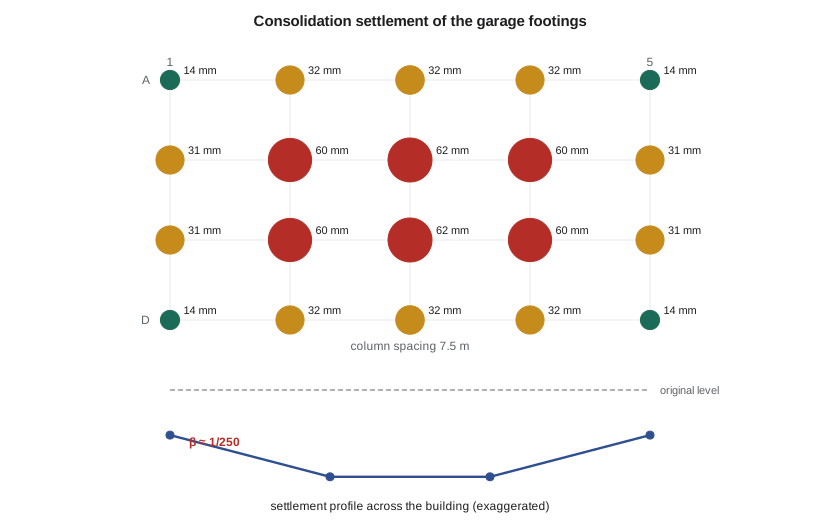
14 32 32 32 14
31 60 62 60 31
31 60 62 60 31
14 32 32 32 14
Maximum settlement 62 mm, minimum 14 mm
Largest angular distortion between adjacent footings: 1/251 (footings (2, 3) and (2, 2))
1/500: safe limit against cracking (Bjerrum) -> exceeds
1/300: first cracking of panel walls -> exceeds
1/150: structural damage -> withinReading the results
The settlements form a dish: about 14 mm at the corners, 31 to 32 mm along the edges and 60 to 62 mm at the interior. The interior footings settle most because they carry the largest loads and because the stress bulbs of their neighbours overlap deep in the clay. The largest angular distortion, 1/251, occurs between an interior footing and the edge footing beside it. It exceeds the safe limit of 1/500 and the 1/300 cracking threshold, though it remains short of the 1/150 level associated with structural damage. The garage has a concrete flat plate, masonry partitions and overhead doors along its edges, all of which would suffer.
Owen asks whether the footings could simply be resized so that all of them settle by the same amount. Making the edge footings smaller would raise their pressure but not much their settlement, because most of their settlement comes from deep stresses that depend on the total load rather than the footing size. Making the interior footings larger would lower the pressure near the top of the clay but not the deep stresses. Proportioning footings for equal settlement works on sand, where settlement depends strongly on pressure, but has little effect when a thick clay is stressed by the whole building. Lesson 7 examines the remedies that do work.
Time and the pattern of settlement
The consolidation settlement does not happen at once. With the coefficient of consolidation from CIV-340, about half of it occurs in the first year and 90 % in about four years. The distortion therefore grows after the building is finished, and cracks that appear a year or two after completion are typical of buildings on clay. Secondary compression adds a further 10 to 20 % over the following decades. Monitoring the settlement of a few columns during and after construction is cheap, and it allows the prediction to be compared with reality while there is still time to act.
Other causes of movement on clay
Clays move for reasons other than the building load. Desiccation by tree roots and drought shrinks clays near the surface, and rewetting swells them; this is a serious problem for light buildings on highly plastic clays in dry climates and occasionally near large trees elsewhere. Frost heave lifts footings placed above the frost line on silty soils. Lowering of the water table by dewatering or drainage increases the effective stress and causes consolidation, as CIV-340 found for the pump station. And loading by new fills or buildings nearby adds stress beneath existing footings, a common cause of damage to older structures beside new developments.
Practical points
- Calculate the settlement of corner, edge and interior footings, not just one typical footing.
- Judge damage by angular distortion between adjacent columns, with 1/500 as the usual target where cracking is not acceptable.
- On thick compressible layers, resizing footings does little to equalize settlement.
- Remember that distortion on clay grows with time after completion.
- Monitor settlement of a few columns during and after construction.
Common mistakes
MistakeChecking the distortion between two interior footings only.
InsteadCheck every pair of adjacent footings, especially edge against interior.
MistakeAssuming that total settlement alone decides acceptability.
InsteadDistortion causes damage; total settlement matters for services and access.
MistakeProportioning footings on thick clay for equal pressure and expecting equal settlement.
InsteadCompute the settlements with superposition; overlap of stress bulbs makes interior footings settle more.
MistakeIgnoring the time-dependent growth of distortion.
InsteadPresent settlements with their time scale and plan monitoring.
Summary and key terms
- Settlement on clay: immediate, primary consolidation and secondary compression.
- One-dimensional consolidation with superposed Boussinesq stresses gives the settlement of each footing.
- Angular distortion \(\beta = \delta/L\) is the key measure of damage; 1/500 is the usual design limit, 1/300 the onset of cracking, 1/150 structural damage.
- The garage settlements form a dish from 14 mm at the corners to 62 mm in the interior, with \(\beta \approx 1/250\) between edge and interior footings.
- Resizing footings does not solve differential settlement over a thick clay.
- Primary consolidation
- Compression of saturated clay as excess pore pressure dissipates.
- Secondary compression
- Continued compression after primary consolidation, at a rate decreasing with the logarithm of time.
- Differential settlement
- The difference in settlement between two points of a foundation.
- Angular distortion
- The differential settlement between two points divided by the distance between them, after removing tilt.
- Tilt
- Rigid-body rotation of a whole structure.
- Relative deflection
- The displacement of a point relative to the line joining two reference points on either side of it.
- Dish-shaped settlement
- A pattern in which the centre of a building settles more than its edges.
- Skempton-Bjerrum correction
- A factor that adjusts one-dimensional consolidation settlement for lateral strain beneath footings.
Practice problems
Work each problem on paper first, then reveal the answer to check.
Two adjacent columns 9 m apart settle 45 mm and 20 mm. Find the angular distortion.
Show answer
\(25/9000 = 1/360\).
Which is more damaging: 50 mm (2 in.) of uniform settlement or 25 mm (1 in.) of differential settlement over 6 m (20 ft)?
Show answer
The differential settlement: β = 1/240, beyond the cracking threshold; uniform settlement causes no distortion.
Why do interior footings on a thick clay settle more than edge footings with the same pressure?
Show answer
Their stress bulbs overlap with more neighbours, so the stress increase deep in the clay is larger.
Give two causes of settlement on clay other than the building load.
Show answer
Lowering of the water table, desiccation by trees or drought, new fills or buildings nearby.
Lesson quiz · 5 questions
Score 60% or more to complete this lesson.
Create a free account to save your progress, take quizzes and earn a certificate.