
CIV-341 · Lesson 3 of 12 · 21 min
Bearing capacity theory
Press a flat plate into sand and, at first, it settles in proportion to the load. As the load grows, the settlement accelerates, and eventually the plate plunges while the sand heaves up around it. The load at which this happens is the ultimate bearing capacity. This lesson develops the theory that predicts it, from Prandtl's solution for a weightless plastic material to the general bearing capacity equation used in practice, and applies it to the garage footings, first as if the sand extended to great depth. Lesson 4 then adds the complications of the real site: groundwater, the clay beneath the sand and loads that are eccentric or inclined.
Modes of failure
Vesić, in a series of model tests in the 1960s and 1970s, described three modes of bearing failure. In general shear failure, typical of dense sand and stiff clay, a continuous slip surface forms from the edge of the footing to the ground surface, the soil heaves on both sides and the load reaches a clear peak. In local shear failure, typical of medium dense sand and firm clay, the slip surfaces develop only partly, heave is slight and the load keeps rising slowly with large settlement. In punching shear failure, typical of loose sand, soft clay and deeply embedded footings, the footing pushes vertically into the ground by shearing around its edges, with no heave and no clear peak.
Bearing capacity theory is built on the general shear mechanism, because it can be analysed with plasticity theory. For local and punching shear, the equations are used with reduced strength parameters, or the design is controlled by settlement anyway. In practice, a footing designed with an adequate factor of safety against general shear on a medium dense or dense soil will settle by only a small fraction of its width, and the mode of failure matters mainly in judging how much margin is real.
Prandtl, Terzaghi and the three terms
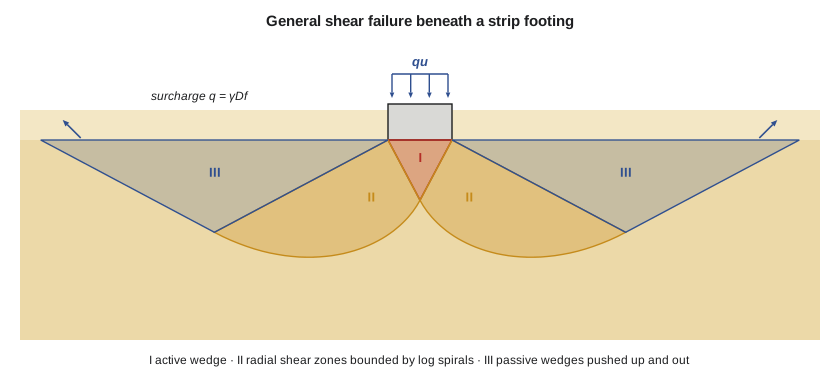
In 1921, Ludwig Prandtl solved the problem of a rigid punch pressed into a weightless, rigid-plastic material with cohesion \(c\) and friction angle \(\phi\). His mechanism has three zones: an active wedge beneath the footing, radial shear zones bounded by logarithmic spirals and passive wedges at the sides. Reissner added the effect of a surcharge \(q\) on the ground surface beside the footing. In 1943, Terzaghi combined these results with an approximate term for the weight of the soil in the failure zone and wrote the bearing capacity of a strip footing of width \(B\) as the sum of three terms:
The bearing capacity factors \(N_c\), \(N_q\) and \(N_\gamma\) depend only on the friction angle. The first term is the contribution of cohesion, the second the contribution of the soil above the footing base acting as a surcharge \(q = \gamma D_f\), and the third the contribution of the frictional strength of the soil beneath the footing, which increases with the footing width because a wider footing mobilizes a larger and deeper failure zone. The equation treats the soil above the footing base as a surcharge only, ignoring its shear strength, which is slightly conservative.
The exact factors for \(N_q\) and \(N_c\) come from Prandtl and Reissner:
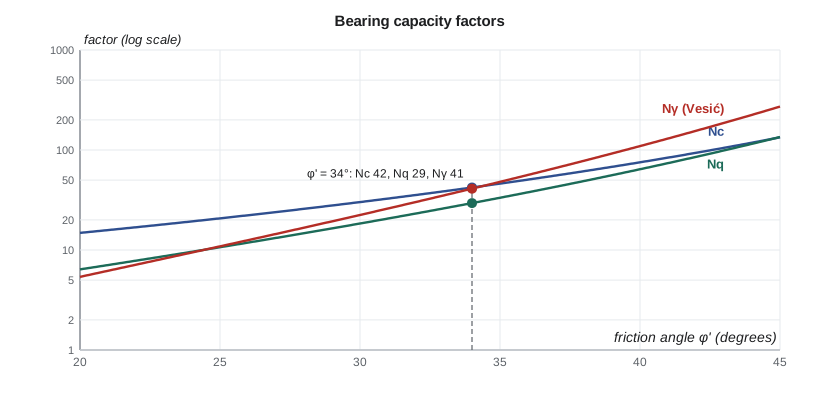
For \(\phi = 0\), \(N_c = \pi + 2 = 5.14\) and \(N_q = 1\). The factor \(N_\gamma\) has no closed-form solution, and several approximations are in use. Among the most common are those of Vesić, Meyerhof and Brinch Hansen:
The differences between them are substantial, about 30 % at a friction angle of 34°, which is a reminder that bearing capacity theory is an approximation. Codes and manuals differ in the expressions they recommend, and an engineer should use the set of factors, shape factors and depth factors that belong together, consistently.
The general bearing capacity equation
Real footings are not infinitely long strips at the ground surface. Meyerhof, Brinch Hansen and Vesić extended Terzaghi's equation with correction factors for the shape of the footing, its depth, inclination of the load, inclination of the base and slope of the ground. In its usual form,
with shape factors \(s\), depth factors \(d\) and load inclination factors \(i\). For a rectangular footing \(B \times L\) with \(B \le L\), the shape factors of De Beer, adopted by Vesić, are
The depth factors of Brinch Hansen, for \(D_f/B \le 1\), are
The depth factors credit the shear strength of the soil above the footing base. Many engineers omit them, or limit them, because that soil may be disturbed by construction, backfilled loosely or removed later by an adjacent excavation. The inclination factors are covered in lesson 4.
Drained and undrained analysis
The equation is used in two ways, as for any stability problem in soil mechanics. In a drained analysis, appropriate for sands and for clays in the long term, the effective stress parameters \(c'\) and \(\phi'\) are used with effective unit weights below the water table. In an undrained analysis, appropriate for saturated clays loaded quickly, the total stress parameters \(c = s_u\) and \(\phi = 0\) are used with total unit weights. With \(\phi = 0\), \(N_q = 1\) and \(N_\gamma = 0\), and the ultimate bearing capacity becomes simply
where \(\sigma_v\) is the total overburden stress at the footing base. For clay footings, Skempton's factors, based on model tests and widely used in practice, combine the shape and depth effects:
For saturated clays, the undrained case nearly always governs for footings, because loading increases the pore pressure and the clay gains strength as it consolidates. For unloading problems, such as the base of an excavation, the reverse is true and the drained case governs in the long term.
Worked problem
The garage footing on deep sand
Find the ultimate bearing capacity of the 3.0 m square footing founded at 2.0 m on sand with \(\phi' = 34^\circ\) and \(\gamma = 18.0\) kN/m³, assuming for now that the sand is deep and dry.
Show solution
- Bearing capacity factors for 34°:
- \[N_q = e^{\pi\tan 34^\circ}\tan^2 62^\circ = 29.4 \qquad N_\gamma = 2(30.4)\tan 34^\circ = 41.1\]
- Shape and depth factors, with \(B/L = 1\) and \(D_f/B = 0.667\):
- \[s_q = 1 + \tan 34^\circ = 1.675 \qquad s_\gamma = 0.6 \qquad d_q = 1 + 2(0.675)(1 - 0.559)^2(0.667) = 1.175\]
- With \(q = 18.0(2.0) = 36\) kPa:
- \[q_u = 36(29.4)(1.675)(1.175) + \tfrac{1}{2}(18.0)(3.0)(41.1)(0.6) = 2085 + 665 = 2750\ \text{kPa}\]
Answer: On deep, dry sand the footing would have an ultimate bearing capacity of about 2,750 kPa, more than three times the 813 kPa it needs. Most of it comes from the overburden term.
Sofia's script tabulates the factors, repeats the calculation, tests its sensitivity to the friction angle and computes the undrained bearing capacity of a footing placed directly on the clay.
# Bearing capacity factors and the general bearing capacity equation
from math import tan, sin, exp, pi, radians
def factors(phi_deg):
    f = radians(phi_deg)
    Nq = exp(pi * tan(f)) * tan(radians(45 + phi_deg / 2))**2
    Nc = (Nq - 1) / tan(f) if phi_deg > 0 else 5.14
    return Nc, Nq, 2 * (Nq + 1) * tan(f), (Nq - 1) * tan(1.4 * f), 1.5 * (Nq - 1) * tan(f)
print("phi'   Nc     Nq    Ngamma: Vesic  Meyerhof  Hansen")
for p in (25, 28, 30, 32, 34, 36, 38, 40):
    Nc, Nq, Ngv, Ngm, Ngh = factors(p)
    print(f"{p:3d} {Nc:7.1f} {Nq:6.1f} {Ngv:12.1f} {Ngm:9.1f} {Ngh:7.1f}")

def q_ult_drained(B, L, Df, phi, gamma_q, gamma_b):
    f = radians(phi); Nc, Nq, Ng = factors(phi)[:3]
    sq, sg = 1 + (B / L) * tan(f), 1 - 0.4 * B / L
    dq = 1 + 2 * tan(f) * (1 - sin(f))**2 * min(Df / B, 1.0)
    q = gamma_q * Df
    t1, t2 = q * Nq * sq * dq, 0.5 * gamma_b * B * Ng * sg
    return q, t1, t2, t1 + t2, sq, sg, dq
print("\nGarage interior footing, 3.0 m square at 2.0 m, phi' = 34 deg, sand assumed deep and dry (gamma 18.0)")
q, t1, t2, qu, sq, sg, dq = q_ult_drained(3.0, 3.0, 2.0, 34, 18.0, 18.0)
print(f"q = {q:.0f} kPa, sq = {sq:.3f}, s_gamma = {sg:.2f}, dq = {dq:.3f}")
print(f"overburden term {t1:.0f} kPa + self-weight term {t2:.0f} kPa = qu {qu:.0f} kPa")
for p in (32, 34, 36):
    print(f"  sensitivity: phi' = {p} deg -> qu = {q_ult_drained(3.0, 3.0, 2.0, p, 18.0, 18.0)[3]:.0f} kPa")

print("\nUndrained (phi = 0) bearing of a 3.0 m square footing placed on the clay at the excavation base")
su, B, Df, sigma_v = 55.0, 3.0, 0.5, 18.0 * 0.5    # embedment 0.5 m into the clay below the excavation
Nc_sk = min(5 * (1 + 0.2 * Df / B) * (1 + 0.2), 7.5) # Skempton, square
print(f"Skempton Nc = {Nc_sk:.2f}; qu = su Nc + sigma_v = {su * Nc_sk + sigma_v:.0f} kPa (net {su * Nc_sk:.0f} kPa)")
print(f"Terzaghi/Prandtl strip 5.14 su = {5.14 * su:.0f} kPa")phi' Nc Nq Ngamma: Vesic Meyerhof Hansen 25 20.7 10.7 10.9 6.8 6.8 28 25.8 14.7 16.7 11.2 10.9 30 30.1 18.4 22.4 15.7 15.1 32 35.5 23.2 30.2 22.0 20.8 34 42.2 29.4 41.1 31.1 28.8 36 50.6 37.8 56.3 44.4 40.1 38 61.4 48.9 78.0 64.1 56.2 40 75.3 64.2 109.4 93.7 79.5 Garage interior footing, 3.0 m square at 2.0 m, phi' = 34 deg, sand assumed deep and dry (gamma 18.0) q = 36 kPa, sq = 1.675, s_gamma = 0.60, dq = 1.175 overburden term 2085 kPa + self-weight term 665 kPa = qu 2750 kPa sensitivity: phi' = 32 deg -> qu = 2095 kPa sensitivity: phi' = 34 deg -> qu = 2750 kPa sensitivity: phi' = 36 deg -> qu = 3645 kPa Undrained (phi = 0) bearing of a 3.0 m square footing placed on the clay at the excavation base Skempton Nc = 6.20; qu = su Nc + sigma_v = 350 kPa (net 341 kPa) Terzaghi/Prandtl strip 5.14 su = 283 kPa
Reading the results
The table shows how quickly the factors grow: \(N_q\) doubles between 30° and 35°. The Vesić, Meyerhof and Hansen values of \(N_\gamma\) at 34° are 41, 31 and 29. For the garage footing, a change of only two degrees in the friction angle changes the bearing capacity from 2,095 to 3,645 kPa. That sensitivity is why the friction angle must be chosen with care, and why the resistance factor is as low as 0.5.
A footing placed directly on the clay would be a very different matter. With \(s_u = 55\) kPa, the Skempton factor for a square footing at shallow depth is 6.20, and the net ultimate capacity is only 341 kPa, less than half of what the garage footing needs. The sand layer is what makes the footings possible, and lesson 4 shows how much of its strength survives when the clay lies only 2 m below the footing base.
Gross and net bearing capacity
The ultimate bearing capacity \(q_u\) is a gross pressure: it includes the overburden stress at the footing base. The net ultimate bearing capacity \(q_{u,net} = q_u - \sigma_v\) is the pressure in excess of the overburden. Both are used, and confusion between them causes errors. The rule is to compare like with like: the gross bearing capacity with the gross applied pressure, which includes the weight of the footing and the backfill over it, or the net capacity with the net applied pressure. For footings on clay, the net form is more natural, because the overburden term \(qN_q\) with \(N_q = 1\) simply cancels the weight of the soil removed.
Limits of the theory
Bearing capacity theory assumes a rigid, rough footing on a uniform soil that behaves as a rigid-plastic material obeying the Mohr-Coulomb criterion, a failure mechanism that can develop fully, and loads applied slowly enough for the chosen drainage condition. Real soils are compressible, especially loose sands and soft clays, and may fail in local or punching shear at loads below the theoretical value. Vesić suggested a rigidity index to judge when compressibility matters; a simpler approach in common use is to reduce the strength parameters for loose soils, for example to \(\tan\phi^* = \frac{2}{3}\tan\phi'\). Large footings also show a scale effect: the bearing capacity factor \(N_\gamma\) decreases with footing width, because the average stress in a larger failure zone is higher and the friction angle of sand decreases with stress. These limitations rarely cause problems in practice, because settlement usually governs before bearing failure, but they matter for wide mats on loose sand and for footings near slopes.
Practical points
- Use one consistent set of bearing capacity, shape, depth and inclination factors.
- Use effective unit weights below the water table in drained analyses, and total stresses in undrained analyses.
- Check whether the depth factor should be relied on; omit it if the soil above the base could be removed.
- Compare gross capacity with gross pressure, or net with net.
- Remember the sensitivity to the friction angle; check a range of values.
Common mistakes
MistakeUsing total unit weights below the water table in a drained analysis.
InsteadUse the effective (buoyant) unit weight, as lesson 4 shows.
MistakeUsing the drained bearing capacity of a saturated clay for an immediate loading case.
InsteadFor clays, the undrained case with \(s_u\) usually governs for loading.
MistakeCombining Meyerhof's \(N_\gamma\) with Vesić's shape factors and a different author's depth factors.
InsteadUse one consistent set.
MistakeComparing a net bearing capacity with a gross applied pressure.
InsteadCompare like with like.
Summary and key terms
- Failure modes: general shear in dense or stiff soils, local shear in medium soils, punching in loose or soft soils.
- Terzaghi's equation: \(q_u = cN_c + qN_q + \tfrac12\gamma BN_\gamma\), with factors depending on \(\phi\).
- \(N_q = e^{\pi\tan\phi}\tan^2(45^\circ + \phi/2)\), \(N_c = (N_q - 1)\cot\phi\); for \(\phi = 0\), \(N_c = 5.14\).
- Shape, depth and inclination factors extend the equation to real footings.
- Undrained (\(\phi = 0\)): \(q_{u,net} = s_u N_c\), with Skempton's \(N_c\) up to 7.5.
- The garage footing would have \(q_u \approx 2{,}750\) kPa on deep sand but only 341 kPa net on the clay.
- Ultimate bearing capacity
- The average pressure under a foundation that causes shear failure of the supporting soil.
- General shear failure
- A failure mode with continuous slip surfaces to the ground surface and a clear peak load.
- Punching shear failure
- A failure mode in which the foundation shears vertically into compressible soil without heave.
- Bearing capacity factors
- Dimensionless functions of the friction angle in the bearing capacity equation.
- Shape factor
- A correction to the strip footing bearing capacity for a rectangular or circular footing.
- Depth factor
- A correction that credits the shear strength of the soil above the footing base.
- Net bearing capacity
- The ultimate bearing capacity minus the overburden stress at the founding level.
- Surcharge
- The overburden stress at the footing base, treated in the bearing capacity equation as a load beside the footing.
Practice problems
Work each problem on paper first, then reveal the answer to check.
Find \(N_q\), \(N_c\) and \(N_\gamma\) (Vesić) for \(\phi' = 30^\circ\).
Show answer
\(N_q = 18.4\), \(N_c = 30.1\), \(N_\gamma = 22.4\).
A 1.5 m wide strip footing at 1.0 m depth rests on dry sand with \(\phi' = 30^\circ\) and \(\gamma = 17\) kN/m³. Find \(q_u\) without depth factors.
Show answer
\(17(18.4) + 0.5(17)(1.5)(22.4) = 313 + 286 = 599\) kPa.
A 2.0 m square footing at 1.0 m depth rests on clay with \(s_u = 40\) kPa. Find the net ultimate capacity with Skempton's \(N_c\).
Show answer
\(N_c = 5(1.1)(1.2) = 6.6\); \(q_{u,net} = 264\) kPa.
Why does the \(N_\gamma\) term grow with footing width while the other terms do not?
Show answer
A wider footing mobilizes a larger, deeper failure zone whose weight and frictional resistance increase with the width.
Lesson quiz · 5 questions
Score 60% or more to complete this lesson.
Create a free account to save your progress, take quizzes and earn a certificate.