
CIV-280 · Lesson 8 of 12 · 21 min
Wastewater collection and treatment: an overview
Every flush, shower and load of laundry sends water into a sewer. Together with wastewater from businesses and industries, and in many older cities rain and snowmelt as well, it flows to a treatment plant that must remove enough organic matter, solids, nutrients and pathogens to protect the river or lake that receives the effluent. Wastewater treatment is the reason rivers that were open sewers a century ago now support fish, rowing clubs and drinking water intakes downstream. This lesson describes wastewater sources and characteristics, sewer systems and their problems, the stages of treatment from screens to disinfection, nutrient removal, biosolids, and the regulations that set effluent quality.
The Brandon wastewater plant that Willowbend is upgrading treats an average of 30,000 m³/d from homes, businesses and a large food processing plant. Its effluent must meet the federal Wastewater Systems Effluent Regulations and a provincial licence that adds limits on phosphorus and nitrogen to protect the Assiniboine River and, far downstream, Lake Winnipeg.
Where wastewater comes from
Domestic wastewater comes from toilets, sinks, showers, dishwashers and laundry. Typical residential water use in North America is roughly 200 to 350 litres per person per day, and most of it returns as wastewater. Commercial and institutional users add more, and industries such as meat packing, dairies, breweries and pulp mills can dominate a city's load. Many municipalities require industries to pretreat their waste under a sewer-use bylaw or pretreatment program so that it does not upset the plant or pass through it untreated. Groundwater leaking into cracked pipes (infiltration) and rainwater entering through roof leaders, foundation drains and manhole lids (inflow) add clear water that does not need treatment but takes up capacity; together they are called inflow and infiltration, or I/I.
| Parameter | Typical raw municipal wastewater | Per person (approx.) |
|---|---|---|
| BOD₅ | 150 to 300 mg/L | 60 to 80 g/d |
| Total suspended solids | 150 to 300 mg/L | 60 to 90 g/d |
| COD | 300 to 700 mg/L | 120 to 180 g/d |
| Total Kjeldahl nitrogen | 25 to 50 mg/L | 10 to 15 g/d |
| Total phosphorus | 4 to 10 mg/L | 1.5 to 2.5 g/d |
| Faecal coliforms | 10⁶ to 10⁸ per 100 mL |
Engineers often express an industrial load as a population equivalent, the number of people who would produce the same BOD load. A meat-packing plant discharging 2,400 kg of BOD a day has a population equivalent of about 30,000 people at 80 g per person per day.
Sewers
Sanitary sewers carry only wastewater; separate storm sewers carry rain and snowmelt straight to rivers. Older parts of many cities, including some Canadian and American downtowns built before about 1950, have combined sewers that carry both in one pipe. In dry weather all the flow goes to the treatment plant, but in heavy rain the flow exceeds the pipes' and plant's capacity and the excess overflows, untreated, to the river through combined sewer overflows (CSOs). CSOs are a major source of bacteria and floatable debris in urban rivers, and many cities are spending billions on separation, storage tunnels and treatment to control them. Sanitary sewers can overflow too, when I/I overwhelms them.
Most sewers flow by gravity, sloped so that the wastewater moves fast enough, typically at least 0.6 m/s, to keep solids from settling. Where the land is flat or the sewer must cross a rise, lift stations pump the flow to a higher point. The flat prairie landscape means that cities such as Brandon, Winnipeg, Fargo and Sioux Falls need many lift stations. Hydrogen sulphide generated in long, slow sewers and force mains causes odours and corrodes concrete, so sewer design pays attention to keeping wastewater fresh.
Stages of treatment
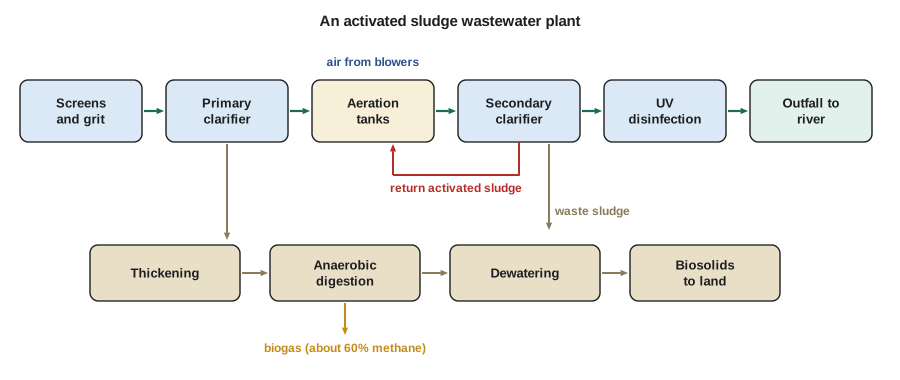
Preliminary treatment protects the equipment downstream. Screens remove rags, plastics and debris, and grit chambers let sand and gravel settle while lighter organic solids stay in suspension. Flow is measured here, and many plants add equalization basins to even out daily peaks.
Primary treatment is plain sedimentation. Primary clarifiers hold the wastewater for about two hours, during which roughly 50 to 70 per cent of the suspended solids and 25 to 40 per cent of the BOD settle out as primary sludge, while grease and scum float and are skimmed off. Primary treatment alone is not enough for most receiving waters; a few coastal cities long relied on it, but nearly all now provide more.
Secondary treatment uses microorganisms to consume the dissolved and colloidal organic matter that primary treatment cannot remove. The bacteria use the organic matter as food, converting part of it to carbon dioxide and water for energy and part of it into new cells, which are then settled out. The most common secondary process is activated sludge, in which wastewater is mixed with a suspension of microorganisms, the mixed liquor, in aerated tanks for several hours. The mixture flows to secondary clarifiers where the biological floc settles; most of it is returned to the aeration tanks to keep the microorganism population high, and the excess is wasted as waste activated sludge. Other secondary processes include trickling filters and rotating biological contactors, where the microorganisms grow on fixed media, and membrane bioreactors, which replace secondary clarifiers with membranes.
Small communities on the prairies very often use lagoons, large earthen ponds in which bacteria and algae treat wastewater slowly over months. Facultative lagoons have an aerobic upper layer, kept supplied with oxygen by algae and wind, above an anaerobic bottom layer. Because lagoons freeze in winter, many prairie systems store wastewater through the winter and discharge treated effluent only in spring and fall when the receiving stream can accept it. Lagoons are cheap to build and operate but need a lot of land and struggle to meet ammonia limits in cold weather.
Designing the activated sludge process
Two parameters summarize an activated sludge design. The food-to-microorganism ratio (F/M) compares the daily BOD load with the mass of microorganisms in the aeration tank, measured as mixed liquor volatile suspended solids (MLVSS):
Here S₀ is the influent BOD, V the aeration tank volume and X the MLVSS concentration. Conventional plants run at F/M of about 0.2 to 0.4 per day. The solids retention time (SRT), or sludge age, is the average time microorganisms stay in the system, equal to the mass of solids in the aeration tank divided by the mass wasted per day. A long SRT, typically 8 to 20 days in cold climates, is needed for the slow-growing nitrifying bacteria that convert ammonia to nitrate.
Worked problem
Sizing an aeration tank
Primary effluent at the upgraded plant flows at 30,000 m³/d with a BOD₅ of 147 mg/L. The design F/M is 0.30 per day and the MLVSS will be held at 2,500 mg/L. Find the aeration tank volume and the hydraulic residence time.
Show solution
- \[V = \frac{Q S_0}{(F/M)\,X} = \frac{30\,000 \times 147}{0.30 \times 2\,500} = 5\,880\ \text{m}^3\]
- \[\tau = \frac{5\,880}{30\,000} \times 24 = 4.7\ \text{h}\]
Answer: The aeration tanks need about 5,900 m³, for example two tanks of 2,950 m³ each, giving a residence time of under five hours. To nitrify reliably in winter, Martin will check the SRT and may choose a lower F/M and larger tanks.
Removal efficiencies and loads
Removal efficiency is the fraction of a pollutant removed, E = (C_in − C_out)/C_in. Following loads through each stage of a plant is a direct application of the mass balance from lesson 3.
# BOD and TSS through the plant (concentrations in mg/L, flow in m3/d)
Q = 30000
raw = {"BOD5": 220.0, "TSS": 240.0}
primary_removal = {"BOD5": 0.33, "TSS": 0.60}
final = {"BOD5": 12.0, "TSS": 15.0}          # secondary effluent (CBOD for BOD5)
for p in raw:
    pe = raw[p] * (1 - primary_removal[p])
    print(f"{p}: raw {raw[p]:.0f} -> primary {pe:.0f} -> final {final[p]:.0f} mg/L")
    print(f"      loads: {raw[p] * Q / 1000:,.0f} -> {pe * Q / 1000:,.0f} -> {final[p] * Q / 1000:,.0f} kg/d,"
          f" overall removal {100 * (1 - final[p] / raw[p]):.1f}%")
F_M, X = 0.30, 2500                            # 1/d, mg/L MLVSS
S0 = raw["BOD5"] * (1 - primary_removal["BOD5"])
V = Q * S0 / (F_M * X)
print(f"Aeration volume = {V:,.0f} m3, HRT = {24 * V / Q:.1f} h")BOD5: raw 220 -> primary 147 -> final 12 mg/L
loads: 6,600 -> 4,422 -> 360 kg/d, overall removal 94.5%
TSS: raw 240 -> primary 96 -> final 15 mg/L
loads: 7,200 -> 2,880 -> 450 kg/d, overall removal 93.8%
Aeration volume = 5,896 m3, HRT = 4.7 hThe plant removes about 95 per cent of the BOD and 94 per cent of the suspended solids, cutting the BOD load to the river from 6,600 kg/d to 360 kg/d. Primary treatment does a large share of the solids removal cheaply, while secondary treatment does most of the BOD removal.
Nutrient removal
Conventional secondary treatment removes only a small part of the nitrogen and phosphorus. Where receiving waters are sensitive, plants add nutrient removal. Phosphorus can be removed chemically by adding iron or aluminum salts that precipitate it into the sludge, or biologically by creating anaerobic zones that encourage bacteria able to take up extra phosphorus, a process called enhanced biological phosphorus removal. Nitrogen is removed in two steps: nitrification converts ammonia to nitrate under aerobic conditions, and denitrification converts nitrate to nitrogen gas in anoxic zones where bacteria use nitrate instead of oxygen. Biological nutrient removal plants arrange anaerobic, anoxic and aerobic zones in sequence to achieve both. Achieving 1 mg/L of total phosphorus is routine with chemical addition; reaching 0.1 mg/L or less requires tertiary filtration or membranes.
Disinfection
Effluent disinfection reduces bacteria and viruses before discharge to waters used for swimming or downstream water supply. Ultraviolet light is now the most common choice because it adds no chemicals. Where chlorine is used, the effluent must usually be dechlorinated, often with sodium bisulphite, because chlorine residuals are toxic to fish; this is why effluent limits for total residual chlorine are so low. Some northern plants disinfect only in the recreation season.
Biosolids
Treatment removes pollutants from water but concentrates them in sludge, which can make up a third or more of a plant's operating cost. Sludge is thickened and then stabilized to reduce pathogens, odours and its tendency to rot. Anaerobic digestion, in which bacteria in heated, sealed tanks convert organic matter to biogas that is about 60 to 65 per cent methane, is the most common stabilization process at medium and large plants; the biogas heats the digesters and buildings and can generate electricity or be upgraded to renewable natural gas. The stabilized sludge, called biosolids once it meets quality standards, is dewatered and applied to farmland as a fertilizer and soil conditioner, composted, landfilled or incinerated. Concerns about PFAS, microplastics and other contaminants in biosolids are prompting new testing requirements in several jurisdictions.
Effluent regulations
The federal Wastewater Systems Effluent Regulations, made under the Fisheries Act and in force since 2012, set national minimum effluent standards for systems that discharge to surface water: an average carbonaceous BOD of 25 mg/L or less, average suspended solids of 25 mg/L or less, average total residual chlorine of 0.02 mg/L or less where chlorine is used, and un-ionized ammonia below 1.25 mg/L as nitrogen at 15 °C. Systems that did not meet the standards when the regulations took effect were given deadlines to upgrade according to their risk. Provinces add their own licence conditions; Manitoba, for example, has required phosphorus and nitrogen limits for larger plants because of Lake Winnipeg's algal blooms.
Common mistakes
MistakeTreating inflow and infiltration as harmless clean water.
InsteadI/I takes up sewer and plant capacity and causes overflows; it must be controlled.
MistakeAssuming secondary treatment removes nutrients.
InsteadConventional secondary treatment removes little nitrogen or phosphorus; nutrient removal needs added processes.
MistakeUsing total suspended solids for X in the F/M ratio.
InsteadF/M is usually based on the volatile fraction, MLVSS.
MistakeDischarging chlorinated effluent without dechlorination.
InsteadChlorine residuals are toxic to fish; effluent limits on residual chlorine are very low.
Summary and key terms
- Municipal wastewater carries about 60 to 80 g of BOD per person per day; industries are expressed as population equivalents.
- Combined sewers overflow in wet weather; inflow and infiltration take up capacity.
- Preliminary treatment removes debris and grit; primary sedimentation removes about 60 per cent of solids and a third of BOD.
- Secondary treatment uses microorganisms; activated sludge is designed with F/M = QS₀/(VX) and the SRT.
- Nutrient removal uses chemical or biological phosphorus removal and nitrification-denitrification.
- The federal WSER set minimums of 25 mg/L CBOD, 25 mg/L suspended solids, 0.02 mg/L residual chlorine and 1.25 mg/L un-ionized ammonia; provincial licences add more.
- Inflow and infiltration
- Clear water that enters sewers through leaks and improper connections.
- Combined sewer overflow
- A discharge of untreated wastewater and stormwater from a combined sewer during wet weather.
- Primary treatment
- Removal of settleable solids and floating material by sedimentation.
- Activated sludge
- A secondary treatment process in which an aerated suspension of microorganisms consumes organic matter.
- Food-to-microorganism ratio
- The daily BOD load divided by the mass of microorganisms in the aeration tank.
- Solids retention time
- The average time microorganisms remain in a biological treatment system.
- Denitrification
- Conversion of nitrate to nitrogen gas by bacteria in the absence of oxygen.
- Biosolids
- Treated sewage sludge that meets quality standards for beneficial use.
Practice problems
Work each problem on paper first, then reveal the answer to check.
An industry discharges 900 kg/d of BOD. What is its population equivalent at 75 g per person per day?
Show answer
\(900\,000/75 = 12\,000\) people.
Raw wastewater has 260 mg/L of TSS and the effluent 18 mg/L. What is the removal efficiency?
Show answer
\((260 - 18)/260 = 93\) per cent.
An aeration tank of 4,000 m³ holds 2,200 mg/L of MLVSS and receives 20,000 m³/d at 160 mg/L BOD. Find F/M.
Show answer
\(20\,000 \times 160/(4\,000 \times 2\,200) = 0.36\) per day.
Why do many prairie lagoons discharge only in spring and fall?
Show answer
Winter ice stops treatment and receiving streams may be frozen or low, so effluent is stored until conditions allow discharge.
Name the two biological steps used to remove nitrogen.
Show answer
Nitrification of ammonia to nitrate, then denitrification of nitrate to nitrogen gas.
Why does a combined sewer system cause pollution during storms?
Show answer
The combined flow exceeds the capacity of the interceptors and plant, so the excess overflows untreated to the river.
Lesson quiz · 5 questions
Score 60% or more to complete this lesson.
Create a free account to save your progress, take quizzes and earn a certificate.