
CIV-280 · Lesson 2 of 12 · 23 min
Chemistry for environmental engineers
Almost every environmental calculation starts with chemistry. To decide how much lime softens a water, how much oxygen bacteria need to break down sewage, or whether a lake will turn acidic, an engineer has to count molecules and follow them through reactions. This lesson reviews the chemistry an environmental engineer uses every week: moles and molar concentrations, expressing results as an element or as calcium carbonate, balancing reactions and stoichiometry, chemical equilibrium, acids, bases and pH, the carbonate system that controls the pH of most natural waters, alkalinity and hardness, and solubility. Most of it builds on first-year chemistry, but the units and conventions are the ones used in environmental laboratories and permits.
Joy Kwan's laboratory at Willowbend analyses water from all five of the firm's jobs. When she sends results to Nadia, the reports list nitrate as nitrogen, hardness as calcium carbonate and alkalinity as calcium carbonate. Nadia's first task is to understand exactly what those conventions mean, because a result reported one way can differ from another by a factor of four or more.
Moles and molar concentration
A mole is 6.022 × 10²³ particles, and the molar mass of a substance is the mass of one mole in grams. Molar concentration, or molarity, is moles per litre (mol/L, written M). Environmental waters are dilute, so engineers often use millimoles per litre (mmol/L) or convert between mass and molar concentration:
For example, 40 mg/L of calcium (molar mass 40.08 g/mol) is about 1.0 mmol/L. Because calcium ions carry a charge of two, the same water contains 2.0 milliequivalents per litre of calcium. An equivalent is the amount of a substance that supplies or reacts with one mole of charge, hydrogen ions or electrons; the equivalent weight is the molar mass divided by the number of charges or protons involved. Equivalents let engineers add up ions of different charges, which is the basis of hardness, alkalinity and the ion balance used to check a water analysis.
Reporting as an element or as a compound
Nitrogen exists in water as ammonia, nitrite, nitrate and organic nitrogen. To add these together, laboratories report each as the mass of nitrogen it contains. Nitrate (NO₃⁻, molar mass 62.0 g/mol) contains one nitrogen atom (14.0 g/mol), so 45 mg/L of nitrate is the same water as about 10 mg/L of nitrate-nitrogen, written NO₃⁻-N. Phosphorus is likewise reported as P. Confusing nitrate with nitrate-nitrogen is one of the most common errors in environmental work, because the two differ by a factor of 4.43.
Health Canada's maximum acceptable concentration for nitrate in drinking water is 45 mg/L as nitrate, which equals 10 mg/L as nitrate-nitrogen. The guideline protects bottle-fed infants from methemoglobinemia, a condition in which nitrite formed from nitrate reduces the blood's ability to carry oxygen.
Hardness and alkalinity are reported as milligrams per litre as calcium carbonate (CaCO₃), a convention that puts ions of different charge on one scale. Calcium carbonate has a molar mass of 100.09 g/mol and two charges, so its equivalent weight is 50.0 g/eq. To express a concentration of any ion as CaCO₃, multiply by 50.0 and divide by the ion's equivalent weight:
Balancing reactions and stoichiometry
Stoichiometry is the bookkeeping of reactions: a balanced equation shows how many moles of each reactant are consumed and each product formed. Environmental engineers use it to find chemical doses, oxygen demands and sludge production. For example, when bacteria completely oxidize glucose, a simple model of organic matter, the balanced reaction is:
One mole of glucose (180.2 g) needs six moles of oxygen (192.0 g). The theoretical oxygen demand of glucose is therefore 192.0/180.2 = 1.07 g of oxygen per gram of glucose. A solution of 300 mg/L of glucose has a theoretical oxygen demand of about 320 mg/L. This idea, the mass of oxygen needed to oxidize the organic matter in a water, underlies the biochemical and chemical oxygen demand tests in lesson 5.
Worked problem
Oxygen to nitrify ammonia
In a treatment plant, nitrifying bacteria oxidize ammonium to nitrate: NH₄⁺ + 2 O₂ → NO₃⁻ + 2 H⁺ + H₂O. How much oxygen is needed per milligram of ammonia-nitrogen, and how much oxygen is needed each day to nitrify 30,000 m³/d of wastewater containing 25 mg/L of ammonia-nitrogen?
Show solution
- One mole of N (14.0 g) needs two moles of O₂ (64.0 g).
- \[\frac{64.0}{14.0} = 4.57\ \text{g O}_2 \text{ per g NH}_4^+\text{-N}\]
- \[30\,000\ \text{m}^3/\text{d} \times 25\ \text{g/m}^3 = 750\ \text{kg N/d}\]
- \[750 \times 4.57 = 3\,430\ \text{kg O}_2/\text{d}\]
Answer: Nitrification needs about 4.57 g of oxygen per gram of ammonia-nitrogen, so the plant must supply about 3,400 kg of oxygen a day just for nitrification, on top of the oxygen for organic matter. The reaction also releases acid, which consumes alkalinity.
Chemical equilibrium
Many reactions in water do not go to completion but reach an equilibrium where the forward and reverse rates are equal. For a reaction aA + bB ⇌ cC + dD, the equilibrium constant relates the concentrations (strictly, activities) at equilibrium:
Square brackets denote molar concentrations. Because equilibrium constants span many powers of ten, they are often written as pK = −log₁₀ K. Constants depend on temperature, and in waters with high dissolved solids the ions interact so that their effective concentrations, or activities, are lower than their measured concentrations. Introductory calculations usually ignore activity corrections, which is reasonable for fresh waters.
Acids, bases and pH
Water itself ionizes slightly: H₂O ⇌ H⁺ + OH⁻, with an ion product Kw = [H⁺][OH⁻] = 10⁻¹⁴ at 25 °C. The pH is −log₁₀[H⁺]. Neutral water at 25 °C has a pH of 7; acidic water has a lower pH and basic water a higher one. Each unit of pH is a factor of ten in hydrogen ion concentration, so rain at pH 4.3 is about 20 times more acidic than unpolluted rain at about pH 5.6, which is slightly acidic because it dissolves carbon dioxide from the air.
A weak acid such as acetic acid or carbonic acid only partly dissociates. For a weak acid HA ⇌ H⁺ + A⁻ with dissociation constant Ka, the ratio of the two forms depends only on pH:
When the pH equals the pKa, the acid is half dissociated. One pH unit above the pKa, the base form is ten times the acid form; two units above, it is a hundred times. This simple rule explains much environmental behaviour. Ammonia, for example, is NH₄⁺ ⇌ NH₃ + H⁺ with a pKa of about 9.25 at 25 °C. At pH 7 almost all ammonia is ammonium, but at pH 9 about a third is un-ionized NH₃, the form that is toxic to fish. That is why effluent ammonia limits depend on pH and temperature.
The carbonate system
Carbon dioxide dissolves in water to form carbonic acid, which dissociates in two steps to bicarbonate and carbonate. At 25 °C the first pKa is about 6.35 and the second about 10.33. The total dissolved inorganic carbon is shared among the three forms in proportions set by pH alone.
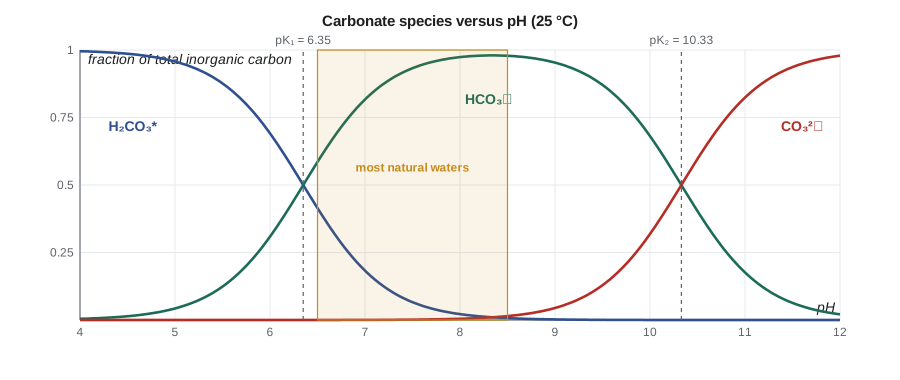
At the pH of most rivers and groundwaters, between 6.5 and 8.5, bicarbonate is by far the main form. The carbonate system acts as a buffer: added acid converts bicarbonate to carbonic acid, and added base converts it to carbonate, so the pH changes much less than it would in pure water.
# Fractions of carbonate species versus pH (25 C, activity corrections ignored)
pK1, pK2 = 6.35, 10.33
K1, K2 = 10**-pK1, 10**-pK2
print(" pH   H2CO3*   HCO3-    CO3--")
for pH in (5.0, 6.0, 6.35, 7.0, 7.5, 8.2, 9.0, 10.33, 11.0):
    h = 10**-pH
    d = h*h + K1*h + K1*K2
    a0, a1, a2 = h*h/d, K1*h/d, K1*K2/d
print(f"{pH:5.2f} {a0:6.3f} {a1:6.3f} {a2:7.4f}")pH H2CO3* HCO3- CO3-- 5.00 0.957 0.043 0.0000 6.00 0.691 0.309 0.0000 6.35 0.500 0.500 0.0001 7.00 0.183 0.817 0.0004 7.50 0.066 0.933 0.0014 8.20 0.014 0.979 0.0073 9.00 0.002 0.953 0.0446 10.33 0.000 0.500 0.5000 11.00 0.000 0.176 0.8239
At pH 7.5, Joy's typical river sample, about 93 per cent of the inorganic carbon is bicarbonate and 7 per cent is carbonic acid, with almost no carbonate. At pH 8.2 the bicarbonate share is about 98 per cent.
Alkalinity
Alkalinity is a water's capacity to neutralize acid, measured by titrating a sample with acid to a pH of about 4.5. In most natural waters it is due to bicarbonate, carbonate and hydroxide, and it is reported as mg/L as CaCO₃. Alkalinity matters in treatment: coagulants such as alum consume it, nitrification consumes about 7.1 mg of alkalinity as CaCO₃ per milligram of ammonia-nitrogen oxidized, and waters with low alkalinity are poorly buffered and can become corrosive to pipes. Lakes on granite bedrock, such as many on the Canadian Shield and in the northeastern United States, have low alkalinity, which is why they were so vulnerable to acid rain.
Hardness
Hardness is the sum of the multivalent metal cations in water, almost entirely calcium and magnesium. Hard water forms scale in kettles, boilers and pipes and makes soap less effective. Hardness is reported as mg/L as CaCO₃, and the part of the hardness that is matched by alkalinity is called carbonate hardness, because it precipitates as calcium carbonate scale when the water is heated.
| Hardness (mg/L as CaCO₃) | Description |
|---|---|
| 0 to 60 | Soft |
| 61 to 120 | Moderately hard |
| 121 to 180 | Hard |
| Above 180 | Very hard |
Worked problem
Hardness of a groundwater
Joy measures 60 mg/L of calcium and 18 mg/L of magnesium in a well at the farming town. What is the total hardness as CaCO₃, and how is the water classified?
Show solution
- Equivalent weights: Ca²⁺ = 40.08/2 = 20.04 g/eq; Mg²⁺ = 24.31/2 = 12.15 g/eq.
- \[\text{Ca: } 60 \times \frac{50.0}{20.04} = 149.7\ \text{mg/L as CaCO}_3\]
- \[\text{Mg: } 18 \times \frac{50.0}{12.15} = 74.1\ \text{mg/L as CaCO}_3\]
- \[\text{Total hardness} = 149.7 + 74.1 = 223.8\ \text{mg/L as CaCO}_3\]
Answer: The total hardness is about 224 mg/L as CaCO₃, so the water is very hard, which is common for prairie groundwater drawn from glacial deposits rich in limestone fragments.
Solubility
Some solids dissolve only slightly. For a salt such as calcium fluoride, CaF₂ ⇌ Ca²⁺ + 2 F⁻, the solubility product Ksp = [Ca²⁺][F⁻]² sets the maximum concentrations that can coexist. If the product of the actual concentrations exceeds Ksp, the solid precipitates. Engineers use precipitation to remove hardness (lime softening precipitates calcium carbonate and magnesium hydroxide), phosphorus (with iron or aluminum salts) and heavy metals (as hydroxides or sulphides, each with a pH of minimum solubility). Gases dissolve in water in proportion to their partial pressure above it, a relationship called Henry's law; it controls how much oxygen a river can hold and how readily volatile solvents escape from water into air.
Laboratories check a full water analysis with an ion balance. In any water, the sum of the cation charges must equal the sum of the anion charges, so the total milliequivalents per litre of calcium, magnesium, sodium and potassium should match the total of bicarbonate, sulphate, chloride and nitrate within a few per cent. A large imbalance means a measurement is wrong or a major ion was missed. Joy runs this check on every complete analysis before releasing results, and Nadia learns to ask for it whenever a report looks odd.
Common mistakes
MistakeComparing a nitrate result reported as NO₃⁻ with a standard written as NO₃⁻-N.
InsteadConvert first: mg/L as N = mg/L as NO₃⁻ × 14.0/62.0.
MistakeUsing molar mass instead of equivalent weight for ions with more than one charge.
InsteadDivide the molar mass by the charge to get the equivalent weight before converting to CaCO₃.
MistakeAssuming a pH change of one unit is small.
InsteadOne pH unit is a tenfold change in hydrogen ion concentration.
MistakeTreating ammonium and un-ionized ammonia as equally toxic.
InsteadOnly the un-ionized NH₃ form is highly toxic to fish, and its share rises steeply with pH and temperature.
Summary and key terms
- Molar concentration is mass concentration divided by molar mass; equivalents account for charge.
- Nutrients are reported as the element (N or P); hardness and alkalinity as CaCO₃ using an equivalent weight of 50.0.
- Balanced reactions give chemical doses and oxygen demands; glucose needs 1.07 g O₂/g and nitrification 4.57 g O₂/g N.
- pH is −log[H⁺]; a weak acid is half dissociated when pH equals pKa.
- The carbonate system (pK₁ ≈ 6.35, pK₂ ≈ 10.33) buffers natural waters, which carry their carbon mainly as bicarbonate.
- Alkalinity is acid-neutralizing capacity; hardness is mainly calcium plus magnesium; solubility products and Henry's law govern precipitation and gas transfer.
- Mole
- An amount of substance containing 6.022 × 10²³ particles.
- Equivalent weight
- Molar mass divided by the number of charges, protons or electrons involved in a reaction.
- Theoretical oxygen demand
- The oxygen needed to oxidize a compound completely, calculated from its balanced reaction.
- pH
- The negative base-ten logarithm of the hydrogen ion concentration.
- Buffer
- A solution that resists changes in pH when acid or base is added.
- Alkalinity
- The capacity of a water to neutralize acid, reported as mg/L as CaCO₃.
- Hardness
- The concentration of multivalent cations, mainly calcium and magnesium, reported as mg/L as CaCO₃.
- Henry's law
- The concentration of a dissolved gas is proportional to its partial pressure above the water.
Practice problems
Work each problem on paper first, then reveal the answer to check.
Convert 6.2 mg/L of nitrate (NO₃⁻) to nitrate-nitrogen.
Show answer
\(6.2 \times 14.0/62.0 = 1.4\) mg/L as N.
Express 35 mg/L of magnesium as CaCO₃.
Show answer
\(35 \times 50.0/12.15 = 144\) mg/L as CaCO₃.
What is the theoretical oxygen demand of 150 mg/L of glucose?
Show answer
\(150 \times 1.07 = 160\) mg/L.
Ammonia has a pKa of 9.25. What fraction is un-ionized NH₃ at pH 8.25?
Show answer
The ratio NH₃/NH₄⁺ is \(10^{-1} = 0.1\), so the fraction is \(0.1/1.1 = 0.091\), about 9 per cent.
How many times more acidic is water at pH 5.0 than at pH 7.0?
Show answer
\(10^2 = 100\) times.
Why does nitrification in a treatment plant sometimes need lime or another base?
Show answer
Nitrification releases acid and consumes about 7.1 mg of alkalinity as CaCO₃ per mg of ammonia-nitrogen, and low alkalinity lets the pH drop and slows the bacteria.
Lesson quiz · 5 questions
Score 60% or more to complete this lesson.
Create a free account to save your progress, take quizzes and earn a certificate.