
CINE-499 · Lesson 9 of 12 · 30 min
Production week two: problem solving and coverage triage
By the second week of a shoot, the plan meets reality. A location falls through, rain arrives on an exterior day, an actor is sick, a light fails, the day runs late and the director wants one more take of everything. The best capstone DPs are not the ones who never face problems; they are the ones who solve them calmly and protect the film. This lesson covers common production problems and how to respond, how to triage coverage when time runs out, how to decide on reshoots and pick-ups, and how to keep the crew safe and motivated when everyone is tired. Problem solving is assessed directly in the capstone rubric, so record every significant decision in the production log.
A method for problems on set
When something goes wrong, use a simple sequence rather than reacting on instinct.
- Stop and check safety first; never let a time problem become a safety problem.
- Define the problem precisely: what is lost, and what does the story need from this scene?
- List options quickly with the director and first AD, including doing less.
- Choose the option that protects the story at the lowest cost and risk.
- Communicate the decision to the crew clearly.
- Record the problem and the decision in the log.
Weather
Exteriors are vulnerable to rain, wind, cloud and changing sun. Plan for weather in prep (Lesson 6) and decide early on the day.
- Check the forecast the evening before and again at call.
- Have a cover set ready: an interior scene that can be shot instead.
- For changing cloud, use large diffusion overhead or frame tighter so the change is less visible; match by shooting the wide shots in consistent conditions.
- For light rain, decide whether rain can become part of the scene; protect equipment with covers and keep electrical connections off wet ground.
- Stop work for lightning, high winds near rigging or lifts, or slippery surfaces near edges, as CINE-340 described.
Worked problem
Deciding to move to the cover set
An exterior scene needs 4 hours of dry weather. At 07:00 the forecast gives a 70 % chance of rain from 10:00. The exterior is scheduled from 08:00 to 12:00, and the cover set is ready. Should the team move?
Show solution
- The scene needs 4 hours; with rain likely from 10:00, only 2 dry hours are probable.
- Half the scene might be shot, but matching it later in different weather would be hard.
- The cover set can be shot fully today, and the exterior can move to a later day with a better forecast.
Answer: Move to the cover set now. Starting the exterior risks half a scene that will not match, while the cover set uses the day fully.
Lost locations and late changes
Locations fall through: an owner changes their mind, a business needs the space, a permit is refused. Have a backup location for key scenes if possible, and keep the location agreement and contacts handy.
- Ask what the scene really needs from the location: a window, a long corridor, a sense of isolation.
- Look for a substitute that gives those elements, even if it looks different.
- Re-plan the shot list and lighting for the new space quickly; simplify rather than recreate.
- Check that the new location has a permit or agreement before shooting there.
- Update the clearance log.
Equipment failures
Lights, batteries, monitors and even camera bodies fail. Keep spares of small items, know the rental house's emergency number and have a plan B for each key item.
- Carry spare batteries, media, cables and lamp bulbs.
- Know which set-ups depend on a particular light and how to replace it with available units.
- If the camera fails, stop, diagnose calmly and call the rental house; do not improvise repairs that could damage the camera or the footage.
- Record the failure and the replacement in the camera report so the colourist knows about any change.
Coverage triage when time runs out
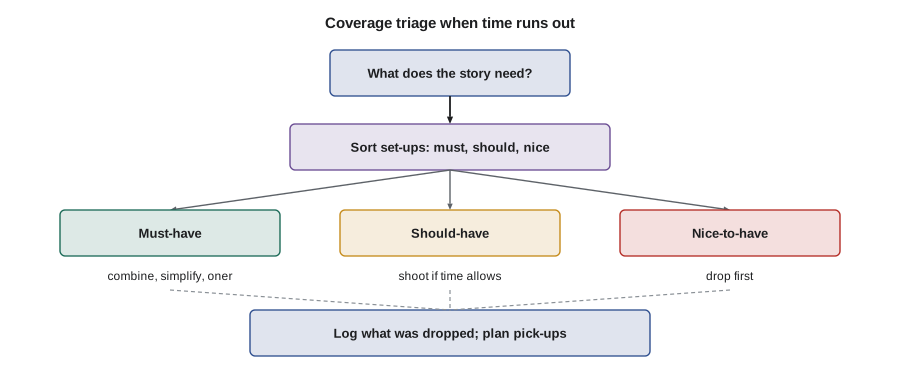
Triage means sorting what remains by importance and doing the most important work first. Use the priority column from the shot list (Lesson 3).
- Must-have shots carry the story; without them, the scene does not work.
- Should-have shots improve the scene, such as a second angle on a key line or an insert.
- Nice-to-have shots add polish, such as extra cutaways or a beauty shot.
- Combine set-ups where possible: a moving master that ends in a close-up can replace a wide and a single.
- Simplify lighting for the remaining set-ups: light the space once and shoot several angles inside it.
- Consider a oner for a short scene if blocking allows.
- Drop nice-to-have shots first and tell the director exactly what you are dropping.
Worked problem
Triage after losing half a day
A scene has 8 planned set-ups: 3 must-have (60 minutes each with lighting), 3 should-have (25 minutes each) and 2 nice-to-have (15 minutes each). A power problem costs half the day, leaving 4 hours. What can be shot, and in what order?
Show solution
- Must-haves: 3 × 60 = 180 minutes.
- Remaining time after must-haves: 240 − 180 = 60 minutes.
- Should-haves: 2 × 25 = 50 minutes fit; the third does not.
- Nice-to-haves: none fit.
- If the gaffer can light the space for all must-haves at once, saving 30 minutes, the third should-have (25 minutes) also fits.
Answer: Shoot the 3 must-haves and 2 should-haves in 230 minutes, or all 3 should-haves if lighting is combined. Drop the nice-to-haves and log what was dropped.
Worked problem
Combining a wide and a single
A wide master takes 50 minutes to light and shoot, and a separate close single on the same actor takes 30 minutes. A slow dolly push from the wide to a medium close-up can replace both, taking 55 minutes. How much time is saved, and what is the trade-off?
Show solution
- Separate set-ups: 50 + 30 = 80 minutes.
- Combined push: 55 minutes.
- Saving: 80 − 55 = 25 minutes.
Answer: About 25 minutes saved. The trade-off is less editorial control, because the pace of the push is fixed in camera; agree it with the director.
Reshoots and pick-ups
Sometimes a shot cannot be saved on the day: a focus problem discovered in dailies, a continuity error, a performance the director is not happy with. Decide quickly whether a reshoot is worth it.
- How important is the shot to the story?
- Can the editor work around it with other coverage?
- Is the location, cast and equipment still available?
- How much time does it cost, and what else is lost?
- Can it be shot as a pick-up on a later day with a small crew?
Pick-ups are short shoots after the main schedule, often for inserts, cutaways or a single missed shot. Plan them with the editor after a rough assembly, so you shoot only what is truly needed.
Worked problem
Is a reshoot worth it?
A key close-up is soft on focus in dailies. Reshooting it requires 45 minutes on the current location, which is available until tomorrow evening. The schedule tomorrow has 30 minutes of slack, and a should-have shot (20 minutes) could be dropped. Is the reshoot possible?
Show solution
- Time needed: 45 minutes.
- Available: 30 minutes of slack + 20 minutes from dropping the should-have = 50 minutes.
- 50 minutes is enough for the 45-minute reshoot.
Answer: Yes. Reshoot the key close-up tomorrow, using the slack and dropping the should-have shot, and record the decision in the log.
People problems
Long days and pressure cause friction. Problems with people often affect the film more than problems with equipment.
- Address conflict early and privately; do not argue in front of the crew or cast.
- Keep criticism specific and about the work, not the person.
- Watch for fatigue: slower work, mistakes, short tempers. Fatigue is a safety issue.
- If a crew member is sick or absent, redistribute roles and simplify the day rather than overloading others.
- Follow the program's code of conduct and reporting procedures for harassment or discrimination.
Keeping momentum and morale
Momentum is a resource. A set that moves steadily gets more done than one that stops and starts.
- Announce the next set-up early so everyone can prepare.
- Celebrate small wins: a difficult shot completed, a scene wrapped early.
- Keep meals on time.
- Wrap on time when you can; finishing an hour late every day wears people down fast.
The second week's log
By week two, the log is long. Make sure it records not only what happened but why decisions were made. Your reflection (Lesson 12) will draw on this, and assessors look for evidence of thoughtful decisions under pressure.
When the director wants one more take
Directors often want one more take, and sometimes they are right. The DP's job is to make the cost visible without blocking the director's work. If time is short, tell the director and first AD what an extra take or an extra set-up will cost later in the day: "one more take here means we lose the insert in scene 7". This lets the director choose with full information. Where possible, offer a faster way to get what they want, such as a pickup of the last line rather than a full take, or a second angle shot at the same time. Never let pressure to get one more take lead to cutting safety steps, such as resetting a rig without a grip present.
- State the cost of extra takes in terms of shots that will be lost.
- Offer alternatives, such as a pickup of a line or a quick tighter size.
- Keep safety steps unchanged under time pressure.
Recording problems in the log
For each significant problem, write a short entry: what happened, when, who was involved, what options were considered, what was decided and what the result was. A typical entry might read: "Day 4, 11:20: rain arrived early. Options: wait, move to cover set, shoot under a canopy. Decision with director and first AD: move to cover set (scene 6). Result: scene 6 completed by 16:00; exterior rescheduled to day 5 morning." These entries are the evidence for the problem solving criterion in the rubric and the core of the reflection.
- Write entries as soon as possible after the event.
- Include the options considered, not just the final decision.
- Note the result, including whether the decision worked.
Assessors read these entries closely, so make them clear enough for someone who was not on set to follow.
Common mistakes
MistakeWhen time runs out, shoot everything faster.
InsteadTriage: protect must-have shots, combine or simplify set-ups and drop the lowest priorities first.
MistakeProblems are best solved by the DP alone.
InsteadSolve problems with the director and first AD so the story and schedule are protected together.
MistakeAlways reshoot anything that is not perfect.
InsteadWeigh importance, workarounds, availability and cost before deciding on a reshoot.
MistakeRain means the day is lost.
InsteadMove to a cover set or adapt the scene, and protect equipment and people.
MistakeFatigue only affects quality.
InsteadFatigue is a safety issue; watch for it and shorten days when needed.
Summary and key terms
- Use a method: safety first, define the problem, list options, choose, communicate and log.
- Check the forecast, keep a cover set and stop work for lightning or high winds.
- For lost locations, find a substitute with the elements the scene needs and update paperwork.
- Coverage triage protects must-have shots, combines set-ups and drops nice-to-haves first.
- Decide on reshoots by weighing importance, workarounds, availability and cost.
- Plan pick-ups with the editor after a rough assembly.
- Manage conflict privately, watch for fatigue and keep momentum and morale.
- Triage
- Sorting remaining work by importance and doing the most important first.
- Must-have shot
- A shot without which a scene does not work.
- Cover set
- An alternative scene to shoot when weather prevents an exterior.
- Pick-up
- A short shoot after the main schedule for missed or extra shots.
- Reshoot
- Shooting a scene or shot again because the first attempt failed.
- Rough assembly
- The first edit of all usable footage in script order.
- Oner
- A scene played in a single continuous shot.
- Slack
- Spare time in a schedule.
- Insert
- A close shot of an object or detail.
- Momentum
- The steady pace of a set that keeps work moving.
Practice problems
Work each problem on paper first, then reveal the answer to check.
What is the first step when a problem occurs on set?
Show answer
Check safety.
Rain is likely in 2 hours and an exterior needs 4. What should the team do?
Show answer
Move to the cover set and reschedule the exterior.
3 must-haves of 50 minutes and 2 should-haves of 20 minutes in 3 hours: what fits?
Show answer
150 + 40 = 190 minutes needed; only the 3 must-haves and 1 should-have fit (170 minutes).
How can a wide and a single be combined?
Show answer
With a move, such as a dolly push from wide to close.
Name four questions for a reshoot decision.
Show answer
Importance, workarounds, availability and cost.
When should pick-ups be planned?
Show answer
After a rough assembly, with the editor.
What should be done with a lost location?
Show answer
Find a substitute with the scene's key elements, re-plan simply and update permits and the clearance log.
Why is fatigue a safety issue?
Show answer
Tired people make mistakes with electricity, rigging, ladders and vehicles.
How should conflict be handled?
Show answer
Early, privately and specifically about the work.
Why record the reasons for decisions in the log?
Show answer
The reflection and assessment depend on evidence of thoughtful decisions.
Lesson quiz · 5 questions
Score 60% or more to complete this lesson.
Create a free account to save your progress, take quizzes and earn a certificate.